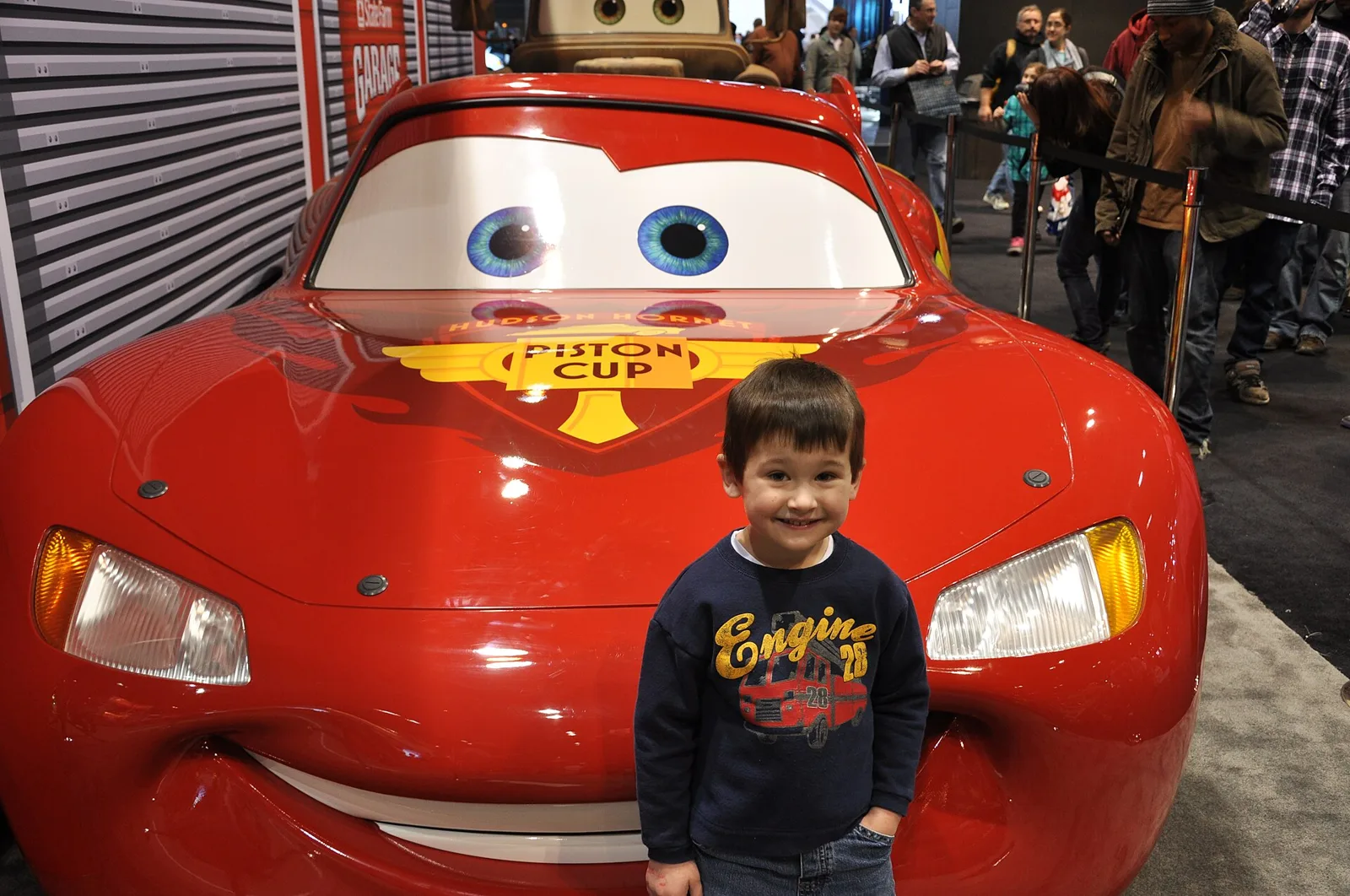
The red stock car from Pixar's Cars films, from a Piston Cup rookie stranded in Radiator Springs to a veteran who trains the next generation.
Lightning McQueen is the central character of the Disney and Pixar Cars films. A red stock car voiced by Owen Wilson, he appears in three films and wins seven Piston Cup titles across the series.
Lightning McQueen is a fictional stock car and the central character of Disney and Pixar's Cars franchise. Voiced by Owen Wilson, he is recognised by his red body, yellow and orange lightning bolt stickers and the number 95. He starred in Cars in 2006, Cars 2 in 2011 and Cars 3 in 2017, and he has also appeared in short films, a television series and many video games.
How did the character of Lightning McQueen begin?
The idea for Cars began in 1998 with the Danish story development artist Jorgen Klubien. He wanted to write an animated feature based on an unpopular three-wheeled electric car from Denmark, a story that echoed Hans Christian Andersen's Ugly Duckling. His early version was titled The Yellow Car, set in a town where cars rather than people lived.
Pixar's chief creative officer John Lasseter liked the idea of a car world but felt the story needed a stronger lead to create conflict. He worked with co-director Joe Ranft to develop a range of car characters, and the yellow car was eventually replaced by a racing car named Lightning. Lasseter chose a racer because it represented speed, power and individuality.
A cocky rookie who learned humility in a forgotten town, then became the mentor he once needed.
How did Pixar research the racing world?
The team studied racing closely. They visited Lowe's Motor Speedway in Concord, North Carolina, and met Richard Petty, and story artist Steve Purcell said that talking to fans and experiencing a track firsthand was the best education the film could have. Lasseter also took driving lessons at Infineon Raceway from instructors at the Jim Russell Racing School, which later helped Owen Wilson shape his performance.
Lasseter's own inspiration came from family road trips. In the summer of 2000 he drove across the country with his family on a two-month journey that avoided the interstate highways. In 2001 a group of Pixar staff followed Route 66 for nine days, visiting places such as the Route 66 Museum in Clinton, Oklahoma. Lasseter also met designers at Ford and General Motors, and Porsche 911 coupes were delivered to the studio so the animators could study them.
How was Lightning designed?
Lightning is not based on one real vehicle. Lasseter felt that the flat profile of NASCAR stock cars, though useful for aerodynamics, made them dull as a character design. The result is a hybrid of a stock car and a Le Mans endurance racer with a more curved body, and Lasseter added that it also carried traces of Lola and Ford GT40 design.
His racing number was first planned as 57, a reference to Lasseter's birth year. It was changed to 95 to mark the release year of Pixar's first feature, Toy Story. The grille serves as the car's mouth, and the windscreen panes are used for the eyes, an idea taken from a Disney short. The animators repositioned the eyelids so that the eyes and mouth worked together.
Production designer Bob Pauley described Lightning as the new rookie, a little sexy, fast and different. To make a character who is cocky but still likeable, Pauley compiled biographies of people with that mix, including the boxer Muhammad Ali, the basketball player Charles Barkley, the American footballer Joe Namath and the musician Kid Rock. Movement was equally important, and the team drew on surfers, snowboarders and the basketball player Michael Jordan.
How did the look of Lightning change across the films?
In Cars his cocky attitude was reflected in stickers that served as headlights. In Cars 2 he regained working headlights and was given flames, a common hot rod feature, so he would stand out among the other World Grand Prix contenders. Bodywork for the sequel took a year to design and involved several contributors, including the custom car designer Chip Foose.
In Cars 3 his appearance changes throughout the story. He starts with a new Rust-eze logo, and during his recovery he appears in gray primer. He later goes undercover at a demolition derby, where he is covered in brown mud. His red paint is replaced by a vinyl wrap, and by the end he has a dark blue paint job that pays homage to his mentor, Doc Hudson. Lasseter said the vinyl wrap symbolised a return to his true self.
What happens to Lightning in Cars?
In the first film Lightning is a rookie in the Piston Cup, sponsored by Rust-eze and secretly hoping to join the more prestigious Dinoco team. He ends the season in a three-way tie with Strip Weathers and Chick Hicks. On the way to a tie-breaking race in Los Angeles, he is separated from his transporter, Mack, and ends up in Radiator Springs, a town forgotten by the interstate.
In the town he is sentenced to repave the road he damaged, and he gradually learns from the locals. He befriends Mater, falls for Sally and becomes Doc Hudson's pupil. In the tie-breaking race he sees Chick Hicks cause The King to crash, and he gives up the win to help The King finish. Dinoco offers him a job, but he chooses to stay with Rust-eze and uses a favour from Tex Dinoco to get Mater a ride.
What happens to Lightning in Cars 2?
Five years later Lightning is a four-time Piston Cup champion who returns to Radiator Springs for the off-season. Mater accidentally signs him up for the inaugural World Grand Prix, a race sponsored by the oil tycoon Miles Axlerod, who wants to promote his biofuel, Allinol. Lightning is reluctant to bring Mater along, but he agrees after Sally persuades him.
The race is full of mishaps. Lightning loses the Tokyo race after Mater's secret involvement with spies Finn McMissile and Holley Shiftwell causes a misunderstanding, and he then wins in Porto Corsa. Engine failures lead to fears over Allinol, and in London Lightning considers quitting to find Mater before he is persuaded to continue. He finds Mater in the pits and learns that Mater was telling the truth about the spy mission.
Mater disarms a bomb, and Axlerod is arrested as the mastermind behind the plot to discredit alternative fuel. Back in Radiator Springs, the film reveals that Sarge swapped Lightning's Allinol for Fillmore's organic fuel before the race, which protected him from harm. The town then hosts a mini Grand Prix with all the World Grand Prix contenders.
What happens to Lightning in Cars 3?
Five years after the second film Lightning is a seven-time Piston Cup champion and a veteran of the series. The new racer Jackson Storm is a high-tech rookie who begins to win race after race. In the final race of the season Lightning pushes too hard against Storm, damages a tyre and crashes, and he has to decide whether to keep racing after his rebuild.
He trains with Cruz Ramirez at the Rust-eze Training Center, but after several failed attempts he asks Mater for help. Mater sends him to Smokey, the former crew chief of Doc Hudson, and Lightning trains with him. He then runs the start of the Florida 500 with Smokey as crew chief before handing the car to Cruz, who finishes the race with him. The pair share the victory, and the newly merged Dinoco and Rust-eze brand sponsors them. Lightning decides to keep racing but spends the rest of the season as Cruz's mentor.
How did critics react to the films?
Critics gave the first film a mixed response. Some felt its lesson about community and humility had been told many times before, while others praised the warm scenes with Mater and Sally. In Cars 2 many reviewers felt that Lightning was overshadowed by Mater, who became the lead comic figure. Cars 3 was praised by several critics for its emotional story about an aging athlete and was described by one as a profound victory lap for Lightning.
Did Lightning face a legal challenge?
Yes. The stock car driver Mark Brill claimed that the design of Lightning McQueen misappropriated his own car. Disney and Pixar won the case on November 30, 2010. The Oklahoma Court of Civil Appeals upheld the lower court's judgment, reasoning that the audience would not mistake a fictional, talking, driverless car with the number 95 for a likeness of a real driver.
Where else does Lightning appear?
Lightning has starred in many video games. A Cars game from THQ was published on June 6, 2006 and featured 30 races with characters from the film, and a Cars 2 racing game followed in 2011. Warner Bros. Interactive released Cars 3: Driven to Win on June 13, 2017, developed by Avalanche Software, and Lightning is a playable character there. He was also added as a downloadable car in Rocket League in November 2023, and he became a limited-time playable character in Disney Magic Kingdoms in June 2025.
Theme park appearances include Cars Land, which opened at Disney California Adventure on June 15, 2012 with the Radiator Springs Racers ride. The Lightning McQueen Racing Academy show debuted at Disney's Hollywood Studios on March 31, 2019, featuring a physical version of the car. At Walt Disney Studios Park in Disneyland Paris, Cars Road Trip opened in June 2021 with the character among those guests meet. In December 2015 the Petersen Automotive Museum hosted a Cars exhibit with a full-size replica that showed the components of the character.
Toys have been a major part of the franchise too. Mattel has produced die-cast versions since 2006, and in 2011 it released a three-inch Lightning McQueen Alive with a moving mouth and voice. Disney Infinity added the character in 2013, and in 2017 Sphero released a remote-controlled animatronic version with a moving mouth and touch-sensitive surfaces.
How has Lightning shaped popular culture?
Lightning is one of the best-known vehicles in film and has been merchandised widely. Disney has built attractions around him, as described above, and his toys sell in large numbers. Critics have described him as one of the greatest or most iconic movie cars.
His influence reaches motor sport as well. The Japanese team APR Racing ran a Lightning-inspired livery in 2008, and in 2023 Stephen A. Smith debated whether Lightning could be called the greatest of all time. In 2024 NASCAR driver Kyle Busch joked about a Lightning-style finish, and the Formula One drivers Isack Hadjar and Liam Lawson have both said the character sparked their interest in racing.