Two body-on-frame off-roaders that looked back to older icons, compared on their underpinnings, V6 engines, trim choices and the special editions that kept them selling.
The JK came as a two-door or a four-door Unlimited, starting with a 3.8-litre V6 and later a 3.6-litre Pentastar. The FJ Cruiser stuck to one body, a 4.0-litre V6 making 239 hp in its first years, and it was built until 2022.
The Jeep Wrangler JK and the Toyota FJ Cruiser were both body-on-frame off-roaders with retro cues, and they reached buyers in the same mid-2000s window. The JK was the third generation of Jeep's Wrangler and was offered as a two-door and a four-door Unlimited. The FJ Cruiser was a single short-wheelbase mid-size SUV built in Japan, and its styling was an echo of the original FJ40.
Why were these two off-roaders compared?
Both were built around a separate body and frame, and both offered four-wheel drive systems with high and low ranges that serious off-roaders still prize. Each carried a retro look that owed much to older icons, the Wrangler's lineage running back through the CJ and Willys MB and the FJ Cruiser's to the FJ40.
Neither was a comfort-first vehicle, and both were sold on their ability to go places most SUVs could not. That shared purpose makes the pair a useful test of what buyers expected from a modern off-roader.
Two retro off-roaders with separate frames and real trail hardware, split by body choice and by how each one was built to go anywhere.
Where did each car come from?
DaimlerChrysler commissioned the JK in 2001 as the successor to the TJ, and Mark Moushegian won the internal design competition by the second quarter of 2003. The design was frozen in January 2004, 31 months ahead of production, and a 2005 Gladiator concept previewed many of its elements.
Toyota's FJ Cruiser began as a concept shown at the January 2003 North American International Auto Show. It was approved for production after strong consumer response and debuted in final form at the February 2005 Chicago Auto Show.
The idea behind the FJ dated to the mid-1990s, when product planner Dave Danzer and sales vice-president Yoshi Inaba began pushing for a rugged FJ. Danzer worked with Akio Toyoda to build prototypes at the NUMMI plant on Tacoma underpinnings, and Toyota's Calty studio then gave the FJ40 a fresh interpretation.
Toyota framed the car as Rugged Youth Utility, aimed at young male buyers the company felt it was losing. The final exterior came from a retro design by 24-year-old Jin Won Kim, while William Chergosky designed the interior.
The FJ concept made its debut at the 2003 Detroit Auto Show in Voodoo Blue, the colour that became the signature of the production car. It drew strong praise from the press and public despite competing with more exotic concepts such as the Cadillac Sixteen and the Dodge Tomahawk, and Toyota saw it as a halo car in the way the 2005 Mustang had been for Ford.
Production engineering took its toll on the concept. Chief production engineer Akio Nishimura had to strip out much of the interior that William Chergosky had designed, including a gear shifter that doubled as a shovel handle, removable lights that worked as flashlights and flat-folding front seats, to keep the price reasonable.
How did the designs differ?
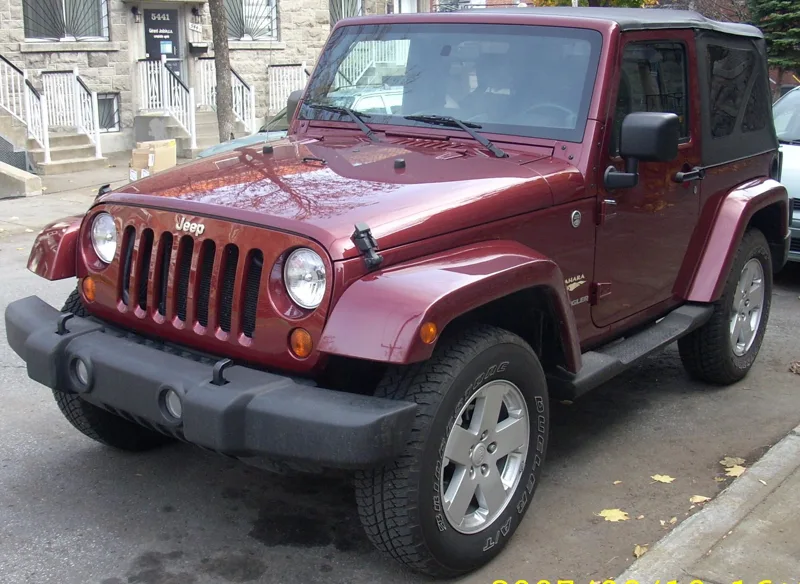
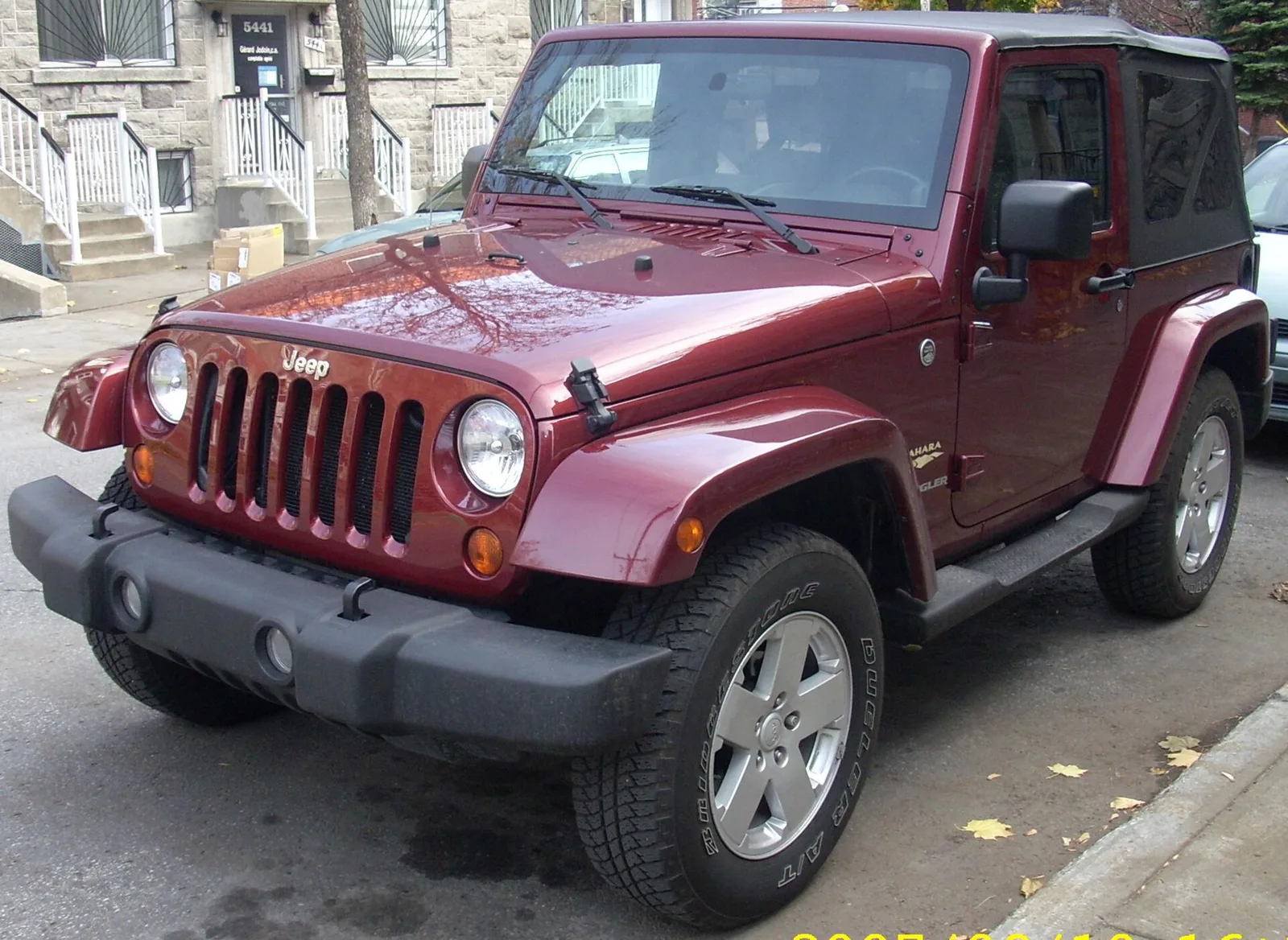
The JK kept the Wrangler's traditional features, including a separate body and frame, rigid live axles front and rear, and a fold-flat windshield. The doors could still be removed, and the car could be driven without them, as in every Wrangler before it.
The JK was wider than the TJ it replaced, with a track 3.4 inches (86 mm) larger. The two-door's wheelbase grew by 2 inches (51 mm) yet its overall length fell by 2.5 inches (64 mm), which gave it a 44.3-degree approach angle and a 40.4-degree departure angle.
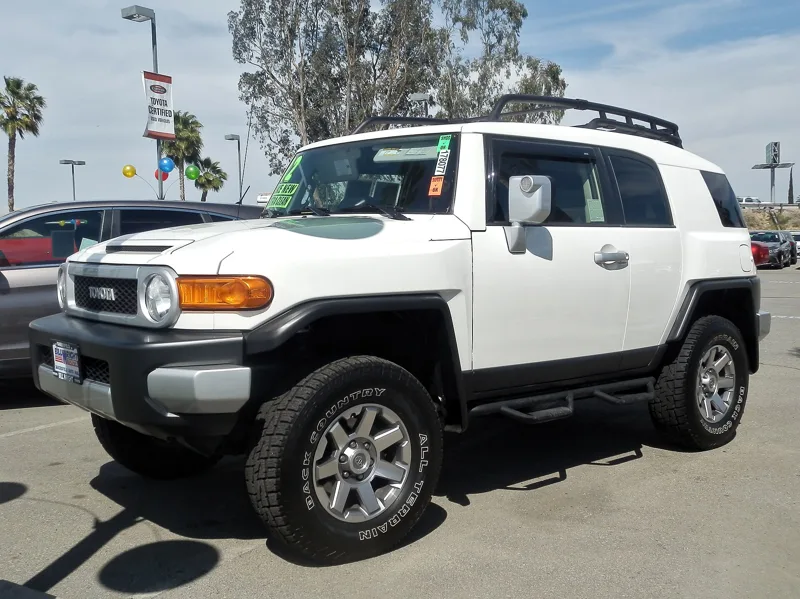
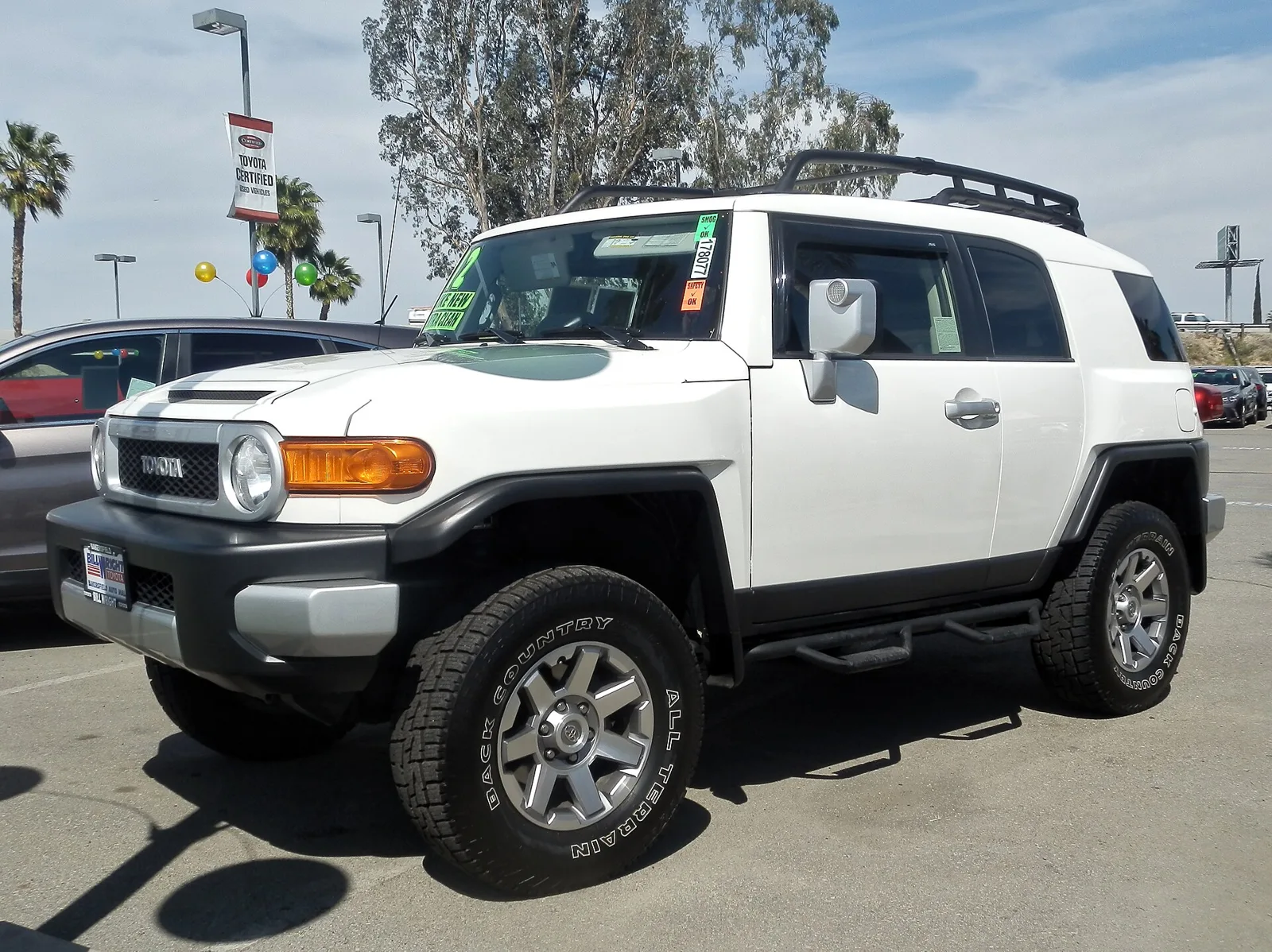
The FJ Cruiser was a mid-size SUV at 183.9 inches (4.67 m) long, slotting between the RAV4 and the Highlander. Its stocky frame, short wheelbase and grille-headlight arrangement recalled the FJ40, and it had a nearly vertical windshield with three wipers.
Toyota spelled the name across the grille instead of using its emblem, and the FJ had rear-opening access doors. Its interior used washable rubber surfaces and oversized controls for drivers in gloves.
How did the Wrangler's four-door model change the story?
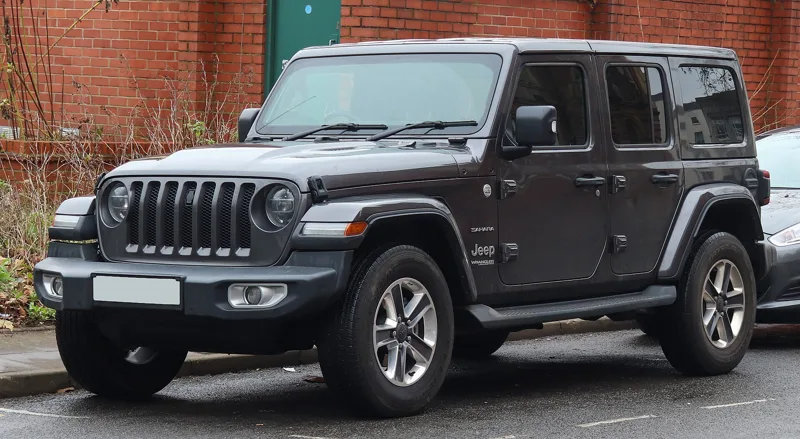
The Unlimited four-door was stretched by 20.6 inches (523 mm) on the 95.4-inch wheelbase, and it went on sale in August 2006 at $21,000. It became the only four-door convertible on sale in the US for years, after the Hummer H1 was discontinued.
Demand for the four-door grew fast, and by mid-2017 roughly three-quarters of the new Wranglers on sale were four-door cars. The Unlimited also brought more equipment than any previous Wrangler, including standard electronic stability program, optional seat-mounted side airbags and the MyGig system with a hard drive for music and pictures.
Specifications side by side
| Specification | Jeep Wrangler JK | Toyota FJ Cruiser |
|---|---|---|
| Launch | Unveiled 2006; sold from August 2006 as a 2007 model | Concept January 2003; production form February 2005 |
| Body | Two-door and four-door Unlimited | Short-wheelbase mid-size SUV |
| Length | Not given | 183.9 in (4.67 m) |
| Base engine | 3.8-litre V6, 202 hp (151 kW), 237 lb-ft (321 N-m), 2007 to 2011 | 4.0-litre 1GR-FE V6, 239 hp (178 kW), 278 lb-ft (377 N-m), 2007 to 2009 |
| Later engine | 3.6-litre Pentastar V6, 285 hp, 260 lb-ft from 2012 | 260 hp (194 kW), 271 lb-ft (367 N-m) for 2011 |
| Transmissions | Six-speed manual; 4-speed automatic, later 5-speed | Five-speed automatic or six-speed manual |
| Drive system | Command-Trac part-time 4WD; Rock-Trac on Rubicon | Full-time 4WD with Torsen centre differential on manual models |
| Ground clearance | Not given | 9.6 in (24 cm) |
| Approach and departure | 44.3 and 40.4 degrees | 34 and 30 degrees |
| Towing | Not given | 5,000 lb (2,268 kg), 4x4 and 4x2 |
| Safety | Three software recalls by mid-2007 | IIHS Top Safety Pick, good in all 14 categories |
Which engine was the stronger performer?
The JK's base engine was a 3.8-litre EGH V6 making 202 hp and 237 lb-ft of torque in the 2007 to 2011 models. It replaced an AMC straight-six and was shared with several Chrysler minivans and the first Pacifica crossover.
For 2012 Jeep switched to the 3.6-litre Pentastar V6 from the Grand Cherokee, rated at 285 hp and 260 lb-ft. The manual stayed as a six-speed, while the automatic moved to a five-speed Mercedes-Benz-derived unit.
The FJ Cruiser's 4.0-litre 1GR-FE V6 made 239 hp and 278 lb-ft in 2007 to 2009 on 91 octane. Dual VVT-i for 2010 brought it to 259 hp, and by 2011 the output reached 260 hp (194 kW) and 271 lb-ft (367 N-m).
Toyota recommended premium fuel for towing, off-roading and high-altitude driving, although the engine ran normally on 87 octane.
How did the two trucks compare off-road?
The Wrangler Rubicon was the dedicated off-road model, with Dana 44 axles, electric lockers, Rock-Trac and a 4:1 transfer case. It came with 32-inch BFGoodrich Mud-Terrain tyres and rock rails, and the Rubicon's breakover angle rose from 22.6 to 25.4 degrees with the larger tyres.
The FJ Cruiser offered 8 inches of front and 9 inches of rear suspension travel, with 9.6 inches of ground clearance. It could drive through water up to 27.5 inches (70 cm) deep, and its A-TRAC system braked spinning wheels to mimic a locking differential without binding steering.
Toyota's prototypes were tested in Moab, on the Rubicon Trail, in the Angeles National Forest and in the Mojave Desert. Those tests shaped the A-TRAC system and the suspension tuning, and Toyota accepted high prototype costs to get the off-road behaviour right.
How did the cars handle on the road?
The FJ Cruiser accelerated to 60 mph (97 km/h) in 7.8 seconds, and it held 0.69 G of lateral grip with stock Bridgestone Dueler tyres. Its high-mounted double wishbone front suspension and four-link rear were shared in part with the Prado, Tacoma and 4Runner.
The Wrangler JK ran almost every vehicle function apart from steering under computer control, which was a first for the model. It also brought electronic stability control and an off-road tuned anti-lock braking system, and its Rubicon got an electronic sway bar disconnect.
Power windows, remote locks and an optional navigation system were new for the Wrangler, and the JK offered an optional three-piece modular hardtop next to the standard soft top.
What did the safety record look like?
The JK's software-controlled systems brought three safety recalls for software fixes by mid-2007. Hill Start Assist became standard for the 2009 model year, and Trailer Sway Control was also offered to correct trailer movement.
The FJ Cruiser won IIHS Top Safety Pick and earned a good rating in both front and side impact tests, along with good in all 14 measured categories. Side curtain airbags became standard on 2008 models.
Toyota also fixed a fault in the FJ's inner fender aprons, which bulged and cracked on some 2007 and early 2008 models. The company attributed the problem to a design flaw and changed the design.
Which trims and special editions did they offer?
The Wrangler JK came in Sport, X-S and Sahara trims alongside the Rubicon. The Sport was originally called the X until 2009, and the X-S became the Sport S. Power windows and locks were added to the Sport S, a first for any Wrangler.
Toyota built 3,200 TRD Special Edition FJ Cruisers in 2007, with a black diamond pearl body, a matching black roof and 16-inch gunmetal TRD wheels. The 2008 Trail Teams edition added another 3,200 cars, and a 2,400-unit TRD package followed in 2009.
Jeep also built a Rocky Mountain Edition of the X model for 2009, with 32-inch tyres and a black tubular sidestep. For 2010 the JK gained an easier-to-fold soft top and standard UConnect on MyGig-equipped models.
Most Wrangler packages could be ordered with a hard or soft top and with full or half doors, although the half-door option applied only to the Sport and Rubicon. The Sahara added body-coloured fenders, a seven-speaker Infinity sound system and a gold SAHARA decal on each front fender.
In Japan the FJ Cruiser replaced the Hilux Surf and sold alongside the Land Cruiser. Right-hand drive Japanese cars had their licence plate on the bumper and their side indicators on the fenders, and Australia and New Zealand received right-hand drive models in 2011, offered only with four-wheel drive, an automatic and a petrol engine.
In November 2013 Toyota USA said the 2014 Trail Teams model would be called the Ultimate Edition and would be the last FJ Cruiser sold in that market. The car remained on sale in other markets, Australia included, until its export there was discontinued in August 2016.
Which buyer should choose which?
On the figures, the Wrangler suits a buyer who wants a choice of two-door or four-door bodies, the Rubicon's electric lockers and rock rails. The FJ Cruiser suits a buyer who wants a single body style, a V6 with a towing rating of 5,000 lb and a retro look with a Toyota badge.
The Wrangler's Unlimited four-door has no counterpart on the FJ side, which was built only with a short wheelbase. The FJ's approach and departure angles are lower than the Wrangler's, which matters on steep trails.
Neither car wins outright. The Wrangler offered more body choices and the stronger Rubicon hardware, while the FJ Cruiser brings the IIHS Top Safety Pick record and a 5,000 lb towing rating. The right choice depends on the trails a buyer plans to use and the body they need.