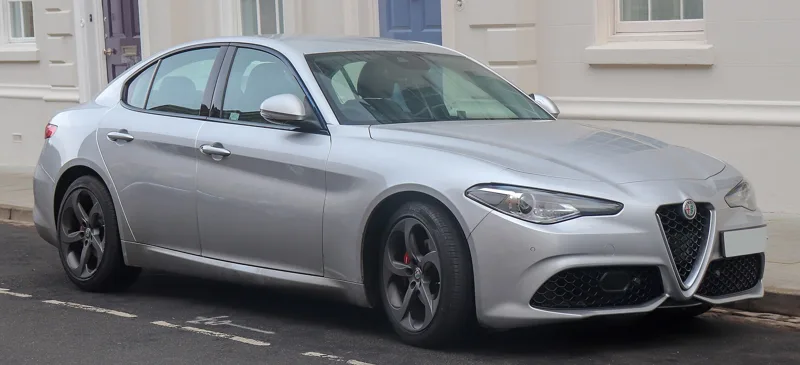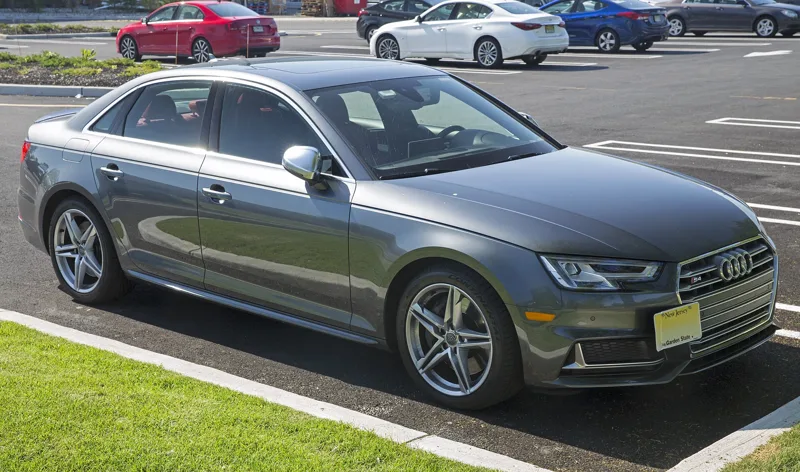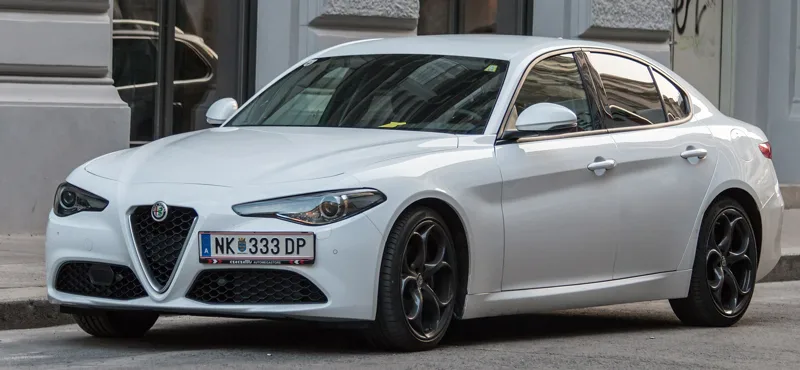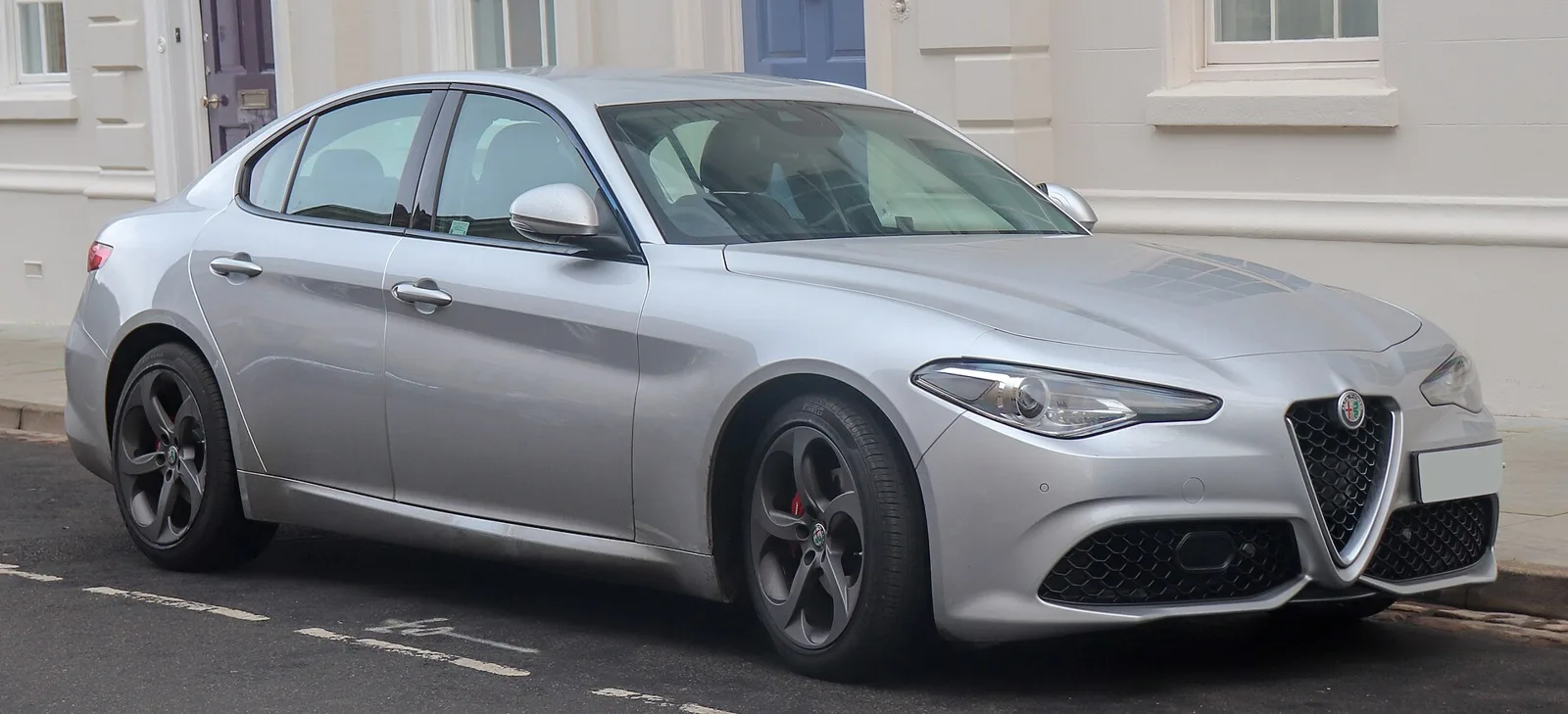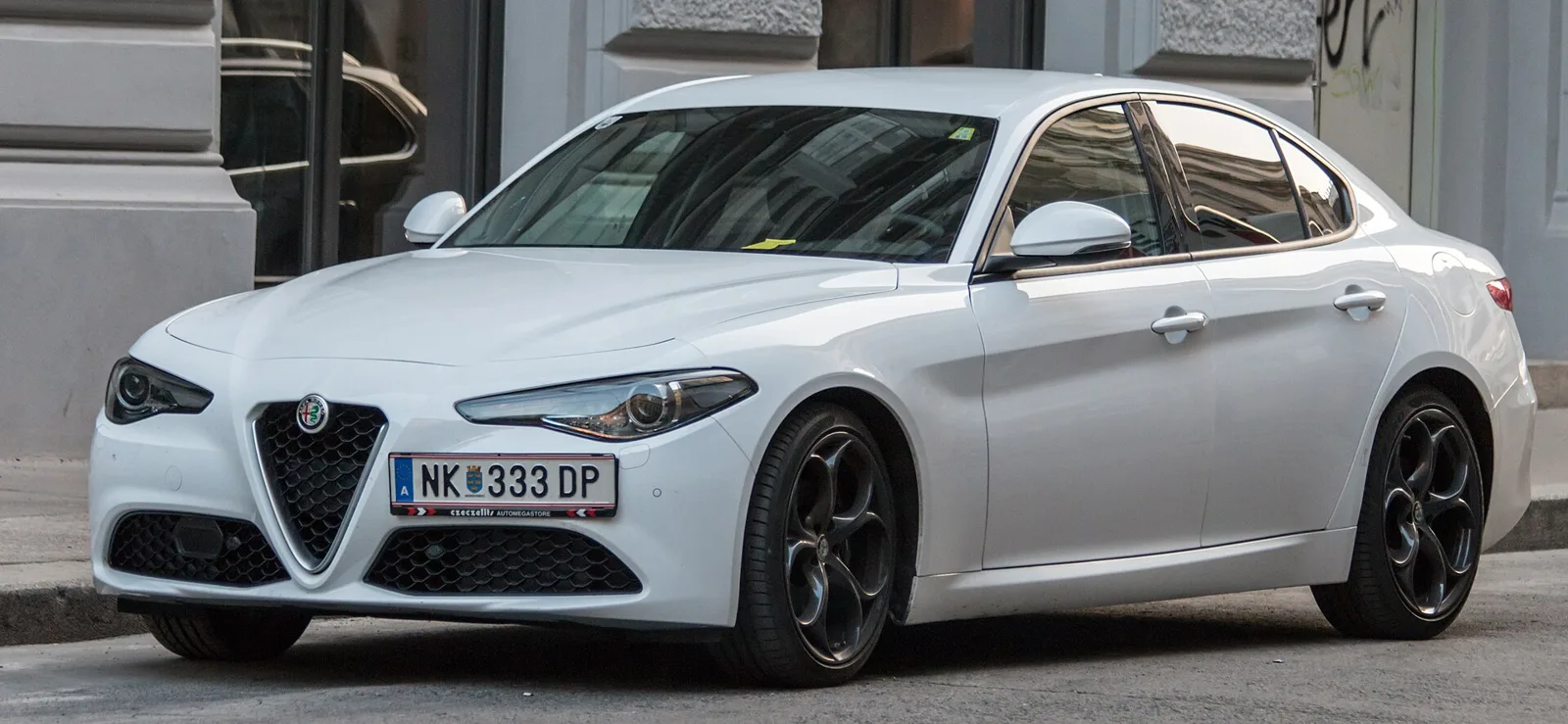
A rear-drive Alfa Romeo Quadrifoglio set against the quattro Audi S4 across three decades of performance saloons, from a turbo five to a V8 and a twin-turbo V6.
The Alfa Romeo Giulia and Audi S4 were compared as rivals in the compact executive performance class, and both faced the BMW M3 at different points. The Quadrifoglio's 510 PS rear-drive V6 contrasts with the S4's quattro all-wheel drive and turbo engines across three decades.
The Alfa Romeo Giulia and the Audi S4 were both built to be performance saloons for buyers who wanted real pace without leaving the executive class. The Giulia arrived in 2015 with rear-wheel drive and a Quadrifoglio V6 of 510 PS (375 kW; 503 hp), while the S4 has been Audi's quattro sports saloon since 1991. The comparison is less about whose figures are biggest and more about how each brand chose to deliver speed.
Why were the Giulia and S4 rivals?
The Giulia and the S4 were measured against each other from the start. The Daily Telegraph, reviewing a Veloce Ti, put it against the Audi S4, the BMW M340i, the Mercedes-AMG C 43 and the Jaguar XE S. Giulia's top Quadrifoglio model had its own list of rivals: the Mercedes-AMG C63, BMW M3 and Cadillac ATS-V.
The S4 has faced the M3 before. The B6 and B7 generations shared a 4.2-litre V8, the first time that engine had been placed in a compact executive car, and that put the S4 in direct competition with the BMW M3 and the Mercedes-Benz C32 AMG.
Rear-wheel drive and 510 PS on one side, quattro traction and a family of engines on the other.
Where did the Giulia come from?
In 2013 Sergio Marchionne wanted a fresh start for the next Alfa Romeo, and asked for a rear-drive sports saloon built from nothing. He appointed Philippe Krief, a former Ferrari technical director, as chief engineer, and gave him a team of ten and two and a half years to deliver the car.
Krief oversaw the Giulia and the platform underneath it, called Giorgio, which was new to Alfa Romeo and built around a longitudinal engine with rear-wheel drive. Marco Tencone of Centro Stile Alfa Romeo led the styling work, supervised by Lorenzo Ramaciotti. Marchionne sent the design back to the drawing board, which lengthened the gestation.
The Giulia was unveiled to the press on 24 June 2015 at the company's museum in Arese, with only the Quadrifoglio on show. The timing matched the company's 105th anniversary and gave the brand a restyled logo. The car was the first model in a relaunch plan of EUR 5 billion for an eight-car line-up. Alfa hoped to reach 400,000 cars worldwide by 2018, against 74,000 in 2013.
How has the S4 changed across generations?
The S4 started as the performance version of the Audi 100, built from 1991 until 1994. Its production began in August 1991, after its debut at the May 1991 Barcelona Show. Audi then renamed the 100 range as the A6 in 1994 and sold the S4 as the S6 for a time, before the S4 name returned on the B5 platform.
The B5 S4 arrived in 1997 on the facelifted A4 platform, and an Avant estate joined the range in 1998. Production ended in September 2001, though cars were still sold in North America alongside the next generation through 2002.
The B6 and B7 generations brought the V8 and the S4 Cabriolet. The B8 moved to a supercharged V6 TFSI of 3.0 litres, and the current B9 uses a turbocharged 3.0-litre V6 TFSI. The S4 has been built at Audi's Ingolstadt plant throughout.
Specifications side by side
| Specification | Alfa Romeo Giulia | Audi S4 |
|---|---|---|
| Generation and dates | Giulia, unveiled 24 June 2015, launched 2016 | C4 from 1991 to 1994; B5 from 1997 to 2001 |
| Layout | Front-engine, rear-wheel drive; all-wheel drive on non-Quadrifoglio models | Front-mounted longitudinal engine; quattro all-wheel drive on every S4 |
| Engine | Veloce 2.0-litre turbo petrol; Quadrifoglio 2,891 cc twin-turbo V6 | C4 2.2-litre turbo five-cylinder; B5 2.7-litre twin-turbo V6 |
| Power | Veloce 280 PS (206 kW; 276 hp); Quadrifoglio 510 PS (375 kW; 503 hp) | C4 230 PS (169 kW; 227 bhp); B5 265 PS (195 kW; 261 bhp), 250 PS (184 kW; 247 hp) in the US |
| Torque | Veloce 400 N m (295 lb ft); Quadrifoglio 600 N m (443 lb ft) | C4 350 N m (258 lb ft); B5 400 N m (295 lbf ft) |
| Transmission | 8-speed automatic on Veloce; Quadrifoglio with automatic and manual | Five-speed or six-speed manual; ZF five-speed tiptronic on B5 |
| Body styles | Saloon | Saloon and Avant estate; Cabriolet in B6 and B7 |
Which car was quicker?
On paper the Quadrifoglio has the bigger engine and the far larger output, at 510 PS against the B5 S4's 265 PS. The S4 is the only one of the pair with a published 0-100 km/h time, at 5.7 seconds for the B5.
The Quadrifoglio's 600 N m of torque sits well above the 400 N m of the B5, and the Veloce's 280 PS is closest to the B5 in output. No sprint time is given for the Giulia, so the gap cannot be measured directly.
How did the chassis and drivetrains differ?
The Giulia was designed around a 50/50 front-to-rear weight distribution. Its double-wishbone front suspension and multi-link rear sit on the Giorgio platform, and it uses a carbon-fibre drive shaft from Hitachi Automotive Systems, with aluminium shock towers and suspension parts. All-wheel drive was offered on the non-Quadrifoglio models, while the Quadrifoglio kept rear-wheel drive.
The Quadrifoglio distributed its weight 52.5% front and 47.5% rear, helped by carbon-fibre composite construction and a carbon roof and bonnet. A torque-vectoring rear differential was fitted, along with active aero, where the front splitter drops 10 degrees once speeds pass 100 km/h, up to 230 km/h (62 to 143 mph), in the Dynamic and Race settings.
The S4 took the opposite route. Every S4 has used Audi's quattro all-wheel drive with a Torsen-based centre differential, and the engine has always sat longitudinally at the front, with the transmission directly behind it. Its B5 suspension used a multi-link front and a double-wishbone rear, and the brakes were ventilated discs of 321 mm (12.64 in) at the front and 256 mm (10.08 in) at the rear.
What did the Giulia line-up offer?
The base Giulia, the mid-level Super and the fully loaded Speciale all used a 200 PS (147 kW; 197 hp) 2-litre petrol engine, or a choice of 2.2-litre turbo diesels with 136, 150 or 180 PS. The base car ran 16-inch alloys, the Super 17-inch, and the Speciale 18-inch wheels with black brake calipers and leather sports seats.
The Ti was the luxury-oriented version, with chrome grille and window surrounds, a heated steering wheel and front seats, a wood-panel interior and 18-inch alloys. In North America the Ti used the 280 hp petrol engine, while European buyers could take the 187 hp diesel. The Veloce was presented at the Paris International Motor Show in October 2016, with a 280 PS petrol engine, a 210 PS diesel, paddle shifts and Q4 all-wheel drive.
The range kept growing after launch. The Estrema arrived in 2022 for the 2023 model year, with active suspension, 19-inch wheels, Alcantara seats and a 14-speaker Harman Kardon sound system.
What were the Giulia's engines like?
The Veloce used a 2.0-litre turbo petrol engine that peaks at 280 PS (206 kW; 276 hp) at 5,250 rpm, with 400 N m (295 lb ft) available from 2,250 rpm and the MultiAir valve system. A 2.2-litre diesel was offered alongside it, rated at 210 PS (154 kW; 207 hp) in the Veloce.
The Quadrifoglio's V6 is a 90-degree, all-aluminium twin-turbo unit of 2,891 cc. Its engineers came from a Ferrari background, and its bore and stroke of 86.5 mm and 82 mm match the California T engine. Peak output arrives at 6,500 rpm, with torque spread across a broad band, which makes it a very different proposition from the Veloce's four-cylinder.
The Quadrifoglio's styling follows its aero. The front bumper has a carbon-fibre splitter and enlarged intakes for extra radiators, the bonnet has two cooling outlets, and a rear diffuser fills the lower part of the bumper, and four exhaust tips finish the look. The Quadrifoglio's efficiency figures are a different matter. A cylinder-deactivation system gives 8.5 litres per 100 km in the combined cycle and 198 g/km of CO2, and the EPA rates the car at 20 miles per gallon combined.
How did the S4 look and feel inside?
The C4 car ran standard five-arm Fuchs forged alloy wheels of 16 inches, shod with 225/50 R16 tyres. A 15-inch six-spoke design with 215/60 R15 tyres was also available, and an electronically controlled servotronic steering system that varied assistance with road speed was an option.
Once the V8 arrived, the front brakes grew to 314 mm (12.36 in) discs. The B5 cars rode on die-cast six-arm Avus wheels, 17 inches across with 225/45 ZR17 performance tyres, and colours such as Imola Yellow and Nogaro Blue were exclusive to the S4.
Options ranged from a Bose sound system and Audi navigation to a Premium Package with sunroof, HomeLink and auto-dimming mirrors. A Cold Weather Package added heated front seats and mirrors, and the Sport Package swapped the wood-grain trim for silver aluminium.
How did the S4's engines develop?
The first S4 used a 2.2-litre turbocharged five-cylinder. It made 230 PS (169 kW; 227 bhp) at 5,900 rpm, with torque of 350 N m (258 lb ft) arriving at 1,950 rpm. It reached 100 km/h in 6.2 seconds with the five-speed manual. A 4.2-litre V8 with 280 PS (206 kW; 276 bhp) became an option for European customers from October 1992.
The B5 generation switched to a 2.7-litre twin-turbo V6 with 30 valves, and it made 265 PS (195 kW; 261 bhp) at 5,800 rpm and 400 N m (295 lbf ft) at 1,850 rpm. US-market cars were detuned to 250 PS (184 kW; 247 hp) to meet emissions rules.
The B8 used a supercharged 3.0-litre V6 TFSI, and the B9 uses a turbocharged version of the same 3.0-litre engine. The B8 faced the BMW 335i and Mercedes-Benz C350, and the B9 is pitched against the BMW M340i xDrive and Mercedes-AMG C43.
How did reviewers judge the two cars?
The Giulia drew strong words from reviewers. The Guardian described it as a midsize executive car that offered a different take on the Audi A4, the BMW 3 Series and the Mercedes-Benz C-Class. The Sunday Times compared the Quadrifoglio with the BMW M3, and the Daily Telegraph praised its steering as remarkably quick, without the artificial feel many modern systems use.
Reviewers were less impressed by the interior. The Sunday Times found the fit and finish below what the price suggested, and the Telegraph said the plastics were slightly behind those of its rivals. The Sunday Times also thought the 58-litre tank (13 imp gal; 15 US gal) was a touch small.
The S4 had strong racing results. Michael Galati took the 2001 SpeedVision GT crown driving a Champion Racing S4. His four race wins helped Audi to its first Manufacturers' Championship. Ayrton Senna also owned a silver S4 Avant, which fitted his role as Audi's distributor in Brazil.
The Giulia's own honours include a second place in the 2017 European Car of the Year voting, the 2018 Motor Trend Car of the Year title and the Compasso d'Oro industrial design award in 2018.
Which car suits which buyer?
A buyer who wants a rear-drive Italian saloon with a turbo V6 and a lighter, more sporting character will look at the Giulia. A buyer who wants quattro all-wheel drive as standard, and an estate or convertible option, will find more in the S4.
Body styles favour the S4 on the figures here. Its saloon and Avant estate have both been available since 1991, and the B6 and B7 Cabriolets added a convertible. The Giulia is described as a saloon throughout.
The Giulia's weight distribution and carbon-fibre construction set it apart, and its Quadrifoglio's output is well beyond the S4's B5 figures. The S4's quattro layout is the constant across its generations, and its V8 and racing record give it a longer performance history than the Giulia.
Neither car is better on every count. The Giulia gives Alfa Romeo's rear-drive character and a powerful Quadrifoglio, while the S4 gives Audi's quattro traction and a family of engines that spans three decades.