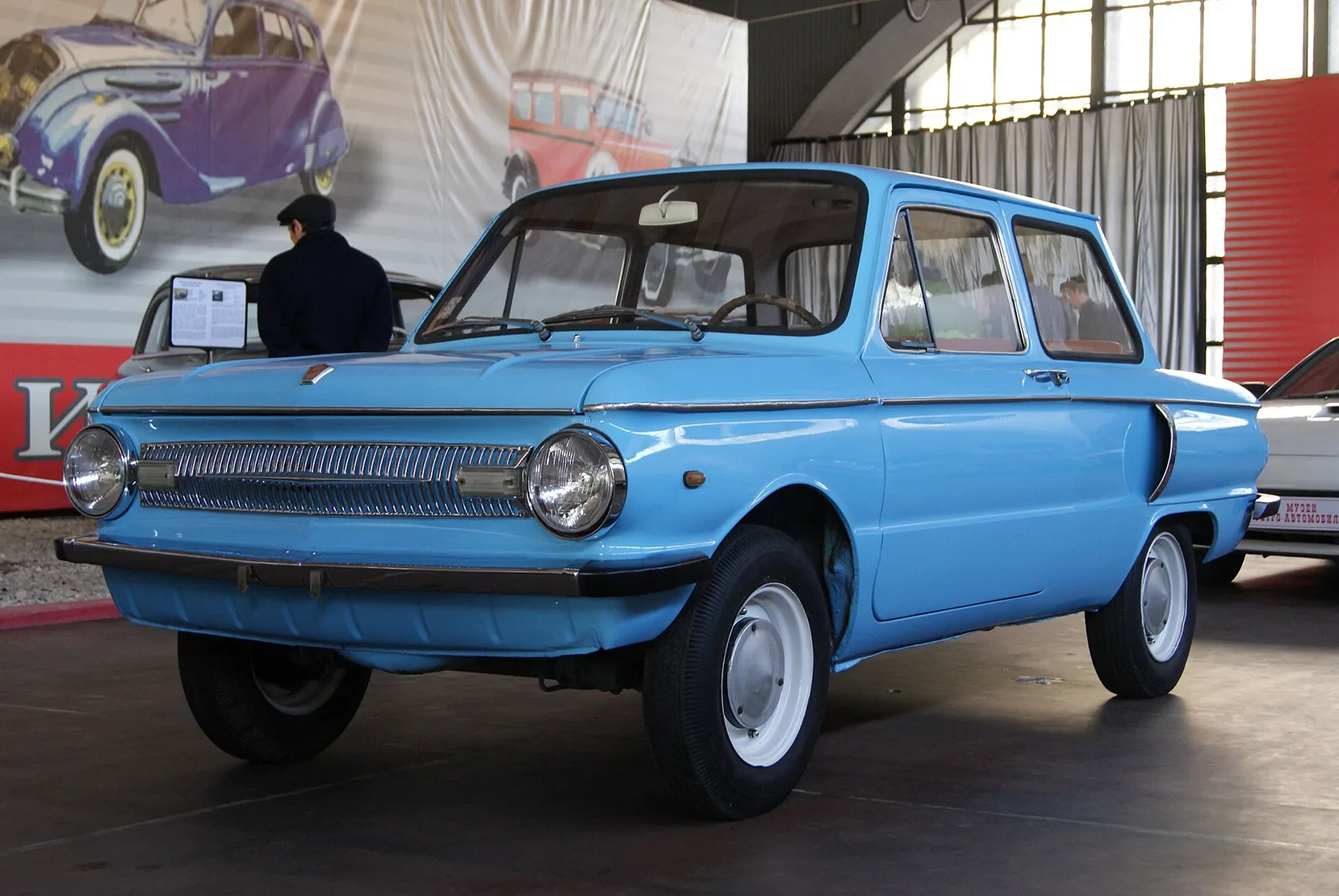
A Ukrainian air-cooled city car that started as a Fiat 600 rival, sprouted nicknames and disability variants, and kept going until 1994.
The ZAZ Zaporozhets was a rear-engined Soviet city car built from 1960 to 1994, with an air-cooled V4 engine behind the rear wheels. It was made in several series, sold as a cheap people's car, and totalled 3,422,444 units.
The Zaporozhets was a Soviet city car with its engine slung behind the rear axle. ZAZ, the factory in Soviet Ukraine that built it, produced the model in several series from 1960 until 1994, and it stayed in service for years longer in many former Soviet states.
It was the Soviet Union's people's car in much the same way the Volkswagen Beetle and the East German Trabant were for their countries. It was cheap, tough on bad roads and simple to repair, and that practicality earned it a loyal following that survived its dated design.
Where did the Zaporozhets name come from?
The name translates roughly as a Cossack of the Zaporizhian Sich, or a man from Zaporozhye, the city now called Zaporizhzhia. The name tied the car to its home city in south-eastern Ukraine.
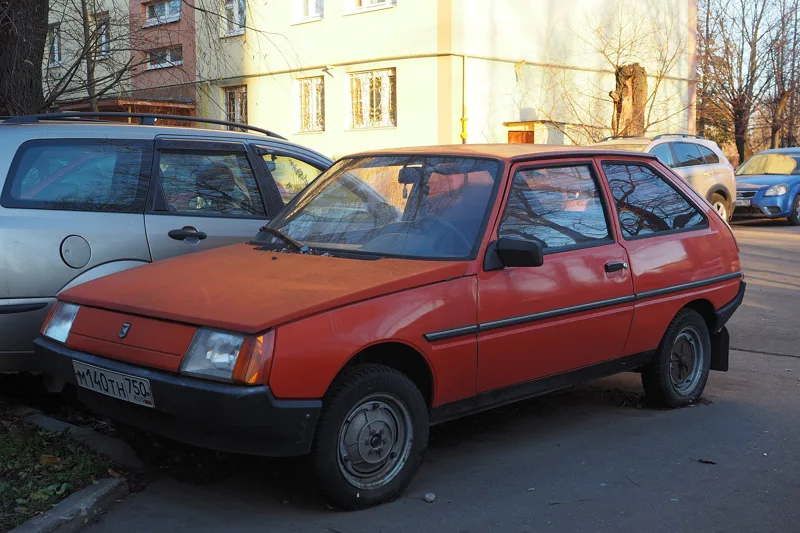
Several rear-engined models carried the name, and all of them used an air-cooled engine behind the rear wheels. The final series, the ZAZ-968M, gave way in the late 1980s to the ZAZ-1102 Tavria, a front-wheel-drive hatchback with a more powerful water-cooled engine.
A rear-engined Soviet city car that outlived its design by decades and sold more than three million copies.
How did the ZAZ-965 come about?
Work on a simple economy city car began in 1956, partly to replace the Moskvitch 401 that was being phased out. City cars then made up between a quarter and two-fifths of European sales, and Soviet automotive minister Nikolay Strokin picked the Fiat 600 as the model to follow. The result looked much like the Italian car but was an entirely different machine.
The first prototype, the Moskvitch-444, was drawn by the MZMA design team in October 1957. Its ground clearance measured 200 mm (7.9 in) on 13 in (330 mm) wheels. The first engine, a flat twin from the Irbitskiy Motorcycle Plant, made just 17.5 hp (13 kW), and it needed major overhauls every 30,000 km (19,000 mi), a figure the planners judged unacceptable.
Air cooling came into favour after the success of the Volkswagen Type 1 boxer. The authorities preferred a rear-mounted 746 cc V4 of 23 hp (17 kW), the NAMI-G, which had been developed for the LuAZ-967 and had a magnesium alloy block. The MeMZ-965 version of that engine was built at the Melitopolski Motor Plant.
A V4 was an unusual choice for a car, and its main precedents were Ford designs such as the Taunus and Transit van. The rear of the body had to be redesigned to fit it, and the new rear suspension went with it. LuAZ engineers influenced the layout, which gave all four wheels independent suspension. The front doors opened in a suicide-door style, which made the car easier for disabled people to enter.
Its engine was air-cooled like the Beetle's flat-four. The Zaporozhets also had bigger wheels and torsion-bar front suspension. In 1958 the government ordered production at the reformed ZAZ factory, and the Zaporizhzhia plant took its name to match. The Mikoyan Diesel-Building Factory in Melitopol, part of the Soyuzdiesel combine, was added to the operation.
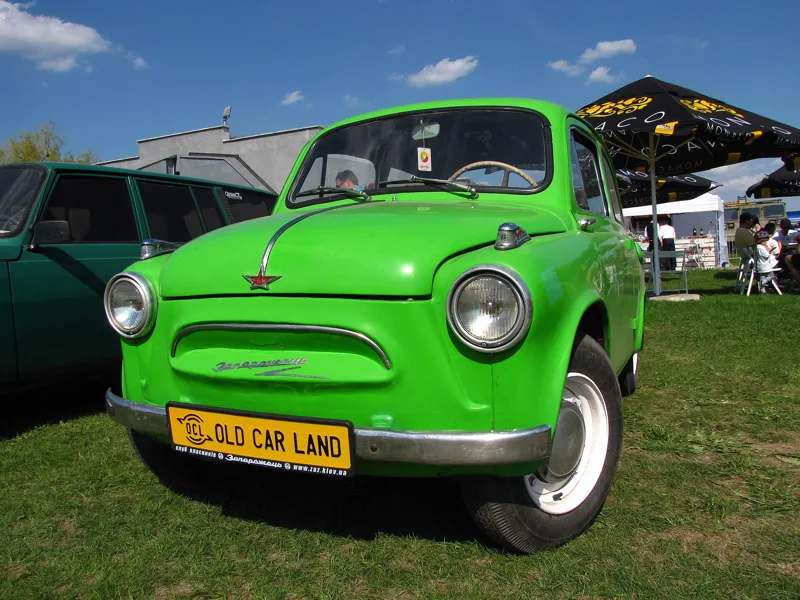
The first car was delivered on 12 June 1959, and the ZAZ-965 was approved on 25 July 1960. Production started in October 1960 at a price of 1,800 redenominated roubles. A car-derived post office van, the ZAZ-965S, had right-hand drive and blanked-off windows.
Why did the ZAZ-965A become the cheapest Soviet car?
From November 1962 the ZAZ-965A replaced the original, and it was built until May 1969. In total, 322,106 ZAZ-965 cars were produced, and the figure is quoted in several slightly different ways in the record.
Its 887 cc MeMZ-965 V4 was rated at 27 PS (20 kW), and from November 1966 some cars received a 30 PS (22 kW) MeMZ-965A unit. The modest power prompted a joke that the engine had served as a starter motor in Soviet tanks.
Soviet owners were expected to service their own cars, and trained mechanics were scarce, so the 90-degree V4 proved practical in harsh winters. Its rearward weight gave strong traction on steep slopes, but the same layout brought the car's notorious lack of cornering stability.
The 965A also spawned disability variants, the ZAZ-965B, AB and AR, plus a luxury export model, the ZAZ-965AE Yalta. Owners and critics alike called it the car for pensioners and intellectuals, and it was the cheapest Soviet car of its day.
Several prototypes and one-offs grew out of the design. The 1962 NAMI 086 Sputnik had a 500 cc vee-twin of 15 PS (11 kW) and weighed only 520 kg (1,150 lb), but it never reached production. The 1969 ZAZ KD used a glassfibre body, weighed 500 kg and could reach 75 mph (121 km/h) on 30 PS (22 kW).
How did the ZAZ-966 and ZAZ-968 refine the design?
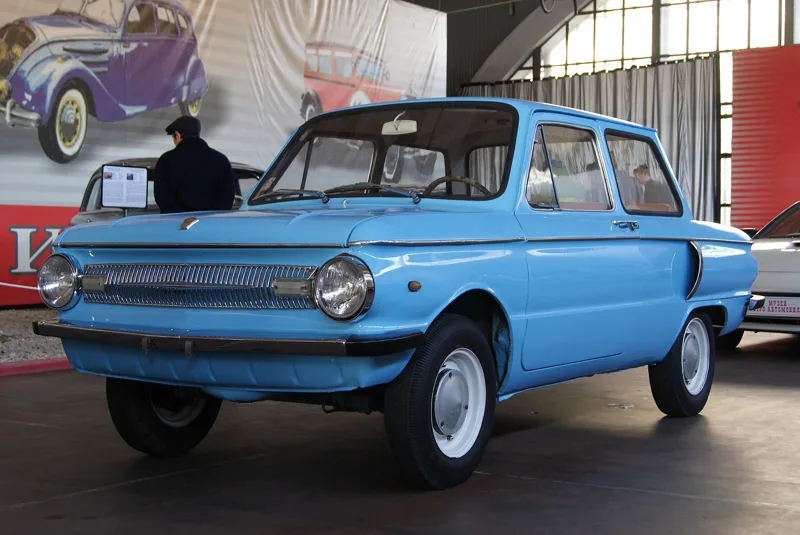
The ZAZ-966 entered production in November 1966, although its prototype had been shown in 1961. Its body was completely restyled by ZAZ, and it no longer looked like the Fiat 600. Critics compared it with the Chevrolet Corvair, the Hillman Imp and the NSU Prinz.
Springs that sagged, doors that opened like suicide doors, and engines that ran hot and made the cabin loud were all addressed. It used the 30 PS (22 kW) 887 cc MeMZ-966A engine, and a radio came as standard. Its price crept up from 1,800 roubles at the 965's launch to 2,200 by 1969.
The simpler ZAZ-966V remained the budget car and the base for disability versions until January 1973. ZAZ launched the full 966 in 1968 with a 40 PS (29 kW) 1,197 cc MeMZ-968 V4, weighing 780 kg (1,720 lb) and reaching 75 mph (121 km/h). The family was dropped in December 1972, over a year after the 968 arrived.
Abroad the car was nicknamed Zapo in the Eastern Bloc, and it found buyers in Finland and France. Some markets swapped its original engine for a 956 cc Renault unit.
The ZAZ-968 ran from spring 1971 to December 1979, using the same 40 hp engine as the 966 with a restyled exterior. A 45 hp MeMZ-968G was planned, but it was cancelled because its higher compression required scarce AI-93 petrol, which defeated the purpose of a people's car.
An autumn 1973 facelift replaced the faux grille with a narrow chrome moulding and shortened the air-intake ears. The upmarket ZAZ-968A arrived late in 1974, with double-circuit brakes, a plastic-padded dashboard, a collapsing steering column and VAZ-2101 seats. Export 968E and 968AE models had modified headlamps, a safety windscreen and an anti-theft steering lock.
Six disability variants again belonged to the 968 family, three using the 887 cc engine and three the 1,197 cc unit.
What happened to the ZAZ-968M?
The ZAZ-968M replaced the 968 series in 1979 and was built until 1 June 1994, making it the longest-running Zaporozhets. Its ears were removed, the chrome was replaced by black plastic and the interior was modernised, with an enclosed glovebox and a newer dashboard.
Its standard engine was the 1,197 cc MeMZ-968E, rated at 40 hp, with carburettors designed for 76-octane fuel. Louvres replaced the side-mounted ears on the bonnet and rear quarter panels.
By the time production ended, the Soviet Union had collapsed and Ukraine was independent. Western front-wheel-drive economy cars such as the Volkswagen Polo and Ford Fiesta were widely available, and a design from the 1950s and 1960s had no realistic chance against them.
The 30 hp 887 cc MeMZ-966G returned to the conventional car as the ZAZ-968M-005, though in smaller numbers than the 1,197 cc versions. Higher-powered MeMZ-968G and MeMZ-968B engines were developed, and the MeMZ-968G was fitted to some export cars between 1979 and 1983.
Four disability variants were built around the 968M. The 968MB had hand controls with throttle paddles on the steering column, the 968MD and 968MG kept a clutch pedal for one-legged drivers, and the 968MR was controlled with one hand and one foot. Its joystick-like steering element and electromagnetic gear assist allowed a top speed of 118 km/h, though it was limited to 60 km/h for safety.
Planned 968 versions with 1.3 and 1.4 L engines never entered production. The collapse of the Soviet economy and the arrival of newer cars overtook them.
How many Zaporozhets were built?
Export variants included the ZAZ-965E, 965AE, 966E, 968E and 968AE, with names such as Jalta or Eliette depending on the market. All of them, like the home-market cars, used the same family of air-cooled V4 engines mounted at the rear.
In total, 3,422,444 Zaporozhets were manufactured at the Melitopol factory from 1960 to 1994. The car's looks and sound made it a frequent prop in films and games, from the 1963 Soviet comedy Three Plus Two to GoldenEye and Half-Life 2.
How were the disability versions used?
Special Zaporozhets variants carried extra controls that let a driver with a limited set of limbs operate the car. They were handed out free or at large discounts to disabled people, especially war veterans, in a scheme similar to the one used for the SMZ microcars. At times these mobility cars accounted for as much as 25% of the factory's output.
The variants came in many forms. The 965 had its B, AB and AR versions, the 966V had three, and the 968 family had six. The most unusual was the 968MR, which could be driven with one hand and one foot.
What nicknames did the Zaporozhets earn?
Few Soviet cars collected as many nicknames. The ZAZ-965 was called horbatyi, meaning hunchback, for its insect-like outline, although factory workers never used the name themselves. Malysh meant kiddy, and in Estonia the car was known as maanteemuhk, a roadbump.
The round air intakes on the 966 and 968 earned the nickname ushastyi, or big-eared. Zapor, a word for constipation, was another, and the boxy 968M became the mylnitsa, or soap-box, because it had lost its ears and looked like one.
What did the Zaporozhets mean in popular culture?
Film and game makers found the car useful for its image. Three Plus Two, a Soviet romance from 1963, showed a ZAZ-965 throughout, with the script poking fun at its tin-can build. Jack Wade, the CIA contact in GoldenEye (1995), drove a ZAZ-965A built in 1963.
The 2011 animated film Cars 2 based its Trunkov characters on the ZAZ-968, and a ZAZ-968 variant appeared as a map car in the game MudRunner. Half-Life 2 used the car as a dilapidated prop on the roads, and S.T.A.L.K.E.R., the post-apocalyptic shooter, also uses it as a prop.
Zaporozhets specifications by model
| Model | Years | Engine | Notes |
|---|---|---|---|
| ZAZ-965 | 1960-1963 | 887 cc V4, 27 PS (20 kW) in the 965A | Fiat 600 rival; ground clearance 200 mm (7.9 in) |
| ZAZ-966 | 1966-1972 | 887 cc V4, 30 PS (22 kW); 1,197 cc from 1968 | 780 kg (1,720 lb); 75 mph (121 km/h) |
| ZAZ-968 | 1971-1979 | 1,197 cc V4, 40 hp (29 kW) | Ears, six disability variants |
| ZAZ-968A | 1974-1979 | 1,197 cc V4, 40 hp (29 kW) | Double-circuit brakes, VAZ-2101 seats |
| ZAZ-968M | 1979-1994 | 1,197 cc V4, 40 hp (29 kW) | Black plastic trim; louvred panels |