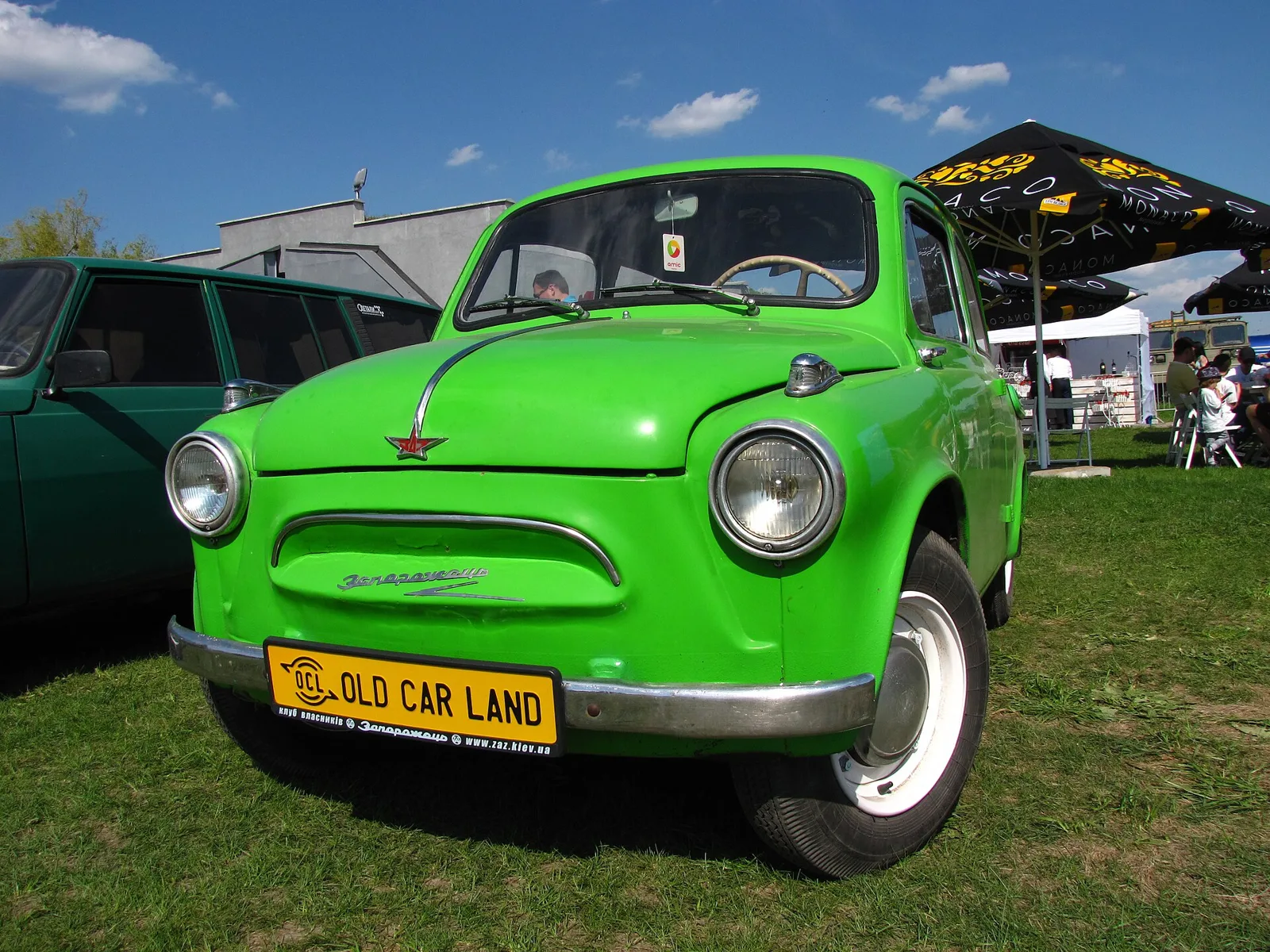
A Soviet microcar that borrowed a Fiat body idea, then rebuilt its suspension, engine and factory for domestic roads and mass output.
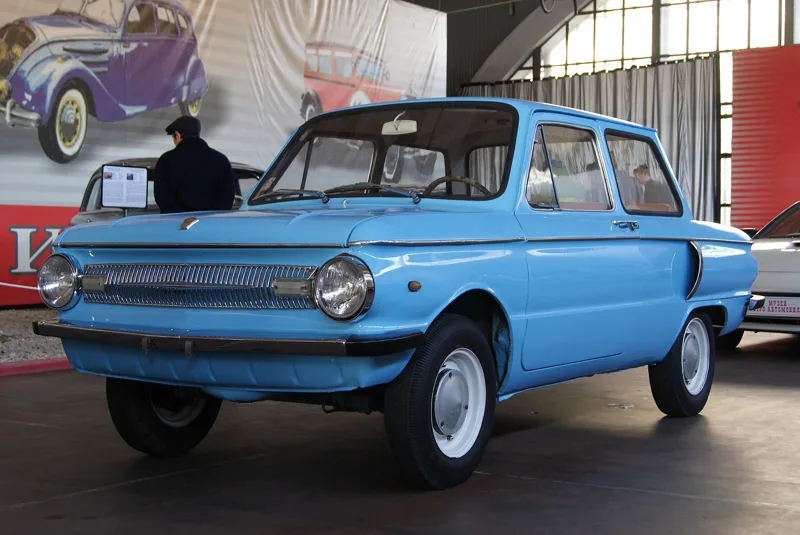
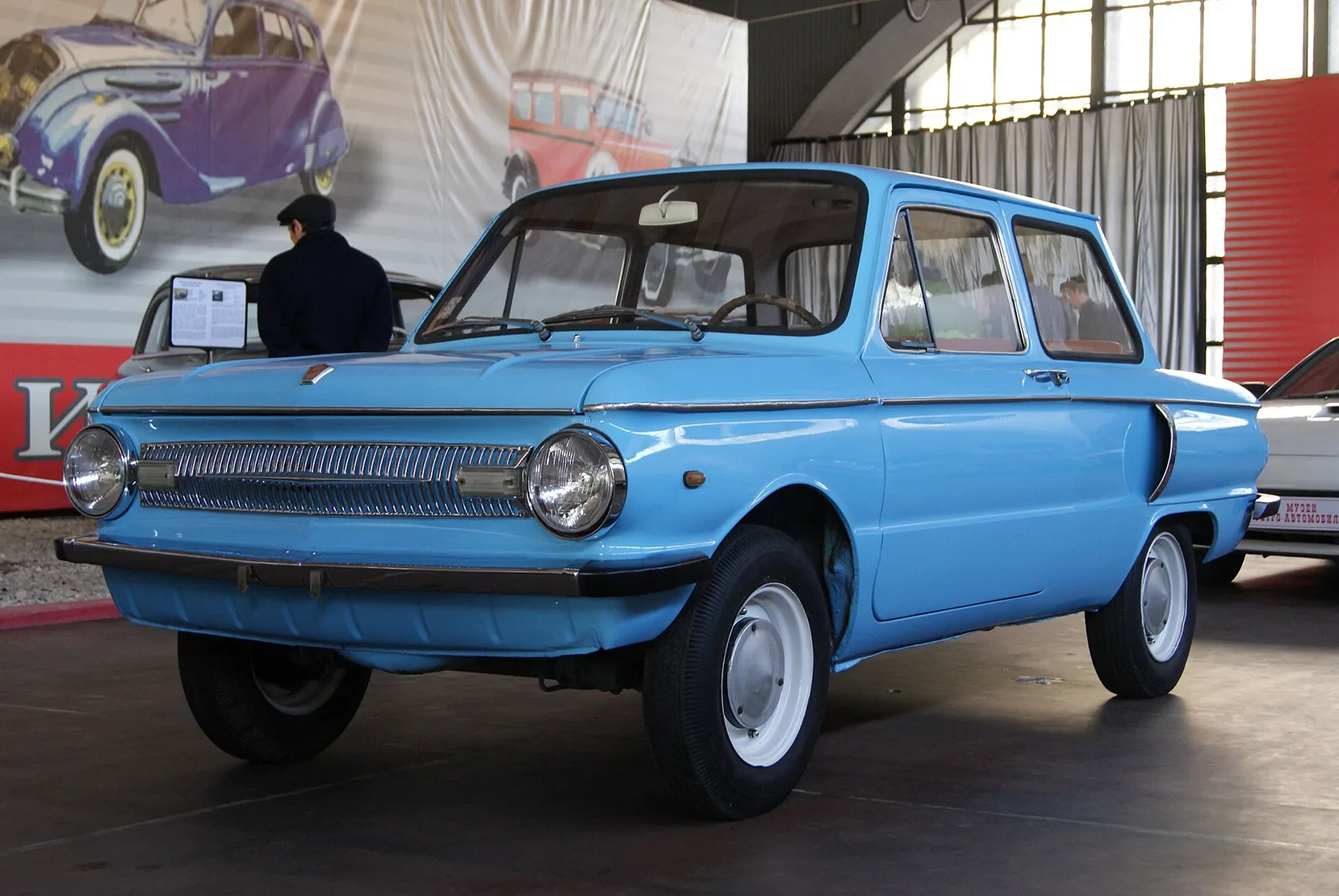
The ZAZ-965 Gorbaty was a four-seat Soviet microcar built at the Kommunar plant in Zaporozhye from 1960 to 1963. It borrowed its body concept from the Fiat 600, then used a rear-mounted air-cooled engine and new torsion-bar suspension for rough domestic roads. In total 322,166 cars were produced.
The ZAZ-965 was a four-seat microcar from the Soviet Union, nicknamed Gorbaty, a word meaning hunchback. A hump over its projecting engine compartment gave the body its character. The body concept came from a study of the Italian Fiat 600, but the suspension, engine and styling were reworked for rough roads and cheap mass production.
Why did the Soviet Union want a microcar?
Incomes climbed quickly in the second half of the 1950s, and more goods reached the shops, yet the main form of personal transport was still the two-wheeler. Planners wrote a microcar into their 1959 to 1965 programme: a light, cheap four-seater weighing around 600 kg (1,323 lb) dry, with a 20 to 25 PS engine and simple upkeep.
The Moskvich-401 had gone out of production in 1956. Its successor, the Moskvich-402, was larger, stronger and more comfortable, yet it cost 15 thousand roubles against 9,000 for the M-401. Engineers at the Moskvich works, known as MZMA, and at the NAMI automotive institute therefore aimed for something more compact, lighter and more economical to run.
A Soviet microcar that kept one good body idea and rebuilt much else for its own roads.
Why was the layout rear-engined?
Designers ruled out the classic front-engine, rear-drive plan. A propshaft running beneath the floor pushed up height, cost and weight, and it ate into cabin room. Front-wheel drive fell short as well, since its grip on domestic roads was poor and its drive joints were expensive to produce. A rear-mounted unit was the answer that remained.
Front-drive cars were uncommon at the time and largely found in Western Europe, where roads were good. Most microcars used a rear engine, and at the modest speeds of those years its drawbacks showed only slightly. The Soviet team followed the same path. Engine and gearbox were combined into one assembly placed right at the driven wheels.
What did the earliest prototypes show?
Work on the 965 began with several prototypes that helped define the requirements of the class and tested individual parts of design. The NAMI-050 Belka, built in autumn 1955, was a little over 3.3 metres long and had a rear engine. Its front hood was glazed and lifted forward and down for entry. Its cabin sealing and its motorcycle-based engine let it down, so it never became a production car.
Other trial vehicles followed in 1957 and 1958. Among them were the NAMI-031 with a torsion-bar front suspension, the NAMI-048 with a wagon layout, the NAMI-049 light off-road vehicle and the NAMI-059 with a fibreglass body. Each tested one idea without becoming a finished car. A rural version of the Belka with a simplified open body, by the designer Eduard Molchanov, also appeared.
Yuri Dolmatovsky, who conceived the Belka, believed that weaker passive safety would be offset by high active safety, through good visibility and light steering. Not everyone was persuaded, even then.
Why was body manufacture such a hurdle?
Soviet cars of the time with unitary bodies had a skeleton of many welded panels, with a separate sub-frame carrying the engine and bolt-on wings. That construction suited a larger car, but it would make a microcar too heavy and too labour-intensive. The Volga GAZ-21 body of early production, for instance, went through four welding jigs in turn, and one side panel alone was welded from five pieces.
The seams between those pieces were hand-tinned with solder before the frame and wings were bolted on, which shows how many manual operations the process needed, each one needing parts fitted to one another. A microcar built for mass production needed far fewer and larger parts. The team therefore had to find a new way of making the body as well as a new design.
Why did the team choose the Fiat 600?
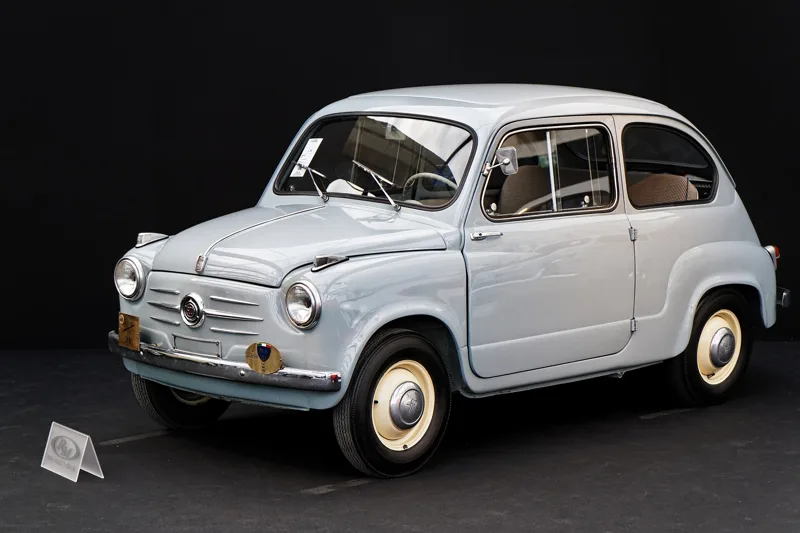
NAMI experts rated the Fiat 600 highly for its structure and for the way it was built, and they used it as the direct reference for the new body. The Italian car kept the cabin roomy without a taller roofline, with its floor set low between the sill boxes and its reinforced wing panels doing the work of side members.
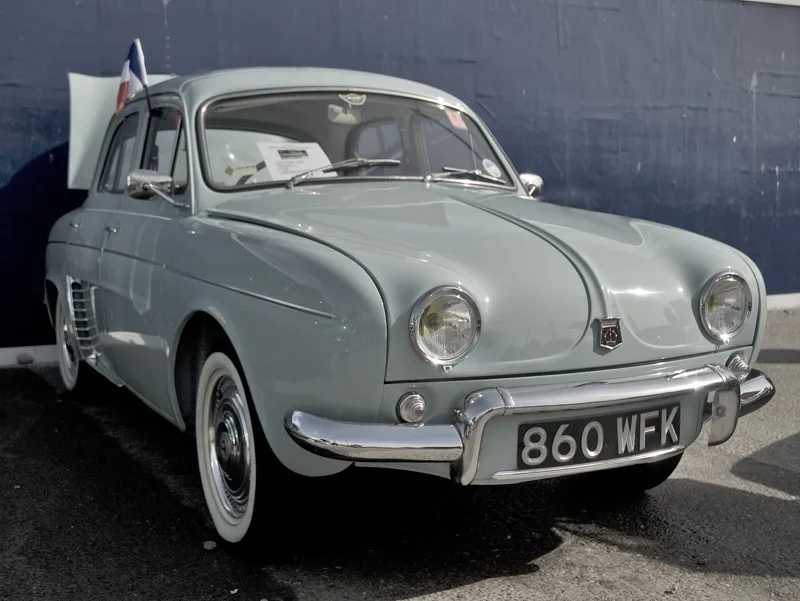
The Soviet team kept the Fiat's general plan, its load-bearing structure and the way its panels joined, so it could borrow some of the Italians' production solutions. A single pressed part formed the body side, with its door opening and rear wing. The Renault Dauphine was named alongside the Fiat as the same kind of body.
Style was a different matter. The Soviet car became a three-box, two-door saloon with a flat side, a distinct boot, a raised hump over the engine and a large rear window matched to the windscreen. It was not a fastback with pressed-on wing shapes. The doors stayed hinged at the rear, which made getting in easier and suited the versions planned for disabled drivers, although a door opened by accident on the move could be dangerous.
The side windows changed too. The Fiat's sliding glass gave way to drop-down windows with pivoting quarter-lights for draught-free ventilation. The Fiat itself later adopted drop-down glass, but without the quarter-lights, which arrived only after its doors were hinged at the front.
How did the chassis depart from the Fiat?
The Fiat's transverse leaf spring offered only 40 mm of dynamic travel, which was too little for Soviet roads. The 965 used double longitudinal arms and two transverse torsion bars, and the pedal assembly moved forward to free space in the cabin. Larger 13-inch wheels with taller tyres completed the change.
The torsion bars were lamellar rather than round, so the layout looked like a Volkswagen arrangement but was not borrowed from it. The wheel arches had to be enlarged and the body layout altered to fit the bigger wheels, which were intended for roads of poor quality.
The result was a car suited to unimproved roads and, for a short time, beyond them. Only the engine was wholly domestic. The four-speed gearbox, combined with the final drive, and a lever clutch working through a cable both closely followed the Fiat.
What powered the 965?
The design chosen was the 965V, a V-shaped, air-cooled engine of 746 cc, with the camshaft set in the vee of the block. The unit later grew to 877 cc, and the 965A version made 27 PS, later 30 PS. Magnesium and aluminium alloys kept the unit light.
Before settling on the V-shaped unit, the team considered a 650 cc MD-65 opposed twin of motorcycle origin. Its life under heavy loads was short, with no more than 30 thousand km before overhaul, and its torque curve made dirt roads hard going. Its deep sump also forced wheel reduction gears at the rear axle, which raised the car's mass.
The team then aimed for around 750 cc, with room to grow to 900 cc, and turned to four cylinders. In 1958 the 444-BKR prototype, named after its lack of wheel reduction gears, carried a production BMW 600 engine as a stopgap.
By 1959 NAMI's engines were ready, but the first, the 965G, which kept the opposed layout, was judged unsuitable. Its underslung camshaft and cylinder heads near the rear wheel arches made routine work extremely hard without removing the engine, including valve clearance adjustment. The 965V replaced it.
Why did the engine use air cooling?
Antifreeze was barely available to ordinary buyers in those years, and owners were expected to service their own cars, so air cooling suited the market. It also removed the risk of a parked car's water freezing in winter, while detachable cylinders made repairs simpler.
The same unit was adapted for the TPK light amphibious transporter, whose sealed engine compartment was easier to fit with an air-cooled engine. The TPK designers had earlier tried the Irbit MD-65 without success, so they were keen to see the new unit. The military MeMZ-967 and civilian MeMZ-965 engines differed only in individual parts, and the transmission also shared many engineering solutions and even common parts.
Several engineering choices came from the military side: a rear oil radiator, a high-mounted distributor and a lightened aluminium-magnesium crankcase with detachable cylinders. Later LuAZ-969 vehicles used derivatives of the amphibian's engine and transmission, which are often wrongly described as based on the 965.
What gearbox did the ZAZ-966 use?
Only the ZAZ-966, with its 40 PS engine, got a gearbox wholly of the designers' own making. They built it from the LuAZ gearbox, a sturdier unit with synchromesh on every forward gear.
The next model from the plant, the ZAZ-966 / 968, kept technological continuity with the 965, despite a very different look and substantial changes to the design as a whole.
Why not simply buy a foreign design?
Buying a finished foreign car, together with its production process, was out of reach, so the engineers studied foreign analogues closely, focusing mainly on production technology. The USSR of the late 1950s was still recovering from war damage and had too little hard currency for such purchases. Later a foreign design with its production technology was bought for the VAZ-2101, and production engineering for the VAZ-2108 was ordered from a foreign firm, but in the late 1950s that was closed.
The NAMI-1, the first Soviet small-car project, of the 1920s, showed the same trap. Its design was generally successful, yet it never developed further, because of its high cost and because even modestly mass production was impossible under the conditions of the time.
Low unit cost depended on a proven, efficient process. Without one, the new microcar risked repeating the fate of foreign models that did not live up to their makers' hopes because their output was tiny and their unit costs high. Engineers therefore needed new answers in production technology as well as in design, and the two could not be separated.
Where was the car built?
Production moved to the Kommunar works in Zaporozhye because the MZMA line was already full. Kommunar, in the Ukrainian SSR, had made combine harvesters and other farm machinery before the conversion. The engine would come from a light-diesel factory in Melitopol.
The first examples carried the designation Moskvich-444 before being renamed Moskvich-560. Production of the 965A ran from November 1962 to 1969.
Output across all versions came to 322,166 cars. That total covers every version the plant built.
What was the design brief?
The brief asked for a modern and rational design, one suited to mass production and able to last under domestic conditions, with most servicing done by the owner. Those demands shaped the engine, the cooling and the chassis choices that followed.
In practice that meant detachable cylinders, a simple air-cooled engine that needed no antifreeze, and a body built from few large panels. The target dry weight of about 600 kg (1,323 lb) and a 20 to 25 PS engine fixed the scale of every compromise.
What were the specifications?
| Specification | Value |
|---|---|
| Years built | 1960 to 1963; 965A from November 1962 to 1969 |
| Seats | Four |
| Engine | 27 PS, later 30 PS (965A) |
| Displacement | 746 cc at first, later 877 cc |
| Dry weight (planned) | about 600 kg (1,323 lb) |
| Total production | 322,166 cars, all versions |