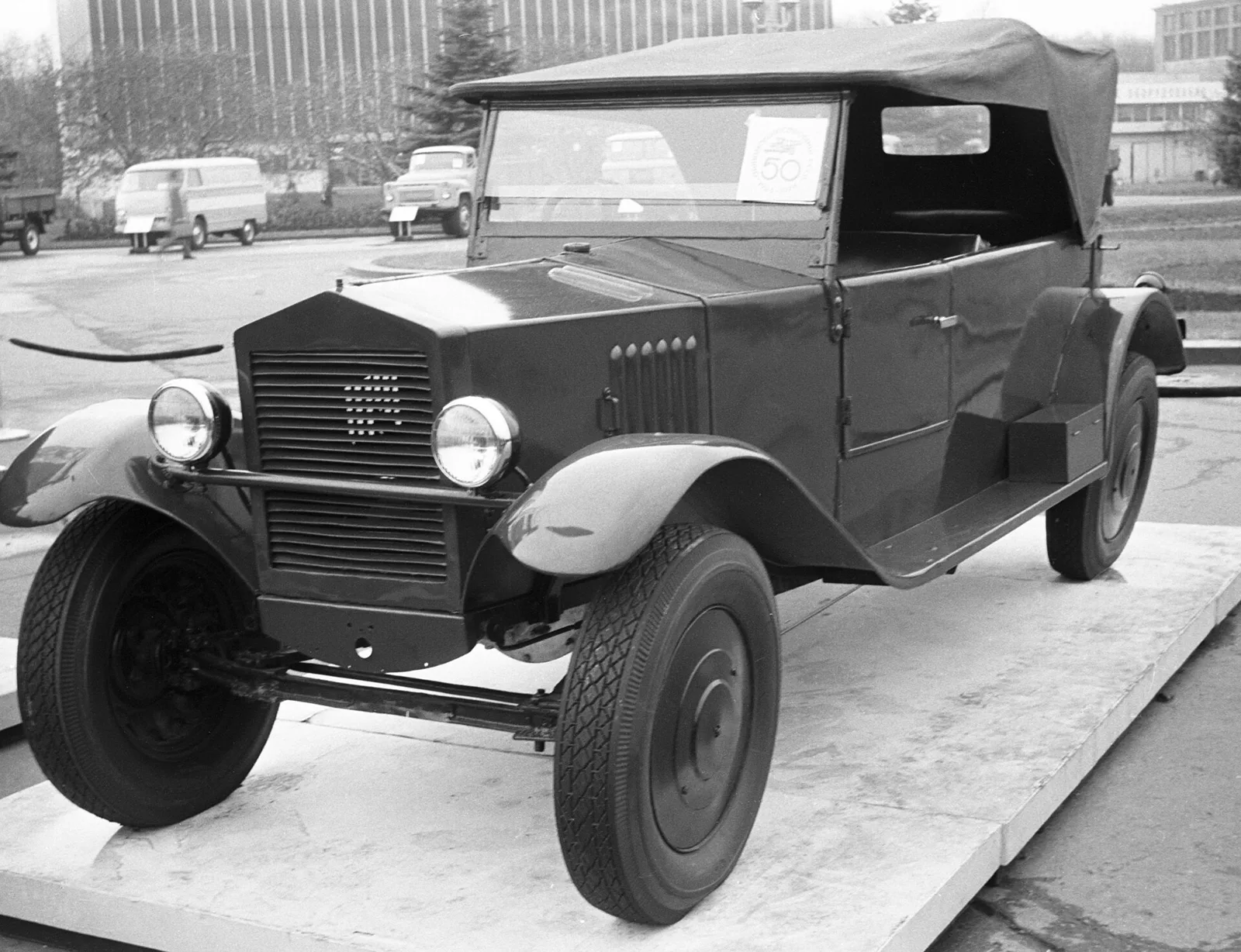
A backbone-framed open tourer from a diploma project, built by hand at Spartak, sold at a price few could afford and withdrawn after less than three years.
Designed at the NAMI institute in 1927, this small open tourer used a backbone frame and a 22 PS air-cooled V-twin. Series output at Spartak in Moscow was halted in 1930, after a few hundred cars had been built and sold mostly to state garages.
The NAMI-1 was the first passenger car made in the Soviet Union, a small open tourer built from a diploma project and produced by hand in Moscow. Its backbone frame and independent rear suspension gave it cross-country ability that many passenger cars of its day lacked. Production lasted less than three years before it was halted in 1930.
Why was the NAMI-1 built?
Engineers at the NAMI research institute wanted a simple car that also offered comfort and carrying capacity, a middle ground between a motorcycle combination and a conventional car. The project began as a private initiative and was taken up by the institute, and the state trust Avtotrest later decided on production.
The idea came from Konstantin Andreyevich Sharapov, a graduate of the Moscow Mechanical and Electrotechnical Institute. His diploma, titled A small car for Russian operating and production conditions, was approved in February 1925 by his supervisor, Professor Yevgeny Chudakov. The aim was a car that sat between the cyclecar (a motorcycle combination) and an ordinary car, as plain to build as the first and as roomy as the second.
Chudakov recommended the project to his colleague at NAMI, Professor N. R. Brilling, who gave the young engineer close attention. After the diploma was defended, Sharapov stayed on as a staff engineer, working within a circle of enthusiasts that included A. A. Lipgart and E. V. Charnko.
Built by hand from a diploma project, the NAMI-1 was the first Soviet passenger car, and it was halted before its faults could be fixed.
How did the NAMI-1 get into production?
The first press mention appeared in August 1925, in the magazine Motor. Full drawings existed by summer 1926, and the State Trust of Automobile Plants, Avtotrest, decided at the start of 1927 that the car would be produced. Avtotrest was the body that directed the country's car industry until VATO was formed in 1930.
The first trial chassis was complete by 1 May 1927 at Moscow State Automobile Plant No. 4, known as Avtomotor and later Spartak. A week after it was finished, it went out for trials, still lacking a complete body. Two further cars followed by September, and all three had rough temporary bodies, one seating four and one seating two.
On 16 September the pair of experimental cars left on a trial run from Crimea to Moscow and back. They travelled alongside foreign-made cars, mainly Ford Model Ts, and two motorcycles with sidecars. The run was completed without serious breakdowns, and the NAMI-1 proved economical, with a full tank enough for 300 km.
How did the NAMI-1 bodies differ?
Chassis No. 1 and No. 3 went to the AMO plant after testing, and each received a new four-seat body. The more refined design was harder to build, while the simpler one had only two doors and no boot. Neither reached series production.
The first design had a neat look, three doors (one on the front right, two at the back), a windscreen split into two sections and a compact luggage space at the rear. The second had cruder finishing and a three-section windscreen with separate quarter windows for each side. Neither body went into series production.
Who built the NAMI-1 and how?
Spartak was given series production, though its modest capacity limited it to machining parts and final assembly. The AMO plant supplied most of the cast and forged blanks, and it also provided the body sets, which were fitted out at the 2nd Auto Repair Plant. Small parts and body fittings came from Auto Accessories Plant No. 5.
There was no conveyor. Every car was put together by hand, slowly and with uneven quality, since the workforce had limited technical experience and the equipment was obsolete. Bodies were treated as a separate product supplied by outside firms, a practice that was common across the industry. Even Ford ordered many of its body types from specialised coachbuilders.
The series body was very basic, with angular shapes forced by panels bent from sheet metal, a one-piece windscreen with no ventilation quarter windows, and a poorly designed canvas roof. The series car was also far heavier than planned, mostly because of that body.
What happened at the Izhora plant?
The Izhora Plant in Leningrad bought a second set of NAMI-1 documentation in 1927, before production began in Moscow. Izhora set up a car department and started preparing parts, but Avtotrest stopped the work after about a month.
Izhora was a large industrial enterprise with long experience of technically complex products. Avtotrest's instruction was to wait for a more advanced model, which never came. One candidate considered for it was a six-seat tourer analogous to the Opel 10/45 PS.
How many NAMI-1 cars were built?
Sources give different totals, but the main account counts 369 cars from 1927 to 1930. Another gives 512 cars for 1928 to 1931, and a third gives 190 cars for 1928 and 1929, of which 40 were built in 1928 and 150 in 1929.
Parts for 125 cars were stocked in the 1927-28 economic year, but delays in receiving complete drawings from NAMI, and gaps in imported components such as tyres, magnetos and starters from the State Trading Organisation, held up full production. The first 50 were finished in October and November 1928, and buyers received them only in spring 1929.
What did a NAMI-1 cost?
The first 100 cars carried a price of 8,000 roubles, cut later to 5,180. For comparison, a Ford A of domestic assembly cost roughly 2,000 roubles in those years, which put the NAMI-1 far beyond most private buyers. Potential buyers found it unaffordable even in a shortage.
At first buyers were expected to apply directly to the factory or to Avtotrest, and Avtotrest was even given commercial advertising in the press. Because so few cars were made, the cost of each was very high, and that fed into the retail price.
Practically every car made was bought up centrally by Avtodor and distributed to the garages of state departments. The cars drew many complaints in service, and the faults were put down mainly to poor workmanship rather than to the design.
Why did NAMI-1 production stop in 1930?
Production stopped on 1 October 1930, by order of Avtotrest, less than three years after it had begun. The defects could not practically be corrected under the economic and production conditions of the time, and resources were needed for a new car plant at Nizhny Novgorod that was designed for hundreds of thousands of cars a year.
Spartak's production capacity went to AMO, with the reservation that NAMI-1 output could be restored at any time. Production could in principle be restored.
What were the NAMI-1's technical specifications?
The NAMI-1 was a four-seat open tourer with a backbone chassis and a small air-cooled engine. The series car weighed far more than its design figure.
| Specification | Figure |
|---|---|
| Engine | 1,163 cc (71.0 cu in) V-twin, air-cooled, overhead valves |
| Power | 22 PS (22 hp; 16 kW) |
| Gearbox | Three-speed, no synchromesh |
| Final drive | No differential |
| Frame | Steel tube backbone, 135 mm (5.3 in) in diameter |
| Rear suspension | Independent, swinging half-shafts with a transverse leaf spring |
| Front suspension | Dependent, on two longitudinal quarter-elliptic springs |
| Wheel diameter | 730 mm (28.7 in) |
| Ground clearance | 225 mm (8.9 in) |
| Kerb weight | 700 kg (1,543 lb); design weight 400 kg (882 lb) |
| Top speed | 90 km/h (56 mph) |
| Fuel use | 8 to 10 l/100 km (23.5 to 29.4 mpg-US) |
How was the NAMI-1 engineered?
The chassis was built around a steel backbone tube 135 mm (5.3 in) in diameter, rigidly fixed to the flanges of the engine crankcase and the final drive. The tube was very stiff in torsion and weighed much less than a traditional ladder frame. It also removed the need for propeller shaft joints.
The rear suspension was independent, with swinging half-shafts and a transverse leaf spring. The front suspension stayed dependent, on two longitudinal quarter-elliptic springs, and its parts, like the steering, were mounted on the crankcase, which eased assembly at the plant. Long travel and low mass gave the car good cross-country ability on dirt and country tracks.
The engine was an air-cooled V-twin with overhead valves and a displacement of 1,163 cc (71.0 cu in), producing 22 PS (22 hp; 16 kW). The clutch was a cone type with a foot-operated linkage. The three-speed gearbox had no synchromesh, and the final drive had no differential. Brakes were band types, mechanically operated, on all wheels, or on the rear wheels only according to another account.
Was the NAMI-1 copied from the Tatra?
The NAMI-1 was not a straight copy of the Czechoslovak Tatra, although some accounts name the Tatra 11 and 12 as its model. Only the tubular backbone frame was shared. Engine, front suspension and layout all differed, so the car was a Soviet design in its details.
The Tatra had earned attention at the 1925 Moscow-Tiflis-Moscow run, where it finished first of 78 cars on reliability and cross-country ability rather than speed. Many units differed substantially. The Tatra used a single transverse semi-elliptic spring up front and a flat-twin engine instead of a V-twin. The layout also differed. In the NAMI-1 the power unit sat entirely within the wheelbase, while the Tatra's projected forward over the front axle, which helped weight distribution but limited front suspension travel.
What became of the NATI-2?
The NATI-2 was an improved successor created by Sharapov at NATI, the renamed NAMI, by mid-1932. Its engine was a stronger inline four, air-cooled, a more attractive open body with four doors and bumpers, and many reworked units. Do not confuse it with the half-track NATI-2 vehicle.
Several experimental NATI-2 cars were built in 1933, at the Izhstal workshops in Izhevsk according to one account. Six engines, five bodies and five chassis were made, and three finished cars were assembled. The car never reached series production, because the Nizhny Novgorod plant was already under construction. That plant was designed to build 250 to 300 thousand vehicles a year on proven foreign technology, including 100 thousand medium-capacity passenger cars. Enthusiasts such as Yu. Dolmatovsky argued for a small car alongside it, but the case did not succeed.
Where can a NAMI-1 be seen today?
Complete cars are displayed at the Polytechnic Museum and at the labour history museum of the Gidromash enterprise, which bears the name of V. I. Luzyanin. A chassis with its engine and some fittings is shown at the UGMK museum complex in Verkhnyaya Pyshma.
Did the NAMI-1 appear on a stamp?
A stamp showing the NAMI-1 was issued by the USSR Post in 1973. It is the only cultural reference listed for the car.