A state that started with no car industry built a people's car plant on a Fiat design, kept buyers queuing for years and left Russia's makers to face the open market.
The Soviet Union built its car industry from the late 1920s with Western help, produced 2.1-2.3 million vehicles a year by 1991, and based the Lada on the Fiat 124. After 1991 Russian makers faced crisis, foreign rivals and sanctions, and Chinese brands took 57.2% of sales by 2025.
Before the revolution, Russia's cars were put together in small numbers from imported parts. By the time the Soviet Union dissolved in 1991, it was making between 2.1 and 2.3 million vehicles a year of all types and ranked first in the world for buses and third for trucks. Cars lagged: it stood ninth.
The story between those two points runs through Western-built factories under Stalin, a Fiat licence that produced the Lada, a car market with years-long waiting lists, a crash after 1991, a short boom and, most recently, sanctions that have handed more than half of Russian sales to Chinese brands.
Before 1917: engines, a Monte Carlo result and unfinished plants
Russia had a long record in machinery. Ivan Polzunov, working in the eighteenth century, built the world's first steam engine with two cylinders, and Ivan Kulibin made a human-powered vehicle fitted with a flywheel, brake, gearbox and roller bearings. Fyodor Blinov invented one of the first tracked vehicles in 1877. The first Russian petrol car, the Yakovlev & Freze, came from an engine factory and a carriage workshop in 1896. In 1899 the engineer Hippolyte Romanov built an electric car nicknamed the Cuckoo, and a battery-electric omnibus as well.
Before 1917 the country turned out a rising number of cars and trucks from Russo-Balt, Puzyryov, Lessner and other makers, and held its first motor show in 1907. Its drivers competed abroad. A Russo-Balt finished ninth in the 1912 Monte Carlo Rally despite winter conditions that threatened the driver and his riding mechanic on the way from Saint Petersburg, and the following year one came second in the San Sebastian Rally and covered more than 15,000 km across Western Europe and North Africa. Its driver, Andrei Nagel, was personally honoured by Emperor Nicholas II for raising the prestige of Russian cars.
Volumes stayed tiny. Cumulative output had reached about 1,000 motor vehicles by 1915, and imports vastly exceeded domestic output, which made up less than 10% of the vehicles on the road by 1914. In February 1916 the Tsarist government funded six plants, among them AMO in Moscow and Russo-Balt at Fili, but none was finished before the October Revolution.
Domestic car production satisfied only 45% of demand, yet imports were not permitted.
The Soviet start: nationalisation, licences and Stalin's giant factories
The new leadership nationalised Russo-Balt on 15 August 1918 and renamed it Prombron, which continued with Russo-Balt cars and added a new model on 8 October 1922. A prewar Citroen factory kept running privately until its nationalisation in 1921. AMO assembled FIAT 15 Ter trucks to a licence and then produced a more modern truck derived from them, the AMO-F-15, of which about 6,000 to 6,500 were made between 1924 and 1931. The first fully Soviet-made vehicles left AMO's Moscow plant on 7 November 1924.
The first original Soviet car, the NAMI-I, was created in 1927 by engineers at the Scientific Automobile and Motor Institute and built in small numbers by the Spartak factory in Moscow until 1931. Gorky and Moscow became the main manufacturing centres, with components made in many places.
Stalinist pressure for rapid industrialisation, and a taste for economies of scale, then produced vast factories turning out highly standardised vehicles with slowly changing product lines. The Moscow (ZIL), Gorky and Yaroslavl plants, partly or wholly built by Western firms, lifted output from a few thousand vehicles in 1928 to 200,000 in 1937, nearly all of them trucks. In 1929 the Supreme Soviet of the National Economy set up GAZ, working with the Ford Motor Company, and a year later a second plant opened in Moscow, destined to become a major car maker after World War II under the name Moskvitch. Cars were only a small share of early output. Even so, between 1932 and 1939 car production rose by 844.6%, and by 1937 the country stood second in the world for truck production.
Rebuilding after the war
The postwar industry grew fast. The State Defense Committee ordered new car factories at Kutaisi and Dnepropetrovsk, and on 26 August 1945 it issued Resolution No. 9905, which set out how car production should develop after the war. In 1947 the Soviet Union made 132,968 vehicles, of which 9,622 were cars, 121,248 trucks and 2,098 buses, still short of the prewar level. It passed the earlier record in 1949 and reached 363,000 vehicles a year in 1950.
Exports began in 1948. Soviet cars appeared at the 1950 international exhibition in Poznan, Poland, and soon went on sale in Western Europe. By the late 1950s the country made 43 car models. In 1957 it produced 495,994 vehicles, among them 113,588 cars, 369,504 trucks and 12,316 buses, and the level the following year was put at 600,000 a year.
Lada history: the Fiat 124 and the town of Togliatti
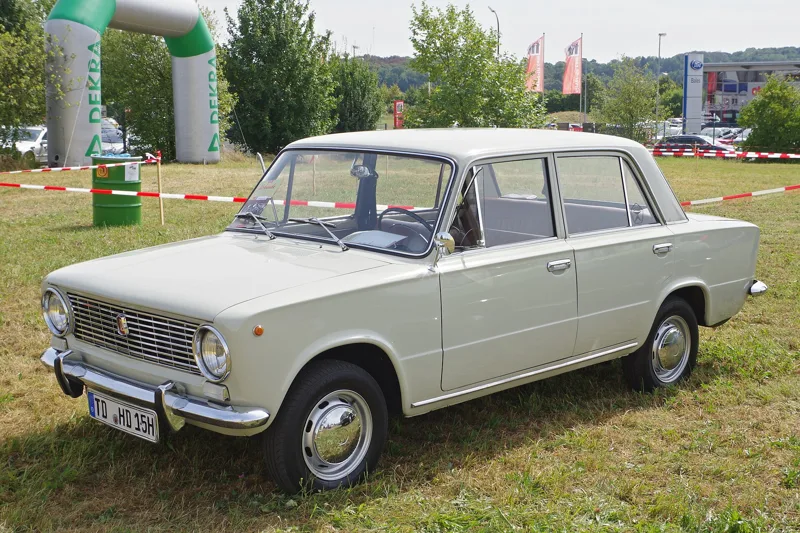
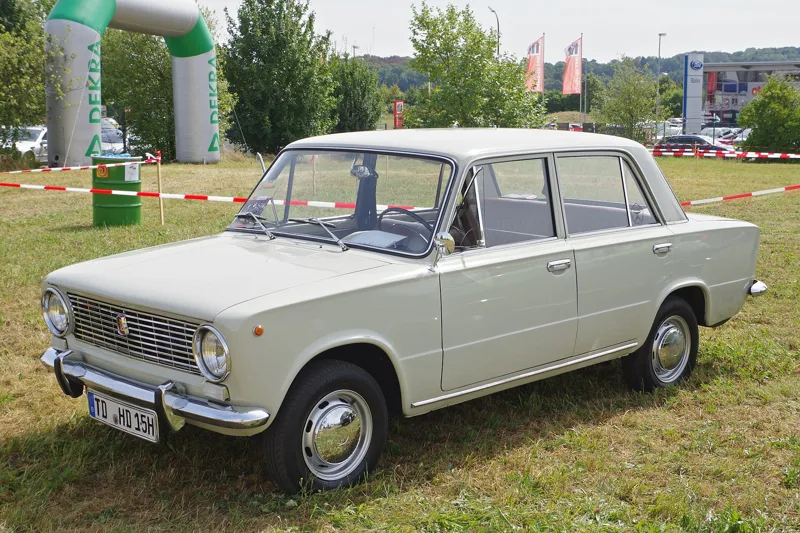
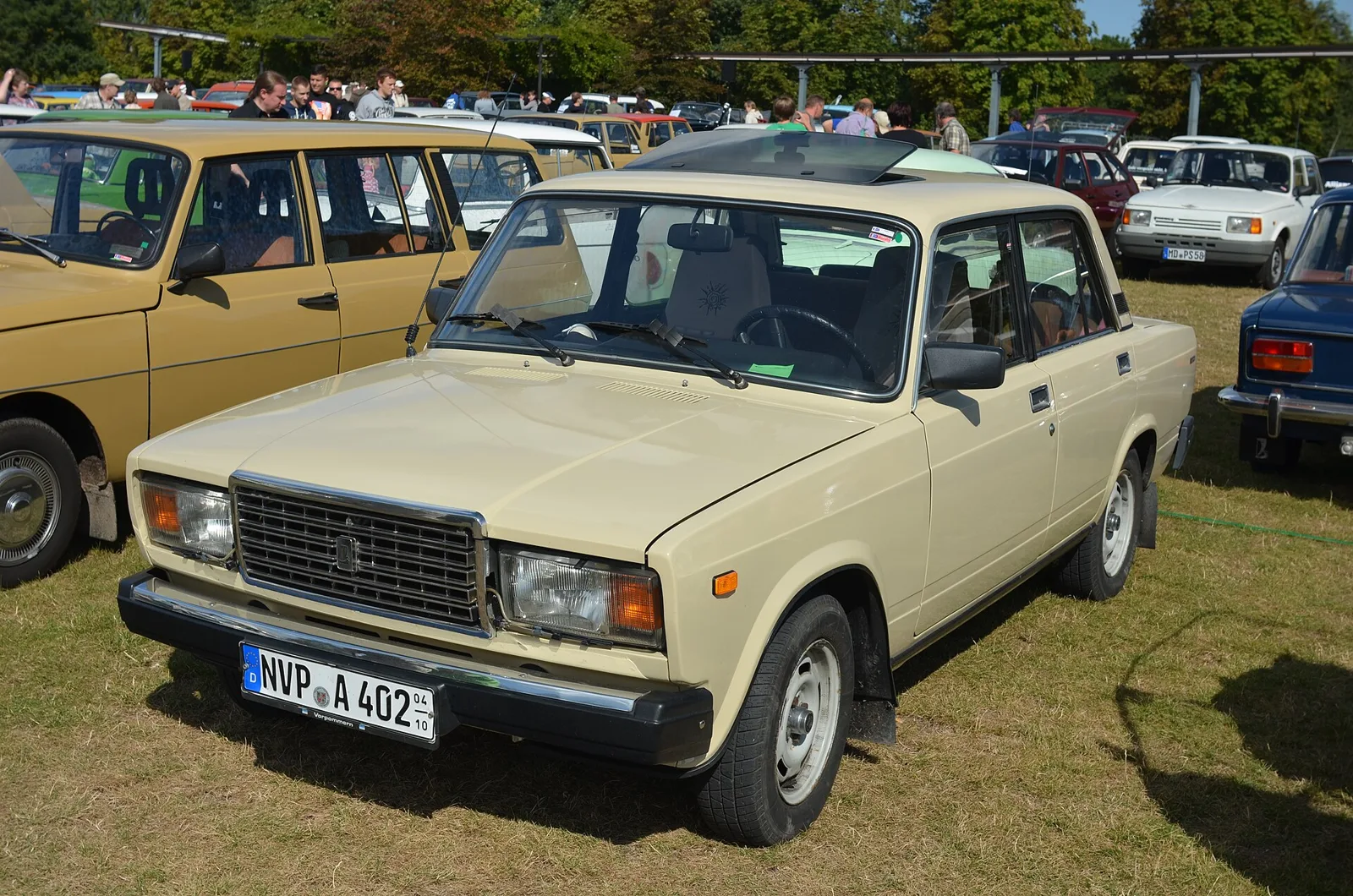
In the early 1960s the Moskvitch 408 appeared as an economy car intended to put ordinary people behind the wheel, and MZMA, GAZ and ZAZ all offered cars to a growing public. The government wanted something bigger still: a plant to produce a people's car. For reasons of cost it chose a licence deal with a foreign company, built on a modern existing model. Volkswagen, Ford, Peugeot, Renault and Fiat were all considered. The Fiat 124 won because its design was simple and sturdy, easy to build and easy to repair.
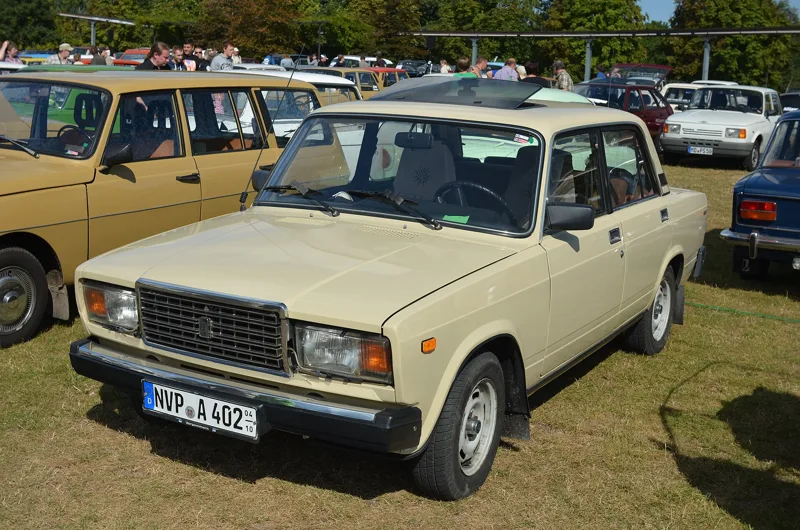
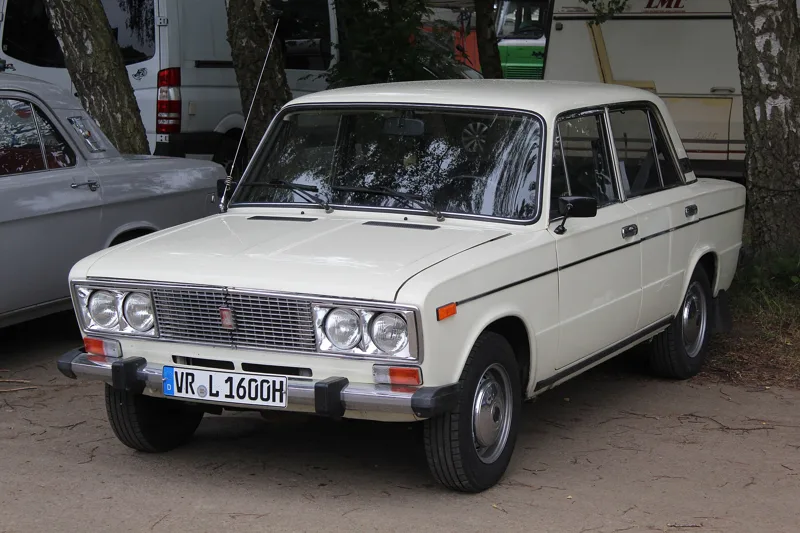
The plant went up in only four years, from 1966 to 1970, in the small town of Stavropol Volzhsky. The town later passed half a million people and was renamed Togliatti in honour of Palmiro Togliatti, who had led the Italian Communist Party for many years and died shortly before construction began. The factory became AvtoVAZ, known as Lada, and produced up to 800,000 cars a year. It started with the Zhiguli, licensed and upgraded variants of the Fiat 124 and Fiat-derived models, and later developed cars of its own design, including the VAZ-2108, 2109 and 21099, the VAZ-2121 and the VAZ-1111.
Elsewhere the Izhmash car plant opened in Izhevsk, an initiative of Defence Minister Dmitriy Ustinov aimed at lifting overall car output, and made Moskvitchs and Moskvitch-based hatchbacks. KamAZ rose at Naberezhnye Chelny, where Europe's largest heavy truck plant was built.
The 1960s and 1970s were years of planning. A 15-year transport modernisation plan announced in 1965 called for more cars and heavy trucks to lift consumer welfare. Trucks were spread across Belarus, Ukraine, Georgia and the Volga and Ural regions by 1970, but cars were confined to Moscow, Gorky and Izhevsk until the late 1960s. From 1970 to 1979 car output grew by nearly 1 million units a year and truck output by 250,000 a year, and the ratio of cars to trucks moved from 0.7 to 1.7, a sign of greater attention to consumers. The Soviets reportedly put half of an estimated 7 billion rubles invested in 1971-75 into the Volga car and Kama truck plants. By the end of the plan officials were stressing productivity and new designs rather than simply adding plants.
Buying a Soviet car
For buyers the story was waiting. There were queues for new cars, and many private buyers spent years on the list. In the 1970s the Lada and the Volga were the most in demand. The Volga was the most prestigious car sold to private owners, though up to 60% of its output was reserved for state and party institutions. Moskvitch and Zaporozhets cars were always popular and available, as were the compact four-wheel-drive LuAZ. UAZ all-terrain vehicles could not be bought privately, but decommissioned ones could. The Chaika and ZIL limousines were never offered to the public. Before 1988 private buyers were also barred from buying vans, minibuses, trucks or buses.
By the early 1980s the industry was a handful of main plants serving different segments. Domestic production met only 45% of demand, yet no car imports were allowed. The Soviet Union also exported 300,000 to 400,000 cars a year, mostly to satellite states, with smaller flows to North America, Latin America and Europe, both central and western.
Soviet car brands and plants
| Maker | Years | What it built |
|---|---|---|
| AvtoVAZ (Lada) | 1966 to present | Fiat 124 derivatives, then own designs; up to 800,000 cars a year |
| AZLK (Moskvitch) | 1929 to 2001 | Durable, easily repaired cars; up to 200,000 a year; closed in 2010 |
| GAZ (Volga) | 1932 to present | Volga sedans, taxis and the Chaika for officials; up to 100,000 cars a year |
| IzhAvto | 1967 to present | Moskvitch family cars and pickups; up to 200,000 a year |
| UAZ | 1941 to present | Light four-wheel-drive vehicles for military or farm use |
| ZiL | 1916 to 2016 | Trucks, luxury sedans and state limousines |
| SMZ (later SeAZ) | 1939 to present | Cyclecars for disabled drivers; car production ended in 2008 |
| RAF (Latvia) | 1949 to 1998 | Vans and ambulances |
Geography was lopsided. The Russian republic accounted for annual output approaching 1.8 million units, the Ukrainian republic for more than 200,000 and Byelorussia for 40,000, and only the first two built every type of vehicle. ZAZ and LuAZ were in Ukraine, and other republics specialised in trucks or buses.
After 1991: crisis, recovery and the boom years
When the Soviet Union dissolved in December 1991, makers in the successor states were pushed into a market economy and hit at once by lost financial backing, economic upheaval, crime and tougher competition in the home market. AvtoVAZ turned to cooperation such as GM-AvtoVAZ for capital. AZLK became dormant, and ZAZ turned into a new company, UkrAVTO.
Import duties were slashed in the early 1990s, and by 1993 foreign-made cars were 49% of sales. Total output that year was 14% below 1990. Falling Lada sales and tougher European Union emissions rules ended exports to Western Europe by the end of the decade, after Britain had peaked at more than 30,000 Lada sales a year in the late 1980s. Some 850,000 cars were sold in 1996, but local brands carried a reputation for poor build quality. One 1996 estimate said a newly bought AvtoVAZ needed $1-2,000 of repairs to be comfortably safe. Dealer financing did not exist in the 1990s, so cars were bought in cash. In 1997 car production rose 13.2% on 1996 to 981,000, with AvtoVAZ up 8.8%, UAZ up 52% and KamAZ doubling its output. The 1998 financial crisis led makers to stop using imported parts, yet the industry recovered quickly, and car output climbed from roughly 800,000 in 1993 to over 1.16 million by 2000.
The early 2000s brought recovery. Russian metals companies with profits from foreign markets bought into the car sector: Siberian Aluminum took the Pavlovo Bus Factory and rising stakes in GAZ, and Severstal took control of UAZ. Ford, in 2001, became the first Western manufacturer to open a plant of its own, putting $150 million into Vsevolozhsk to build the Focus, for a time the country's top-selling foreign-brand car. Even so, in 2003 Russian manufacturers still produced over 90% of the country's cars.
Rising incomes fed demand. In 2005 Russians bought 1,446,525 new cars, 832,200 Russian and 614,325 foreign, and in the first quarter cars with foreign badges beat local ones in sales for the first time, used imports included. The number of foreign cars built in Russia climbed from 157,179 in 2005 to 456,500 in 2007, and local brands responded with newer designs such as the Lada Kalina. The market grew 14% in 2005, 36% in 2006 and 67% in 2007, making it the fastest-growing in the world by 2008. Russia's labour, material and energy costs were just one-sixth of Western Europe's. In late 2005 the government created special economic zones with tax allowances for foreign carmakers, and the regions drew investment: Toyota, GM and Nissan went to the Saint Petersburg and Leningrad area, Volkswagen to Kaluga Oblast.
Russian car brands since the 2008 crash
The Great Recession hit hard. Passenger car production fell from 1,470,000 units in 2008 to 597,000 in 2009, and lorry production from 256,000 to 91,000. In late 2008 the government introduced $5 billion of protectionist support, $2 billion in bailouts and $3 billion in credits for buyers of Russian cars, and raised tariffs on imported cars and trucks to between 50% and 100% according to engine size. Protests followed in Vladivostok, where Japanese imports matter to the local economy, and Prime Minister Vladimir Putin ordered Sollers to move a factory there from Moscow. It was completed in 2009 and employed about 700 people.
The most effective measure was a scrappage scheme in March 2010, offering up to 600,000 rubles (US$20,000) to new-car buyers. AvtoVAZ sales doubled in the second quarter and the company returned to profit. By the end of 2010 production was back at pre-crisis levels, and nine of the ten best-selling models were domestic, with Lada models at the top. In the first seven months of 2010 Lada sales rose 60%, KIA reported a 101% jump and Chevrolet a 15% rise. Russia ranked as the world's 15th largest car producer in 2010, with about 2% of global output.
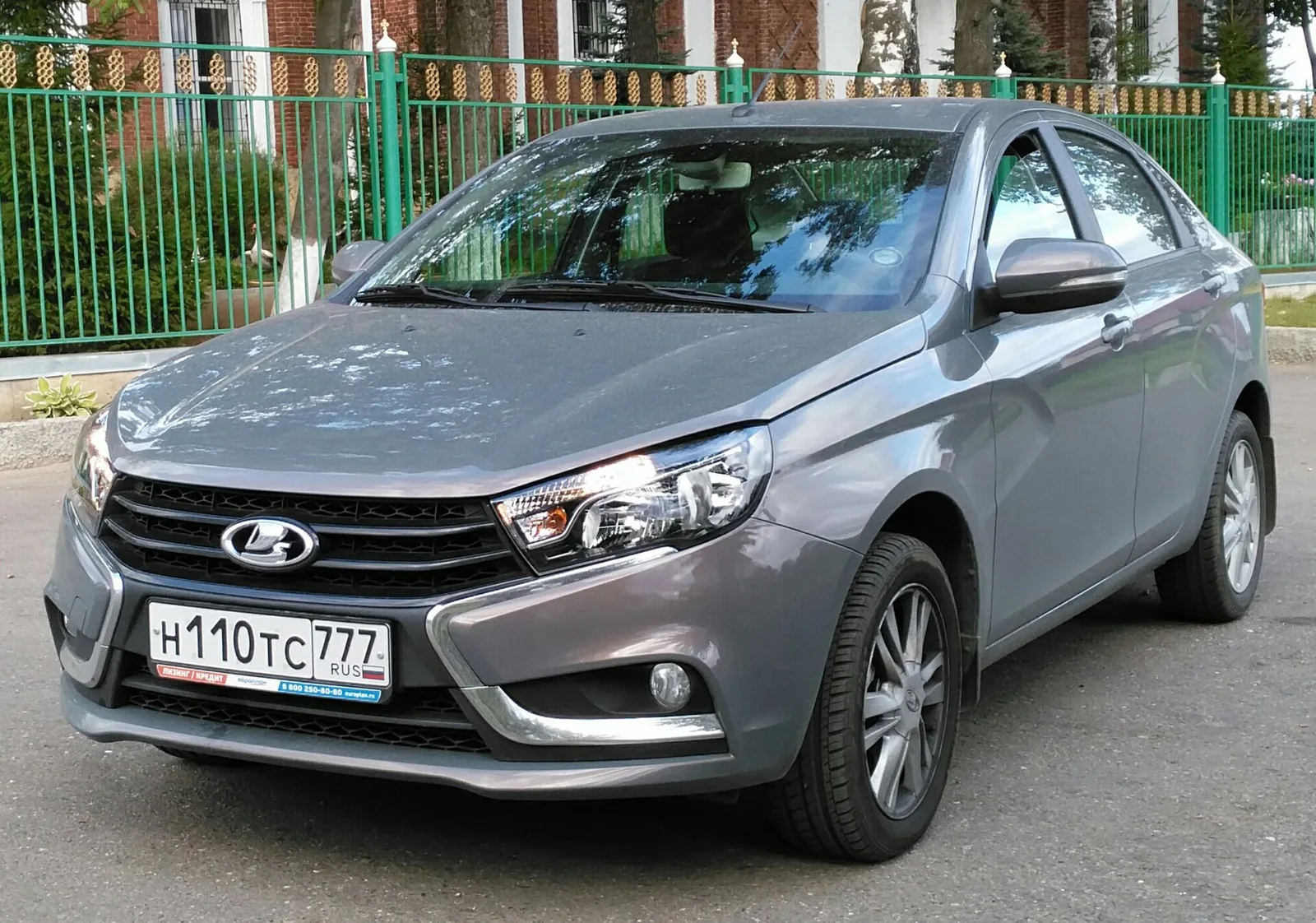
The balance then shifted. Russian-branded vehicles fell to a 34% market share in 2010 and 21% in 2012, while foreign brands built in Russia reached 45% in 2012. Imports made up 27% of cars and 46% of trucks in 2014, the year of another economic crisis. By 2016 Russia had 40,629,200 cars on its roads, 34.6% of them Ladas, down from 41.6% five years earlier. Almost half were over ten years old, and the classic Lada Riva was still the most popular model.
Where Russia's car market stands now
Automotive production directly employs around 600,000 people, about 1% of the workforce. Russia built 1,767,674 vehicles in 2018, 13th among car-producing nations and 1.8% of world output. AvtoVAZ and GAZ are the main local makers of light vehicles and KamAZ leads in heavy ones, and eleven foreign carmakers have production operations or plants in Russia.
Chinese brands have made the biggest gains. Chery shows the best dynamics, with Haval and Geely also gaining popularity, and international sanctions led to a rapid rise in the Chinese share. Following the Russian invasion of Ukraine, sales and production fell sharply, with only around 4000 cars produced in May 2022. In 2025, 57.2% of all cars sold in Russia came from Chinese brands, up from 6.9% in 2021, with Russian brands at 30.7%.