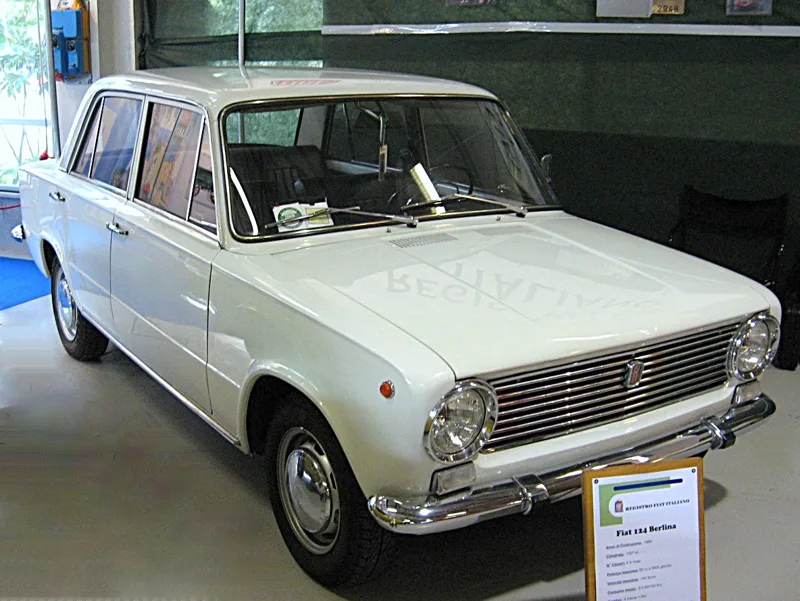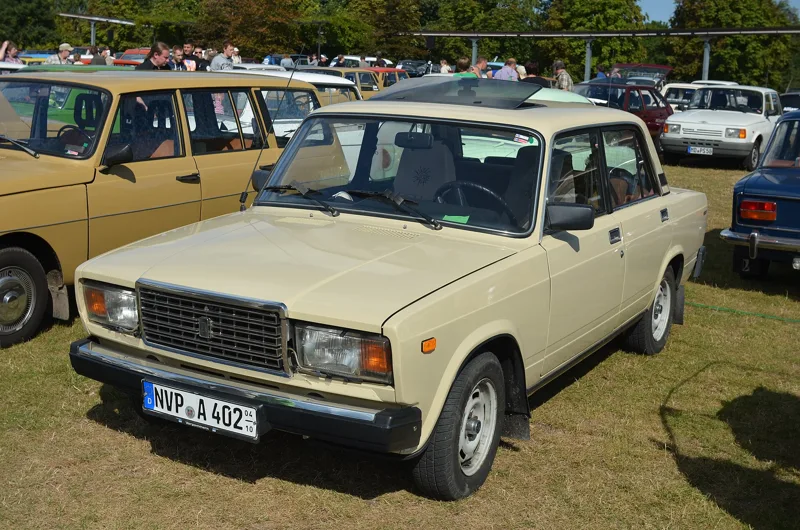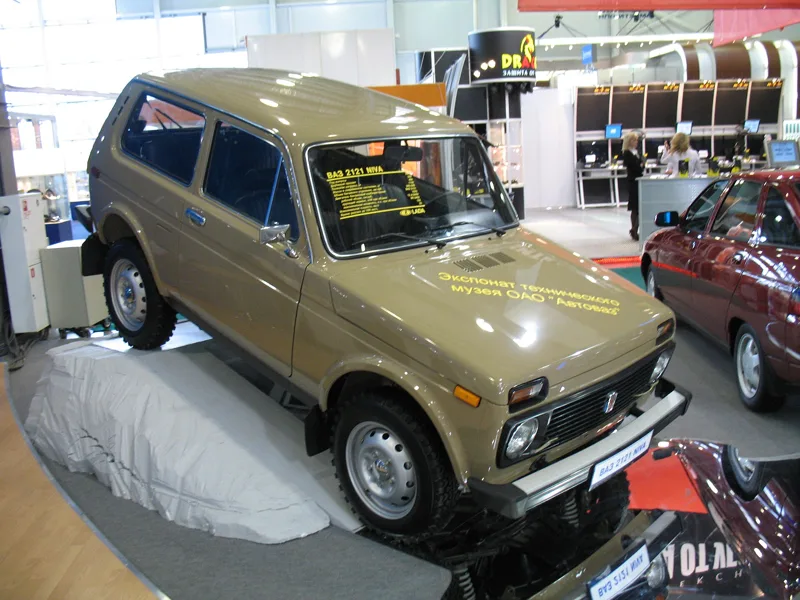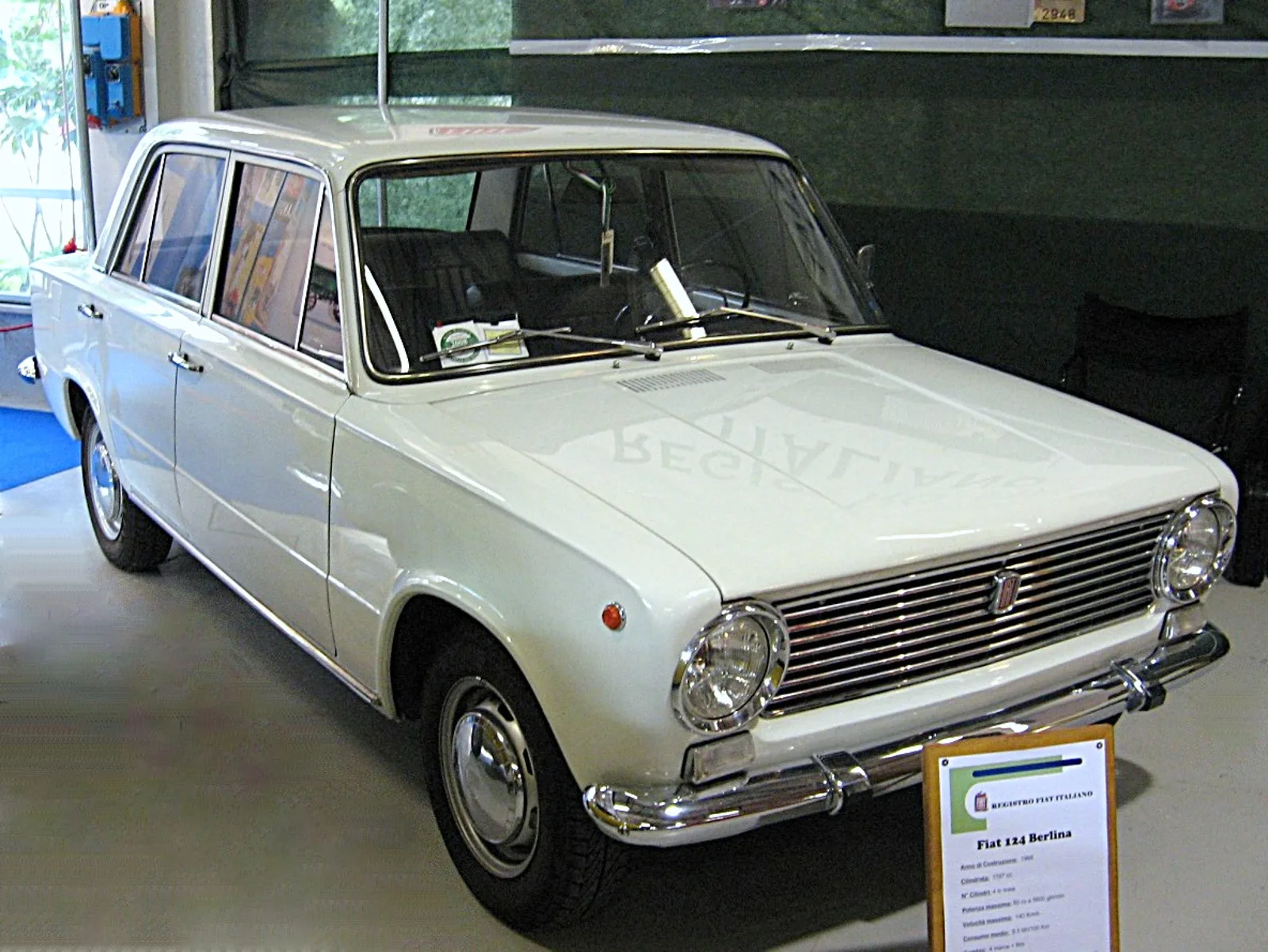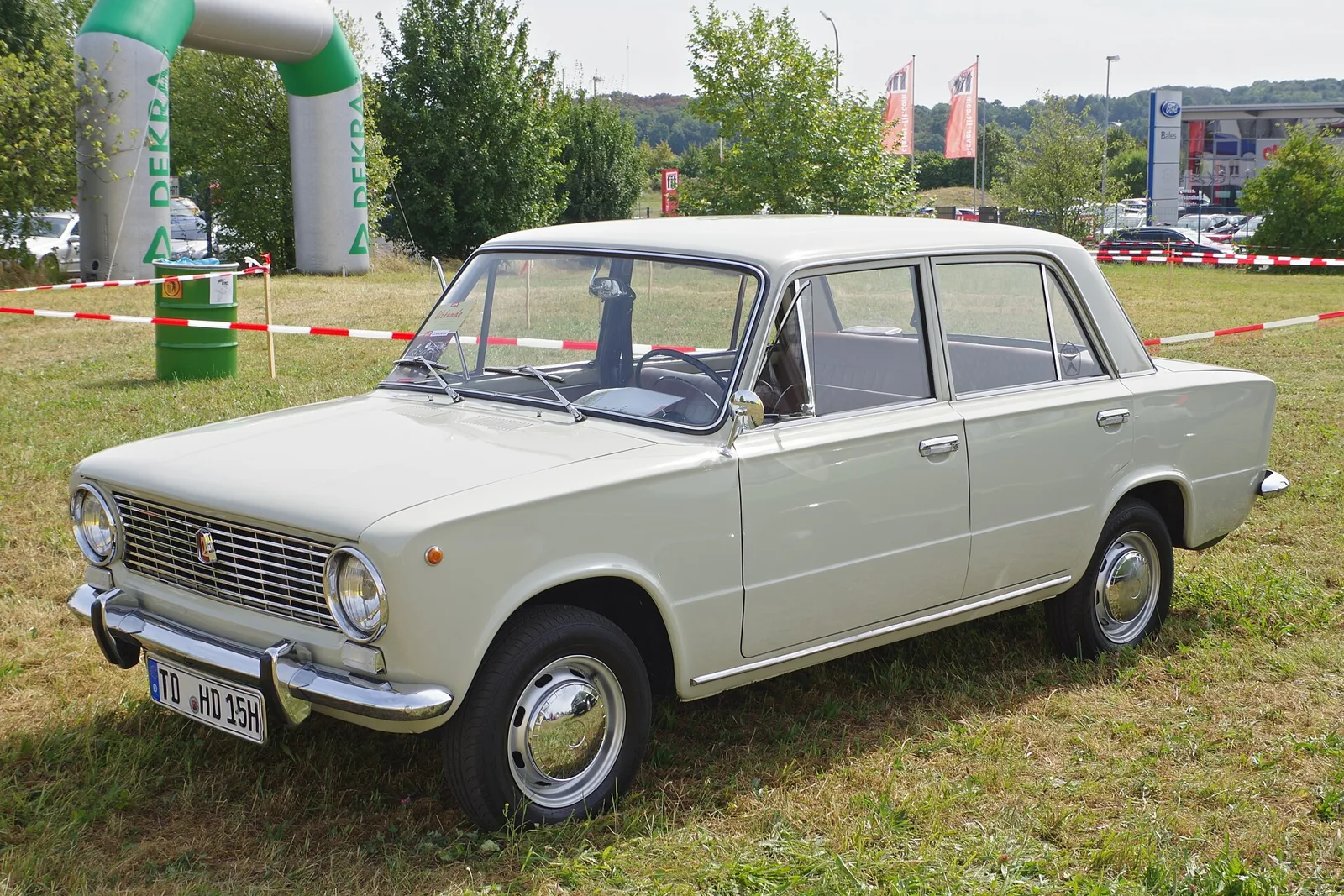
Built under licence from Fiat and toughened for Russian roads, the VAZ-2101 Zhiguli launched AvtoVAZ's export story and sold for more than two decades.
The Lada VAZ-2101 was a compact Soviet saloon built by AvtoVAZ from 1970, based on the Fiat 124 but heavily modified for rough roads. It was sold across the Soviet bloc and exported to the West as the Lada, reaching Britain in 1974 at GBP 979.
Known in Russia as the Zhiguli and nicknamed Kopeyka, the VAZ-2101 was the first car AvtoVAZ ever produced. Its story is one of a Fiat design reshaped for harsh winters and rough roads, then sold to the world as a bargain.
How did the Fiat 124 become the VAZ-2101?
AvtoVAZ built the car under licence from Fiat, using the Italian 124 as its starting point. Soviet engineers then adapted the design for rough Russian roads and cold winters, changing enough of it that the result was a different car in most respects.
Inside Fiat the Russian version carried the internal code 124R, with the R standing for Russian. Some of the improvements that VAZ engineers developed with their Italian counterparts later found their way back into the 124 itself.
The licence set firm limits. The Soviet car could not be sold in Italy, which protected Fiat's home market, and exports were also restricted in ways that kept the two cars apart.
The wagon version, the VAZ-2102, was based on the Fiat 124 Familiare and gave the family a practical estate option. It shared most of its mechanical parts with the saloon.
A Fiat design rebuilt for Russian winters, then sold abroad under a new name that became a brand in its own right.
What changes made it suit Soviet roads?
Engineers made around 800 modifications compared with the Fiat 124, including thicker steel in the bodyshell, rear drum brakes in place of discs and a raised suspension. The car weighed 945 kg (2,083 lb), about 90 kg (200 lb) more than the Fiat.
Durability testing revealed cracking, so the bodyshell was reinforced in key chassis areas with thicker steel. The suspension was raised to clear rough roads, and its soft settings gave a comfortable ride on gravel.
Early cars carried a starting handle for cranking the engine if the battery went flat in cold conditions, and a manual auxiliary fuel pump helped with winter starts. The starting handle was later dropped, but the fuel pump remained a useful feature for buyers in cold regions.
The rear end stayed deliberately simple. Rear-wheel drive with a live rear axle kept the mechanicals cheap to make and easy to repair, which mattered in a country where spare parts were often hard to find.
What engine did the VAZ-2101 use?
The VAZ-2101 used a 1,198 cc inline four with two valves per cylinder and a single overhead camshaft. The engine produced 60 PS (44 kW; 59 hp) and was designed by NAMI, a Soviet research institute, rather than by Fiat.
The overhead camshaft layout was a modern choice that Fiat never used on this car. It gave the engine a sound basis, even though the car itself was built around simple and proven parts elsewhere.
Performance was modest. The car reached 140 km/h (87 mph) at the top and needed about 20 seconds to get from rest to 100 km/h.
The engine had a known weakness. The crankshaft wore too quickly, and around 1980 replacement parts were out of stock for a while before supply recovered.
Coolant was another first for the country. Tosol A40 was developed as Russia's first anti-freeze, and Fiat had insisted that a nationwide network of service stations be established as part of the agreement.
How quickly did the car sell?
The first year brought 22,000 cars, and capacity reached 660,000 a year by 1973. One million sales were recorded on 21 December 1973, and the total passed one and a half million in 1974.
Demand always outstripped the output of the Togliatti plant. Buyers waited years for a car, and the waiting list stretched to a year by 1980 before the situation eased.
The VAZ-2101 was built virtually unaltered from 1970 until 1982, while the upgraded 21013 continued until 1988 for the domestic market. The 21013 carried the exterior and dashboard changes of the 21011, and it was exported as the Lada 1200S with the same 1,198 cc engine.
The estate, the VAZ-2102, passed 660,000 built by 1986. Its production began on 27 April 1972, and it became a familiar sight on Soviet roads alongside the saloon.
How did the car reach export markets?
Exports began on 21 February 1971, when cars went to Yugoslavia. Sales to Western Europe followed in autumn 1971, and the car was exported under the Lada name for over two decades.
The name Lada was chosen in September 1971 after a contest in a Soviet motoring magazine drew 1,812 entries. Lada means harmony in Russian, and the early export models were sold under the Lada 1200 badge.
Angola took its first one thousand Ladas in 1977 and became a significant buyer. Cuba had been a customer since 1971, and Canada followed in 1978, while the car was never offered in the United States.
In Britain the car went on sale in May 1974, and it was the first Lada to reach the UK. It remained on sale until the Riva arrived in 1983.
What were the VAZ-2101 variants?
The main variants were the VAZ-21011 with a 1,294 cc engine, the right-hand-drive VAZ-21012 for Japan, Australia and Britain, and the VAZ-21013 with the original 1,198 cc engine. The family also included the VAZ-2103 with four headlights.
The 21011, built from 1974 to 1981, used a 67 hp (50 kW; 68 PS) engine. It was identified by flat front indicator lenses and a revised dashboard.
The estate VAZ-2102, also sold as the Lada 1200 Combi, ran from 1971 to 1986. Its wagon body gave buyers the practicality of the Fiat original with the added durability of the Soviet changes.
A police special, the VAZ-21016, used a 1,452 cc engine in the 21011 body, and it was reserved for the authorities rather than sold to the public.
Did the VAZ-2101 have rotary-engined versions?
Yes, but only for Soviet security services. The VAZ-21018 used a one-rotor Wankel engine producing 70 hp (52 kW; 71 PS), and 250 were built. The later VAZ-21019 Arkan used a two-rotor unit giving 120 hp (89 kW).
Durability proved an issue for the rotary engine, which wore out at around 20,000 km (12,000 mi) in service. The engineering was interesting, but reliability held the rotary models back from wider use.
No motorsport programme is recorded for the VAZ-2101, so its reputation rests on everyday use and export success rather than on competition results.
How is the car remembered today?
The VAZ-2101 is remembered as the car that brought mass motoring to the Soviet Union and then to the West. Its no-frills character and low running costs made it a budget favourite in several export markets, and few cars travelled so far from their origins.
Its story also reads as a case study in licensing, adaptation and export. A Fiat design was rebuilt for conditions its creators never faced, then sold abroad under a new name that became a brand in its own right.
Raul Castro drove a Lada saloon to work until 2006, a detail that shows how long some examples stayed in service. Lada became a real hit across the Soviet Union, and the brand's export network carried the car for over two decades.
The model was replaced in the West in the early 1980s by the VAZ-2105 family, but domestic production continued until 1988.
How did the car handle on Soviet roads?
The soft suspension suited rough gravel roads, and the raised ride height helped the car clear ruts and potholes that would stop a lower saloon. The handling was never sporting, but it was predictable, which mattered more to most drivers.
The layout was simple and sturdy. The car's weight of 945 kg (2,083 lb) gave it a planted feel on gravel, though it also made the 60 PS (44 kW; 59 hp) engine feel stretched on hills.
Compared with the Fiat, the Soviet car gave up some agility in exchange for ground clearance and durability. For many owners on poor roads, that was the right trade.
What cold-weather features did the car have?
The car was designed for winters in which the battery could fail in the cold. Early cars therefore included a crank handle that could turn the engine by hand if the battery went flat, a feature later dropped as batteries improved.
A manual auxiliary fuel pump gave owners a way to prime the engine before a cold start. The combination of a starting handle and a manual pump showed how much the designers expected owners to need help in extreme weather.
Cold conditions also shaped how the car was built. Engineers raised the suspension and used thicker steel, and buyers in Siberia relied on these features to keep the car on the road through long winters.
What was the right-hand drive version?
The VAZ-21012 was built with right-hand drive for Japan, Australia and Britain. That version gave Lada a foothold in markets where the driver sits on the right, and Britain proved an important destination for it.
The right-hand drive car used the same basic chassis and 1,198 cc engine as the standard saloon. Its export success helped establish Lada as a budget brand in several countries, and the British market in particular responded strongly to the low price.
Buyers in these markets valued the simple layout and low price, which set the car apart from more expensive European rivals.
What are the VAZ-2101 specifications?
The table gathers the core figures for the original VAZ-2101 with its 1,198 cc engine, plus the UK launch price and early production numbers. Metric figures come first, and imperial values appear in brackets where they are known. Figures reflect the 1970 to 1982 build.
| Specification | Detail |
|---|---|
| Engine | 1,198 cc (73.1 cu in) inline four |
| Valvetrain | Two valves per cylinder, single overhead camshaft |
| Output | 60 PS (44 kW; 59 hp) |
| Kerb weight | 945 kg (2,083 lb) |
| Top speed | 140 km/h (87 mph) |
| 0-100 km/h | About 20 seconds |
| Drive | Rear-wheel drive, live rear axle |
| Rear brakes | Drums, replacing the Fiat discs |
| First-year output | 22,000 cars |
| UK launch | May 1974 at GBP 979 |
| Export start | 21 February 1971, Yugoslavia |
| Estate version | VAZ-2102, 1971 to 1986 |
Frequently asked questions
Was the Lada the same as the Fiat 124?
No. The two cars shared an origin, but the Lada had a different engine, thicker steel and rear drum brakes. The Fiat had won the 1967 European Car of the Year, and the Lada was built to survive far harsher roads.
What did the GBP 979 price buy?
The price bought a basic saloon with a 1,198 cc engine and few extras. It was positioned as a budget car with no frills, which suited buyers who valued low running costs above comfort.
Why did the crankshaft wear out?
The crankshaft was prone to wear, and replacement parts were in short supply for a time around 1980. The problem was eventually resolved, though it hurt the car's reputation in the early years of its sale.
What were the police versions?
The VAZ-21016 used a 1,452 cc engine in a 21011 body, while the VAZ-21018 and VAZ-21019 used rotary engines. Only 250 of the 21018 were built, and the programme was never intended for public sale.