A 1933 Leningrad experiment: six Buick-based cars, a test run to Moscow and a sudden halt that handed the design on to ZIS.
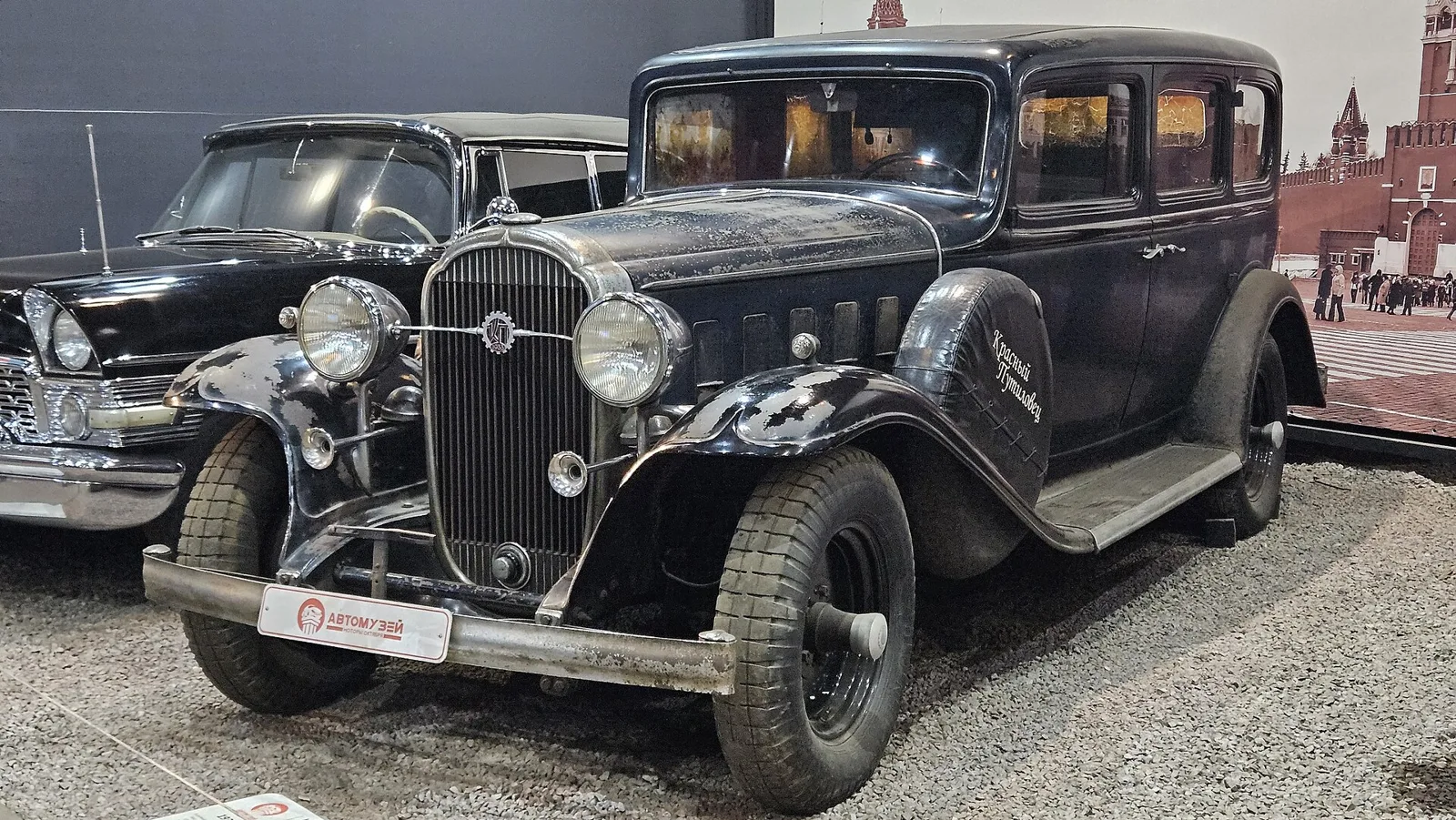
The L-1, or Legkovoy-Pervyy, was a Soviet experimental car. Six were produced in 1933 at the Krasny Putilovets works in Leningrad, and it was based on the 1932 American Buick 32-90; its design passed to ZIS, which used it as the starting point for the ZIS-101.
The L-1 began with a single American model, a Buick bought for study. It was built in six examples in 1933, mastering its production was counted a victory for Soviet industry, and its test run to Moscow ended in a triumphant welcome home before the programme was dropped for reasons that are still disputed.
Why did the Soviet Union need a heavy-type car?
By the early 1930s the GAZ-A covered the middle class, but there was a pressing need for a heavy-type car. It needed a strong chassis, a roomy body and a powerful engine, and it was used for representation and service duties, with ambulances built on the same chassis.
Many specialists thought this type of car the best fit for domestic road and operating conditions, provided it had enough strength, ease of repair and cross-country ability. It also needed a powerful engine for high speeds on highways, a traction reserve for difficult roads and a range large enough for long journeys.
Until then the state met the need by buying foreign models from Mercedes-Benz, Steyr, Buick, Packard and Lincoln. Buying, servicing and repairing them was expensive for the state.
The Krasny Putilovets plant offered a route. Its outdated Fordson tractor line had been stopped, freeing large floor space. Technical director Mikhail Ter-Asaturov, backed by a team of engineers and plant director Karl Ots, proposed a high-class car for that space.
Six Buick-based cars, one test run to Moscow, and a programme that stopped for reasons still argued over.
Choosing the Buick 32-90
The chosen model was the 1932 Buick 32-90 with a seven-passenger sedan body. The 32 meant the model year and the 90 the Series 90 range. In American terms it sat in the upper-middle class, above most makes but below Cadillac and Packard, and it combined a high technical level with a reasonable fit to Soviet roads.
The idea won backing from VATO, a forerunner of the automobile commissariat, and from the People's Commissariat of Heavy Industry, to which the plant reported directly. The official aim was a trial batch of "Soviet Buicks", the name the press used openly, by 1 May 1933.
Two Buicks were purchased in America: one was used to take drawings of every part and to pick the materials. LenGiproVATO, with Professor Leonid Klimenko, one of its founders, helped finalise the prototype and the production papers. In October 1932 a team called Avtokrasnoputilproekt, drawn from the plant and LenGiproVATO, was formed.
How hard was it to build the Soviet Buick?
Mastering it was difficult. Even a diaphragm fuel pump was an unfamiliar, complex part for Soviet industry, and the GAZ-A still fed fuel by gravity. The Buick, by contrast, used automatics and servo drives throughout.
The engine was a very advanced overhead-valve unit for its time, fed by twin carburettors with automatic air control. A semi-automatic clutch worked from inlet-manifold vacuum, and a thermostat opened and shut the radiator shutters on the sides of the bonnet.
The lever-arm shock absorbers could be stiffened or softened from the driver's seat to suit the number of passengers and the road surface. Mastering that production was treated as a matter of pride and a major victory for Soviet industry.
From first chassis to the May Day parade
Assembly began in March 1933, with every component produced domestically by Soviet factories. On 24 April the first chassis was delivered, and by the May Day demonstration six fully assembled cars had appeared. They carried the L-1 name, which was read as Legkovoy-Pervyy, a label meant only as a stopgap.
On 19 May the cars made the round trip to Moscow. The trip was combined with an inspection by G. K. Ordzhonikidze, the heavy-industry commissar, who was broadly pleased and set the plant the task of building 2 thousand cars the following year. Management hoped for a far larger order, with around 20 thousand cars annually after full ramp-up.
Why was L-1 production halted?
Work at Krasny Putilovets was stopped suddenly, and the reasons are disputed. Several explanations circulate, but most are considered legendary. The press of the time and later publications are the main evidence against the more dramatic versions, and the cars' later use points the same way.
Some non-authoritative and anonymous post-perestroika publications claimed the Leningrad cars failed to get to Moscow or broke down on the return leg. Contemporary reports answer that claim directly.
Across the entire trip, not one of the six cars was idle for even a minute because of its engine or chassis, and on some stretches the speed reached 105 km/h (65 mph). In Moscow the cars were checked by leading specialists, all participants were given an audience with the heavy-industry commissar, and the Putilov workers toured the Kremlin.
Leningrad gave them a triumphant welcome, with a brass band at the Moscow Gates and crowds on Zagorodny Prospekt, Nevsky and Morskaya. The run report mentions no breakdowns, and the same cars went into ordinary service afterwards without complaint.
A tank link is also rejected. The claim that the car plan was dropped to make T-28 tanks at the plant ignores that the tank programme had run at Krasny Putilovets since 1932, in separate areas.
A cost argument rests on a figure of 3 million roubles in gold for converting the tractor shop, including imported machine tools. That figure does not match the currency costs in the official feasibility study and looks invented. In July 1932 Stalin did suggest waiting for domestic machine tools in a letter to Kaganovich, but the plant could hardly have launched the project without economic study and backing from Moscow.
Did the plant's economics support the project?
The figures in the Kirov plant history point to a sound economic basis. Converting the tractor shops into a works with output valued at 400 million roubles, equal to 20 thousand cars annually, was estimated at around 40 million roubles, against roughly 150 million for a new factory.
More than 80% of the tractor department's machine-assembly equipment, along with the blank-making shops, could be adapted to car production. Imported equipment was to cost no more than 6 million roubles, and the calculations suggested that currency outlay would come back within months of building 2 thousand cars.
Pilot-batch shortages forced improvisation. Of the 5,450 parts and elements, some had to be made by makeshift means. The bodies were hand-made by wagon-shop craftsmen, while the American Buick body was made on proper equipment with costly dies. The American engineer attached to the plant, Kharl, first laughed at the wagon-builders, then advised the director to wait for the dies rather than waste money and energy.
A different account credits ZIS. Mikhail Kosinsky of LenGiproVATO, an interested party, said that ZIS director I. A. Likhachev, close to the top of the industry and the state, persuaded Stalin to give the representative car to his plant, promising that ZIS could supply everything needed.
The hand-over to ZIS and the ZIS-101
Two weeks after the run, all the design documentation, two L-1 cars and the disassembled Buicks went to ZIS. Its engineers again took the Buick as a starting point and produced a design of their own, the ZIS-101.
To justify a minimum economic scale for big cars, the ZIS-101 was also to be built in ambulance and taxi versions.
The other L-1 cars went to various Leningrad institutions, and in autumn 1933 four of them were shipped to the Mongolian People's Republic, presented as a gift of labour.
A rival heavy staff car, the NAMI-Staff, was developed at NAMI at the same time for the Red Army's Military-Technical Directorate and Glavmashstroy. With no production capacity available, it was never built.
Does any L-1 survive today?
None of the L-1 cars survives. The Buick 32-90 that inspired it is on display at the UGMK Museum Complex in Verkhnyaya Pyshma.