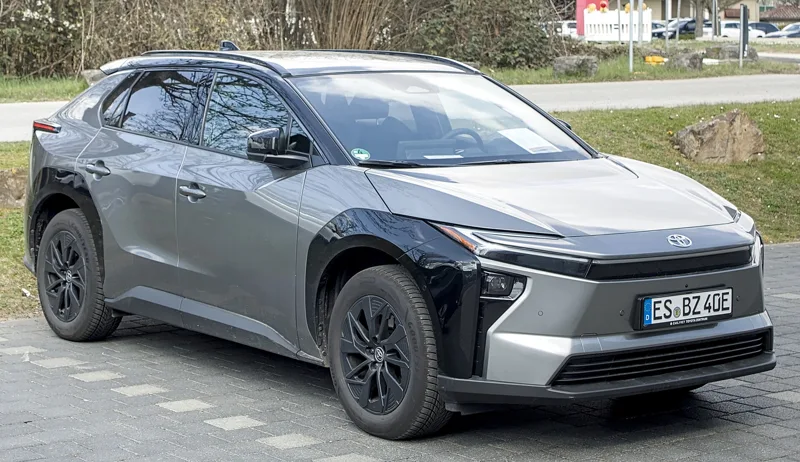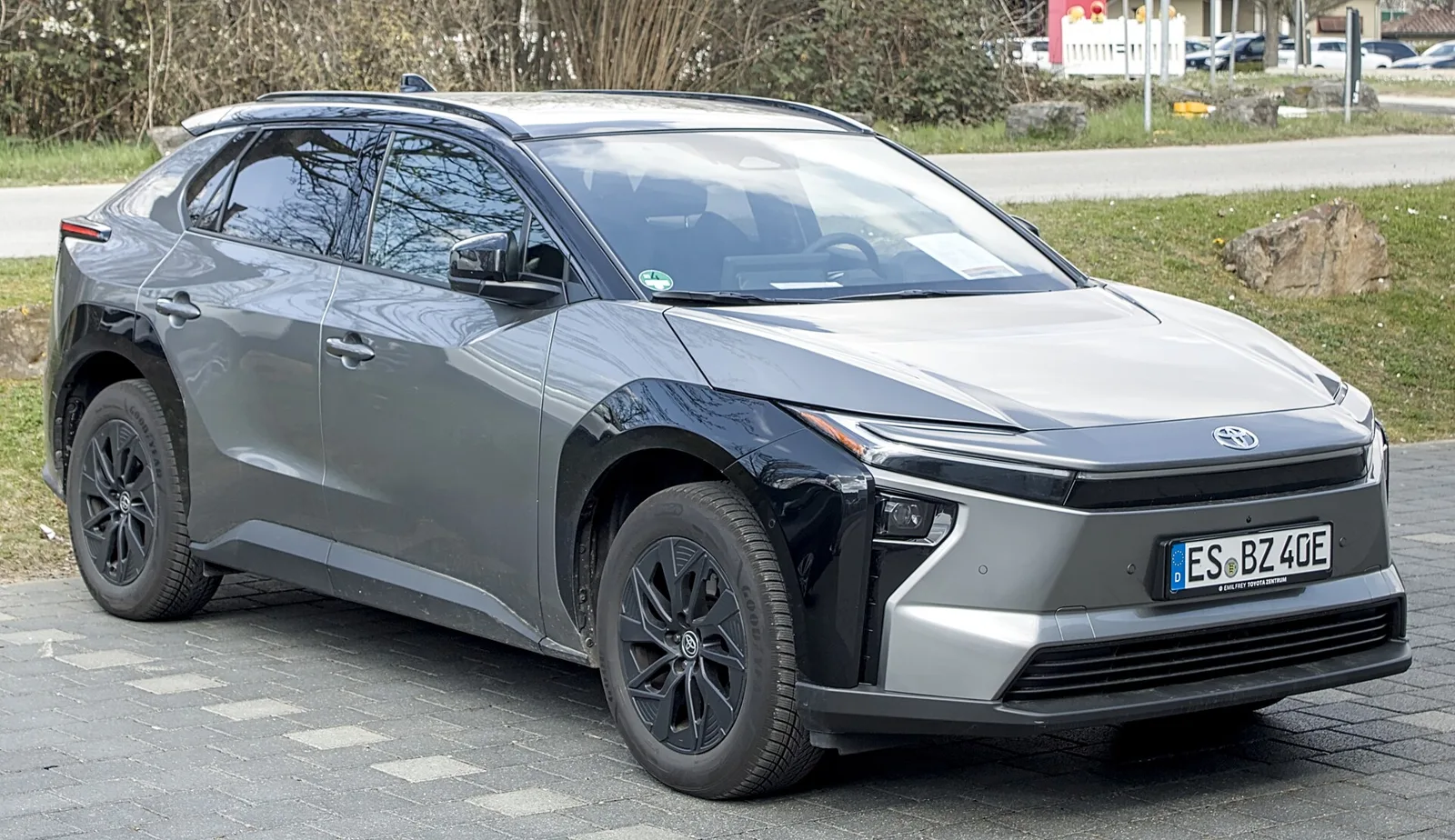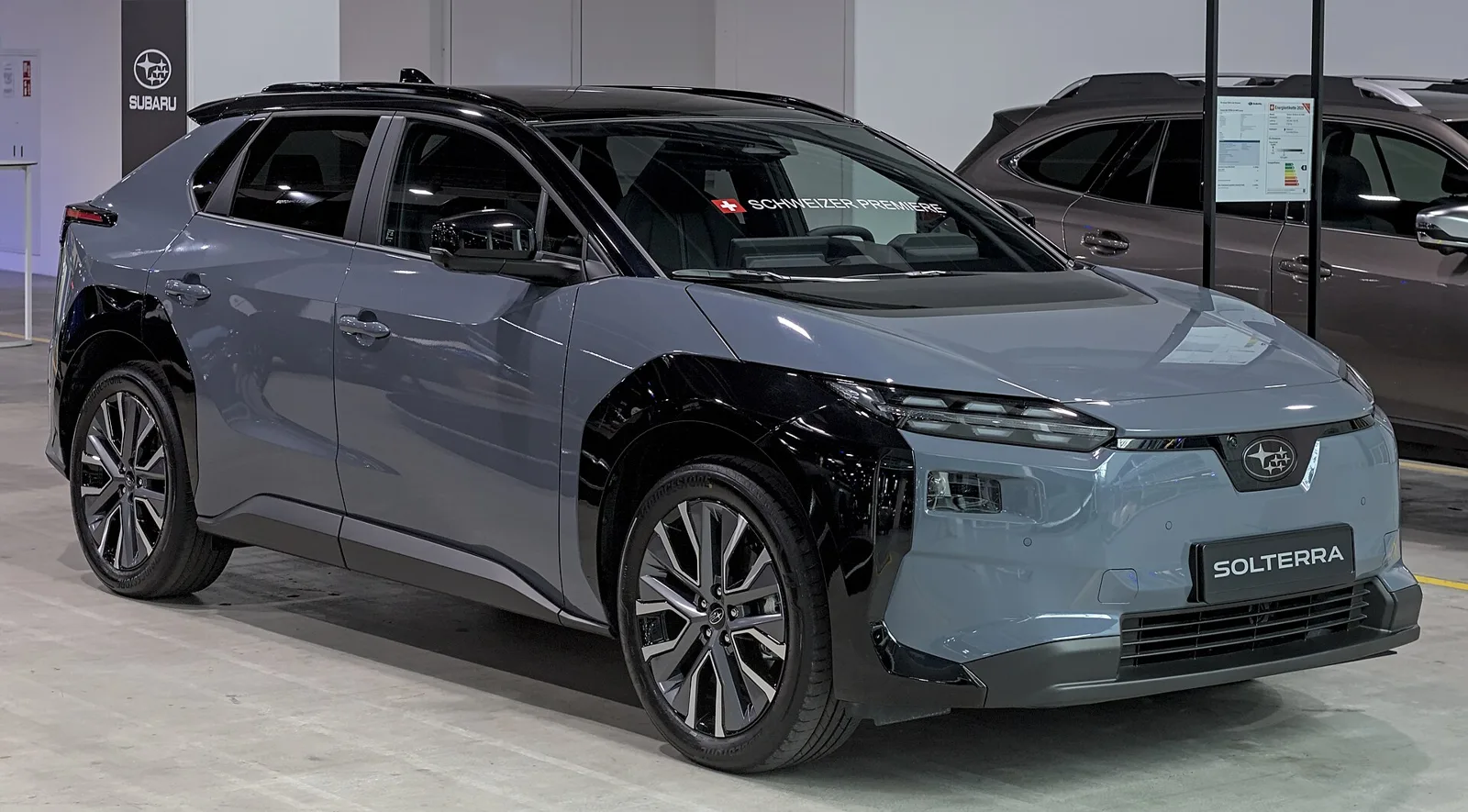
A compact battery-electric SUV built on the jointly developed e-TNGA platform, sold as the Toyota bZ and the Subaru Solterra, with a charging rethink in 2025.
Toyota's bZ4X is a compact battery-electric SUV that Subaru also sells as the Solterra. Built on the e-TNGA platform, it appeared as a concept in 2021 and reached buyers worldwide from 2022. A 2025 refresh improved charging and added a larger battery and more power.
The Toyota bZ4X is a battery-electric compact crossover SUV that Toyota built with Subaru on the jointly developed e-TNGA platform. Subaru sells the same vehicle as the Subaru Solterra, while Toyota markets it simply as the Toyota bZ in North America and Ireland from 2025. The car was revealed as a concept in April 2021 and went on sale worldwide from mid-2022.
What is the Toyota bZ4X?
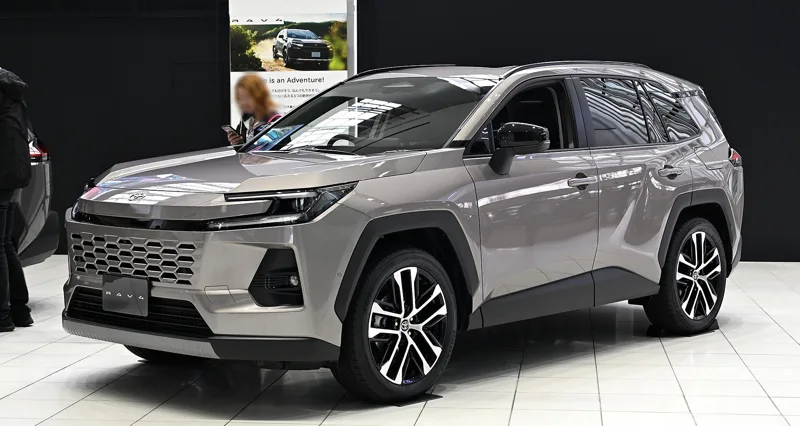
The bZ4X is a compact SUV in the same size band as the RAV4, but with a sharper look and a longer wheelbase that matches the larger Highlander. It is the first vehicle to use the e-TNGA platform, and the first model in Toyota's bZ, or beyond Zero, range of zero-emissions vehicles. Toyota's name breaks down into beyond Zero emissions, the RAV4 comparison and the crossover body.
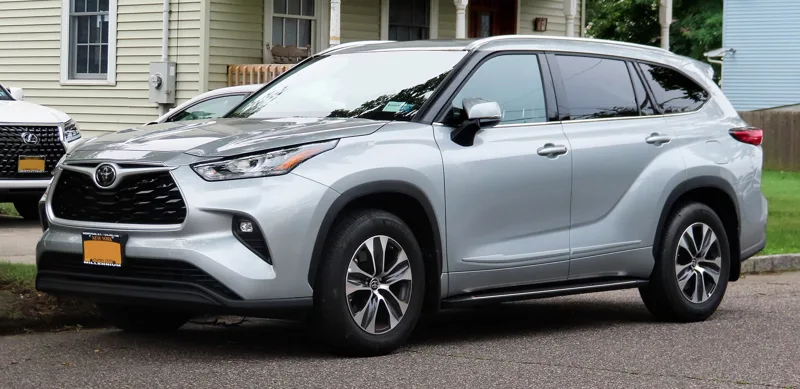
The Subaru version shares the same mechanical core, but it carries its own badge, front end and interior details. Lexus also offers a sibling model called the RZ, so the platform reaches three brands.
A compact electric SUV built with Subaru on the shared e-TNGA platform, sold as the Toyota bZ and the Subaru Solterra.
Where did the bZ4X come from?
Toyota previewed the design in June 2019 with a series of electric concept vehicles, and it said it planned to release six electric models between 2020 and 2025 on the e-TNGA platform. Subaru showed a similar concept in January 2020, and the two companies developed the car together.
The bZ4X Concept was revealed on 19 April 2021 and shown at Auto Shanghai the same day. Although it was presented as a concept, it looked close to production-ready. Subaru had a hand in the all-wheel-drive system and the car's collision safety, while Toyota handled much of the battery and electric axle development.
Why did Toyota and Subaru share the platform?
The two companies split the work along their strengths. Toyota took the lead on battery and electric axle development, while Subaru worked on the all-wheel-drive control and collision safety. That shared division produced a vehicle that carries two badges but was designed as one project.
The e-TNGA platform was the first to be used by the bZ series, and the bZ4X became the brand's first model in that line. Toyota had originally planned seven bZ models by 2025, a goal that it fell far short of before moving away from the naming in 2025.
How is the bZ4X built and sized?
The bZ4X is 4,690 mm (185 in) long, which is comparable to the RAV4 (XA50). Its wheelbase of 2,850 mm (112 in) is similar to the Land Cruiser (J300), which gives the cabin a large interior for a compact car. The platform's joint development meant each company took the parts it knew best.
Some markets offer an optional steer-by-wire system with a yoke in place of a conventional steering wheel. The system was developed for the Chinese market, and Toyota said the yoke creates a more open interior when combined with the low instrument panel.
What powertrain and range does the bZ4X have?
The bZ4X uses an e-Axle that combines the electric motor, gears and inverter. It is built by BluE Nexus, a joint venture of Aisin and Denso with investment from Toyota. Front-wheel-drive models use a single 1XM e-Axle rated at 150 kW (201 hp; 204 PS), while all-wheel-drive models use two 1YM units of 80 kW (107 hp; 109 PS) each, for a combined 160 kW (215 hp; 218 PS).
Front-wheel-drive models have an estimated range of 510 km (317 miles) and reach 100 km/h in 7.5 seconds. All-wheel-drive models manage 460 km (286 miles) and 6.9 seconds to 100 km/h. The AWD versions use the X-MODE system sourced from the Subaru Forester.
The front-wheel-drive models use a 71.4 kWh battery supplied by Prime Planet Energy and Solutions, while the North American AWD models use a 72.8 kWh pack from CATL. Both battery types run at 355 volts and are expected to keep 90 percent of their capacity over ten years.
A roof-mounted solar panel is available as an option, adding roughly 1,800 km (1,100 miles) of range a year. The car was originally expected to offer bidirectional charging, but as of July 2025 that function had not been enabled on the 2023, 2024 and 2025 models.
How fast does the bZ4X charge?
DC fast charging was the car's weakest point at launch. The PPES battery could reach 80 percent in about 30 minutes, but AWD models with the CATL battery could take up to an hour to charge from 0 to 80 percent. Those cars were also limited to three fast-charging sessions per day, which drew strong criticism.
The 2025 refresh changed that picture. Toyota improved the charging curve and added a battery pre-conditioning feature, which warms the pack before a charge. Charging still peaks at 150 kW, which is behind some rivals and on par with others, but the 10 to 80 percent charge now takes about 30 minutes.
What changed with the 2025 refresh?
In May 2025 Toyota announced a mid-cycle refresh aimed at the outgoing model's criticisms. The North American and Irish cars were renamed from bZ4X to simply bZ. The onboard AC charger rose from a 7.6 kW unit to 11 kW, which improved Level 2 charging.
North American cars adopted the North American Charging Standard port, moved to the front right side of the car, and gained Plug and Charge. Those changes improved compatibility with the Tesla Supercharger network. The refresh also introduced a 74.7 kWh battery with a manufacturer-estimated range of up to 505 km (314 miles).
Power increased with silicon carbide electronics in the eAxle motors. All-wheel-drive models were uprated to a combined 338 hp (343 PS), a 50 percent increase, and they reach 60 mph in 4.9 seconds. Front-wheel-drive models rose to 221 hp (224 PS). The interior now has a 14-inch screen and physical knobs for volume and climate control.
How does the Subaru Solterra differ?
The Subaru Solterra is the rebadged version of the bZ4X. Its name comes from the Latin words for sun and earth, and its changes are minor: regenerative paddles, a squared steering wheel and a tweaked front end and rear lights. It runs on the same e-TNGA platform, which Subaru calls the e-Subaru Global Platform.
Solterra went on sale in mid-2022 in Japan, the United States, Canada, Europe and China. In Japan it is offered in ET-SS and ET-HS grades, and unlike the Toyota in Japan it can be bought outright. A Solterra STI Concept with cherry red spoilers was shown at the 2022 Tokyo Auto Salon.
The refreshed Solterra debuted at the New York show in April 2025 and arrived as a 2026 model. It brought a new nose, 25 percent more range and 233 hp (236 PS) from stronger motors, along with a 74.7 kWh battery. A new XT trim uses dual motors for a combined 338 hp (343 PS).
What are the Touring and Woodland models?
The stretched model, sold as the bZ Woodland in North America and the bZ4X Touring in Europe, dates from 15 May 2025. Subaru's own versions, the Trailseeker and the E-Outback in Europe, came out on 16 April 2025. The longer cars measure 140 mm (5.5 in) more in length and 20 mm (0.79 in) more in height, with standard roof rails and a single 74.7 kWh battery.
All-wheel-drive models add Snow and Dirt and Deep Snow and Mud modes, hill descent control and 8.3 inches (210 mm) of ground clearance, and towing is rated at 3,500 pounds (1,590 kg). The cabin has a 14-inch touchscreen with wireless Android Auto and Apple CarPlay, plus two 15W wireless chargers at the front.
The Touring and Woodland versions reached Japan on 25 February 2026, with a single Z grade in front-wheel or all-wheel drive. Japanese Trailseeker pre-orders opened on 9 April 2026 in ET-SS and ET-HS grades, with four-wheel drive only on the ET-HS.
In Singapore the Subaru E-Outback arrived on 5 May 2026 as a single all-wheel-drive version with the 74.7 kWh battery. The combustion Outback is not sold there because it does not meet Singapore's emissions standards.
Where is the bZ4X sold?
In Japan the bZ4X was launched on 12 May 2022 and offered only on lease through Kinto. The first phase accepted up to 3,000 applications, and a plan for up to 5,000 cars a year followed. The facelifted model went on sale on 9 October 2025 in Z and G grades.
In North America the car was unveiled at the 2021 Los Angeles Auto Show and went on sale in mid-2022 as a 2023 model. Buyers could claim the full US$7,500 federal tax subsidy, although each maker could sell only up to 200,000 eligible cars. The bZ4X does not qualify for Inflation Reduction Act incentives because it is made in Japan.
Europe received its first deliveries in summer 2022. In Southeast Asia the car launched in Thailand on 9 November 2022 and in Indonesia on 10 November 2022, where it later began local production. Malaysia followed on 2 April 2026, and the Philippines in December 2025. South Africa launched on 3 July 2026.
Chinese production began in October 2022 through GAC Toyota and FAW Toyota, using CATL batteries of 50.3 kWh and 66.7 kWh. Australian imports from Japan began in 2024. Fortescue, the mining company, later used the pre-facelift car as a transport vehicle with all-terrain tyres and Hi-Vis decals.
In North America the Woodland and Trailseeker are offered only as all-wheel drive, and the Woodland is sold in a single fully equipped trim. The Trailseeker has its own front fascia with redesigned headlights, and 3D SUBARU lettering at the rear. Both are rated at 420 km (260 miles), slightly less than the 459 km (285 miles) of the 2026 bZ and Solterra.
Has the bZ4X had safety problems?
On 23 June 2022 Toyota and Subaru recalled 2,700 bZ4X cars and 2,600 Solterras because wheels could come loose. Production and sales were halted until a fix was found, and on 6 October 2022 Toyota reported that production had resumed.
The car earned a five-star Euro NCAP rating in 2022, and the Solterra earned a five-star JNCAP rating from Japan's NASVA. The US Insurance Institute for Highway Safety gave the 2025 model year its Top Safety Pick+ award.
Key specifications at a glance
| Item | Figure |
|---|---|
| Length | 4,690 mm (185 in) |
| Wheelbase | 2,850 mm (112 in) |
| FWD battery | 71.4 kWh |
| 2025 refresh battery | 74.7 kWh |
| AWD range (original) | 460 km (286 miles) |
| DC charging | Up to 150 kW, about 30 minutes for 10 to 80 percent |
| AWD output (2025) | 338 hp (343 PS) |
| Platform | e-TNGA |
Is the bZ4X a success?
The bZ4X is a credible compact electric SUV that spread across many markets, and the 2025 refresh addressed its most public weakness, charging. Toyota's broader goal of seven bZ models by 2025 was missed, and the company has since moved away from the bZ naming. The Solterra gives Subaru buyers the same car with a different badge.