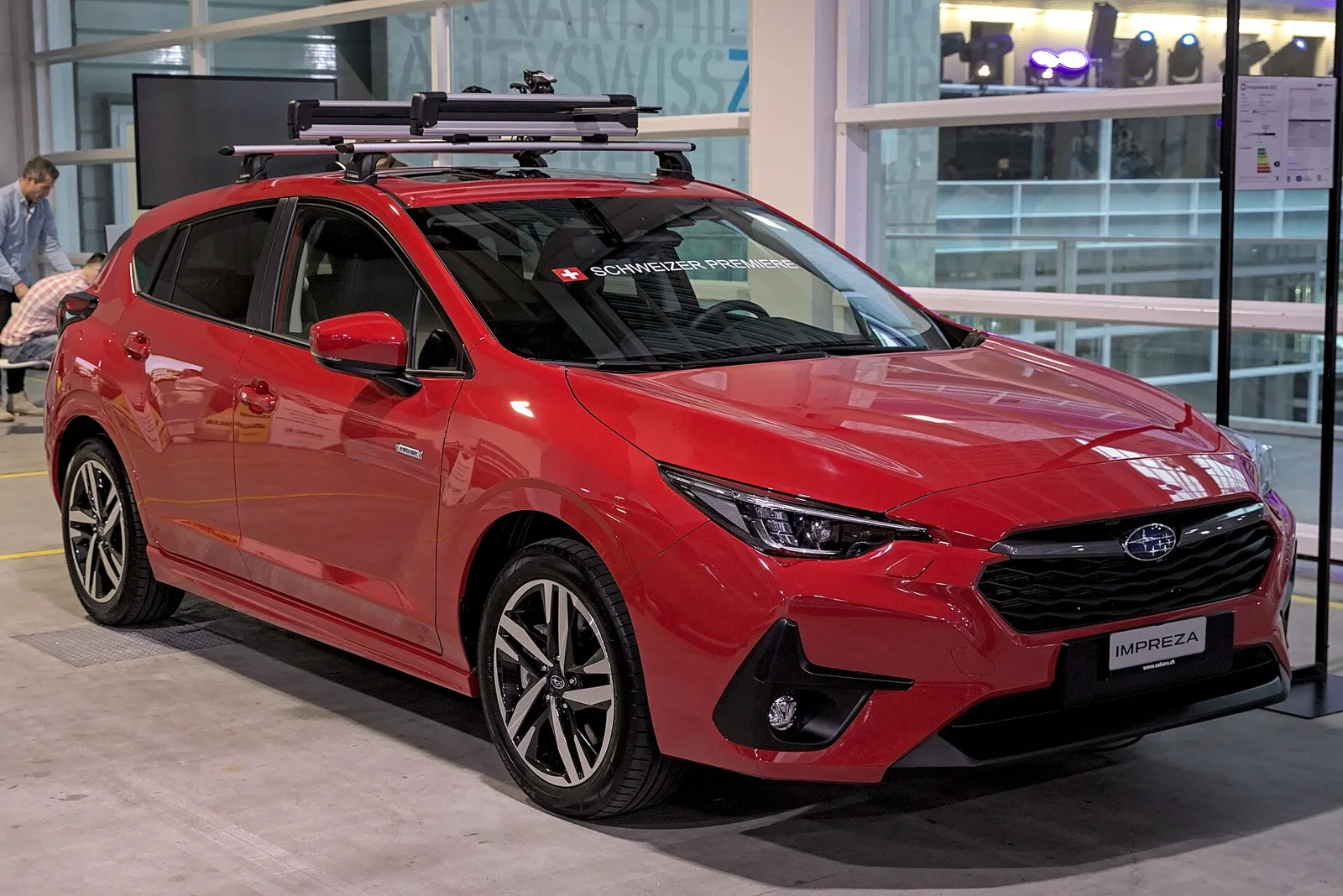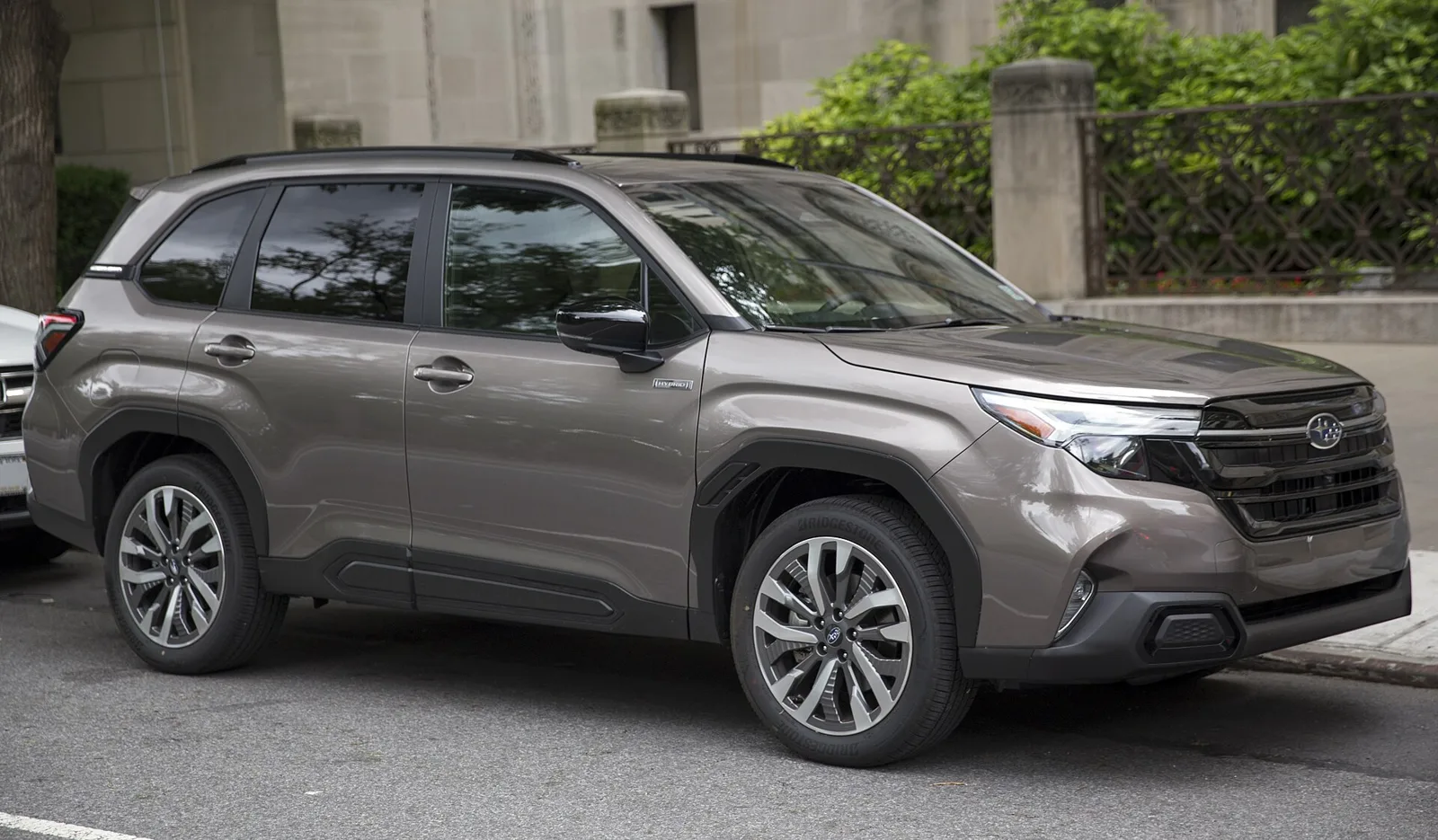
From a tall wagon built on the Impreza to a rugged, hybrid-capable SUV, the Forester has carried Subaru's all-wheel-drive reputation since 1997.
Subaru's Forester has been a compact crossover built since 1997. It began on the Impreza platform as a taller station wagon, and it became a crossover SUV from the third generation. Performance versions, hybrids and the Wilderness off-road model have followed.
The Subaru Forester is a compact crossover SUV that Subaru has made since 1997. It began life on the Impreza platform, styled as a taller station wagon, and today it is a rugged family vehicle with all-wheel drive. Its performance versions, hybrids and off-road models have made it one of the brand's most important nameplates.
Across six generations the Forester moved from a wagon-like body to a true crossover. Each new generation brought larger dimensions, new engines and more safety equipment, while the core idea of a practical all-wheel-drive car stayed in place.
When did the Forester first go on sale?
The Forester was first shown as the Streega concept at the 1995 Tokyo Motor Show. It went on sale in Japan in February 1997 and reached the United States later that year as a 1998 model. Subaru marketed it with the slogan SUV tough, Car Easy, which captured its blend of rough-road ability and everyday manners.
The Forester was reportedly inspired by Volkswagen, and it was one of the first crossover SUVs on the market. In Japan it took over from the Impreza Gravel Express, although the Outback Sport remained in production for American buyers.
A tall wagon that became a crossover SUV, with all-wheel drive kept at the centre of every generation.
How did the first generation work?
The first generation used the 2.5-litre DOHC EJ25D engine borrowed from the Subaru Outback. The unit peaked at 123 kW (165 hp) at 5,600 rpm, while torque reached 220 Nm (162 lb-ft) by 4,000 rpm. The body was built in the style of a station wagon, with a taller stance and higher seating for the driver and passengers.
The car's low centre of gravity meant it met United States safety standards without a rollover warning label on the driver's visor. Its size and price placed it between the Impreza and the larger Legacy, which gave Subaru a distinct place in its own range.
How does the Forester split power between its wheels?
The automatic all-wheel-drive system normally sends 60% of the engine's torque to the front wheels, with the remaining 40% going to the rear. A computer-controlled, continuously variable, multi-plate transfer clutch manages that split as conditions change.
When the system senses a speed difference between the front and rear axles, the clutch feeds more power to the rear. In slip conditions it can reach an equal split between the two axle sets. Under acceleration or uphill, weight moves rearward and more torque goes back, while braking shifts the balance forward.
In reverse or first gear the torque is divided 50/50. Manual cars start from a split close to 50/50, with more bias towards the rear than the automatics.
What changed in the second generation?
The second generation arrived as a 2003 model, introduced at the 2002 Chicago Auto Show on the new Impreza platform. It used an aluminium hood and a hydroformed front sub-frame to save weight. The most noticeable change was the arrival of 2.5-litre engines in both naturally aspirated and turbocharged forms.
Naturally aspirated cars used the EJ253 SOHC engine. The turbocharged XT used a DOHC unit fitted with the Mitsubishi TD04 turbocharger that also powered the Impreza WRX. By 2006 the XT's compression had risen to 8.4:1, lifting its output to 230 HP and 235 ft-lbs.
Every 2.5-litre engine in this generation is an interference design, so a broken or stretched timing belt can damage the valves. Subaru set a belt change at 105,000 miles (169,000 km), and mechanics usually advise replacing the water pump and tensioner at the same time.
Did the Forester ever come as a performance car?
Yes. The Forester STi arrived in 2004, sold exclusively in Japan. It borrowed most of the running gear from the WRX STi and paired a turbocharged 2.5-litre flat-four rated at 265 PS (261 hp; 195 kW) with a stronger six-speed manual.
The STi reached 100 km/h in 5.4 seconds, and a quarter-mile run took 14.1 seconds, with the car at 97.0 mph (156.1 km/h) at the finish. Its top speed was 140 mph (230 km/h), helped by taller top gears that also made highway cruising more relaxed.
The chassis received STi sport springs, bigger anti-roll bars and a quicker steering rack. Four-piston Brembo brakes sat at the front, with two-piston units at the rear, and the car rode on 18-inch, 10-spoke alloy wheels. The cabin had dark grey cloth sport seats and a smaller leather MOMO steering wheel, with a six-speed H-pattern shift map.
What made the third generation different?
The third generation pulled the Forester away from the wagon design and towards a crossover SUV. It grew in nearly every dimension and gained a sloping roof and a bigger load area. The 2008 model year car was first shown in Japan on 25 December 2007, and the North American version followed at the Detroit show. Styling was led by Subaru's chief designer, Mamoru Ishii.
The wheelbase grew by 3.5 inches (89 mm), while length rose by 76 mm (3.0 inches), width by 46 mm (1.8 inches) and height by 110 mm (4.3 inches). Cargo space rose from 31 cu ft (0.88 m3) to 69 cu ft (2.0 m3) with the rear seats folded, and ground clearance reached 8.9 inches (230 mm).
In Europe the car was offered with a 2.0-litre petrol engine and a horizontally opposed diesel, the EE20. That diesel was later reworked in 2011 after cracks in its crankshaft appeared in cold climates.
What did the fourth generation add?
The fourth generation made its debut at the Guangzhou show in November 2012, with New York following in 2013. It brought a major revamp of interior comfort, with higher seats, an upgraded sound system and a repositioned centre console for the middle passenger.
The continuously variable transmission became the main automatic choice, and the turbocharged XT gained sport-oriented suspension, 18-inch wheels and extra chassis bracing. The car was 1.4 inches longer and 0.6 inches wider, with a wheelbase 1 inch longer, and rear cargo volume with the seats folded reached 74.7 cubic feet (2,115 L).
X-MODE arrived as an option on the higher trims. It coordinates the engine, transmission and stability control on slippery or uneven ground. Motor Trend also named the Forester its SUV of the Year in 2014.
How did the fifth generation change the Forester?
The fifth generation was presented at the New York International Auto Show on 28 March 2018. It moved to the Subaru Global Platform, which the company said offered better handling, comfort and crash protection, along with improved resistance to noise and vibration.
Interior space grew with a longer wheelbase of 2,670 mm (105.1 in), and rear legroom increased to 1,000 mm (39.4 in). Cargo space with the seats folded reached 2,155 litres (76.1 cu ft), and the tailgate opening became much wider for loading.
North American cars used the FB25 direct-injection flat-four rated 182 hp (136 kW) at 5800 rpm, paired only with the Lineartronic CVT. The e-Boxer hybrid arrived in Europe at the March 2019 Geneva show, adding an electric motor to the CVT.
What does the sixth generation offer?
The sixth generation reached North America in the second quarter of 2024 as a 2025 model. It still rides on the Subaru Global Platform, which the company says has 10% greater rigidity than before. It came in Base, Premium, Sport, Limited and Touring trims, and it kept the 2.5-litre FB25 gasoline engine. The hybrid version, the Forester Hybrid, went on sale in February 2025 with the FB25D.
The Wilderness model followed for the 2026 model year, with 9.3 in (240 mm) of ground clearance, 17-inch Wilderness alloy wheels and an upgraded X-MODE with snow, dirt, deep snow and mud settings. Its maximum towing capacity is 1,600 kg (3,500 lb), and US-market Foresters are built at Subaru of Indiana Automotive in Lafayette, Indiana.
Where else was the Forester built or sold?
The Forester travelled well beyond Japan and North America. In India, General Motors sold it as the Chevrolet Forester from 2003, which made it the first Chevrolet-badged model in that country. Sales ended in 2007, when General Motors no longer held a stake in Subaru's parent company. The Chevrolet badge was a first for India, because earlier GM models there carried Opel badges.
In China a look-alike called the Yema F99 was built from 2012 to 2014. It used a small four-cylinder engine and a five-speed manual, and it was not related to the Forester despite the strong resemblance.
In Southeast Asia, Malaysia-based Tan Chong Motor Assemblies built about 10,000 Foresters a year for Malaysia, Thailand and Indonesia. That local production began in February 2016, which helped bring the car to a wider regional audience.
How safe is the Forester?
The Forester has a strong safety record, although its results have not always been straightforward. In the 2014 model, the IIHS gave a Good rating in the small overlap front test only after changes were made for that model year, and the small overlap test had shown weaker results before then. That test, introduced by the IIHS in 2012, hits about a quarter of the front corner on the driver's side.
The 2019 model year earned the IIHS Top Safety Pick+ award, while the 2025 model year was named a Top Safety Pick. Those honours reflect how the Forester's structure and driver assistance systems have been assessed over several generations.
What are the Subaru Forester specifications?
| Generation | Years | Engine | Key change |
|---|---|---|---|
| First (SF) | 1997 | 2.5-litre EJ25D, 123 kW (165 hp) | Impreza platform, station-wagon style |
| Second (SG) | 2003 | 2.5-litre EJ253 and turbo XT | Aluminium hood, XT turbo |
| Third (SH) | 2008 | 2.0-litre EJ20 and diesel EE20 | Crossover shape, 89 mm longer wheelbase |
| Fourth (SJ) | 2013 | Two-litre and 2.5-litre petrol, CVT | X-MODE option, sport-tuned XT |
| Fifth (SK) | 2018 | FB25, 182 hp (136 kW) | Subaru Global Platform |
| Sixth (SL) | 2024 | FB25 2.5-litre, FB25D hybrid | Wilderness, 1,600 kg (3,500 lb) towing |