Pre-war styling cues on General Motors running gear, hand-built Italian bodies and a price that reached US$70,000 by 1979.
Stutz Motor Car of America built the Blackhawk III from 1973 to 1979 as a two-door luxury coupe with pre-war styling cues, General Motors running gear and hand-finished Italian bodies. Over 300 were built, and show business figures were among the buyers.
The Stutz Blackhawk III is a two-door luxury coupe that Stutz Motor Car of America offered between 1973 and 1979. Its styling looked back to the years before the Second World War, its running gear came from General Motors, and its bodies were finished by hand in Italy.
Where did the Blackhawk III come from?
Stutz was an Indianapolis maker of sports and luxury cars that existed from 1898 to 1938. For a time it competed with Duesenberg, and after financial problems it ended sports car production in 1932. The Blackhawk name had already been used by Stutz in the 1920s, and the idea of reviving the brand 30 years after it ended came from the designer Virgil Exner.
James O'Donnell, a banker from New York who lived from 26 March 1914 to 12 January 1997, was convinced of the concept in 1968. That year he founded Stutz Motor Car of America to sell a coupe that Exner had drawn. To hold down cost and effort, the firm relied on the volume-built hardware of General Motors, while the bodies were made by hand in Italy.
Pre-war styling on General Motors running gear, built by hand in Italy and priced far above a Grand Prix.
Why did the Blackhawk numbers keep changing?
The numbers marked the passing years rather than a new design. The first series became Blackhawk I in 1970, the second was Blackhawk II in 1972, and the third series, launched in 1973, began as Blackhawk III before the suffix climbed to VII in 1979.
Only the engine output changed with each emissions standard, and the tail lights were swapped from year to year. Nothing technical or stylistic changed with the new number. From 1980 a fourth series, called Blackhawk VIII, carried on the same design, and differences came mainly from fitting the Exner styling to each base vehicle.
Why did Virgil Exner design revival cars?
Exner's revival cars were modern bodies that carried classic styling from pre-war marques. He had styled several Chrysler models in the 1950s, left the group in 1961, and then worked as a freelance designer. Most of his designs for Bugatti, Duesenberg and other makes never went beyond drawings.
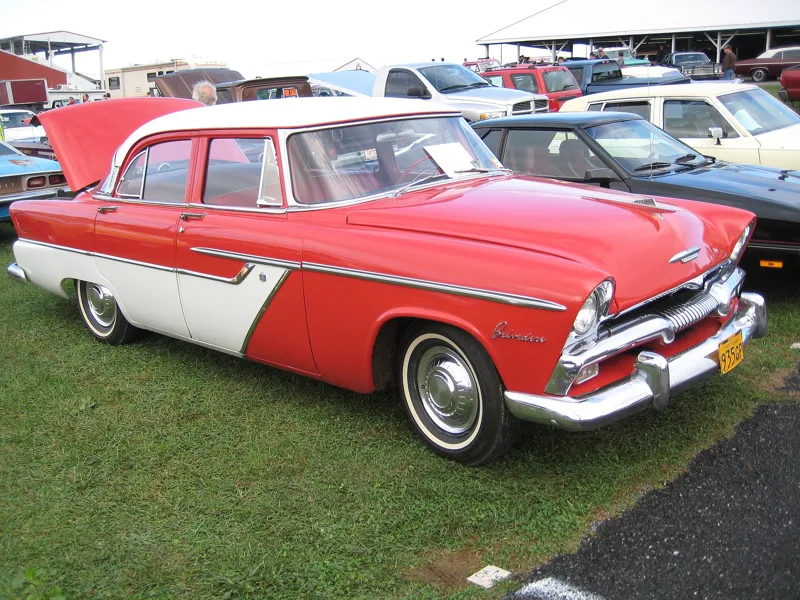
Earlier, his progressive Chrysler work had included the Forward Look of 1955. His 1961 Imperial, however, carried freestanding headlights and stylized wings, and it was not a success. His revival designs covered Bugatti, Duesenberg, Mercer, Packard and Pierce-Arrow. Ghia built one Bugatti design on a Type 101 chassis in 1965, and a four-door Duesenberg saloon was made as a one-off in 1966, called the Model D. Series production of the Model D failed for lack of finance.
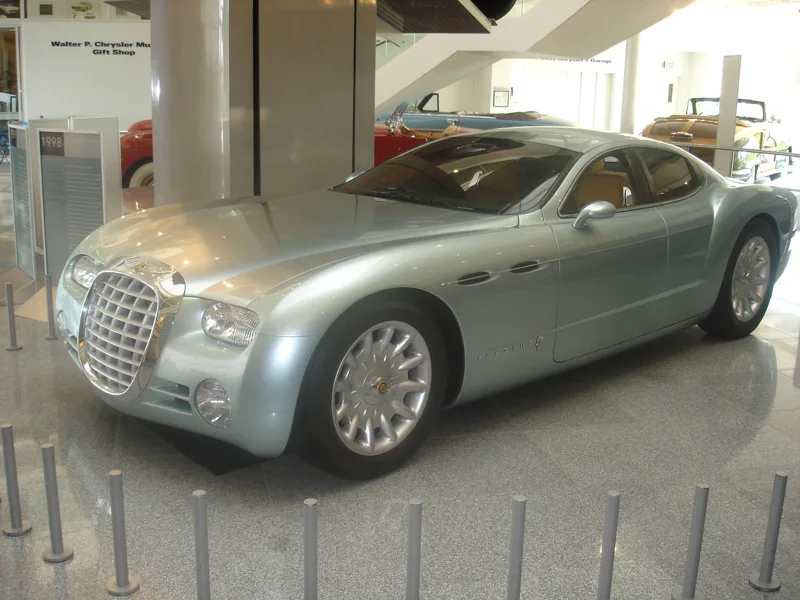
The aim was to take features of classic automobile design and adapt them to contemporary cars. That makes the Blackhawk an early case of retro styling in cars.
How was the Blackhawk III engineered?
The Blackhawk III used the chassis, subframe, suspension, brakes and wheelbase of the third-series Pontiac Grand Prix. Stutz changed little beyond the body, and it bought stocks of Grand Prix models in advance so that production could run on until the end of 1979.
Stutz took over the chassis with its subframe. The suspension, springs and brakes were not modified, and the wheelbase, the basic body structure, the windscreen, the rear window and the electrics were all kept. Some attachments, such as the door handles, came from Italian mass-produced cars, for example the Alfa Romeo Giulia GT.
Grand Prix production ran from late summer 1972 to summer 1977. When General Motors shrank the car for model year 1978, Stutz did not follow. The Blackhawk therefore kept the older, larger platform in use to the close of 1979, over two years after the Grand Prix generation had stopped.
What engine did the Blackhawk III have?
The standard engine was a 7.5-litre (458 cu in) General Motors eight-cylinder, and its output changed from year to year to meet American exhaust rules. For model year 1979 it was quoted at 200 PS (197 hp; 147 kW). One American source reports that individual cars carried a Cadillac unit of 8.2 litres (500 cu in) instead, which gave more torque but no more power.
In model year 1979 the Stutz was the car with the largest-displacement engine. The 8.2-litre units were not stronger than the 7.5-litre versions, so the extra capacity mattered for pulling power rather than top-end output.
Keeping the GM parts unchanged had its drawbacks. The magazine auto motor und sport noted that the radiator openings, reduced from the base car, caused high heat loads that could create serious problems in city traffic. The door and hood hinges, also taken from GM, were said to be too weak for the heavier Stutz body parts, so open doors soon hung crooked.
How heavy and how fast was the Blackhawk III?
The Blackhawk III had a kerb weight of 2,400 kg (5,291 lb), roughly 400 kg more than the base car, and a minibar could add a further 200 kg. The factory's top speed figure was 200 km/h (124 mph), with 12.5 seconds from 0 to 96 km/h.
Measured end to end, the car came to nearly 5,800 mm (228 in), which put it 250 mm longer than the Grand Prix. On fuel, the average figure stood at 8 miles per gallon, or roughly 30 l/100 km.
What did the Blackhawk III look like?
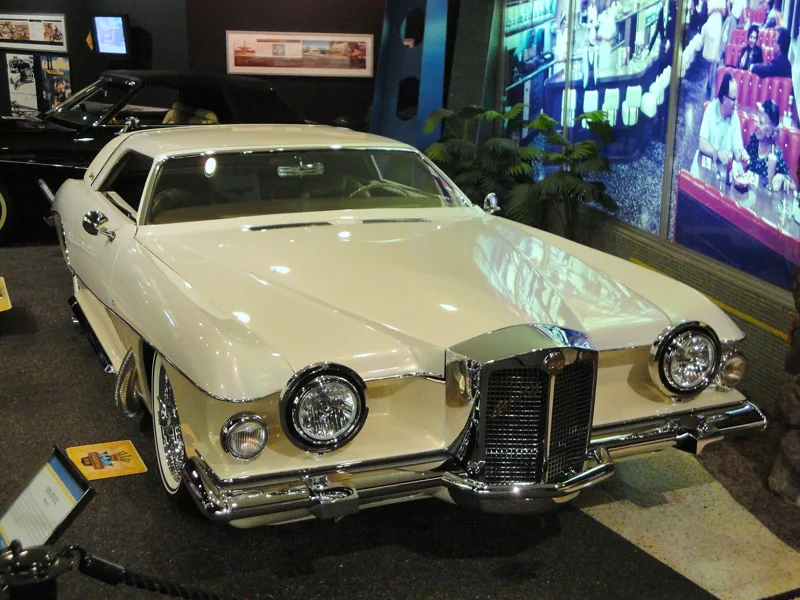
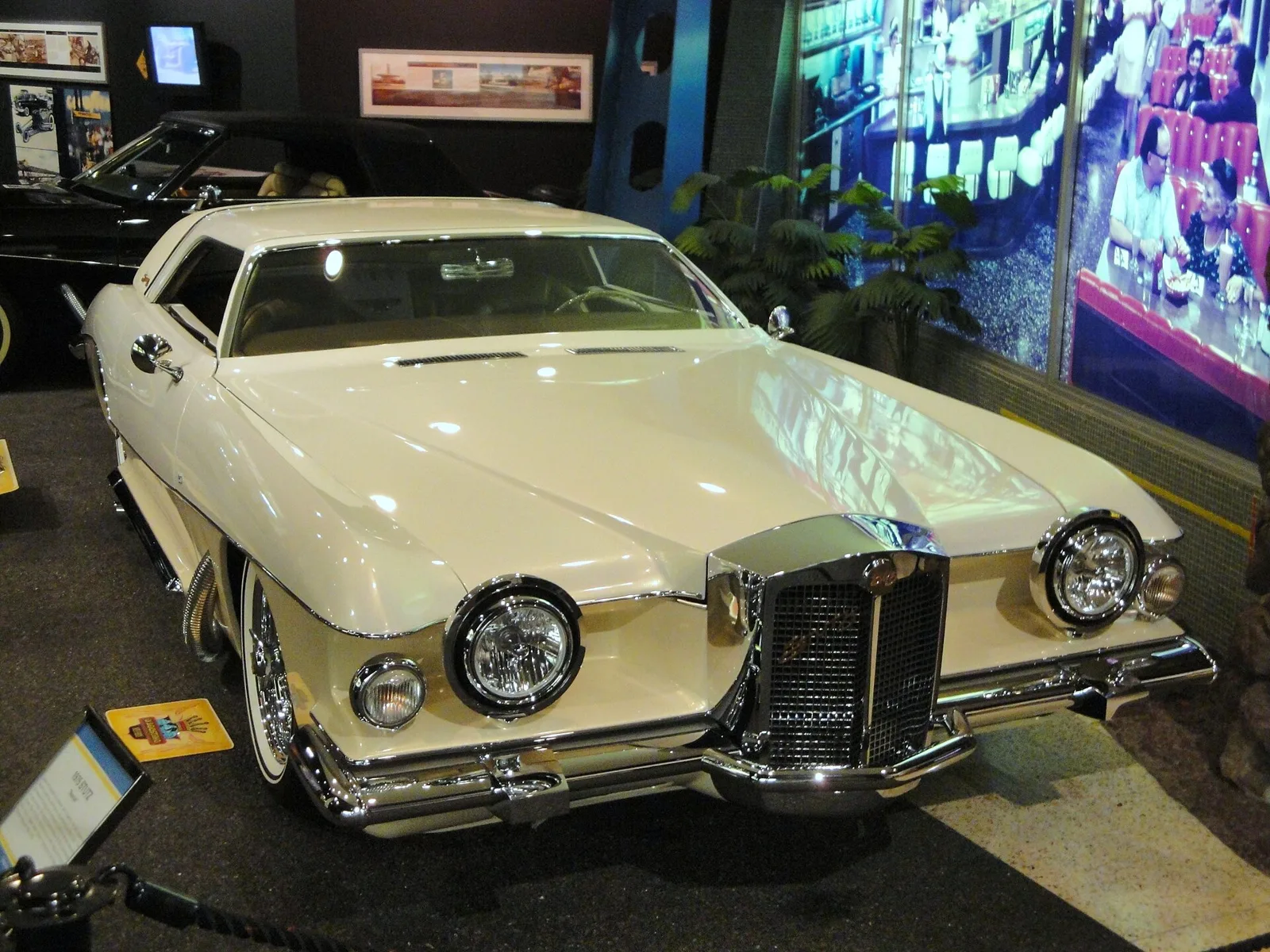
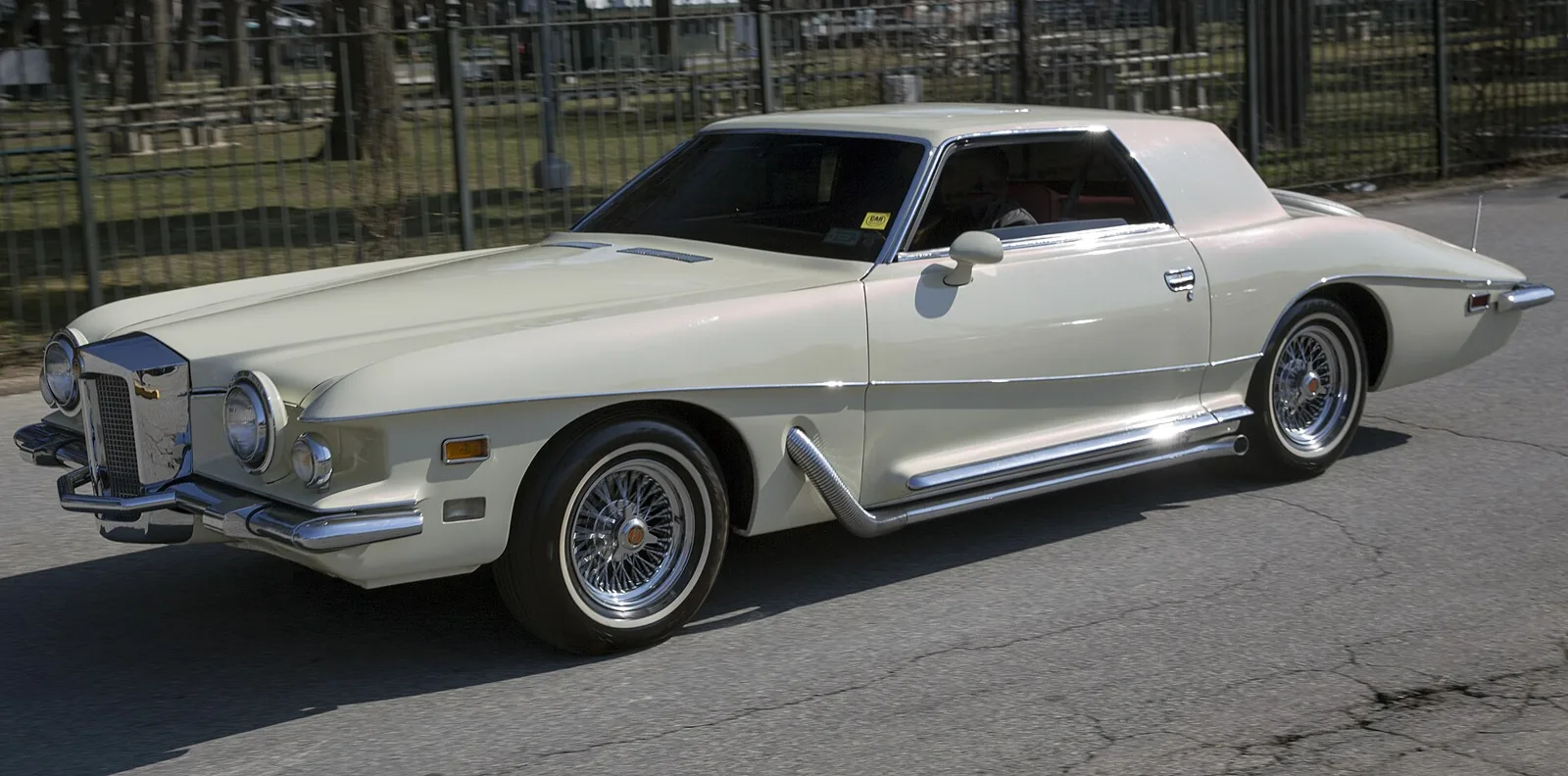
The Blackhawk III had two doors, a long hood and a closely cut cabin. Apart from its dimensions and basic layout, its body had no outward resemblance to the Grand Prix, but many of its details recalled cars from before the Second World War, from chrome strips that mimicked freestanding wings to a radiator grille that projected past the bumper.
The pre-war references included:
- Chrome strips curving along the flanks, copying the lines of freestanding wings
- Running boards that were suggested below the doors but did not function
- A long hood ending in a Knudsen nose
- A large radiator grille that projected beyond the bumper line
- Freestanding headlights set into cut-outs beside the grille
- Imitation side pipes that ran rearward below the doors
- A spare wheel left fully visible, partly sunk into the boot
According to O'Donnell, Exner wanted the grille understood as a phallic symbol.
The tail sloped steeply down to a high-set bumper, with the tail lights mounted beneath it, as on the first series. The lamps changed over the years: in one model year they were taken from the Chevrolet Vega, another from the Pontiac Astre, its near-twin, and some cars wore round lamps from the aftermarket.
Inside, the cabin used British Connolly leather, carpets knotted by hand and root wood from Italy. Gold leaf covered the instrument surrounds and the switches and levers.
How was the body built in Italy?
Stutz bought finished base cars from General Motors, shipped them to Italy, and had them stripped of their standard bodies. Around 10 Italian tinsmiths then made the new panels by hand, while the interior and a 20-layer paint job were also finished in Italy.
Officine Padane made the first examples of the first series in 1970. From 1971 the work went to Carrozzeria Saturn in Cavallermaggiore, in Piedmont, a workshop that O'Donnell had set up specially for his cars.
More than 300 were built between 1973 and 1979, which made the third series the most successful model of the marque. Between 50 and 70 cars were made each year, and the bulk went to the USA and the Arab states.
What did the Blackhawk III cost?
The list price was US$40,000 for 1973 and US$70,000 by 1979. For comparison, a standard Pontiac Grand Prix cost US$4,900 in 1976, and the Cadillac Seville, the priciest regular car from General Motors, was US$14,020 in 1979.
Many Blackhawk III cars went to figures from show business. Owners included Elvis Presley, Wayne Newton, Lucille Ball and Elton John, and Kenny Rogers, Liberace and Evel Knievel also bought one. In Germany the distribution was handled by Auto Becker, and only a few cars reached Europe at all.
Which variants were built?
The third-series Blackhawk gave rise to two convertible versions. Specialist firms converted at least two coupes into convertibles after completion, and from 1978 a run of about 30 Bearcats, with a roll bar, was built and sold by the factory. The IV Porte saloon, which arrived the same year, was a separate car.
The first conversions were full convertibles without a roll bar. One was made in 1974 by American Custom Coachworks in California for Elvis Presley, and a very similar car, named D'Italia, was delivered to Evel Knievel three years later.
The IV Porte was styled by Paolo Martin and took its name from the Maserati Quattroporte. Technically it had nothing to do with the Blackhawk, although it carried some of its design elements. It was built on the 1977 Oldsmobile 88, and from it came the Diplomatica and a 7.5 m long Royale limousine.
How did critics react to the Blackhawk III?
Critics were cautious. Few contemporary road tests exist, the European press was often reserved or dismissive, and a German description mocked it as one of the costliest gags around. Hindsight has not softened that verdict.
A British specialist magazine wrote in 2003 that a flashy luxury car around 1980 meant choosing a Rolls-Royce Camargue, an Aston Martin Lagonda or the Stutz.
A 2000 road test by auto motor und sport, of a coupe based in Berlin, focused on the handling. The magazine found the Stutz rode through crowded city streets like an aged Pontiac with a solid rear axle, soft and rocking, and about as nimble as an oil tanker.
Specifications at a glance
| Specification | Stutz Blackhawk III |
|---|---|
| Body | Two-door coupe |
| Series produced | 1973 to 1979 |
| Engine | 7.5-litre (458 cu in) General Motors eight-cylinder |
| Output (1979) | 200 PS (197 hp; 147 kW) |
| Kerb weight | 2,400 kg (5,291 lb) |
| Length | Nearly 5,800 mm (228 in) |
| Top speed | 200 km/h (124 mph) |
| 0-96 km/h | 12.5 seconds |
| Fuel use | 8 miles per gallon, about 30 l/100 km |
| Price | US$40,000 (1973); US$70,000 (1979) |