Designers in Czechoslovakia and Italy, two factories and a 1972 government ruling shaped a mid-size Skoda that never went on sale.
The Skoda 720 was a mid-size prototype developed by the Automobile Works, National Enterprise (AZNP) at Mlada Boleslav from 1967 to 1972. It had a longitudinal front engine, rear-wheel drive and bodies from several designers, including ItalDesign. A government ruling in November 1972 ended development, and the car never went on sale.
The Skoda 720 was a mid-size prototype that the Automobile Works, National Enterprise (AZNP) developed at Mlada Boleslav between 1967 and 1972. It was meant to become the Skoda 1250 and Skoda 1500, with series output pencilled in for 1973. The car never reached showrooms, and its story runs through shifting designers, a long run of prototypes and a government decision that moved the work to another factory.
The car shows how one factory tried to add a second passenger car line, and why that plan stalled.
Where did the Skoda 720 project begin?
The project began with a November 1959 proposal from AZNP director Josef Kaderzavek for a mid-size Skoda 1500 with about 100,000 cars a year from 1970. Serious work on a second model line only resumed in 1965, once the Skoda 1000 MB was in production at the factory.
The 1959 concept was a transaxle: the engine sat longitudinally at the front, while the gearbox was mounted on the rear driven axle. The planned six-cylinder OHV unit, 1,482 cc (90.4 cu in) and 65 PS (64 hp), was to be built on the basis of a four-cylinder 988 cc (60.3 cu in), 42 PS (41 hp) engine already in development for the Skoda 1000 MB.
The factory later kept the idea of two model lines alive. A 1967 project under the new director, engineer Josef Simon, again proposed two main Skoda lines, and the aim was integrated production of passenger cars across Czechoslovakia.
Several designers, two factories and a 1972 government ruling shaped a Skoda that never went on sale.
Which layouts were considered in 1966?
A March 1966 document on alternatives for the new passenger car, designated NOV II, examined four layouts, all of them built around four-cylinder engines. The option chosen for development was PP 020, which became the official Skoda 720. Its engine sat longitudinally at the front, its gearbox also sat at the front, and the drive went to the rear wheels.
The four options were:
- PP 020: 2,550 mm (100.4 in) wheelbase, rear-wheel drive, with the engine and gearbox both placed at the front.
- PP 024: the same 2,550 mm (100.4 in) wheelbase, but front-wheel drive, with the engine and gearbox joined as one unit.
- PP 009, described as an intermediate type: a revised Skoda 1000 MB with a horizontal engine and the radiator at the front.
- PP 011: also based on the Skoda 1000 MB, with the power unit turned through 180 degrees and moved forward to drive the front wheels.
Unlike the small team that worked on the smaller Skoda 740 series, the Skoda 720 was handed to a group of leading specialists. Both series were planned with saloon and estate bodies, and the Skoda 720 was also to be built as a coupe. Each series was to have two engine types, and the versions were to differ at the front: the less powerful car carried a panel with two headlights, the more powerful one four.
Who shaped the Skoda 720 body?
Several designers worked on the body, starting with unofficial sketches by Milan Strejcek in 1965 and ending with prototypes refined by the Italian studio ItalDesign. The bodies had serious faults, particularly low rigidity and leaks.
Milan Strejcek's concept sketches
Working for the Motor Vehicle Research Institute (UVMV), Strejcek drew four concepts in 1965: a sloping-rear saloon, an estate, a coupe and a pickup. The institute built a life-size model in spring 1966 and photographed it beside ordinary cars in a car park to compare them.
Josef Brokes's fastback
Josef Brokes, a body designer at the AZNP works in Kvasiny, drew a bold four-door fastback with a reverse-raked front. Its smooth rear and large glazed area were inspired by the Renault 16. Work on the first functioning prototype, fitted with a 1.5 litre (91.5 cu in) engine, began in spring 1967 and ended in October of that year. Because of the technologies used, it was less elegant than the mock-up, and its rigidity was extremely low. After only 6,000 km of testing, the body had deformed noticeably.
Even then the factory went looking abroad for designers and nearly reached terms with Vignal, but the cooperation never started because money was short. The team dropped the fastback in favour of a classic saloon, strengthened with massive longitudinal members.
Jan Zacek's pontoon body
Jan Zacek, another body designer from Mlada Boleslav, partly built on Brokes's work but moved to a pontoon-type body with a slightly altered front. Its extremely angular shapes earned the unflattering nickname 'Zacek's sheds'. The saloon and estate bodies became much stiffer, and five Zacek prototypes were built.
ItalDesign's refinements
In spring 1969, on the initiative of the chief designer, engineer Frantisek Sajdl, the factory opened talks with Italian design studios and secured budget funding. An agreement signed on 8 May 1969 between AZNP and CAZ (Czechoslovak Automobile Works) set a repayable subsidy of 3.86 million crowns, and ItalDesign with the designer Giorgetto Giugiaro entered the project. Within four months the Italians had refined the Brokes and Zacek bodies, and genuinely representative cars began to appear.
What chassis and drivetrain did the Skoda 720 have?
The Skoda 720 had a longitudinal front engine, a four-speed manual gearbox and rear-wheel drive. Its suspension was independent, using a McPherson-type layout at the front and triangular arms with an inclined roll axis at the rear. Brakes were hydraulic, with discs at the front and drums at the rear.
Frantisek Uglirz was chief designer for this part, and engineer Ivan Rocek was responsible for the chassis itself. Behind the engine sat a four-speed manual, although an automatic was also considered, and a propeller shaft carried the power to the rear axle. Planned extras were progressive for the time: air conditioning, power steering, disc brakes on the rear axle and ABS.
Anticipating exports and budget income, the factory tied suppliers in the Czech PAL group closely to appearance demands, and sometimes to the functional specification of body parts. Motor from Ceske Budejovice and Autobrezdy from Jablonec nad Nisou took an active part in development. The steering was to be rack and pinion, and the brakes could take a booster from Girling or Dunlop.
Which engines were built for the Skoda 720?
Engine development was led by engineer Frantisek Fidrmuc. The units were four-stroke, in-line, petrol engines with an overhead camshaft and water cooling. The main sizes were a 1,498 cc (91.4 cu in) unit and a 1,236 cc (75.4 cu in) unit, with a 1,772 cc (108.1 cu in) engine built for a planned upgrade of the Skoda 1203.
The 1,498 cc (91.4 cu in) engine was built in five examples in spring 1968. Its output was 62.5 kW (85 PS; 84 hp) at 5,300 rpm, with torque of 125 Nm (92 lb ft) peaking at 4,000 rpm. The 1,236 cc (75.4 cu in) engine followed in three examples in autumn 1969, rated at 48.5 kW (66 PS; 65 hp) at 5,500 rpm, with 98 Nm (72 lb ft) of torque.
The 1,772 cc (108.1 cu in) unit delivered 70 kW (95 PS; 94 hp) at 5,250 rpm, and its 152 Nm (112 lb ft) arrived at 3,500 rpm. After the project closed, engines up to 2 litres (122.0 cu in) were also tried, such as the type found in the Skoda 200 RS coupe. Fourteen engines were built in all.
Skoda 720 specifications at a glance
| Item | Detail |
|---|---|
| Planned wheelbase (PP 020) | 2,550 mm (100.4 in) |
| Layout | Longitudinal front engine, rear-wheel drive |
| Gearbox | Four-speed manual; automatic considered |
| Front suspension | McPherson type |
| Rear suspension | Triangular arms, inclined roll axis |
| Steering | Rack and pinion |
| Brakes | Hydraulic; discs at the front, drums at the rear |
| Engine, smallest | 1,236 cc (75.4 cu in); 48.5 kW (66 PS; 65 hp) at 5,500 rpm; 98 Nm (72 lb ft) |
| Engine, main | 1,498 cc (91.4 cu in); 62.5 kW (85 PS; 84 hp) at 5,300 rpm; 125 Nm (92 lb ft) |
| Engine, largest | 1,772 cc (108.1 cu in); 70 kW (95 PS; 94 hp) at 5,250 rpm; 152 Nm (112 lb ft) |
| Planned series start | 1973, with output of 120,000 cars a year by 1975 |
Which prototypes were built and how did they perform?
The prototypes covered tens of thousands of kilometres in testing, and the fastest figure came from a red coupe. Its July 1971 upgrade to a 1.8 litre (109.8 cu in) engine and a faster final drive took the maximum speed to 161 km/h (100 mph). Most prototypes were tested for chassis and endurance, and several were used for brake and crash tests.
Prototype I-1 was a silver saloon with a 1.5 litre (91.5 cu in) engine, completed on 12 August 1968. Chassis and endurance trials ended on 30 March 1969 after 54,600 km. Once repaired, it went to the Motor works in Ceske Budejovice for further testing, and it underwent a crash test in November 1969.
Prototype I-2 was a red saloon finished in September 1968. Its 1.25 litre (76.3 cu in) engine took it to 136 km/h (85 mph), and fuel use was 8.8 l/100 km at 58 km/h (32.1 mpg-imp; 26.7 mpg-US) and 10.3 l/100 km at 75 km/h (27.4 mpg-imp; 22.8 mpg-US). Endurance work ended in June 1969 after 53,400 km, and the car was later sold in June 1971, following brake trials.
The coupe I-5, with a 1.5 litre (91.5 cu in) engine, was completed at Kvasiny in January 1969. It reached 148 km/h (92 mph) and averaged 11.5 l/100 km (24.6 mpg-imp; 20.5 mpg-US) at 100 km/h. Mostly it served for brake tests or as a show car, and by October 1969 it had covered 9,500 km.
Why was the Skoda 720 stopped?
A meeting with Prime Minister Lubomir Strougal on 22 February 1972 decided to end the project because investment funds were short, although design work was still going on. A government regulation of 30 November 1972 then banned further development of the model and told AZNP to continue only in cooperation with East German car factories.
A popular story says the Skoda 720 was stopped because it would compete with the VAZ-2101, but this is treated as a legend. In fact the USSR itself had a shortage of passenger cars, and it encouraged its satellite states to motorise independently.
The real reason was technical, and as a consequence financial. The Skoda 720 and Skoda 740 series had been designed as completely new models with no link between them, so parts were hardly shared. Existing production had no technological continuity with them either. Mlada Boleslav was still repaying loans for the technology behind the Skoda 1000 MB, and the Bratislava factory (BAZ) had hardly come into being, although it had a design centre built on a branch of the Tatra works.
What happened when the project moved to BAZ?
On 18 April 1971 the government moved the Skoda 720 project to the Bratislava Motor Works (BAZ), a plant that did not yet exist, with a planned capacity of 150,000 cars a year. AZNP was meanwhile to start a front-wheel-drive project with East Germany, the Skoda 760. The transfer of rights was in place by 30 June 1971.
An AZNP report from summer 1970 had warned that the project's uncertain future was slowing production preparation, and that series output would not begin before 1975 without central support. The government chose the opposite course. By the end of November 1971, AZNP and BAZ had signed an agreement on supply and cooperation in the design work.
BAZ built only two extra saloons, the Skoda 720 OP-1 and OP-2, which AZNP's type book listed as the Skoda 731. At the time nobody foresaw that the plant would never reach full strength, and that only in the 1980s would it turn out small series of the Skoda Garde and Skoda Rapid, with poor build quality.
How much would the Skoda 720 have cost?
The planned production cost was 25,240 crowns per car, with a wholesale price of 27,140 crowns. For the base specification the recommended retail figure was 30,000 crowns on the Skoda 1250 and 35,000 crowns on the Skoda 1500.
Total project costs were estimated at 37,372,870 crowns by 30 June 1971. Of that sum, 483 thousand crowns was a non-repayable state subsidy, and a further 26.7 million crowns came as a non-repayable subsidy from the industry fund of the CAZ General Directorate.
Which Skoda 720 prototypes survive today?
Several prototypes survive, in very different states. The derelict red saloon listed as I-2 is awaiting restoration at the Bratislava Transport Museum, while green paint on its front doors and right front wing points to the prototype I-3. The Skoda 720 ID-2 was repainted red and is in the Bratislava museum.
The estate I-4 was originally light green and has since been repainted yellow after several accidents and interventions by enthusiasts. Its original engine, gearbox, brakes, axles and differential were kept, and in autumn 2009 it ran on Plzen Region plates and appeared at the celebrations at Vrchlabi in partly restored form.
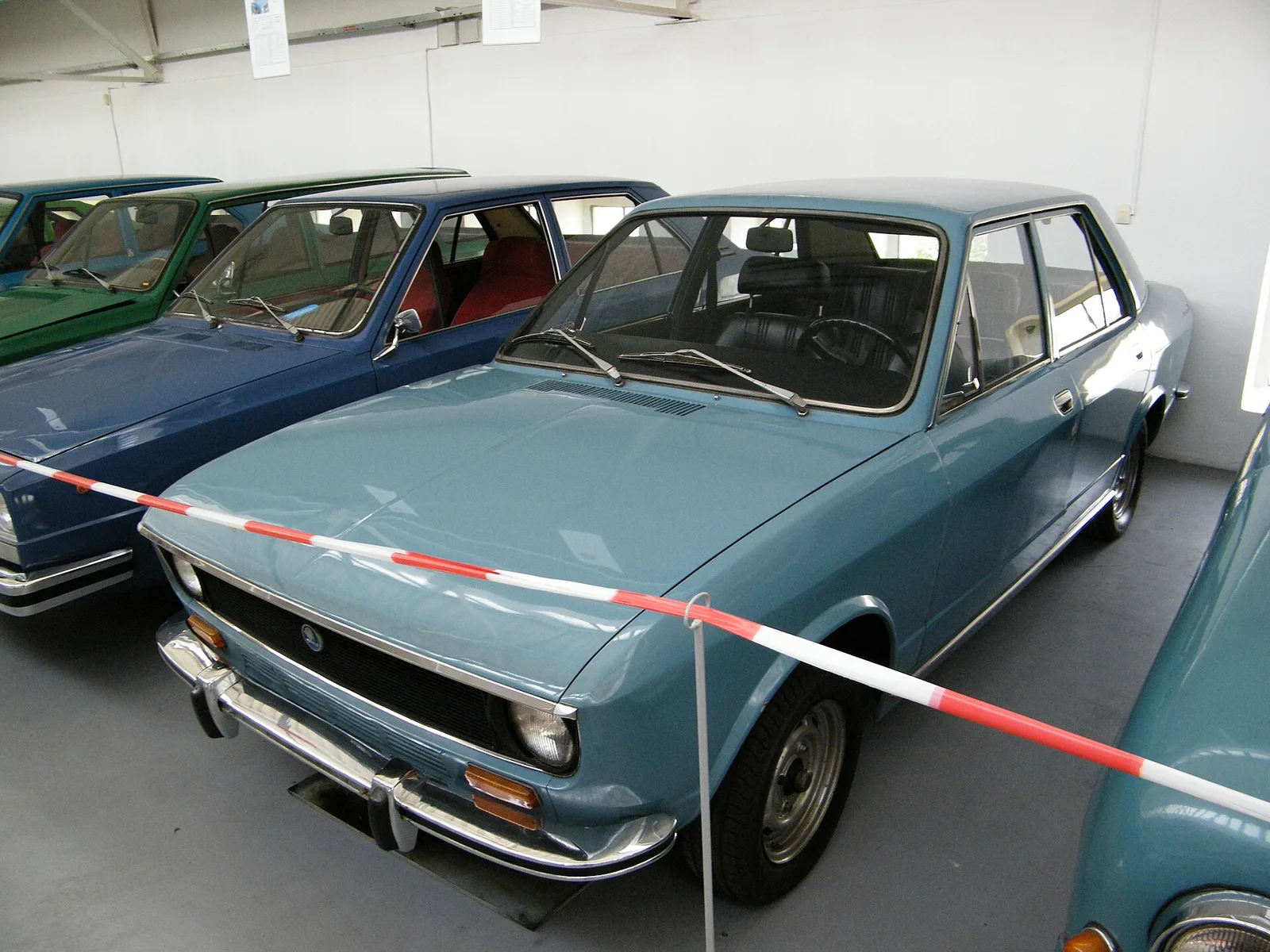
The rest are scattered. The Skoda 720 AD-2 is in the Skoda Auto archive, the red coupe is in private hands and displayed at the Technical Museum in Brno, and the blue saloon OP-1 is a non-running exhibit at the Skoda museum in Mlada Boleslav. OP-2, repainted red, is registered in Prague, and one red saloon is in the Volkswagen museum. Nothing is known about the fate of the Brokes fastback.
Did the Skoda 720 leave a legacy?
The car never went on sale, but its ideas did not vanish. Elements of the closed project can be seen in the early Skoda 105 and 120 models, and the 1976 to 1980 models took body elements and interior directly from the Skoda 720.