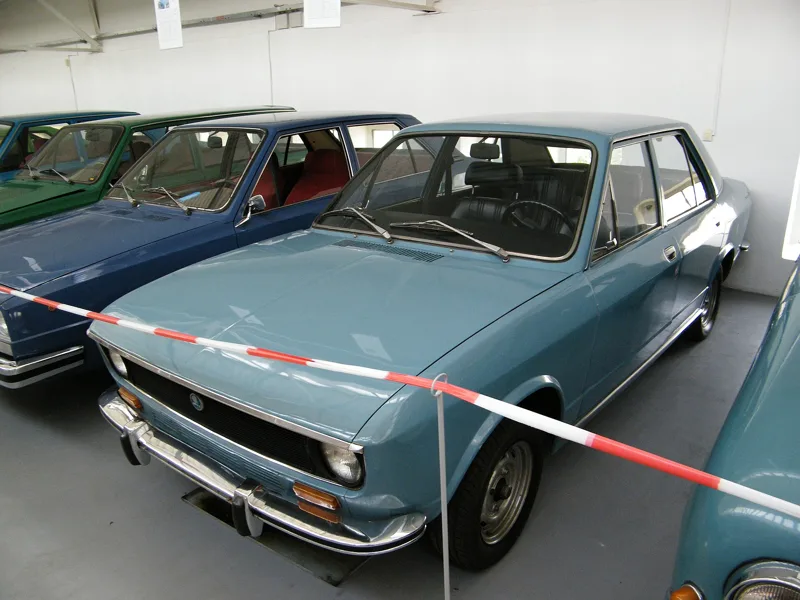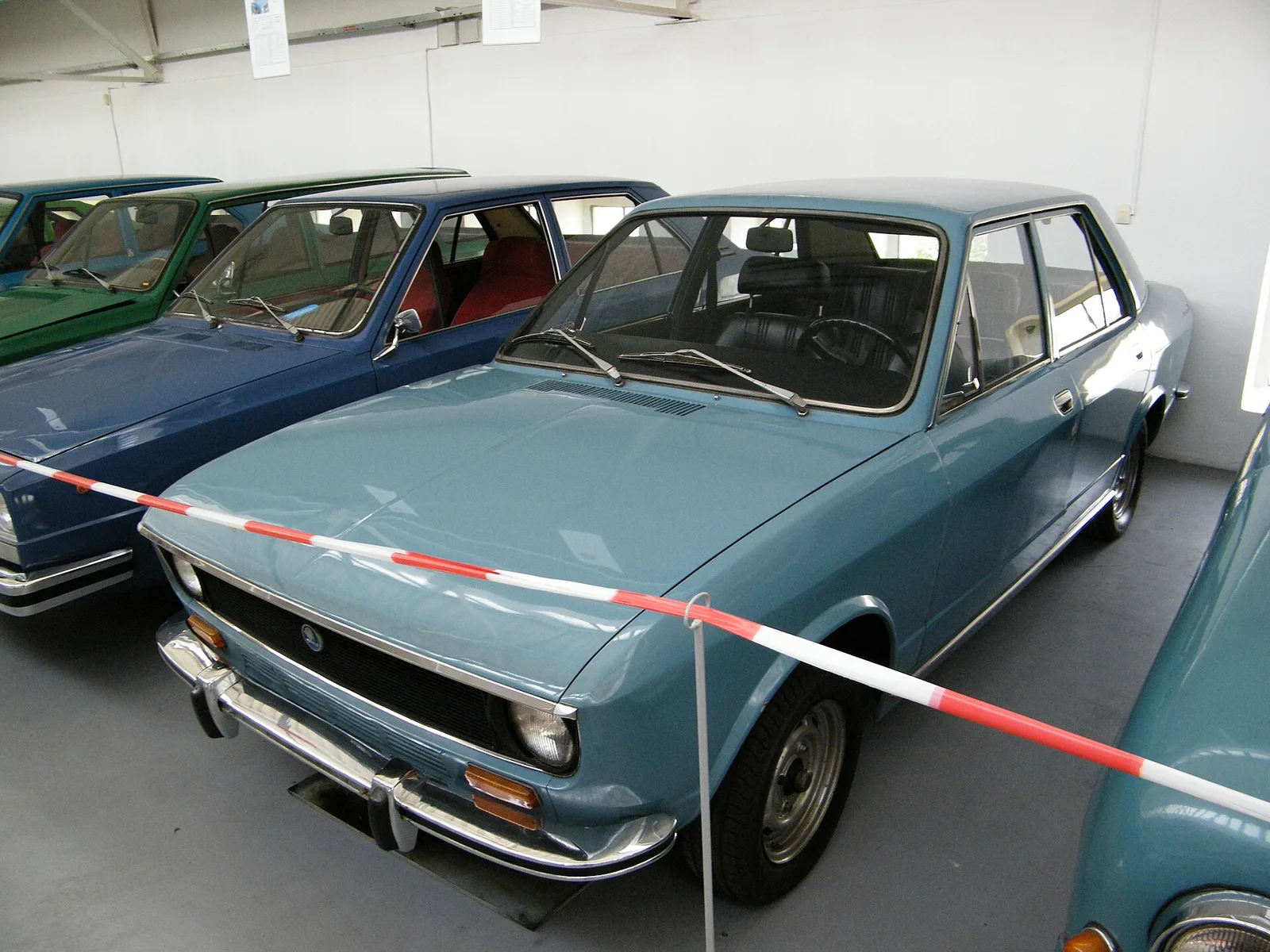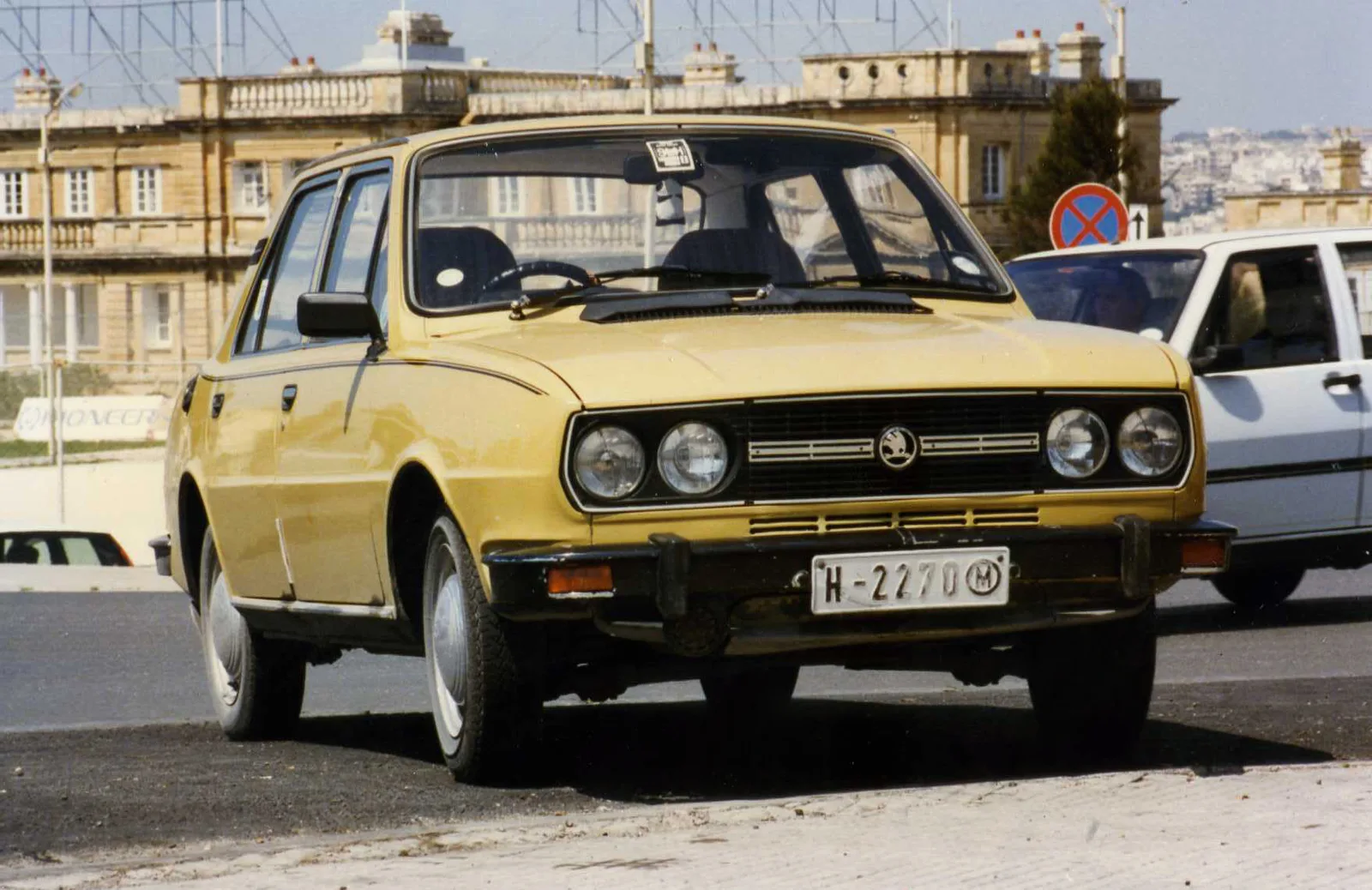
A front-radiator, rear-engined family car from Mlada Boleslav that rallied, sold well in Britain and stayed on the road for decades.
The Skoda 120 was a rear-engined family car built from 1976 to 1990 as part of the Type 742 range. Sold as the Estelle in Britain, it reached more than two million saloons and won class titles in the RAC Rally.
The Skoda 120 was part of a rear-engined small family car range that Skoda built in Mlada Boleslav, Czechoslovakia, from 1976 to 1990. It was sold as the 105 and 120 in the first years, later as the 125, 130, 135 and 136, and the range ultimately produced more than two million saloons.
The 120 is best known in Britain as the Estelle, a cheap, durable and spacious car with a rear engine and a front radiator. Its story combines a forced design update, an unusual rear-engined layout and a long run of rally success that kept the name in the public eye.
Where did the Skoda 105 and 120 come from?
The 105 and 120 took the Type 742 code and went into production in August 1976. They replaced the older S100 and 110 saloons, which had been Skoda's mainstay, and carried over much of the mechanical layout of their predecessors under new bodywork.
Skoda had hoped to produce a front-engined, front-wheel-drive successor. It applied for a licence in Moscow to build that car, but the licence was refused, which forced the company to update the S100 and 110 instead. The rear-engined car was a compromise that still ended up as a much more modern design.
The company finished a prototype of the front-drive layout, and it looked almost identical to the rear-engined car. The design was still able to accept a front-engined, front-wheel-drive layout later, but the rear-engined version went into production as the 105 and 120 instead.
A rear-engined family car that outlasted most of its rivals, won class titles on the RAC Rally and sold as the Estelle in Britain.
How did the 120 differ from the S100 and 110?
Despite sharing much of its underpinnings with the S100 and 110, the new car was an obvious step forward. It had a front-mounted radiator with a thermostatic fan, a heater unit inside the dashboard and a fuel tank under the rear seat instead of up front.
Most other mechanical details came from the old car. The 105 and 120 kept a four-speed gearbox, independent front suspension, worm-and-drive steering and a swing-axle rear end. One of the most noticeable features was the side-hinged front bootlid, which opened like the lid of a concert piano.
The engines were the other big change. The 105 S and 105 L used a 1046 cc unit with 46 PS, while the 120 L used a larger 1174 cc engine with 52 PS. The 120 LS and GLS brought the more powerful 58 PS version of the 1174 cc unit in 1977 and 1978 respectively.
How did the 120 handle, and what was the criticism?
Early cars were criticised for unpredictable handling at the limit, although most drivers were unlikely to notice anything unusual in normal conditions. The radiator at the front cooled the engine well on the motorway, but the cooling system was complicated and prone to airlocks.
Airlocks often caused overheating, and that could lead to head gasket failure. Skoda told owners of cars built before June 1978 to block the perforated slits on the engine lid, because those openings did nothing useful for cooling and dirtied the engine bay.
In 1979 the tread was widened and both models moved to 13-inch wheels with 165 SR 13 tyres, except the 120 GLS, which took 175/70 R13 tyres. The change was made to improve stability, handling and fuel consumption, and it helped make the car feel more settled on the road.
What changed in the 1983 M-series facelift?
In September 1983 the range received a facelift and technical update, earning the 742M nickname inside the company. New rectangular headlamps and blocky rubber bumpers modernised the look and improved aerodynamics, and the steering moved from recirculating ball to rack and pinion.
Power dropped slightly with the facelift, to 45, 50 and 55 PS for the 105, 120 and better-equipped 120 versions. The 1983 update also brought changes to the rear suspension on later models, while the earlier 105 and 120 kept the swing-axle design.
The 1983 car added a more confident chassis, although it still kept the rear-engined character that defined the range. The changes were designed to answer the earlier complaints about handling without changing the core layout.
What were the Garde and Rapid coupes?
The Garde was a two-door fastback introduced in November 1981, using the 1174 cc engine from the 120 LS and GLS saloons. Its semi-trailing arm rear suspension was a clear step up, and a later facelifted version of the Garde became the Rapid coupe.
The Garde carried the same 58 PS engine as the saloons it shared drivetrains with, and it paved the way for the later facelift models. The Rapid name carried the coupe idea into the 130 range, and in 1984 a limited Rapid 120 CE of 90 cars marked Skoda's 90th anniversary with golden alloy wheels and gold stripes on an all-black finish.
Why did the 130 and 135/136 models follow?
The 130 arrived in August 1984 with a 1289 cc engine, a semi-trailing arm rear suspension and a track widened to 1,395 mm (54.9 in). The engine was an enlarged version of the 1174 cc unit, and it produced 58 PS. The new rear suspension had first appeared on the Garde fastback in late 1981.
The 130 introduced five-speed gearboxes and four-pot front brake calipers, which helped answer earlier criticism of tail-happy handling. Autocar and Motor praised the 136 Rapid in 1988 as handling like a Porsche 911, with the rear-engined layout encouraging oversteer.
The 135 and 136 followed in April 1987 with the same 1289 cc engine that powered the Favorit. The 135 made 58 PS, and the 136 made 62 PS with a higher compression ratio. The 135 used an aluminium eight-port head that accepted unleaded fuel, while the 130 had a cast-iron five-port head that did not.
How did the Estelle sell in Britain?
In Britain the 105 and 120 were sold as the Skoda Estelle, a name created by the advertising agency Childs Greene. Between May 1977 and March 1990, about 120,105 cars found homes, and the range was known for spacious interiors, dependability and a low asking price.
The 130 reached the UK in March 1985 in Estelle 130 L and 130 LSE saloon form, plus the 130 Rapid coupe. The Rapid Cabriolet was developed at Ludgate Design Developments in Kent, and at least 334 cabriolets were sold in Britain. UK dealers managed to sell 17,000 rear-engined Skodas in 1987 alone.
The Estelle name faded as the cars aged. In August 2006 an Auto Express survey found just 612 Estelles still registered with the DVLA. Many more are believed to have been re-exported to Eastern Europe, where they were worth more than in Britain, so the figure reflects both scrappage and export.
Across the Czech Republic the picture was different. A 2004 survey of registrations counted 305,726 Skoda 120s and 216,857 Skoda 105s, and it found 1,780,124 Skodas among 3,706,012 registered cars. The 120 was the largest model represented in that survey, which made the rear-engined range a fixture of home roads.
Which other markets bought the 120?
Finland took the 105 and 120 with few changes beyond extra options suited to snowy roads, and sales were strong in the late 1970s before dipping slightly during the 1980s. In Greece the range was sold as the Skoda Target. Buyers valued its low price and sturdy reputation during the recession of the early 1980s.
Canada and Finland both received a fuel-injected 135 GLi saloon. It was technically similar to the rare Rapid 135 RiC, which was sold in Britain and Austria, so the same mechanical package reached several markets in slightly different forms.
In Australia the 120L sold in the late 1970s and early 1980s, though import limits capped sales. It was the last Skoda sold there until the 2007 launch of the Octavia and Roomster, and it is estimated that about 21 Skoda 120Ls survive in the country.
New Zealand imported the 105 and 120 from the late 1970s and found them affordable and robust, although a false report in the early 1980s claimed that some imports were built with prison labour. Iceland imported the 120 between 1977 and 1989, and some of those cars were sold there as the Skoda Amigo.
Did the 120 succeed in rallying?
Yes, although the odds were long. The 1.3-litre Estelle became a surprise winner on rally stages in the 1970s and 1980s. Skoda's works crews took their class on the RAC Rally for 17 years in a row, and they picked up class results on other world and European championship rounds as well.
Many of the team's drivers came from the company's own staff, although foreign professionals also drove, most notably the Norwegian John Haugland. Until the mid-1980s the team ran the 120, then it built a lightweight 130 LR to suit Group B. Once Group B ended after the 1986 season, the team moved to Group A machines and ran the 130 L until the Favorit arrived in 1989.
Group B did not reach 1300 cc cars until the following season, so a Group B 130 still took its class on the 1987 RAC Rally. That result came from a regulation gap rather than a standard production car, and it shows how far the rear-engined design could be pushed in competition.
What are the Skoda 120 specifications?
| Model | Engine | Output | Notes |
|---|---|---|---|
| 105 S and 105 L | 1046 cc | 46 PS | Single headlamp versions early on |
| 120 L | 1174 cc | 52 PS | Type 742 saloon |
| 120 LS and GLS | 1174 cc | 58 PS | Introduced 1977 and 1978 |
| Post-1983 105 and 120 | 1046 cc and 1174 cc | 45, 50 and 55 PS | Facelift cut power slightly |
| 130 | 1289 cc | 58 PS | Semi-trailing arm rear suspension |
| 135 | 1289 cc, aluminium head | 58 PS | Unleaded fuel compatible |
| 136 | 1289 cc, higher compression | 62 PS | Type 746 code |
| Fuel-injected 135 | 1289 cc | Injection from December 1989 | Limited markets only |