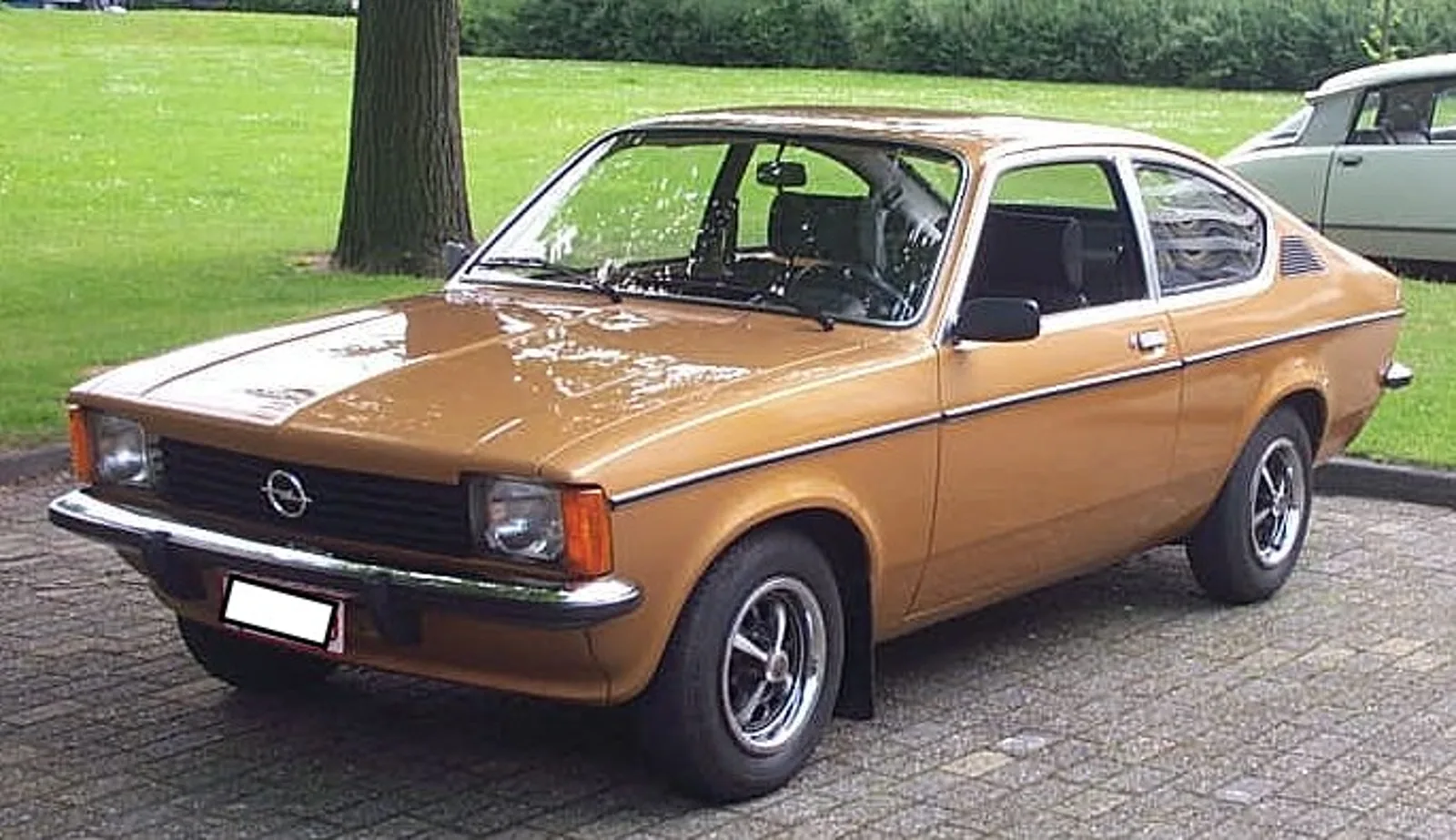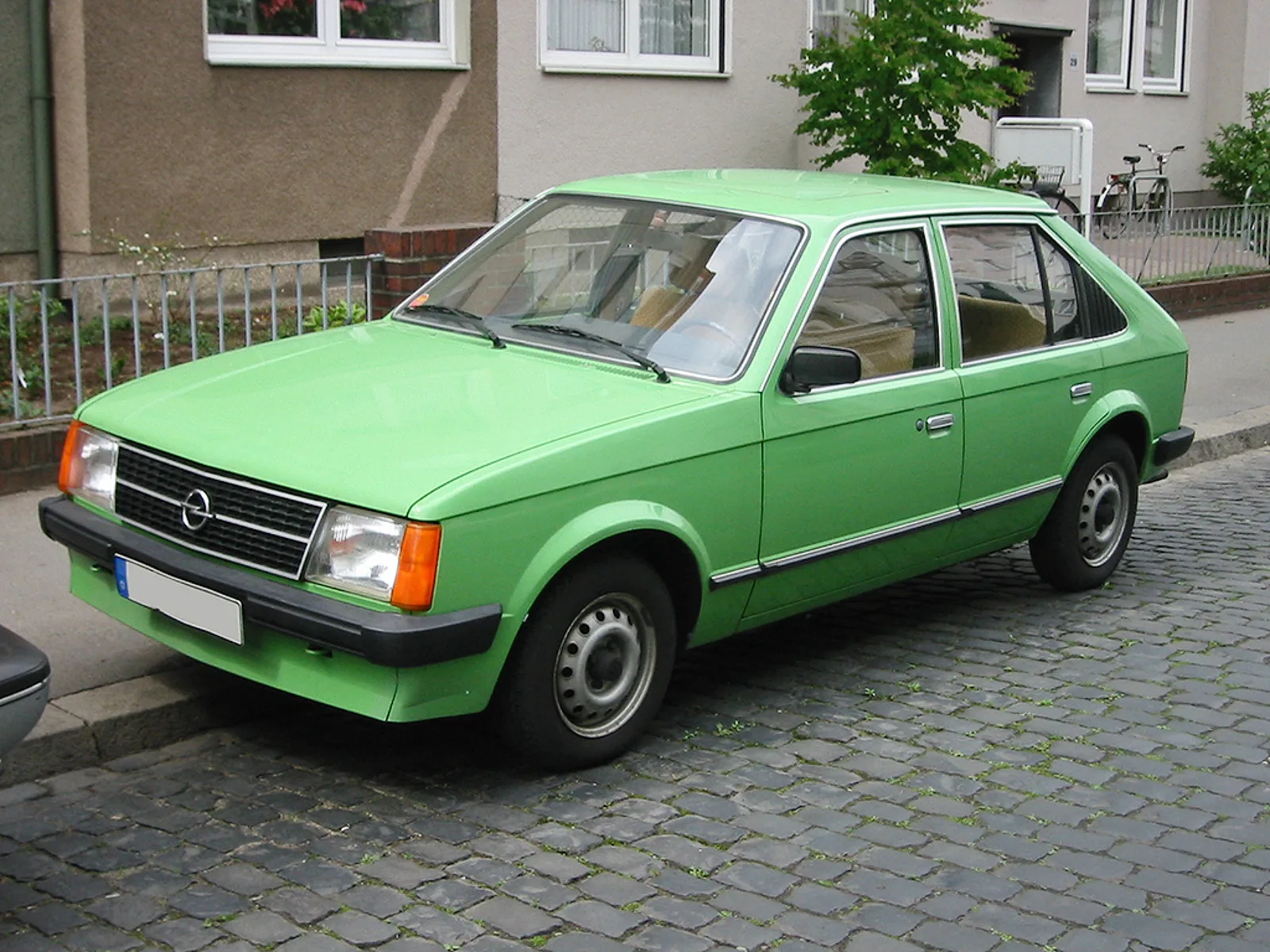
A compact fastback with a transverse engine and a Golf rival, built from 1979 until its 1984 successor took over.
The Opel Kadett D was a compact car built by Adam Opel AG from August 1979 to July 1984. It was the first Opel with front-wheel drive and a transverse engine, styled as a direct rival to the Volkswagen Golf. Engines ranged from 1.0 to 1.8 litres, and the Vauxhall Astra was its British twin.
The Opel Kadett D arrived in August 1979 as the first Opel with front-wheel drive, placing a transverse engine under a compact fastback body. GM had been comparatively late to follow the trend towards front-wheel drive, after Volkswagen had changed the compact class with the Golf. What Opel delivered was a serious rival, and the specialist press hailed it as a revolution for the company.
Why did Opel switch to front-wheel drive?
Opel judged its Kadett C, technically old-fashioned and rear-driven, no longer competitive, so work on a successor started in 1974, internally called Project 2040. Engineers at Russelsheim pushed inside GM for a transverse engine driving the front wheels, because that layout promised the largest interior in compact outside dimensions. The idea prevailed under development chief Friedrich W. Lohr.
Lohr's persistence paid off, and inside the company front-wheel drive became known as 'Fritz wants it'. From that point Opel relied only on front-wheel drive, up to the mid-size class.
Front-wheel drive arrived at Opel in a compact fastback, and the Kadett D carried the company's new layout into the 1980s.
How did the Kadett D reach showrooms in 1979?
Bochum was where the first cars came off the line from August 1979. Frankfurt's 48th IAA show was the public debut, on 11 September 1979. At launch buyers could pick a saloon in Standard, Luxus, Berlina or SR trim, or an estate car in Standard or Luxus trim.
The SR came only with the 75 PS (55 kW; 74 hp) unit. A right-hand-drive version reached Britain that November, where it first carried the plain Kadett badge.
How did the Kadett D's size and shape compare with the Golf?
The Kadett D was 13 cm shorter than its predecessor and 5.6 cm wider. Its wheelbase stretched past the 10 cm mark, reaching 2.51 m (8 ft 3 in), 11 cm ahead of the Golf. Its cw value of 0.39 was 15 per cent better than the Kadett C's and slightly better than the Golf I's.
The car was conceived to take on the Golf head-on, with a contemporary fastback silhouette and a hatchback tailgate that was initially an option. The luggage compartment offered 402 litres, and the estate car offered more. Legroom and knee room in the rear improved on the Kadett C.
Opel reworked the body structure to meet tougher safety demands and improved the corrosion protection as well. Trapezoidal headlamps appeared on most versions, while the basic car kept round lamps. Opel also kept conventional steel bumpers, wrapped in plastic, instead of the plastic front aprons other makers were then adopting.
How did the Kadett D compare with the Fiat and Alfa Romeo rivals?
When it appeared, the Kadett D clearly outsized the Golf in its dimensions, and in that respect it sat closer to the Fiat Ritmo and the Alfa Romeo Alfasud. Compared with the Kadett C it was 5.6 cm wider and 14 cm shorter, yet the space inside had improved.
Opel's first answer to the move towards hatchback bodies in smaller cars had been the Kadett C City, built from 1975. To make full use of a hatchback body, however, the company needed front-wheel drive. Opel also named the extra interior space, especially from the transversely mounted engine, as the main reason for the change.
The boot volume could be enlarged too, and the large hatchback added to the car's versatility. The new body was built to meet higher safety demands. Opel's new styling followed the line of its larger models.
Which engines did the Kadett D offer?
Engines ran from a 1.0-litre 29 kW (40 PS; 39 hp) unit to the 1.8-litre GTE engine at 85 kW (115 PS; 113 hp), with a 1.6-litre diesel added in 1982. The long-serving 1.2-litre OHV engine lost 1.5 kW in the Kadett D, yet according to the maker the exhaust matching had become more harmonious.
Engine line-up
| Engine | Output | Notes |
|---|---|---|
| 1.2 OHV | 39 kW (53 PS; 52 hp) | Until August 1982 |
| 1.3 N, OHC | 44 kW (60 PS; 59 hp) | Voyage and Voyage Berlina |
| 1.3 S, OHC | 55 kW (75 PS; 74 hp) | Fitted to the SR |
| 1.6 S, OHC | 66 kW (90 PS; 89 hp) | From August 1981, not for Pirsch |
| 1.8 E, OHC | 85 kW (115 PS; 113 hp) | GTE only |
| 1.6 D diesel, OHC | 40 kW (54 PS; 53 hp) | From February 1982 |
The 1.3-litre engine was new and first appeared in the Ascona B from February 1979. Its light-alloy cross-flow cylinder head and overhead camshaft brought Opel back into line with the technical standard of car engine building at the time. In its S form it had boosted compression, a register carburettor made by GMF, clearly more power and lower fuel consumption.
The smallest engines were rare. The 1.0 N, with 29 kW (40 PS; 39 hp), was built in very small numbers, around 10 cars, while the 1.0 S with 37 kW (50 PS; 49 hp) was made for export only, for example to Italy. Automatic transmission was a three-speed unit, offered from May 1981 on the new OHC engine and from September 1982 on the diesel.
The diesel was a swirl-chamber engine developed from the 1.6 S petrol unit. From 1982 an SRD Diesel version of the Kadett SR was also offered for the Italian market, fitted with the 1.6-litre diesel.
What were the SR and GTE versions like?
The SR was the sporty Kadett, with a matt black lower body, front spoiler, wheel-arch extensions and light-alloy wheels, plus Recaro sports seats inside. The GTE, introduced early in 1983, took the 1.8-litre engine, sat lower on its springs and had gas-pressure dampers plus internally vented front discs. Only the GTE had a speedometer scaled to 220 km/h.
The 1.3 S had a notorious reputation for weak performance, and camshaft failures were regularly found. The same hardening problem had appeared in the early years of the 1.3 N, but it was fixed during revision work, and affected owners could hope for goodwill help from Opel. From about April 1983 the SR's alloy wheels cost extra, and 14-inch steel sports wheels became standard.
About 36,300 GTEs were built at Bochum and at Antwerp in Belgium, roughly two thirds of them left-hand drive. The model was built for barely more than a year. Buyers could choose Polar white, Carmine red, silver or black, while other models offered the full colour range.
How did the Kadett D sell and what came after it?
The Kadett D came close to the Golf in sales figures and at times pushed the Opel Rekord out of second place in German registrations. It was replaced by the Kadett E from August 1984. The Kadett E, built until May 1993, kept the same GM-T platform.
From an economic standpoint the Kadett D ranked among Opel's most significant models of its time. Astra and Corsa, two names launched by this model, lived on in later cars.
Which trim levels and special models were offered?
Saloons came as Standard, Luxus, Berlina and SR, with the estate in Standard and Luxus forms. Special models included the Pirsch, an off-road utility estate from September 1981 with reinforced springs and stone-chip protection, and the Kadett Corsa, limited to 5,000 cars.
The Corsa was offered in just four paints, black and three others, and carried gold flank stripes with Corsa script. It ran only until the smaller Corsa A arrived on the market. Other special versions included the Voyage from March 1980, a Voyage Berlina with five doors only, and the Kadett J from October 1981.
Body variants
- Hatchback, small tailgate: two or four doors
- Hatchback, large tailgate: three or five doors
- Estate: three or five doors
- Van: three doors, no rear side windows, from September 1983
The Kadett D is the only post-war Kadett generation without a notchback saloon. Its small tailgate version, held by two external hinges below the rear window, proved a flop, while the large tailgate with its roof-edge hinges sold far more strongly.
Chassis and running gear
The chassis was redesigned for the much wider body. At the front were MacPherson struts with separate shock-absorber cartridges and wishbones, along with a negative steering roll radius. At the rear a compound-link axle with small block springs replaced the old rigid axle, and it was similar to the axle of the Senator and Monza.
Rack-and-pinion steering was fitted, and the brakes were a dual-circuit system with X-split. Anti-roll bars were fitted only to the S versions and the estate, as standard. A brake servo was omitted on the 1.2-litre versions, and a load-dependent brake-pressure regulator was omitted on the N models.
How did the Kadett D's equipment change in production?
Opel updated the car steadily. In August 1980 standard head restraints, a brake servo, reversing lamps and a laminated windscreen arrived, and a longer final drive improved consumption. In February 1981 the 1.2 S engine became available without surcharge, and an optional limited-slip differential appeared.
The 1.6 S engine gained contactless transistor ignition in August 1981, and the 1.3-litre engines were optimised. From January 1982 the 1.6-litre diesel came from the new plant at Kaiserslautern, and the Pirsch equipment added stone-chip protection. The August 1982 facelift brought a redesigned grille, angular headlamps and a central console, and the 1.2 N engine gave way to the 1.2 OHC.
In January 1983 the Kadett GTE, with a 1.8-litre engine and a five-speed gearbox, went on sale alongside the Vauxhall Astra GTE. Both were aimed at the Golf GTI.
Was the Kadett D sold as a Vauxhall too?
In Britain the Kadett D was sold as the Vauxhall Astra, with right-hand drive and different badges. Production moved from Bochum to Ellesmere Port in 1981 and continued until August 1986, two years after continental production of the Kadett D had stopped in July 1984.
The Astra differed in a few details. It was offered alongside the Vauxhall Chevette, which was sold in Germany as the Opel Chevette, until 1982. Some Astra engines used a Dell'Orto carburettor instead of a Solex, and the Astra GTE came with headlamp washers and two rear fog lamps as standard.
The Vauxhall Astra GTE was presented in March 1983, at the same time as the Kadett GTE. Both shared the 1.8-litre engine with Bosch LE-Jetronic injection, while the Kadett GTE charged extra for those items that came as standard on the Astra.
Were any convertibles built from the Kadett D?
Small body workshops converted some Kadett D cars into convertibles. The most frequently built one came from Bieber of Borken, a firm that no longer exists. It sold a kit for self-assembly with a hood for 3,450 DM and took on the basic conversion for an extra 500 DM. From 1985 to 1992 about 260 Kadett D cars were converted.
Baumgartner also built convertibles, but far more rarely, with estimates giving 9 to 14 vehicles. Its hood was cumbersome and makeshift, and the heavy reinforcements pushed up both weight and price. Full conversions reached 8,000 to 10,000 DM, and the convertible sold hardly at all.
The Kadett D Aero was rarer still. An Opel dealer in Mayen commissioned it on his own initiative from the Welsch body shop, also in Mayen, hoping to repeat the success of the Kadett C Aero. Converting one took 8,500 DM, while a finished car topped 20,000 DM. Nine vehicles were made in total, first five and later four more.