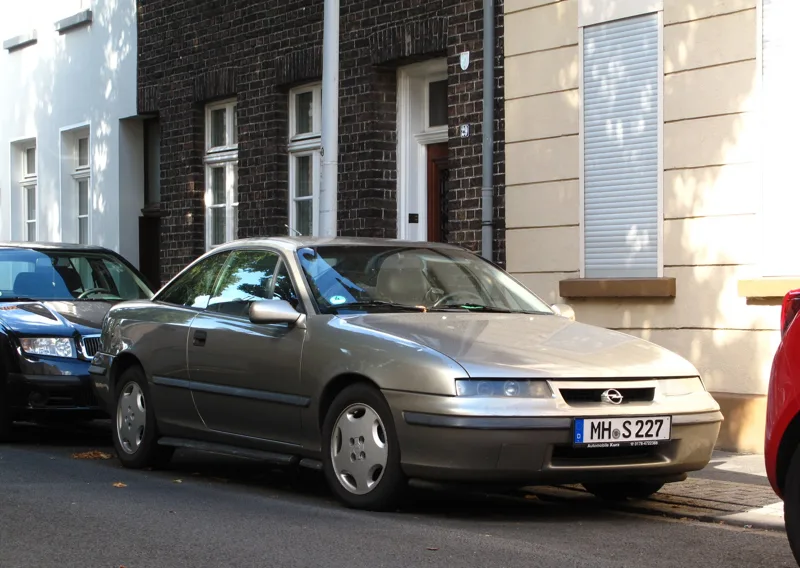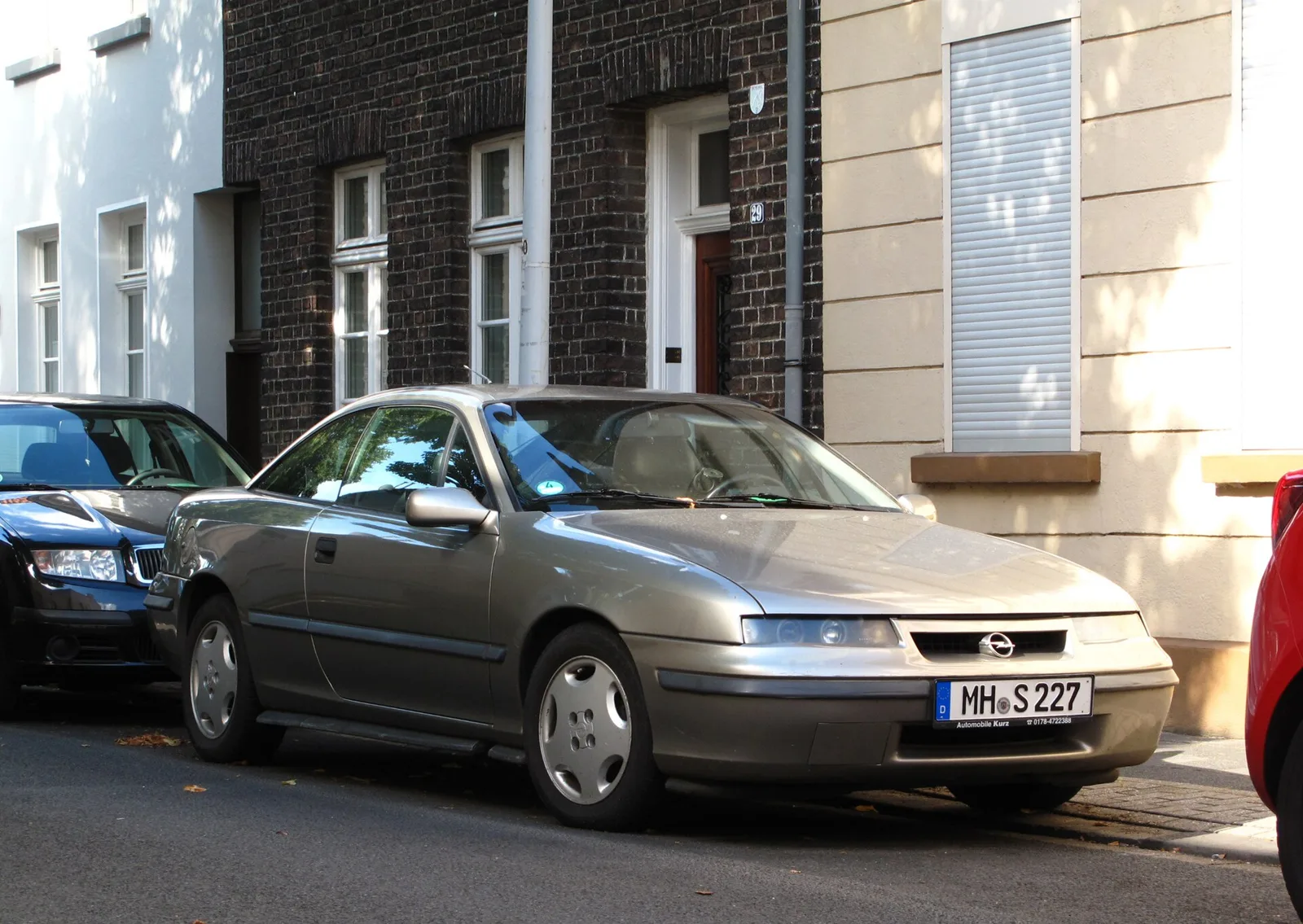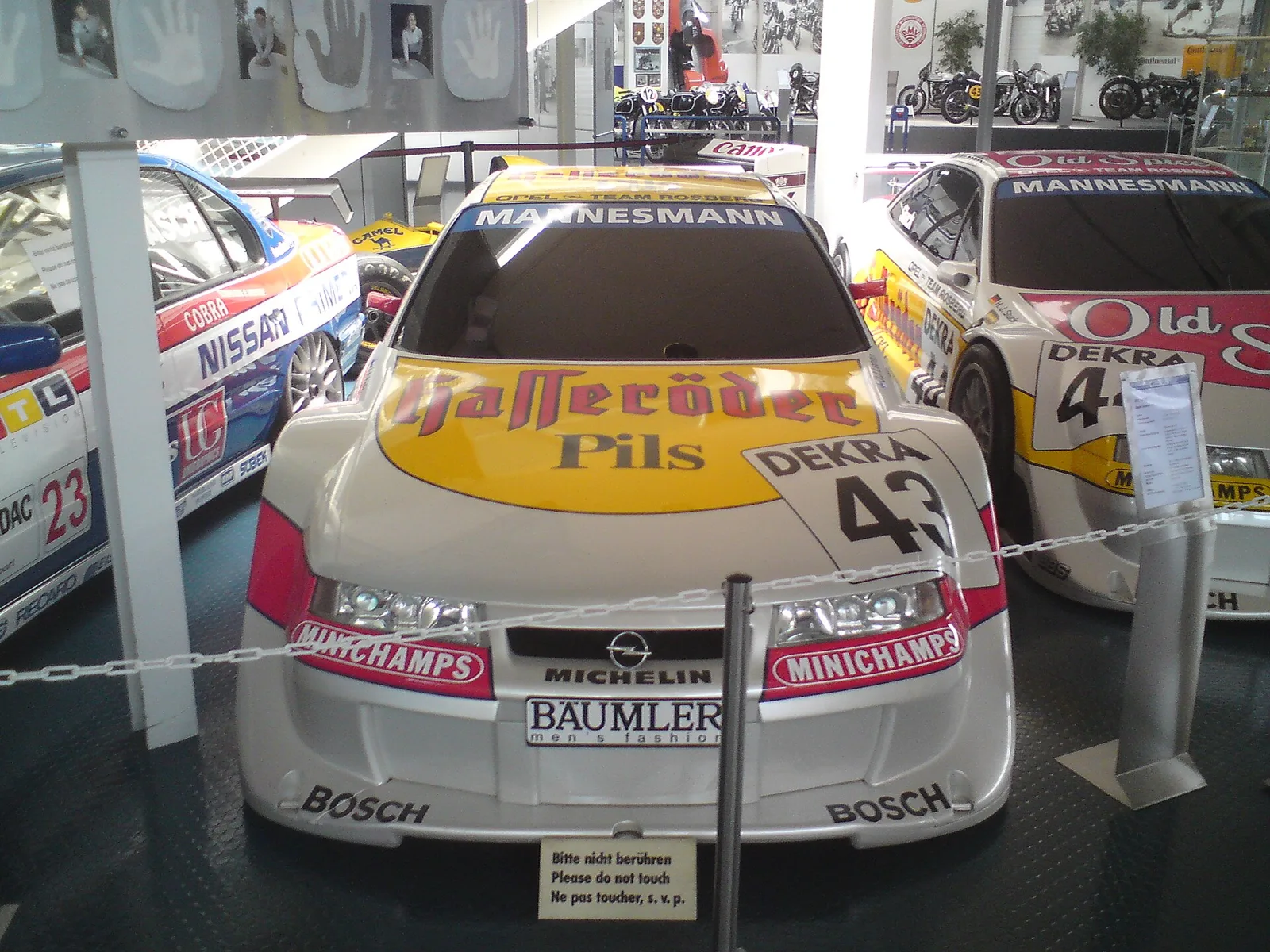
A four-wheel-drive race version of the Calibra, built for the DTM and ITC series, that gave Manuel Reuter his 1996 championship.
The Opel Calibra V6 4x4 was a four-wheel-drive race car built from the road Calibra for the DTM and ITC touring car series. Manuel Reuter won the 1996 championship in it, and the car also reappeared at the 1999 Nurburgring 24 Hours.
Manuel Reuter won the 1996 touring car title in the Calibra V6 4x4, a race car built from Opel's road-going Calibra. The car's story starts with a rule change for 1993 that permitted four-wheel drive, although the Calibra was not ready for that season and its first full year in 1994 was rocky.
What rules shaped the Calibra V6 4x4?
The 1993 regulations replaced a series with several classes by one engine capacity of 2.5 litres, with at most six cylinders. Four-wheel drive was allowed, and the old requirement of 500 cars sold within twelve months was dropped. A large-series model could be used, provided its engine was suited to the company or came from another model range.
Opel's sporting director, Walter Treser, withdrew the Opel Omega from the DTM in 1992 so that a new car could be built for those rules, which the ITR had adopted in 1991. The Calibra with all-wheel drive and a naturally aspirated V6 was not ready in time for the 1993 season.
Reuter beat almost every existing record with the older Phase 3 car at the start of 1995.
How did the Calibra perform in its first race in 1993?
Opel used the car as a test at Hockenheim, the last race of 1993, with the well-known Joest team, which had earned its reputation in Group C sports cars at Le Mans and Daytona. Manuel Reuter qualified fifth, and Keke Rosberg finished seventh in the first race. Electronic problems put both cars out of the second race, which left plenty to improve before 1994.
The first drivers were Reuter, the Le Mans winner, and Keke Rosberg, the former Formula One world champion.
Why was the 1994 season so difficult?
The main innovation of 1994 was the engine, built by Cosworth. It proved very reliable, and Opel had no engine failures until the middle of the season. Officially, however, the unit was not called Cosworth but Phase 3.
The Joest team ran three cars that year, with Reuter and Rosberg joined by the Bremen dealer Louis Krages, who raced under the name John Winter. Recurring braking problems and other minor technical faults caused repeated failures. At the Berlin Avus, John Winter's Calibra caught fire after hitting the guardrail hard, although the driver was not hurt.
How did Reuter win at Donington Park?
The first Calibra victory came in unusual circumstances. An invitational race at Donington Park was not counted in the DTM standings, yet it gave the car its first win. In the first of the two races, Reuter pushed his manager and teammate Rosberg off the track and into a crowd, and he retired.
Reuter then had to start the second race at the back of the field and still finished second. Alessandro Nannini of Alfa had been declared the winner, but a mandatory fuel test led to his disqualification, which made Reuter the first-place finisher.
How did the 1994 season end for Opel?
Opel did not meet expectations that year. Reuter was the best Opel driver with one victory, which was not counted in the championship, and eighth place with 89 points. He showed that he could win respect in the new DTM, although the car itself was still a work in progress.
Rosberg averaged out over the season, but in training he showed what the car could do with good times and a third place at Hockenheim. He finished 14th with 27 points. Krages, as John Winter, scored eleven points and finished 16th.
What changed for the teams in 1995?
For 1995 Walter Treser regrouped his squad, splitting its cars across two teams. The Joest team fielded four cars, with Reuter, Finland's JJ Lehto, France's Yannick Dalmas and Portugal's Ni Amorim. The newly founded Rosberg team, based in Neustadt an der Weinstrasse, ran a second Calibra driven by Klaus Ludwig after his move from Mercedes-Benz.
Practice times were promising, but races kept ending in technical failures. The long-awaited breakthrough finally came at the end of the season. Ludwig won both races at Hockenheim, and Reuter's second place gave Opel its first one-two finish.
Across the season Ludwig finished third in the DTM with 80 points, but in the ITC he had to accept defeat to Reuter. Reuter himself placed 12th in the DTM with 39 points and fifth in the ITC with 50 points, and it was his results that persuaded Opel's chief executive to keep the DTM project going.
Did the Phase 4 Calibra live up to its billing?
Not at first. The Phase 4 Calibra was completely redesigned with parts from several suppliers, including a hydraulic system built by the Williams Formula One team. Malfunctions continued, especially in that system, because the technicians and mechanics had not yet mastered the complex technology.
Reuter beat almost every existing record with the older Phase 3 car at the start of the season, even though the Phase 4 was meant to be the winning car. The races abroad now counted too, which is why the series took the name DTM/ITC with two classifications.
Who drove for Opel in 1995 and 1996?
JJ Lehto finished third at his home race in Helsinki in 1995, Opel's third-best driver after Reuter in the ITC and DTM. Yannick Dalmas finished 18th in the DTM with Rosberg, the pair scoring 17 points each. Keke Rosberg, having founded his own team, was Opel's weakest driver that season and retired from the sport after the DTM finale.
For 1996 Wolfgang-Peter Flohr replaced Walter Treser as sporting director and strengthened the team to win the title. Zakspeed was added and fielded the newcomer Uwe Alzen alongside Klaus Ludwig. Stuck and Lehto moved to the Rosberg team, while Reuter stayed with Joest, alongside Dalmas and the new drivers Alexander Wurz and Oliver Gavin. Gianni Giudici also ran a 1995 Calibra privately.
What were the 1996 results for the Opel drivers?
| Driver | Championship place | Points | Wins |
|---|---|---|---|
| Manuel Reuter | 1st | 218 | 3 |
| Klaus Ludwig | 7th | 170 | 4 |
| JJ Lehto | 5th | 148 | - |
| Uwe Alzen | 8th | 119 | - |
| Hans-Joachim Stuck | 9th | 112 | 1 |
| Alexander Wurz | 16th | 43 | - |
| Yannick Dalmas | 17th | 18 | - |
| Oliver Gavin | 22nd | 16 | - |
How dominant was Opel in 1996?
During the winter break Opel had improved its cars and set a new standard for 1996. Manuel Reuter emerged as Opel's number one driver from the first race. The other Opel drivers were strong too. At Helsinki Opel ran a dominant race, with its drivers taking first to third in both races. Something similar happened at the Norisring, where Ludwig won both races ahead of Alzen and Lehto.
Reuter's victories at Hockenheim and at the Eifel Grand Prix were followed by a tactical drive and steady points collecting. He won the last race in Germany and clinched the title at Sao Paulo. Opel won the championship and the manufacturers' title as well.
Reuter's celebration at Hockenheim cost him a fine: he stopped the Calibra on the start-finish line and got out to celebrate the win.
Why did the DTM/ITC series end after 1996?
Participation costs had become too high. Alfa Romeo and Opel both announced their withdrawal, so the DTM/ITC series came to an end. It did not return until 2000, when Opel was heavily involved.
What happened to the Calibra at the 1999 Nurburgring 24 Hours?
To mark Opel's 100th anniversary, the motorsport chief Volker Strycek entered an older car, a Calibra from the DTM Phase 3 era, in the Nurburgring 24-hour event. It was not planned to run the full distance from the start. At exactly midnight Strycek drove the Calibra off the track toward the marquee where the anniversary party was beginning.
Over 40 laps the Calibra once again showed its class. It gained five seconds per lap on the favourite, the Zakspeed team's Viper.