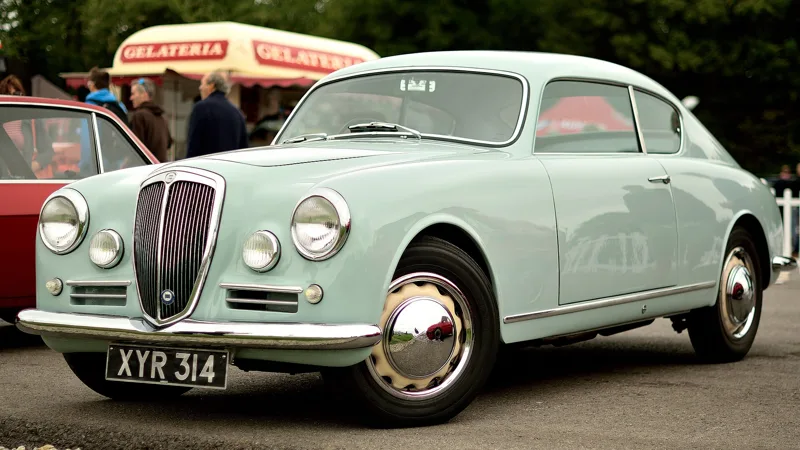
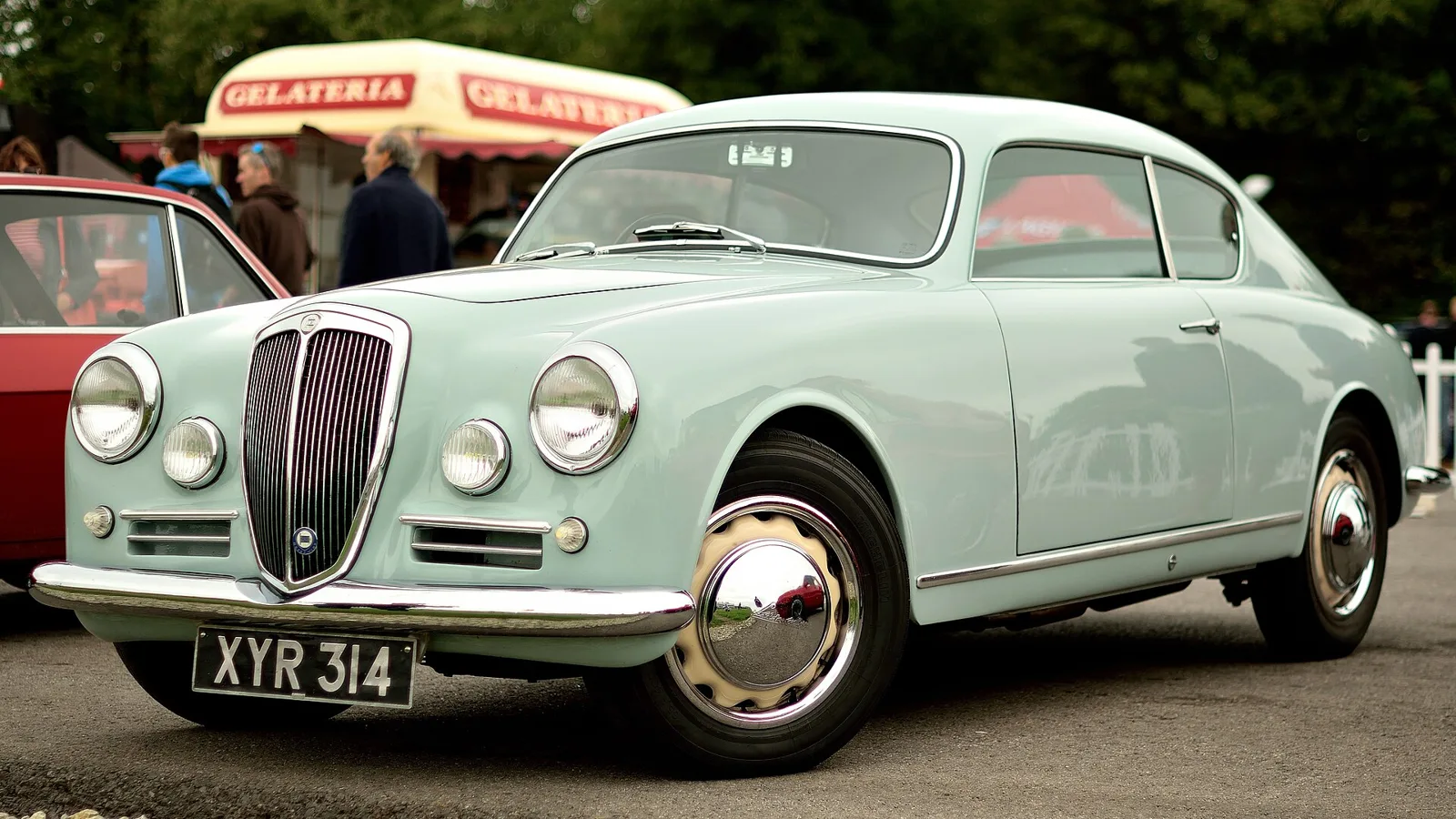
A panoramic-windscreen spider with handle-less doors and no side windows, built on the B20 coupe's mechanics, then reworked into the America convertible and a third series of 371 cars.
The B24 was Lancia's 1955 two-seat spider, a mechanical sibling of the B20 coupe with a 2.5-litre V engine. Lancia built 240 first-series cars, then reworked the car into the America convertible and a third series of 371 units.
The Lancia Aurelia B24 was a two-seat spider, presented in Brussels in January 1955. Its panoramic windscreen, handle-less doors, open sides and folding fabric roof set it apart from the B20 coupe whose mechanics it shared. The car later became linked with the film Il sorpasso, in which Vittorio Gassman drives it.
Where did the B24 come from?
The B24 was a spider that Lancia commissioned from Pininfarina, which had built an open car for the American company Nash in 1952. The first example was seen in Turin during the second half of 1954, and the definitive production car followed at the end of that year.
The project was the idea of young Gianni Lancia, who wanted an elite, sporty product with a line that looked to the trends across the Atlantic. Several stylists worked on it, among them Francesco Salomone, Adriano Rabbone, Aldo Brovarone, Luigi Chicco and Giacomo Borgogno.
Franco Martinengo, a former director of the Pininfarina style centre from 1952 to 1972, is quoted as saying that looking at an Aurelia B24 was not enough, and that you would want to touch it. Some historians rank the spider among the most beautiful cars ever built, which helps explain why it became the Italian icon of the 1950s.
A spider whose doors had no handles and whose windscreen wrapped around the driver, and still it became an Italian icon.
What made the B24 spider look different?
The spider's most noticeable feature was its panoramic windscreen, a wraparound unit framed in chrome brass that was fashionable in the USA. Lancia's classic grille sat at the nose, and the prototype had bumpers made up of four generously sized guards, two at the front and two at the rear.
Doors had no handles. They were opened by a metal cable covered in imitation leather, hidden inside the door itself. There were no side windows, and removable plexiglass panels could be hooked to the top of the doors instead.
The fabric soft top had a tubular frame and folded away into the small space behind the seats. Those seats were wide and sporty, and their backrests tipped forward so that a driver could reach the roof. The three circular dials sat either side of the steering column, while the three-spoke aluminium steering wheel and the curved dashboard completed a sporty cabin.
The tail was very clean, with barely hinted fins that blended into the swelling of the rear wings. The boot was fairly roomy for a car of this type, and the spare wheel lived in a compartment under the boot floor.
Production cars differed from the prototype in a few places. The bumpers changed from four guards to wing-shaped units, the grille badge was modified so its sides converged less towards the bottom, and a slightly protruding band at bumper height made the tail look slimmer.
Inside, the gear lever sat in the centre and the steering column could be adjusted telescopically. There were two door pockets, an open glovebox on the dashboard, and light switches placed where a driver could reach them without taking a hand off the wheel. The seats were covered in imitation leather, with real leather on cars for the USA or when a buyer asked for it. The dashboard was painted in the body colour, or in the interior colour on request.
The speedometer scale ran up to 180 km/h on the production car. The prototype's stopped at 160 km/h, with one further notch at 170 km/h.
How did the first B24 mechanics differ from the B20?
The B24 used the B20's engine, with a few changes. The air filter, fan and water pump were altered so that the engine would fit under a noticeably lowered bonnet. The car kept a 2,451.31 cc (149.6 cu in) 6-cylinder V, giving 118 HP at 5,000 rpm, and it still drove the rear wheels through a 4-speed gearbox with reverse.
The wheelbase was shorter by 20 cm, at 245 cm (96.5 in), and the length was 420 cm (165.4 in) against 437 cm for the B20. The width of 155.5 cm (61.2 in) was almost the same as the coupe's 155 cm. Weight was lower by roughly a quintal, with about 1,120 kg (2,469 lb) in running order, against 1,220 kg for the B20 fourth series.
The fuel tank held 58 litres, against 75 on the coupe, and it sat further forward, just behind the seats. The battery moved under the boot floor, and the brake fluid reservoir was no longer shared with the front suspension oil.
Series at a glance
| Series | Production | Chassis numbers | Engine and power | Notes |
|---|---|---|---|---|
| Pre-series prototype | Second half of 1954 | 0001 | 2,451.31 cc, 118 HP | Right-hand drive; registered August 1955 |
| First series | December 1954 to October 1955 | B24-1001 to 1059; B24S-1001 to 1181 | 2.5 litres, 118 HP (110 HP for the USA) | 240 built, 59 right-hand drive |
| Second series | July to December 1956 | B24S-1182 to 1331 | 2.5 litres, 110 HP | Convertible, officially Aurelia GT 2500 America Convertibile |
| Third series | March 1957 to the end of 1958 | B24S-1332 to 1702 | 2.5 litres, 112 HP | Convertible, officially Aurelia GT 2500 Convertibile; 371 units |
Each B24 series took its mechanics from a B20 series. The first matched the fourth series of the coupe, the second the fifth and the third the sixth. Official records numbered the chassis rather than the series, and the series labels only became common once production had ended.
What happened at the Brussels show?
Lancia showed a B24 at the Brussels motor show, which opened on 15 January 1955. The car was light grey with a red interior, and its chassis number was B24S-1002, the S marking a left-hand-drive car.
Production had only just started. The year-end tally of 1954 showed just one spider completed, and Lancia worked hard to get an example ready for Belgium. Photographs of the Brussels car do not agree on the tyres, since some show white sidewalls and most show dark tyres. White sidewalls do not seem to have caught on for the B24s, and the experiment was probably never repeated.
Did the B24 come with a hard top?
A hard top was not among the accessories the company supplied, but some were made by Pininfarina, in what were probably two styles, and by A. Fontana, a coachbuilder in Padua.
Fixings were three wing nuts at the windscreen end and two at the back. The car shown at Brussels had wheel covers with fake spokes, a choice of debatable taste, but few cars were so equipped because ordinary disc wheels were soon adopted. Wire wheels with tangential spokes were fitted only at owners' initiative years later, after considerable difficulty in mounting them.
How much could a B24 carry?
A B24 in running order weighed about 1,120 kg (2,469 lb), and its maximum permitted weight was 1,270 kg. Assuming a partially filled car, the effective payload was about 170 to 180 kg.
That margin was enough for two people and between 30 and 50 kg of luggage. Empty, the car weighed about 1,060 kg.
What colours did the first B24s come in?
The first twenty-two B24 spiders came in four colours, with seven beige, nine grey, four red and two green. The first light blue car bore number 1148 in summer 1955, a colour destined to become a classic of the model.
The first black car is dated 17 August 1955 and carried number 1159.
Why did so few B24s sell in America?
Sales in America were small, with an estimated 150 to 200 B24s sold overseas in total. About a hundred were convertibles and almost as many were first-series spiders, and the low volume is blamed on a sales organisation that was not very efficient and, above all, on a price that was prohibitive.
A Californian magazine reported in September 1955 that a B24 cost 5,475 dollars. Rivals cost less: the Jaguar XK140, with a 3.4-litre engine, sold for 4,500 dollars in those years, a Porsche for 3,500, and a Corvette for 3,000.
Cars for the USA were built with a de-tuned engine, and they had a horizontal bar between the angled guards of the front bumper. Those cars were rated at 110 HP, and their top speed was 174 km/h (108 mph).
How did the America convertible change the B24?
The America convertible arrived six months after the first series ended, and it debuted at the Turin Motor Show, which opened on 21 April 1956. It lost some power and a few km/h of top speed, but it looked more classic and comfortable than the first car.
The panoramic windscreen disappeared in favour of a less wraparound unit with forward-set, almost vertical pillars. The bumpers were more enveloping and no longer had their distinctive wings. The bonnet air intake was wider and less tall, the doors were wider and now had handles and winding windows, and the dashboard was less rounded.
Production of the second series began in July 1956, and it was supplied only with left-hand drive. By early 1957 the convertible had reached 150 cars, and it then received the same mechanical updates as the B20 coupe. Those included a new carburettor and a small change to the final drive ratio.
The third series looked the same but officially dropped the America name, which also disappeared from the manuals. Deliveries in Italy began on 1 May 1957, and the car stayed in production until 1958, with 371 units making it the largest B24 series.
Did the B24 share a line with the D24 Carrera?
Many people see a likeness between the B24 and the D24 Carrera competition car of 1953. The D24's handsome body is credited, at least in part, to Pininfarina.
The prototype's body had other features that stayed in the production car. These included the soft top that folded behind the seats, the sporty seats that tipped forward, and the removable side panels in place of glass.
Did the B24 race?
The prototype did some competition work. Chassis 0001 was registered in August 1955, and on 3 September 1955 it took part in the Trofeo Supercortemaggiore, driven by Luigi Villoresi and Dorino Serafini. Its race number was 1468.
The prototype's chassis number broke Lancia's usual rule of starting from 1001.
Why is the B24 linked to Il sorpasso?
The car owes part of its fame to the film Il sorpasso, where Vittorio Gassman takes the wheel as the protagonist.
Franco Martinengo's comment about wanting to touch the car explains why the spider is remembered as more than a styling exercise. It stood for the technical progress that Italy was making in the 1950s, alongside other developments of the time.
Was the B24 a success?
The B24 was a short-lived spider that was built in limited numbers and then reworked into the America convertible. Its legacy rests on the design and the film, more than on sales, because it was rare and expensive.
The first Brussels car had fake-spoke wheel covers, but ordinary disc wheels soon replaced them, and the prized wire wheels were fitted only at the owners' initiative years later.