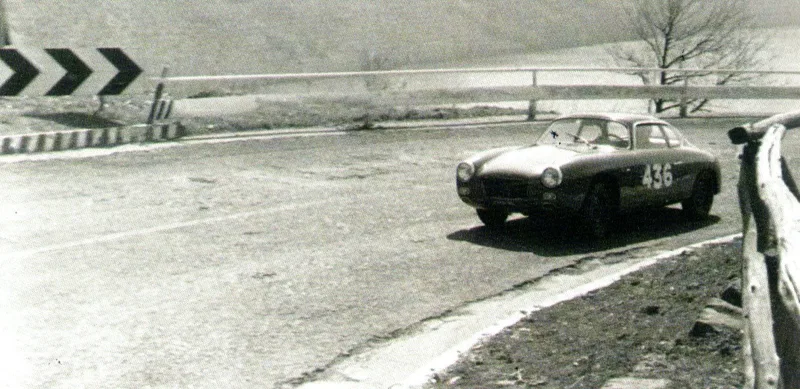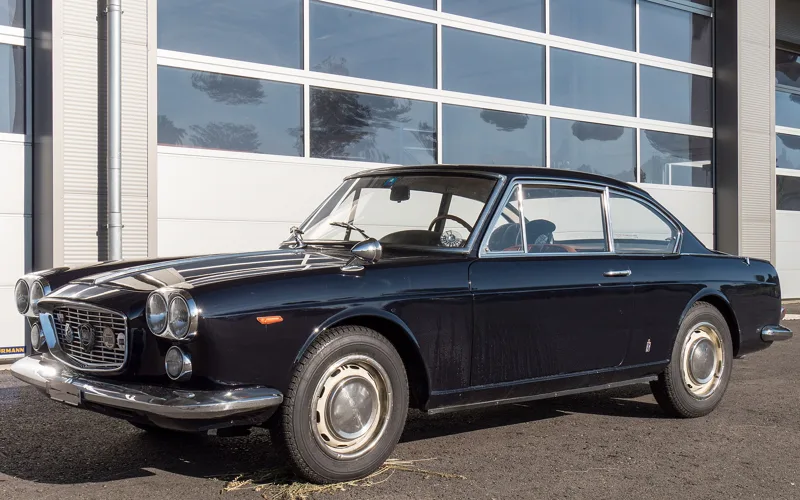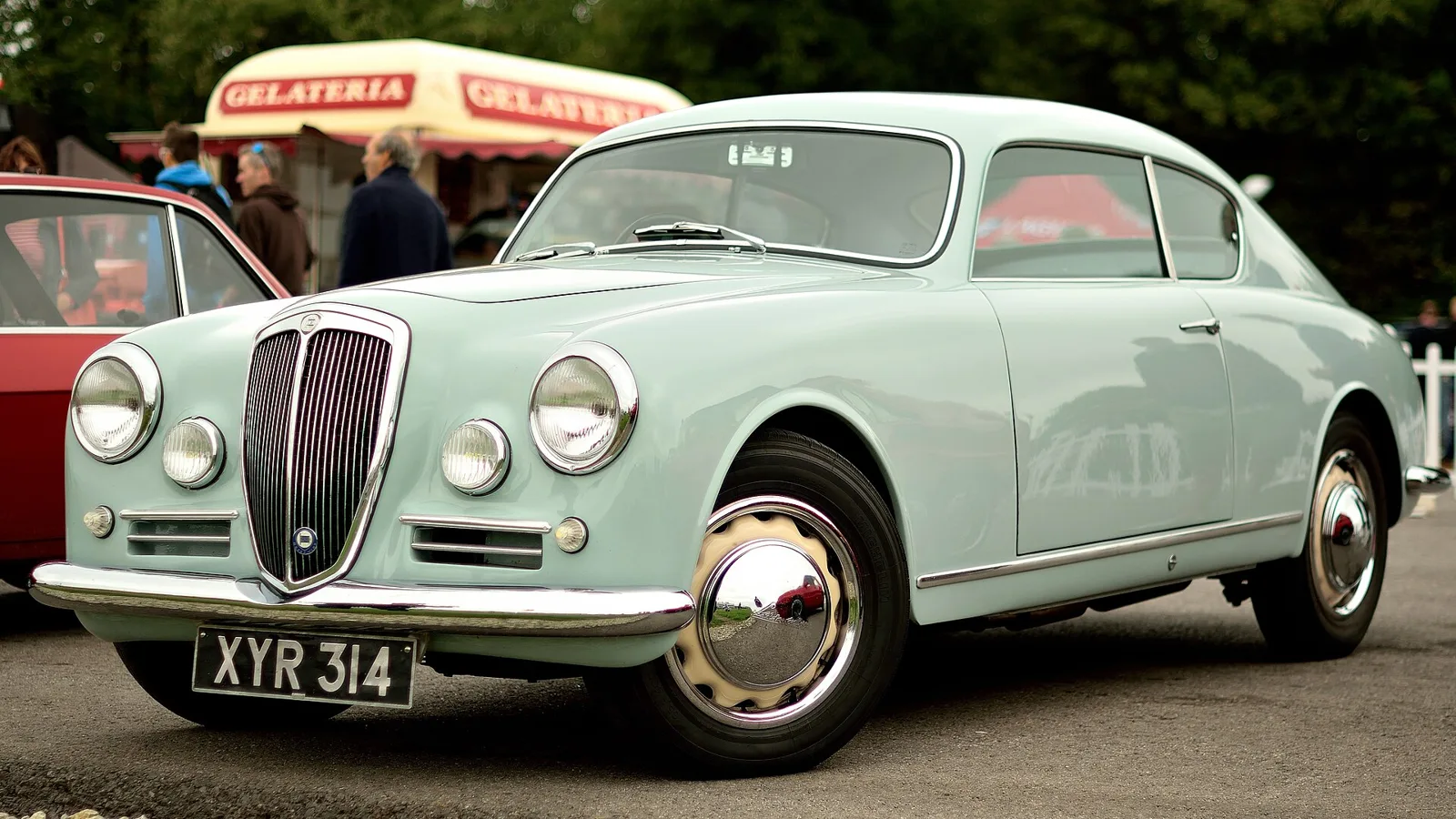
A short-wheelbase Italian coupe with a disputed body line, a 2-litre V engine that grew to 2.5 litres, and six series of production between 1951 and 1958.
The Lancia Aurelia B20 was a two-door coupe built by Lancia from 1951 to 1958. The first cars had a 1,990.97 cc V engine rated at 75 HP, the engine grew to 2.5 litres in 1953, and Pininfarina built 3,773 of the 3,871 coupes.
Lancia showed the B20 coupe at the Turin Motor Show in April 1951, and it stayed in production until late 1958. Built on a shortened wheelbase and powered by a 6-cylinder V engine of 1,990.97 cc (121.5 cu in), it was one of the most agile Italian sports cars of its moment. Its two-seat layout with two more places in case of need introduced the two-seat gran turismo plus two formula.
Who really designed the Aurelia B20 body?
The authorship of the B20 body is still unresolved. Some attribute the line to Ghia, through the pencil of Mario Felice Boano, while others credit Pininfarina. Production records show Pininfarina building the large majority of the cars.
Boano later said that he had drawn the B20 while working with the Ghia coachbuilder. In his account, Gianni Lancia gave the first batch of about a hundred cars to Ghia, which passed the job to Viotti because that firm could manage slightly larger numbers. Pininfarina took over once demand grew, making small changes to some body details along the way.
Ghia passed the work on because its production lines were inadequate. Of the 500 first-series cars, 402 were built by Pininfarina and 98 by Viotti.
The records do not fully support that version. Viotti's 98 cars were spread across the whole first series, from B20-1001 to B20-1405, so Pininfarina was building B20s from the beginning. The Aurelia's designer, Francesco De Virgilio, remembered no role for Boano at all and always believed Pininfarina had created the car.
A third argument cuts both ways. The B20 resembles other Pininfarina work of the early post-war years, yet the Lancia A10 prototype with a V8 engine from the late forties, which Ghia bodied, had a line that partly foreshadowed the coupe. A 1991 book on Ghia is cited for two images of B20s being prepared inside the Ghia plants, offered as further photographic proof of a Ghia role. The question of who drew the lines remains unresolved.
What is beyond doubt is the output. Between 1951 and 1958 Pininfarina built 3,773 of the 3,871 coupes.
Pininfarina built most of the B20s, yet who drew the line is still a question.
How did the first B20 perform?
The first B20 used a 1,990.97 cc (121.5 cu in) six-cylinder V engine rated at 75 HP (55 kW; 74 hp) at 4,500 rpm. Its compression ratio of 8.4:1 required premium fuel, and the car was credited with about 160 km/h (99 mph).
The body was 428 cm (168.5 in) long and 154 cm (60.6 in) wide. The wheelbase was shortened to 266 cm (104.7 in), against 286 cm on the saloon it came from. Kerb weight, filled up and ready to drive, was about 1,070 kg (2,359 lb).
Much of the mechanical package was inherited from the B10 saloon. That meant four independent wheels, familiar controls and a steering wheel and dashboard that drivers of the saloon already knew. The engine also went into the B21 saloon, where it was only slightly de-tuned.
The gearbox offered four speeds plus reverse, with drive to the rear wheels. A longer final drive ratio than the saloon's gave the coupe its extra top speed.
Early cars were fitted with conventional tyres, some with white sidewalls. Later cars switched to radial tyres in place of those first fittings.
What changed in the second and third series?
The second series, from March 1952, raised output to 80 HP at 4,700 rpm and top speed to 162 km/h (101 mph). The third series of 1953 moved to a 2,451.31 cc (149.6 cu in) engine with 118 HP at 5,000 rpm and a top speed of 185 km/h (115 mph).
The second series was easy to spot. It had new steel bumpers without protruding spikes, tail fins at the rear, and a chrome strip below the doors. The number plate moved to a central position low on the nose. Inside, a dashboard with two round dials and a rev counter replaced the clock. The car was 4 cm lower (136 cm instead of 140) and 1 cm longer, and it weighed about 1,120 kg (2,469 lb).
The second series also drew on what the team had learned in the first races of 1951. Its valve gear was reworked, with the valves repositioned and new rocker stands fitted. Opinions differ on the brakes. Some sources put the braking area up from 1,400 to 1,700 cm2, while others say the first series already had 1,700 cm2 and the change was marginal.
The third series gave the B20 a rounded tail once the fins had gone. Its headlamps lost their eyelid surrounds, and the grille no longer had the hole for the emergency hand-crank starter. The body grew to 437 cm (172.0 in) long and 155 cm (61.0 in) wide, and the weight rose by 50 kg to about 1,170 kg (2,579 lb).
The third series kept the two-seat layout, with two extra seats for short journeys. Power, length and weight all rose together, but the basic plan of four independent wheels carried over unchanged from the first cars.
Series at a glance
| Series | Production period | Serial numbers | Engine | Power |
|---|---|---|---|---|
| First | April 1951 to February 1952 | 1001 to 1500 | 1,990.97 cc (121.5 cu in) | 75 HP (55 kW; 74 hp) |
| Second | March 1952 to February 1953 | 1501 to 2231 | 1,990.97 cc (121.5 cu in) | 80 HP |
| Third | March 1953 to December 1953 | 2232 to 2951 | 2,451.31 cc (149.6 cu in) | 118 HP |
| Fourth | Early 1954 to December 1955 | 2952 to 3696, and B20S 1001 to 1255 | 2.5 litres | 118 HP |
| Fifth | Late 1956 to March 1957 | 3697 to 3816, and B20S 1256 to 1435 | 2.5 litres | 110 HP |
| Sixth | April 1957 to November 1958 | 3817 to 4011, and B20S 1436 to 1860 | 2.5 litres | 112 HP |
The 2.5-litre engine stayed in place from the third series to the sixth. Power rose and fell with tuning rather than with size, which is why the fifth series is a story of de-tuning, not a smaller engine.
What made the fourth series different?
The fourth series appeared about a year after the third, and it brought a De Dion rear axle with semi-independent wheels. That is why it became known as the leaf-sprung B20, and it shared that layout with the new B12 saloon shown alongside it at Turin.
Apart from work on the bearings and lubrication and a new carburettor, the car gained polarised green windows like those of the B12, a new black steering wheel and a reversing light. Left-hand drive became available from this series on, and the weight rose by about fifty kilograms.
Why did the fifth series lose its edge?
The fifth series gave up the sporting character. Its new owners, Pesenti, and technical chief Fessia had little enthusiasm for very fast cars or for Lancias in competition. Output fell from 118 HP to 110 HP, and top speed dropped from 185 km/h to 176 km/h.
Production practically halted for about six months, between the end of 1955 and the first months of 1956. Torque fell from 18.5 kgm to 17.2 kgm, and the gearbox was reworked so that fourth gear became a direct drive. Lancia also fitted larger brake drums, which needed different wheel rims with big hub caps that looked a little like alloy wheels.
Other changes were less visible. The tinted glass disappeared, the rear window was enlarged, and a chrome strip ran along the centre of the bonnet. The dashboard became two-tone on some body colours, the seats were revised, and the parcel shelf was now plastic rather than cloth. The car gained about 60 kg, and in running order it approached 1,300 kg.
Left-hand drive was the norm in this series, but Lancia still supplied right-hand-drive cars for the few customers who wanted them. The sixth series, built from April 1957, recovered some power to 112 HP and 180 km/h (112 mph), with door deflectors as its clearest outside sign.
How did the 2.5-litre B20 fare in racing?
The 2.5-litre engine, introduced with the third series, made the B20 a star of Gran Turismo racing for years. Its main rivals were the Alfa Romeo 1900 range, including the Sprint, Supersprint and Turismo Internazionale, and the Fiat 8V, especially in its Zagato-bodied version.
The B20 made its mark in competition almost straight away. The company's later management, though, did not like to see Lancias competing, and that attitude shaped the calmer fifth series.
What did the B20 cost and how many sold?
The B20 launched at 2,600,000 lire, and it still sold 500 examples in less than a year. By 1952 the price had risen to 2,880,000 lire, close to the Fiat 8V at 2,850,000 lire and well below the Alfa Romeo 1900 Sprint Touring at 3,240,000 lire.
Sales held up for the second series, which was built in 731 examples between spring 1952 and the following spring. The third series followed with 720 cars, and the whole run of production was dominated by Pininfarina bodywork.
The Fiat 8V was the closest rival in price. It cost slightly less than the B20 in 1952, and it was faster but more spartan and, above all, more temperamental. The Alfa Romeo 1900 Sprint Touring cost noticeably more than either car, at 3,240,000 lire.
Why do people count the B20 in series?
The series labels are a later convention. Lancia's official data always used chassis numbers, and the 2.5-litre cars were never formally classed by series. Only the first two 2-litre editions were classed by series.
The fourth series was commonly called the leaf-sprung car, after its De Dion rear suspension with leaf springs in place of coil springs. The six-series division only entered common use after the car had gone out of production.
What replaced the Aurelia B20?
The Flaminia was lined up to succeed the Aurelia. In 1957 it was about to go on sale as a saloon, and a Gran Turismo version could be expected later. B20 production ended in 1958, although remaining stock sold on until mid-1959 in small quantities.
The sixth series arrived in spring 1957, when the car's future was already settled. Engineers made a long list of small, secondary mechanical changes rather than a major revision, and the door deflectors are the easiest way to recognise it.
The last B20 to leave the factory did so on 7 November 1958, and it was built with left-hand steering. A right-hand-drive car had come off the line a few months before, on 28 July.
Why does the B20 still matter?
The B20 matters because it opened a formula that enjoyed enormous success over the following twenty years. Its layout, a two-seat gran turismo plus two in case of need, was new, and the car reached the road almost alongside the Alfa Romeo 1900 Sprint as one of the most manoeuvrable Italian sports cars of the moment.
Its suspension, controls, steering wheel and dashboard came largely from the B10 saloon. The coupe was a monocoque with a shortened wheelbase, derived from that saloon.