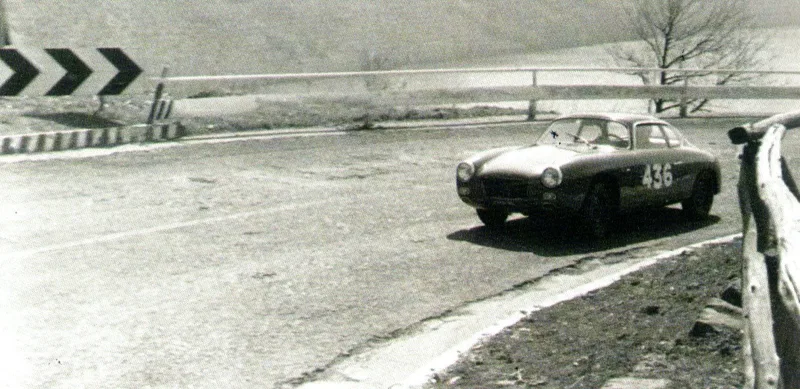
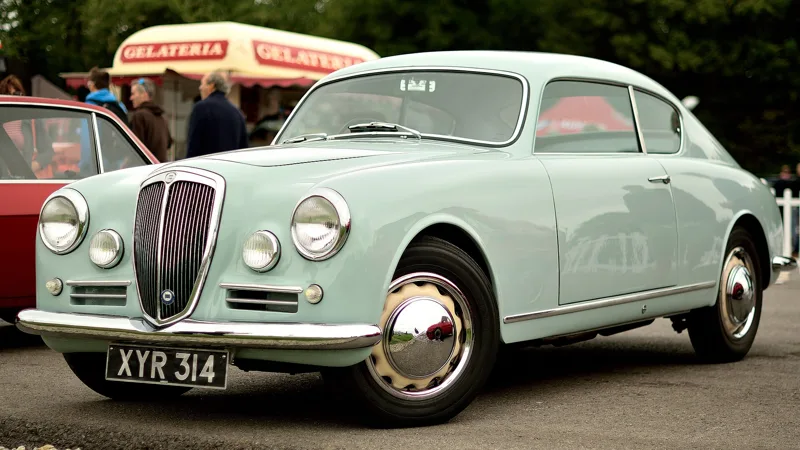
A four-seat coupe from Pininfarina's studio that was built in greater numbers than the saloon it sprang from.
The Lancia Flaminia Coupe Pininfarina was the two-door version of the Flaminia, built in three series from 1959 to 1967 with 5,284 examples made. It grew from the one-off Florida II shown in 1957. Its V6 rose from 119 hp to 140 hp across the range, and it cost 3,100,000 lire at launch.
Between 1959 and 1967, Pininfarina's coupe gave Lancia's Flaminia range a two-door face, built in three series. The carmaker kept it listed until 1970, and it became the most successful model in the whole family. Few contemporary four-seaters could match its 170 km/h top speed.
Where did the Flaminia Coupe come from?
The coupe grew out of a one-off Pininfarina car called the Florida II, which went on show at the Turin motor show in 1957. Its mechanical origin is disputed, with some sources pointing to an Aurelia platform and others to a Flaminia chassis. Either way, the Florida II led directly to the production coupe, which was revealed a year later.
The Florida series had started in 1955 on Lancia Aurelia chassis. Its cars looked like coupes but kept four doors, and the two small rear doors could be opened only from inside, since they had no outside handles. Battista Farina, known as Pinin, used one or two Florida models as his own personal cars for years.
The production coupe kept the general lines of the Florida, but it shared more with the Flaminia saloon. The two small rear doors had gone, and the car was officially launched at the Turin Motor Show in November 1958, twelve months after its forerunner had appeared there.
Across three series the coupe was built a good 30% more often than the saloon it sat beside.
How did the first series differ from the saloon?
The first-series coupe ran on a wheelbase of 275 cm (108.3 in), shorter than the saloon's 287 cm (113.0 in), and its 119 hp engine was a clear step up from the saloon's 102 hp. It dropped the wraparound windscreen and the rear doors, and it reached 170 km/h (106 mph), a speed few four-seat rivals of the era could match.
The body set the coupe apart in small but deliberate ways. Compared with the saloon it had a lowered grille, bumper guards and rear wings cut differently and sloped much less, while the roof met the rear body in a slightly different line, so the rear end was less massive. Inside, a wood-trimmed dashboard, electric window winders and leather upholstery were available from late 1959, some as standard and some for an extra charge.
Disc brakes were a notable feature. The coupe was shown with discs on all four wheels at the Geneva show in March 1959, though the upgrade cost an extra 60,000 lire. After the very first examples, very few coupes ran on the traditional drum brakes.
Small engineering changes followed. In 1960 the steering gained a telescopic hydraulic damper to absorb the kickback that reached the driver's hands, and owners of earlier cars could have it fitted for 20,000 lire. That November the Turin show displayed a coupe with air conditioning, built by the Turin firm I.P.R.A. It was the first experiment of its kind on an Italian series-production car, and it is not known whether any cars were fitted with it from 1961.
Further updates came in 1961, when reversing lights were added and the transmission was reworked. The propeller shaft, which had been split in two, became a single piece. The coupe sat in a segment where comfort, finish and luxury counted for most, but its good engine and sure road manners let some examples, often in the hands of private owners and sometimes helped by the factory, take part in competitions with significant results.
What changed with the 3B in 1962?
The 3B arrived in September 1962 with a single triple-barrel Solex carburettor that replaced three single-barrel units. Power rose from 119 hp at 5,100 rpm to 128 hp at 5,600 rpm, and top speed went from 170 km/h to 178 km/h. Fuel use crept up to 14.3 l/100 km.
The change was more than a carburettor swap. Lancia's V6 used an unusual firing order, so the new unit was designed around it, and the manifold carried three vertical intake ducts feeding one large air filter. Fuller cylinder filling and shorter, almost symmetrical intake runners did the rest, and the car needed a single idle adjustment screw.
The 3B package also brought a modified accelerator linkage, a new fuel pump for steadier petrol delivery, a larger water pump for better cooling and strengthened transmission parts. The 3C designation was used for the versions with three double-barrel carburettors, which set the 3B apart. Outwardly the body was unchanged, and only small 3B badges on the bonnet and boot lid told the versions apart.
Acceleration and pick-up improved, and the list price rose by 80,000 lire to 3,240,000 lire. The 2.5-litre 3B had a short life of just over a year, because in September 1963 the whole Flaminia family moved to the 2.8-litre engine.
How powerful was the 2.8-litre version?
The 2.8-litre Coupe arrived at the Frankfurt Motor Show in autumn 1963. Its 2,774.83 cc V6 produced 140 hp (CUNA) at 5,400 rpm, with 22.5 mkg of torque available from 3,000 rpm. Top speed rose only to 181 km/h (112 mph), but the extra low-speed pull gave a clear gain in pick-up.
The extra capacity came from enlarging the bores from 80 mm to 85 mm, taking the displacement from 2.5 to 2.8 litres. Torque was the real reward here, making the engine feel more elastic in everyday driving. The gearbox and axle ratios were changed to suit, and the brake discs were made a little larger in diameter.
The bodywork did not change at all, so the only outward sign of the bigger engine was the word 2.8 on the tail. Every Flaminia was presented in this form at the Frankfurt show, which means the coupe's upgrade was part of a family-wide change rather than a model-specific one. The coupe remained in production until 1967, and it was still available until early 1970, when every Flaminia finally left the price lists.
What did a Flaminia Coupe cost?
At launch in January 1959 the coupe cost 3,100,000 lire, almost as much as eight Fiat Nuova 500s, while the saloon cost 2,940,000 lire. Across the decade the coupe's premium stayed between about 5% and 8%. The list price peaked at 3,580,000 lire in January 1969 and held there until February 1970.
Pininfarina's careful, almost artisanal construction justified the premium, and the market segment the car was aimed at allowed it. The 2.8 went on sale in September 1963 at 3,440,000 lire, and that price stayed unchanged until November 1968.
The January 1969 rise was partly a bookkeeping matter. The new list included General Revenue Tax (I.G.E.) at 4%, which had previously been paid on top of the price, so the actual cost to buyers barely moved.
How well did it perform on the road?
Three magazines reported on the car, and all three tested first-series cars fitted with the 2.5-litre engine and a single double-barrel carburettor. The weekly L'Automobile, published by the Automobile Club d'Italia, praised its flexibility and steering in 1959, while The Autocar and Ruoteclassiche went further with measured tests.
The ACI weekly made no measurements at all. Its impressions, published in issue 36 of 6 September 1959, were a list of strengths: flexible running, an easy gearchange, excellent forward visibility and a steering wheel that was simple to handle. Its report is useful mainly as a snapshot of how the coupe felt to a driver new to it, rather than as a set of numbers.
The Autocar test
The English magazine ran its test in 1960 over about 1,700 km. It concluded that the car was expensive at home and especially in England, where it came close to 4,000 pounds sterling, yet it praised the build quality, the level of finish and the handling. The kerb weight with 25 litres of fuel was 1,481 kg (3,265 lb).
It reached 170.0 km/h (106 mph) at its top, with a best run of 172.3 km/h (107 mph). From 0 to 97 km/h took 13.6 seconds and the standing quarter mile took 19.1 seconds. Fourth-gear pick-up from 32 to 97 km/h took 23.9 seconds, and a steady 100 km/h in fourth used 10.6 litres per 100 km.
The Ruoteclassiche test
Ruoteclassiche published a short test in issue 107, dated June 1997, on a first-series car from 1959 to 1962. It recorded 166.4 km/h (103 mph) at the top. From a standing start it reached 100 km/h in 16.50 seconds, and from 100 km/h it stopped in 61.40 metres. The magazine found the car still performed admirably after three decades.
How many were built?
The Flaminia Coupe was built in 5,284 examples across its three series, a good 30% more than the saloon. The first series accounted for 3,201 cars and the 3B for 950, and only the 1,133 figure some sources give for the 2.8 makes the three totals add up to 5,284.
Production ran from early 1959 to 1967, with the 2.8 accounting for the final years of output. Both engine sizes stayed listed until October 1968, probably so that the stocks of engines could be used up before the change.
Serial numbering carried across the series change. The left-hand drive first series ran from 1001 to 4053, and the 3B continued from 4054 to 4966. Right-hand drive cars were numbered on their own track, from 1001 to 1148 for the first series and from 1149 to 1185 for the 3B.
The first-series count also includes one special case. A left-hand drive chassis was used by Raymond Loewy, who had his own Loraymo bodied by Motto on it, so that single car sits inside the 3,201 total.
Left-hand drive dominated the output. The first series made 3,052 left-hand drive cars against 148 right-hand drive, and the 3B made 913 against 37, so right-hand drive was clearly a small corner of the coupe's market.
What made the Flaminia Coupe matter in Italy?
It was the most successful model in the Flaminia range, and it combined Pininfarina styling with four seats, brisk performance and disc brakes. The more sporting Flaminias built by Touring and Zagato stood beside it, yet this coupe was the one that sold best across the whole family. Private owners, sometimes helped by the factory, entered their cars in competitions, and the results were significant.
Many judged the coupe one of the masterpieces of Pinin's career, and Pininfarina was ready to adapt a near one-off on request, with special colours or accessories outside the catalogue. That flexibility made each car a little more personal than its list specification suggested.
Specifications at a glance
| Feature | First series (1959-1962) | 3B (1962-1963) | 2.8 (1963-1967) |
|---|---|---|---|
| Type | 823.00 / 823.01 | 823.02 / 823.03 | 826.030 / 826.031 |
| Engine | 2,457.98 cc V6 | 2,457.98 cc V6 | 2,774.83 cc V6 |
| Power | 119 hp (DIN) at 5,100 rpm | 128 hp (DIN) at 5,600 rpm | 140 hp (CUNA) at 5,400 rpm |
| Wheelbase | 275 cm (108.3 in) | 275 cm (108.3 in) | 275 cm (108.3 in) |
| Length | 468 cm (184.3 in) | 468 cm (184.3 in) | 468 cm (184.3 in) |
| Kerb weight | 1,420 kg (3,131 lb) | 1,450 kg (3,197 lb) | 1,450 kg (3,197 lb) |
| Top speed | 170 km/h (106 mph) | 178 km/h (111 mph) | 181 km/h (112 mph) |
| Units built | 3,201 | 950 | 1,085 |