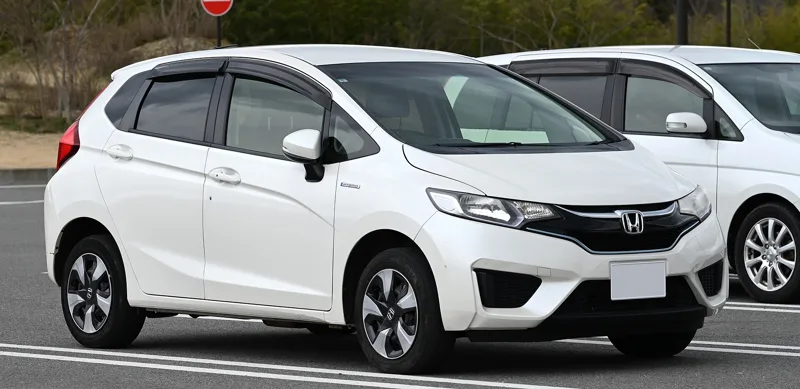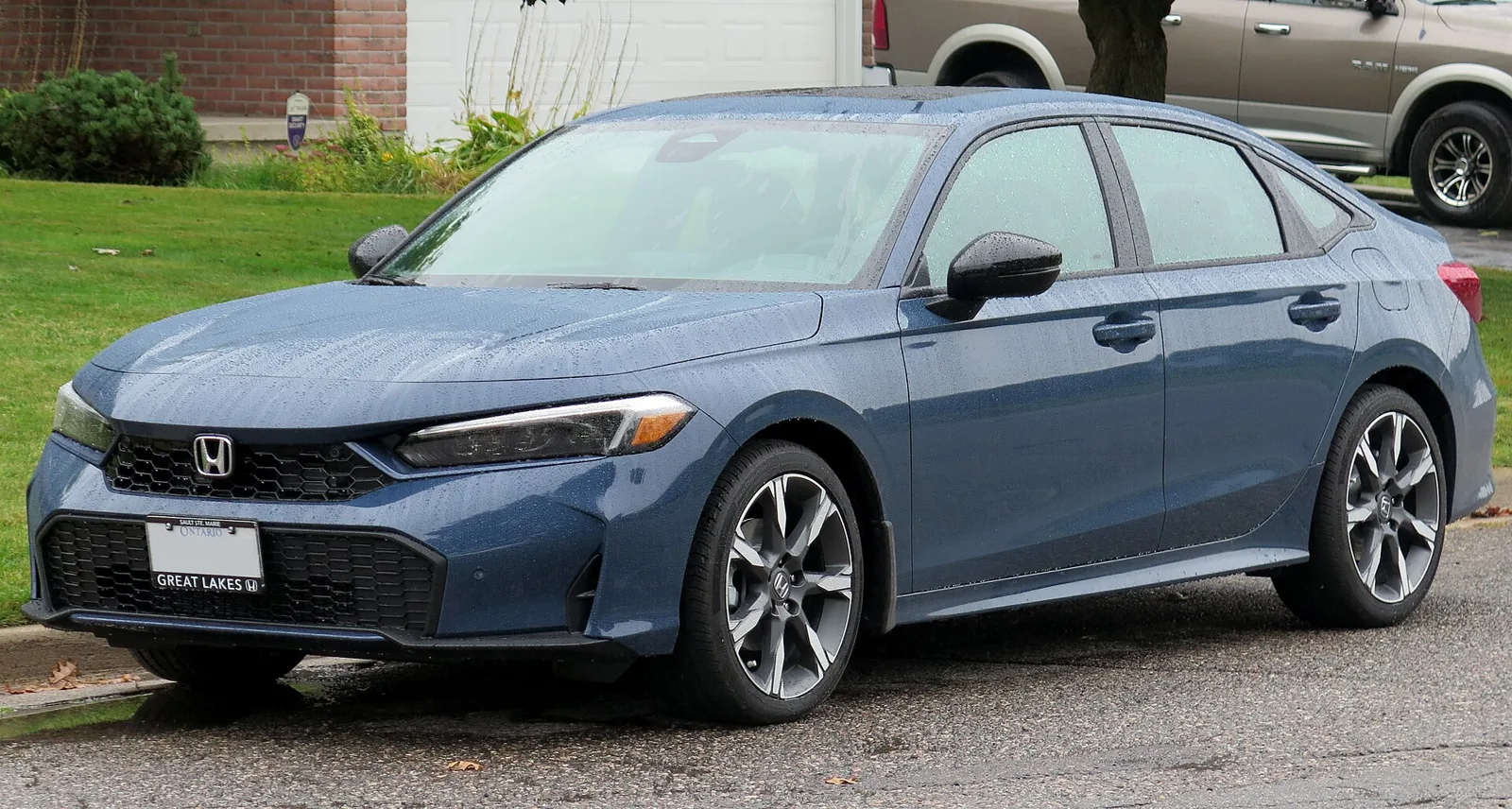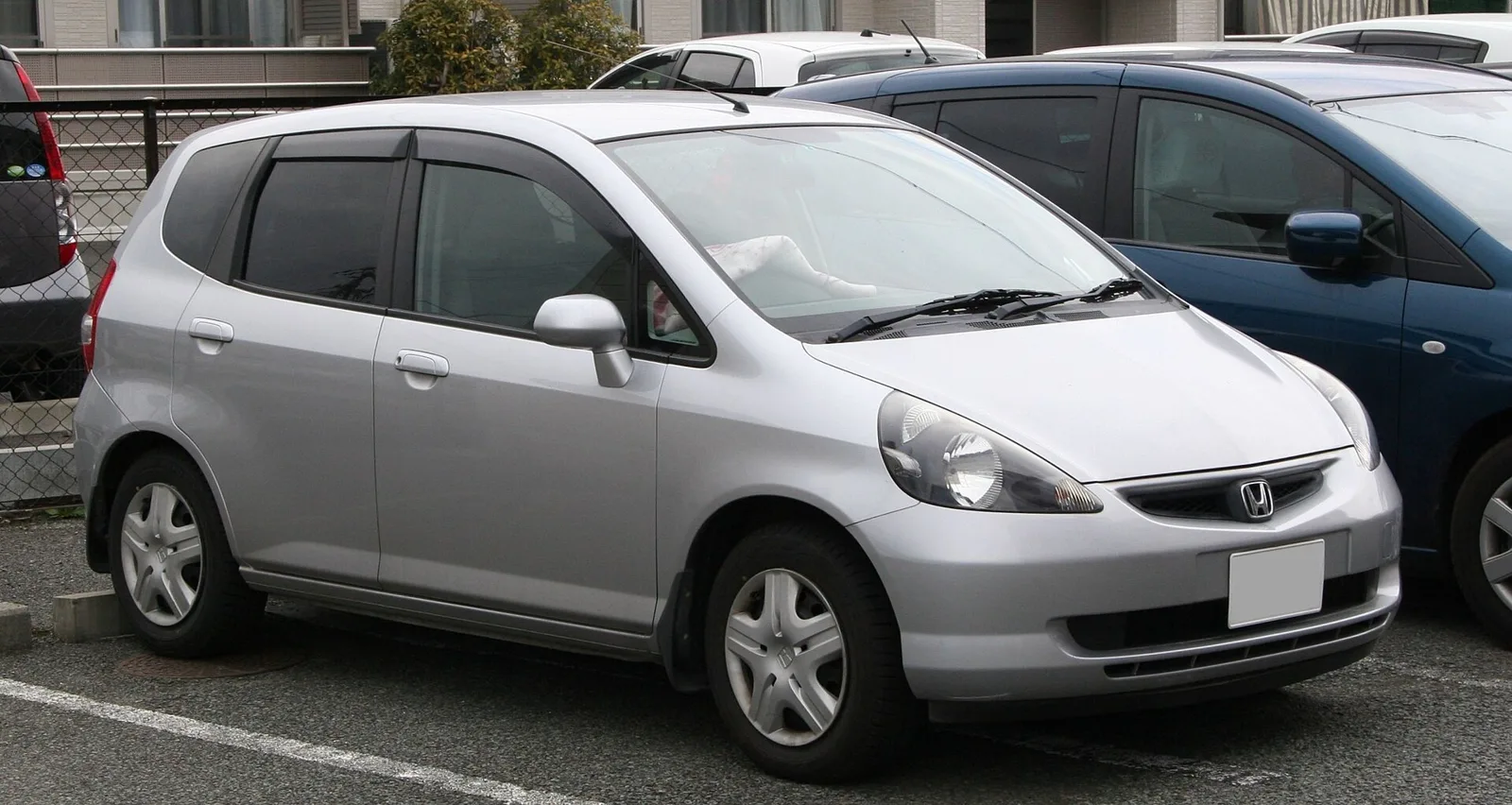
A fuel tank moved under the front seat let the Fit fold its rear seats low, and that packaging trick carried the car through many markets.
Built from 2001 to 2008 and sold as the Jazz in most markets, this supermini offered flexible cargo space thanks to a tank placed under its front seat. Its engines ran from 1.2 to 1.5 litres, and the body shared a platform with a family of smaller Hondas.
The first-generation Honda Fit was a subcompact, or supermini, built from 2001 to 2008. It was known as the Jazz in most markets outside North America, and it used a fuel tank under the front seat to give the rear seats an unusually low fold. That packaging, and a flexible cargo area, helped the car reach many markets from Japan to Brazil and Thailand.
When did the Fit reach each market?
The Fit debuted in June 2001 in Japan. It followed in Europe in early 2002, in Australia in late 2002, in South America in early 2003, and in South Africa and Southeast Asia in 2003. China received it in September 2004 and Mexico in late 2005.
The North American version was first shown on January 8, 2006, at the Detroit auto show. Canada got the car on April 3, 2006, and the US on April 20, 2006, as a 2007 model year. The North American car was replaced after only two model years by a 2009 model, while Japan received that newer design in November 2007 as a 2008 model.
A fuel tank moved under the front seat turned an ordinary subcompact into one of the most flexible cargo cars of its class.
Why did the Fit's rear seats fold so low?
The petrol tank was packaged beneath the front seat rather than the rear seats, and a compact, semi-independent H-shaped torsion beam rear suspension was fitted. Together those choices lowered the load floor and increased cargo volume. The result was a flexible cabin with more room behind the rear seats than many rivals offered.
The Fit was credited with approximately twice the storage behind its rear seats compared with the Toyota Yaris hatchback.
How did the Magic Seat modes work?
The layout allowed a multiple-mode seating system, called Ultra Seat in Asia and Magic Seat in North America and Oceania. Normal mode seats five. Utility mode folds either or both sections of the 60:40 split rear seat onto itself, creating a flat load surface. Long mode folds the rear seat behind the passenger and moves the front passenger seat back, making room for items up to 2.4 meters (7.9 ft) long.
Tall mode folds the rear seat cushion up against the seatback, giving 1.28 meters (4.2 ft) of height. Refresh mode removes the front headrest so the seatback can fold into a lounge-style sitting area, although this was not offered in every market. Honda's chief engineer, Kohei Hitomi, said the seating design grew from watching how shoppers stored their things in supermarkets.
Ultra Luggage went one step further in some markets. Honda removed the spare tyre in those cars, using the spare well as part of a Tall-mode cargo area behind the rear seats. A flexible flap then offered three rear storage configurations.
Which engines did the Fit use?
The Fit used engines from Honda's L-series family, in 1.2, 1.3 and 1.5-litre sizes. The 1.3 and 1.2 units were i-DSI engines, which use two spark plugs per cylinder so the fuel burns more completely. That lowers fuel use and emissions while keeping torque at mid-range revs.
The 1.5-litre VTEC engine had a conventional 16-valve layout designed to maximise output at high revs. In Europe the 1.3 i-DSI was marketed as a 1.4 L, so buyers saw it as a step up from the 1.2. The chosen engine depended on the market, as did the gearbox.
What transmissions and platform did the Fit share?
The engines were paired with a five-speed manual, a five-speed automatic and a continuously variable transmission, depending on the region. The CVT was not offered in the United States before 2015. The CVT-7 variant simulated seven gears, controlled by paddle shifters on the steering column, while still delivering a smooth flow of power.
The Fit used Honda's Global Small Car platform, which also underpinned the Fit Aria and City sedan, the Airwave station wagon, and the Mobilio and Mobilio Spike.
Where was the Fit built?
The first-generation Fit was produced at six locations: Suzuka in Japan, Sumare in Brazil, Guangzhou in China, Ayutthaya in Thailand, Karawang in Indonesia and Laguna in the Philippines. Japanese-built models served Honda's home market, Europe, some Asian markets, Australia until the end of 2005, Canada and the United States.
The Brazilian factory supplied Mexico, Latin America and the Caribbean. Models for Malaysia, Singapore and Vietnam came from Thailand. Chinese models were sold in mainland China, while a dedicated export plant supplied some left-hand-drive European markets.
How did the Fit sell in Japan?
Japan offered two engines, the 1.3 i-DSI and the 1.5 VTEC, with trim lines running from the basic Y to the sporty S. The 1.3 was sold only with the regular CVT. The 1.5 VTEC with CVT-7 arrived in September 2002, and a five-speed manual joined the larger front-wheel-drive engine in June 2004. Four-wheel drive was also available.
Japan's options list was long, and the most notable was Honda's HDD GPS navigation system, called Internavi, with a 6.5-inch (170 mm) colour screen that also handled TV and FM radio. In Japan the Fit took over the segment previously served by the seventh-generation Civic, which had grown beyond the government's 1700 mm width limit for its class.
How did the Jazz perform in Europe?
In Europe the Jazz also had two engines. The 1.2 i-DSI was the base model in many countries and was sold only with a five-speed manual. The 1.4 was identical to the 1,339 cc 1.3 i-DSI sold in Japan, but was marketed as a 1.4 L to set it apart from the smaller 1,244 cc unit, a little closer to 1.3 L than the larger engine was to 1.4 L.
All European Jazz models had anti-lock brakes, with front discs and rear drums or discs. Side airbags were standard on high-end versions. The Jazz became Honda's best-selling model in Europe, taking 30% of the company's European sales.
How did the Fit do in China and Brazil?
Local production and sales of the hatchback in China began in September 2004, about a year after the City sedan arrived in September 2003. China offered the same engines and gearboxes as Japan, across four models in total. The sedan version carried the City and Fit Aria names.
Brazil became the second production base after Japan, starting in April 2003. Its trims ran from LX with a 1.35 i-DSI engine and a driver airbag, through LXL with a passenger airbag and ABS, to EX with the 1.5 VTEC. Honda Brazil began selling an alcohol and gasoline hybrid Fit in mid-December 2006, for the 1.35 engine only, rated at 80 hp (60 kW) on petrol and 83 hp (62 kW) on alcohol.
How did the Fit sell in North America?
Sales in the United States and Canada opened in April 2006 as a 2007 model. It replaced the seventh-generation Civic hatchback in North America and became the region's chief entry-level subcompact. The Civic had grown in size and price, and it had been reclassified as a compact in 2001.
North American cars had power windows, standard side airbags, side-curtain airbags and ABS, alongside the mandatory front airbags. Different safety rules meant larger bumpers and a longer front clip, which increased overall length slightly. The United States offered Base and Sport variants, while Canada had DX, LX and Sport.
Every North American Fit shared the 1.5-litre engine rated at 109 hp (81 kW), with a five-speed manual as standard. A conventional five-speed automatic was optional, replacing the CVT used elsewhere. For 2008 the US cars gained tyre pressure monitoring, which warned of low pressure but did not say which tyre was low.
Sales rose quickly. US sales were 27,934 in the 2006 calendar year and 56,432 in 2007. In 2008 they reached 79,794, an increase of almost 41%, even though the price rose by roughly US$100. Canadian buyers could also claim a $1,000 government rebate, which the 2007 car narrowly missed. Honda Canada reimbursed 2007 buyers, and a revision to the federal ratings let the 2008 car qualify.
How did critics receive the Fit?
Honda marketed the Fit as Small is the New Big. Car and Driver praised its standard equipment, upscale interior and handling, and its lane-change test speed of 71.4 mph beat the best run by a Ferrari F430 Spider F1 it had tested. The magazine included the Fit in its 10 Best Lists three times.
In May 2006 Car and Driver ranked the Fit first among seven economy cars, which included the Nissan Versa and Toyota Yaris. Consumer Guide described the Fit as a small wagon that challenged some compact SUVs for room, while giving noticeably better fuel economy.
How was the Fit sold across Asia and Oceania?
In Australia the Jazz went on sale in October 2002, with the base GLi powered by a 1.34-litre i-DSI engine. The VTi added the 1.5-litre VTEC, sports trim and mirror-mounted indicators, and the VTi-S had a sports body kit, fog lights and 15-inch (380 mm) alloy wheels. Late in 2005 Honda Australia began importing the Jazz from Thailand, which allowed significant price cuts.
The Australian range shrank in colour choice to six, down from twelve in Japan. In 2006 a free trade agreement between Australia and Thailand meant every Australian Jazz was built in Thailand. Owners could tell a first-generation car by a dot on the J in Jazz on the rear: blue for the 1.5 and red for the 1.3.
In Malaysia the Jazz came as a 1.3 i-DSi or 1.5 VTEC, both with CVT-7 and front-wheel drive. Indonesia's Jazz became the fourth best-selling car there, and the local Karawang plant took over assembly after an early import phase. In the Philippines the Jazz was sold under that name from 2004 until 2008, with trims running from a basic 1.3 A to a 1.5 V.
How safe was the first-generation Fit?
Euro NCAP tested a 2004 Honda Jazz 1.4 SE, and the Jazz became the supermini with the best overall combined safety performance in its class.
Under the North American system, the 2007 Fit was rated with NHTSA crash scores for frontal and side impacts, rear passenger side and rollover. In keeping with Honda's safety initiative, side and side-curtain airbags were standard alongside the mandatory front airbags.
What were the Honda Fit's key specifications?
| Specification | Detail |
|---|---|
| Production | 2001 to 2008, Jazz name in most markets |
| Japan debut | June 2001 |
| North American debut | January 8, 2006; 2007 model year |
| North American engine | 1.5 L, 109 hp (81 kW), five-speed manual standard |
| European 1.2 engine | 1.2 i-DSI, 1,244 cc, five-speed manual only |
| European 1.4 engine | 1,339 cc 1.3 i-DSI, marketed as 1.4 L |
| Brazil flex-fuel output | 80 hp (60 kW) gasoline; 83 hp (62 kW) alcohol |
| Long cargo mode | 2.4 meters (7.9 ft) |
| Tall cargo mode | 1.28 meters (4.2 ft) |
| Japanese navigation screen | 6.5-inch (170 mm) colour display |
| US sales | 27,934 in 2006; 56,432 in 2007; 79,794 in 2008 |