Factory specials, dealer packages, race cars, concepts and third-party builds that have flanked the Mustang since its 1964 launch.
The Ford Mustang has been offered in many variants since 1964, from Boss race cars and Mach 1 performance models to Bullitt, Warrior and the 800 hp GTD. Many were made by Ford, while others came from Shelby, Roush, Steeda and Saleen.
Ford Mustang variants are the factory, dealer, third-party and concept versions of the Mustang that have appeared since the car's 1964 launch. Most are performance models or limited editions, with minimal cosmetic changes so the car still looks like a standard Mustang. The range runs from the Boss race cars of the late 1960s to the 800 hp GTD of 2025.
How did the first Mustang concepts differ from the production car?
The Mustang I was a small, mid-engined four-cylinder open two-seater with aluminium bodywork, shown in 1962. It was a design exercise, and it shared few elements with the production car, although it lent the Mustang its name and the galloping horse logo. The Mustang I's fake louvres recreated the radiator scoops of the two-seater.
The Mustang II of 1963 was a different kind of car, a front-engined V8 two-plus-two that closely resembled the production model due in 1964. It debuted at the 1963 Watkins Glen Grand Prix, then spent a short time as a show car before becoming a test mule. The sole example survives in storage at the Detroit Historical Museum.
The production car was developed as a front-engined four-seater, known inside Ford as the T-5 project, using Falcon and Fairlane components to speed development. The 1963 Mustang II concept also briefly carried the T-5 designation.
Ford's Mustang variants range from one-off race cars to limited editions sold to military buyers, most looking much like the car next to them.
Which concepts previewed later Mustangs?
The 1993 Mach III concept, shown at the Detroit International Auto Show, offered a glimpse of the Mustang's near future. It was powered by a supercharged 4.6L DOHC V8 producing 450 hp (336 kW). The 1994 production car was not close in design to it, but the concept hinted at where Ford would take the flagship.
Ford's 2004 GT concept coupe and convertible were shown at the 2003 North American International Auto Show, after the production 2004 Mustang had been finalised. The GT's 400 hp (300 kW) supercharged 4.6L V8 came with a six-speed manual in the coupe and a five-speed automatic in the convertible. Its hood had twin scoops in a U-shaped channel, and the interior was trimmed in red leather with black accents.
The 2005 GT-R was a concept that signalled a focus on the racing market. It had a 440 hp (328 kW) 5.0 Cammer V8, a wider body and GT-R wheels with Brembo brakes and Pirelli slick tyres. Its Valencia Orange paint took its cue from the Grabber Orange Boss 302 Trans-Am racers.
At the 2006 Los Angeles show Ford unveiled the Giugiaro Mustang concept, designed by the Italian firm Italdesign and led by Fabrizio Giugiaro. Italdesign also designed the 1965 Bertone Mustang, which was the first European-styled car to debut in America after the Second World War.
Why were some Mustangs sold as T-5 in Germany?
Ford sold the Mustang overseas, and the American military was an important customer base. The name was a problem in Germany, however, because it had been copyrighted by the German conglomerate Krupp for a small truck. Ford therefore exported Mustangs to Germany under the T-5 name.
For those cars the Mustang name was blanked out from the steering wheel hub, side nameplates, grille and rear fuel filler, and the words FORD were used instead. The T-5 emblem sat on the front fender where the Mustang badge would normally be. Otherwise the cars were identical, and almost every model and package was available, including the GT.
Krupp's brand rights on the name expired after 1979, so Mustangs imported to Germany from 1980 kept the Mustang name. The T-5 designation had also applied to the thirteen prototypes built before production began.
What were the dealer-built and regional Mustangs?
The High Country Mustangs were a dealer promotion for Colorado-area Ford dealers. They were built in 333 units in 1966, 400 in 1967 and 251 in 1968. The first two years were little more than special exterior colours and a triangular HCS emblem, while the 1968 car became a hardtop only and borrowed Shelby rear-end treatments.
The Ski Country Special was a winter 1967 dealer package that was not limited to the Mustang. It came with a ski rack, a luggage rack, a limited-slip axle, a unique emblem, two snow tyres and five new colours, including Vail Blue and Aspen Red.
In 1968 the Mississippi Ford dealers in New Orleans offered a dealer-built Challenger Special. It paired a 302 4v with a plain body in the 1968 model year, and some cars were fitted with Shelby manifolds and Holley carburettors. Its power-to-weight ratio let budget buyers enjoy Shelby-style performance without the cost.
How did the Boss Mustangs work?
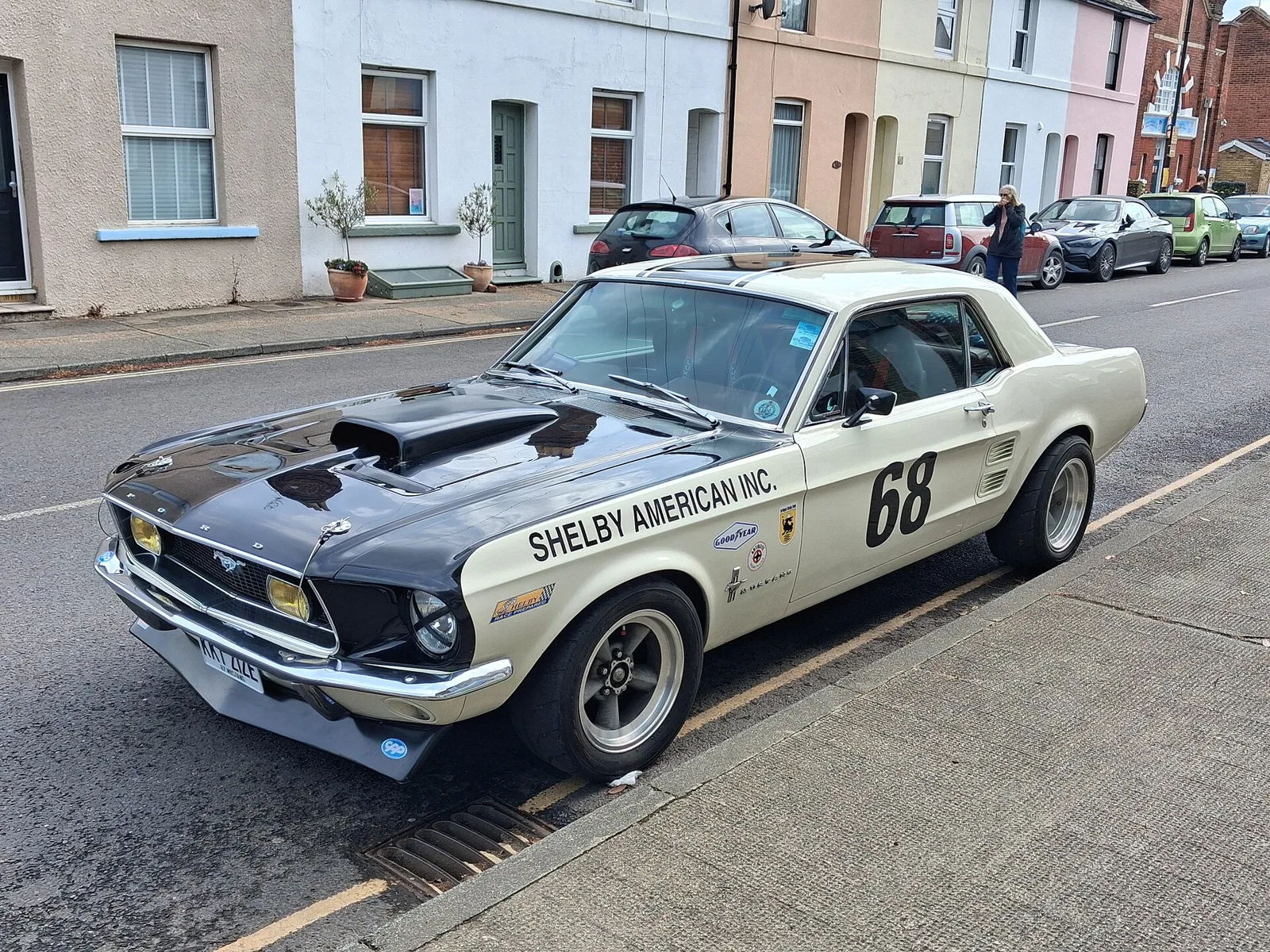
The Boss 302 was built for the 1969 and 1970 Trans-Am racing series. It later became the most popular Boss Mustang Ford produced. Its successor, the Boss 351, arrived in November 1970 as one of the last high-performance Mustangs. It was based on the SportsRoof and replaced both the Boss 302 and the Boss 429.
The Boss 351 engine was a 351 Cleveland four-barrel with a mechanical cam, solid lifters and an 11.0:1 compression ratio. It had an aluminium intake and a four-bolt main-bearing block, topped with a new 750 CFM Ford four-barrel carburettor. The engine produced 330 hp at 5,400 rpm.
The Boss 429 debuted in January 1969, and it was built mainly so Ford could campaign the engine in NASCAR. NASCAR rules required that any trick part be fitted to at least 500 cars sold to the public. The engine was rated at over 370 hp, with aluminium heads, large valves set at an angle and a 735 CFM Holley carburettor on a high-rise manifold.
The Boss 302 was revived as a race car in 2012. The FR500 name had come from Ford Racing's 2005 to 2009 S197 cars, sold as turnkey competition cars without VINs. The FR500S used a 320 hp 4.6L with a Tremec T56R, and the FR500C ran a 420 hp 5.0L Cammer.
What were the Mach 1 and Cobra models?
The original Mach 1 ran from 1969 until 1978 as a performance model. The name returned in 2003 and 2004 to keep interest high before the S197 platform arrived. The new Mach 1 had a non-supercharged aluminium DOHC 4.6 V8, rated at 305 hp, or 310 hp in 2004.
The 2003 Mach 1 had retro interior styling, a blacked-out spoiler, 17-inch Magnum 500 wheels and a Shaker hood scoop that moved with the engine's torque. Its 3.55:1 rear gears made low 13-second quarter-mile times possible with an experienced driver.
The Cobra II was produced from 1976 until the end of Mustang II production in 1978, and it was an appearance package only. The King Cobra followed in 1978 with the 5.0 V8, and it was the first Mustang to carry the 5.0 badge.
The SVT Cobra was built from 1993 to 2004, with no 2000 model because of engine power problems that surfaced with the 1999 car. The Cobra R followed in 1999, and it sat above the GT in the range as the highest-performance Mustang Ford built.
How did the Mustang get colour-shifting paint?
In 1996 Ford approved a paint technology from BASF for a limited run of SVT Cobras. Called Mystic, it used ChromaFlair pigments, with tiny transparent flakes that broke white light into different colours depending on the viewing angle. Every Mystic Cobra was a coupe.
A Mystic Gold Cobra was planned for 2000, but the 2000 SVT Cobras never reached production. Only a few were built, and the paint was later found to be incompatible with Ford's new process during 2001.
The 2004 Mystichrome Cobra shifted between topaz, cobalt blue, royal purple and deep onyx black. It had a colour-shifting leather interior that used the same pigments. Only 1010 were produced, with 515 coupes and 495 convertibles.
What were the SVO and the Special Service Package?
The SVO arrived for the 1984 model year as a modern sports coupe and a rival to European and Japanese compacts. It was the first project of Ford's SVO division, and it used a heavily modified 2.3-litre four-cylinder with computer-controlled fuel injection and an intercooled turbocharger. Early cars made 175 hp, enough for 0-60 mph in 7.5 seconds with a factory Hurst shifter.
Late-production cars were boosted to 205 hp and 245 lb ft in mid-1985, and the rating was revised to 200 hp in 1986.
The Special Service Package was a different kind of car. In 1982 the California Highway Patrol asked for a capable, lightweight police car, so Ford modified its Fox-platform 5.0 Mustang for law enforcement. Nearly 15,000 units were built between 1982 and 1993.
Which special editions and anniversary cars stand out?
The 2000 Spring Feature was a GT package in Performance Red, Black, Silver, White or Zinc Yellow, with 17-inch wheels, body-coloured scoops and GT stripes on the hood. Ford built 3,091 of them.
The 2001 Bullitt was a partnership with Warner Bros. that honoured the 1968 390 fastback driven by Steve McQueen. Its power was a conservative 265 hp, though owners often reported 270 to 275 hp. Production was limited to 5,582 units in three colours, with 3,041 Dark Highland Green, 1,819 Black and 722 True Blue. A 2008 to 2009 Bullitt returned with 315 hp, up from 300, and a 2019 to 2020 version used the GT350's intake and throttle body for an extra 20 hp, rated at 480 hp.
The Warriors in Pink package raised breast cancer awareness, with 2,500 cars built for 2008 and 1,000 for 2009. The Mustang Club of America edition, code 203, arrived in 2011 with side stripes, a billet grille and sterling grey wheels.
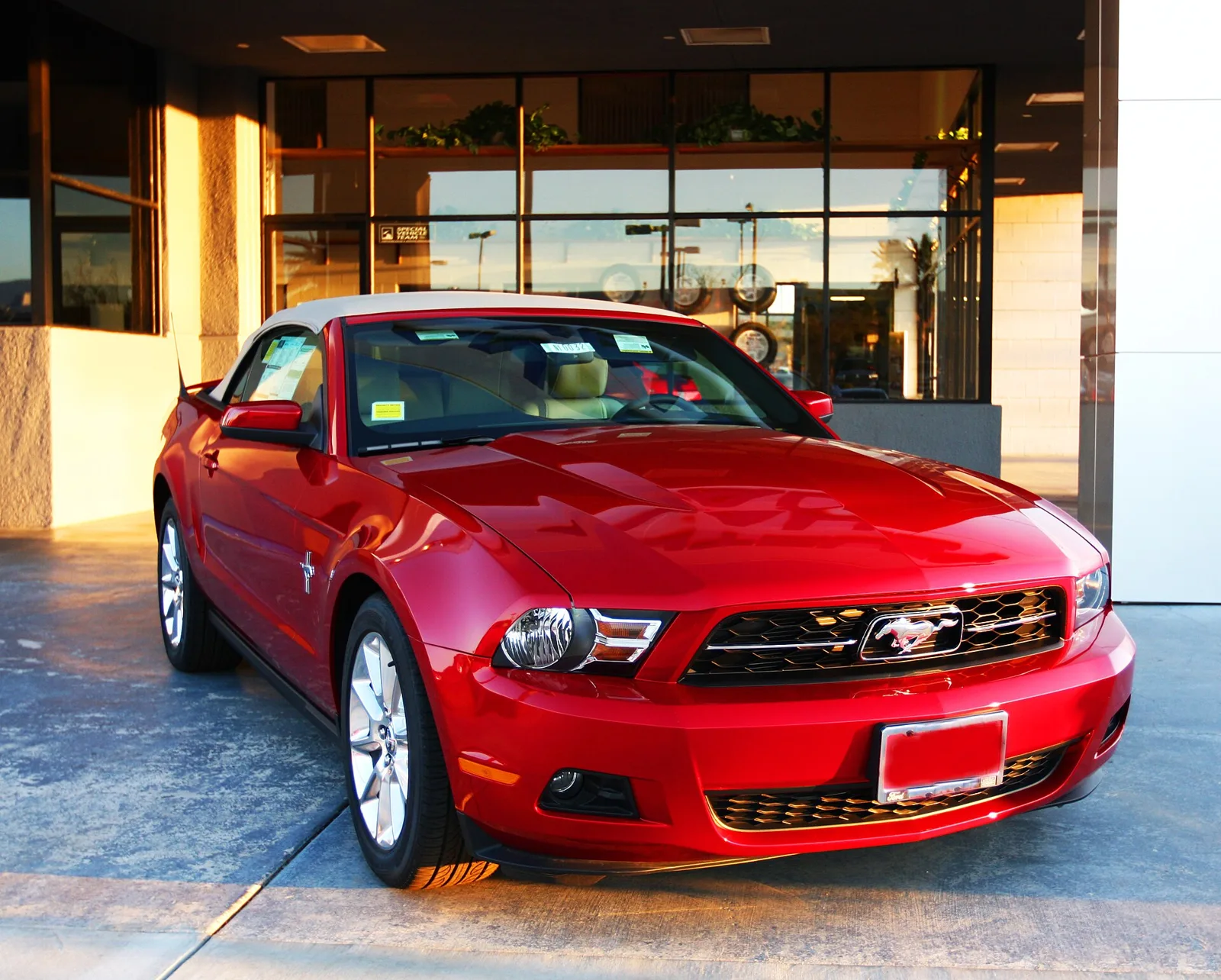
The 1984 GT-350 celebrated the Mustang's 20th anniversary, with white paint, bold stripes and an all-red interior. The 2003 Centennial edition came in black only, with 1,323 convertibles and 717 coupes. The 2004 40th anniversary package produced 4,558 Crimson Red cars.
What were the Warrior and Golden Warrior Mustangs?
The Warrior Mustang arrived in 2014, sold exclusively to military personnel serving overseas. The Exclusive Warrior Package added a Roush 2.3LTVS supercharger producing 670 hp, with 545 lb ft of torque and a Roush front fascia, quad-tip exhaust and matte-finish hood extractors.
Ford and Richard Petty produced a 2018 Warrior with 675 hp, sold only to military buyers. Only eight were built, four of them as 2018 models, with a Petty's Garage badge and Petty Blue detailing. Petty signed the dash plaque of each one himself.
The Golden Warrior of 2002 was a restomod that was donated to a Navy veteran and disabled security officer. The VIN had coincidences with the designation of his old squadron, VFA-87, and members of that squadron restored it with aviation-inspired striping.
How did Roush, Steeda and Saleen tune the Mustang?
Jack Roush, a former Ford engineer, founded Roush Performance in 1976, and in 1988 pitched Ford on a 400 hp twin-turbo Mustang that Ford declined to build. From 1995 to 2003 Roush sold Stage 1, Stage 2 and Stage 3 packages. The Stage 3 used an Eaton supercharger on the 4.6L V8 and produced 360 hp.
By 2005 the Stage 3 used an Eaton M90 supercharger, producing 415 hp (268.4 kW) with an air-to-water intercooler. Roush then introduced the 427R, which added 20 hp over the Stage 3 and a hockey-stick stripe. In 2004 Roush sold 40 Stage 3 440A models, all through a Tampa dealer. Roush claimed 400 hp for them, although dyno testing was reported at 360 hp.
Steeda, based in Pompano Beach, Florida, introduced the Steeda GT in 1998. The Q400 followed in 2003, advertised at 400 hp with a Vortech supercharger, and Motor Trend measured 425 hp at the rear wheels on its test car. The Q525 arrived in 2006 with 500 hp and 530 lb ft of torque from a Steeda supercharger system.
Saleen was founded by racer Steve Saleen in 1983. His S302 Extreme replaced the factory engine with a Saleen-built V8 that produced close to 620 hp. For 2007 the Saleen and Parnelli Jones S302 honoured the Boss 302. It had 400 hp and 390 lb ft of torque, and 500 cars were built.
What are the Shelby Mustangs?
Carroll Shelby turned a standard Mustang into the GT-350 race car, with shortened hoods, deleted rear seats and identifying trim. The conversions were carried out at his plant at Los Angeles International Airport. In 1968 Ford offered the GT500KR, which was named King of the Road and used the 428 Cobra Jet engine.
The 2006 GT-H was a Hertz rental special marking the 40th anniversary, and a convertible version followed in 2007 with 500 units. In 2005 Shelby built a CS6 with 380 hp, followed by a supercharged 350 hp version with 20-inch Shelby wheels.
Are there aviation-themed Mustangs?
Ford has been the exclusive automotive partner of EAA AirVenture Oshkosh since 2000. From 2008 its design teams produced one-off aviation-themed Mustangs for auction at the Gathering of Eagles, with proceeds going to the EAA Young Eagles programme.
The AV8R, based on the P-51 Mustang fighter, sold for US$500,000 in 2008. The SR-71 Blackbird car fetched US$375,000 in 2010, the Blue Angels car US$400,000 in 2011, and the Red Tails tribute US$370,000 in 2012. The Apollo 13 car, which produced 627 hp, sold for US$230,000 in 2015.
What is the Mustang GTD?
Ford unveiled the 2025 Mustang GTD on 17 August 2023. It was designed and engineered by Ford Performance and Multimatic, with a 5.2-litre supercharged V8, active aerodynamics and track-focused changes. Its engine is stated to make 800 hp, sold in very limited numbers at a US$300,000 price.
The Mustang is built at the Flat Rock plant and then shipped to Multimatic's factory in Ontario for modification. Earlier, the Gaffoglio Family Metalcrafters built a 45-unit Iacocca Silver 45th Anniversary edition on the 2009 platform, named for Lee Iacocca, who helped develop the Mustang.
Key Mustang variants at a glance
| Variant | Years | Headline figure |
|---|---|---|
| Boss 302 | 1969 and 1970 | Built for Trans-Am racing |
| Boss 351 | From November 1970 | 330 hp at 5,400 rpm |
| Boss 429 | From January 1969 | Over 370 hp, NASCAR homologation |
| Mach 1 (2003 to 2004) | 2003 and 2004 | 305 hp, 310 hp in 2004 |
| SVT Cobra | 1993 to 2004 | No 2000 model |
| Bullitt | 2001, 2008 to 2009, 2019 to 2020 | 5,582 units in 2001 |
| Special Service Package | 1982 to 1993 | Nearly 15,000 units |
| Warrior | 2014 onward | 670 hp Roush supercharger |
| Mustang GTD | 2025 | 800 hp, US$300,000 |