Ford's racing division swapped the Mustang's V8 for a turbocharged four-cylinder in 1984, and the result was a car that polarised the road-test press.
Special Vehicle Operations built the SVO as a turbocharged, limited-run Mustang. Its 2.3-litre four made 175 hp, it cost US$15,585 at launch, and Ford made 9,844 examples across three model years. Its price put it well above a standard Mustang.
Ford's Special Vehicle Operations division gave the third-generation Mustang a turbocharged four-cylinder heart in the mid-1980s. The result, the Mustang SVO, departed from the V8 tradition of the badge, and the car was built only from 1984 to 1986.
What was the Mustang SVO?
The Mustang SVO was a small-run Mustang built from 1984 to 1986 by Ford's Special Vehicle Operations division, with fewer than 10,000 made. It replaced the V8 with a turbocharged 2.3-litre four, and it kept the Mustang's place in the lineup above the lesser variants.
The car departed from earlier Mustangs in both its physical and mechanical make-up. Yet it held the same position in the range as the Shelby-tuned and BOSS Mustangs of the 1960s and 1970s, both in performance and in prestige.
A turbocharged four-cylinder Mustang from Ford's racing division, praised for its handling and feared for its boost.
Why did Ford create SVO?
Special Vehicle Operations was formed in late 1979 to oversee Ford's racing programme and to build limited-edition, high-performance street cars based on race technology. The public knew the division simply as SVO, and it was led by Michael Kranefuss, who had run motorsport at Ford of Europe.
Ford's motorsport retreat had begun in 1970, when Henry Ford II withdrew manufacturer support for racing. Muscle cars were losing ground to fuel prices, insurance costs and tighter safety and emissions rules.
The Fox platform Mustang of 1979 was the starting point for a comeback, and by 1982 Ford had reworked almost every part of the car. The new team had a clear remit: a limited-production passenger car that carried racing success to the street and helped pay for the division's own operations.
How was the SVO engineered?
The engineering team was led by Glen Lyall, and Bob Negstad handled chassis development. The division's racing role gave the engineers a motorsport brief to work to. The Mustang was the obvious starting point, and the aim was a plainly American car that could challenge small European sports cars.
Ford's president, Donald Petersen, described the car as the company's most definitive American effort at a smaller, higher-revving turbocharged touring car.
Meanwhile, Ford and Mazda were developing a Mustang successor, and enthusiasts' protests kept the Fox car in play until the joint project became the Probe in 1988.
The SVO was first planned as a 1982 1/2 model, but the confusion over the temporary cancellation of Fox Mustangs delayed it to a 1983 press event in northern California. Track sessions at Sears Point Raceway were part of the launch.
How much did the Mustang SVO cost?
The launch price was US$15,585, roughly $48,000 in 2025 money, and cars reached showrooms in mid-April 1984. That was more than double the price of a base Mustang, and US$6,000 more than the Mustang GT.
By 1986 Ford was again weighing a Fox replacement, so SVO turned to Project GN34, which became the 1987 Thunderbird Turbo Coupe nicknamed the Aerobird. Ford built 9,844 SVOs in all, and 4,508 of them came in 1984, the first year.
Production then fell to 1,954 in 1985 and rose to 3,382 in 1986, which made the SVO a short run by any measure.
What made the turbocharged engine different?
SVO chose a small turbocharged 2.3-litre Lima four rather than the 5.0-litre Windsor V8, and the choice had nothing to do with fuel economy or emissions. The engine was a detuned version of the racing unit used in the IMSA Mustang GTP.
The four-cylinder had its base in the Pinto and Ford Mustang II. SVO wanted a high-tech answer, and to get the handling right the car's weight distribution had to change. The engine sat longitudinally, further back than the V8.
A Garrett AiResearch T03 turbo, Ford's new EEC-IV fuel injection and the first domestic air-to-air intercooler helped the engine reach 130 kW (175 hp), peaking at 4400 rpm, from 14 psi of boost. Peak torque of 280 N m (210 lb ft) arrived at 3000 rpm.
The High Output 5.0 V8 was rated 175 hp, with 332 N m (245 lb ft) of torque in 1984, yet the SVO's four was 68 kg (150 lb) lighter than that V8.
In 1985 the 5.0 HO rose to 210 hp, while the SVO stayed at 175 hp. The 1985 1/2 car then reached 200 hp, with some sources saying 205, and 1986 was mostly a carryover.
How did the SVO manage its boost?
A fuel grade switch on the dash let the driver set spark advance for premium or regular fuel. Below 2,500 rpm the computer held boost to 69 kPa (10 psi), and on premium it rose to 97 kPa (14 psi) at higher revs.
A factory Hurst shifter was standard, improving feel and quickness. The engine also gained a new water-cooling system, lifting output to 200 or 205 hp (153 kW) for the 439 cars of 1985 1/2 and to 200 hp (149 kW) for 1986.
The T-5 five-speed manual was revised in 1985, with new gearing to match a 3:73 rear axle.
How did the chassis and brakes differ?
The SVO had revised front suspension geometry, a 15:1 power-assisted rack-and-pinion steering system and a limited-slip 3.45:1 Traction-Lok rear axle in its first year. Its ventilated four-wheel disc brakes came from the Continental Mark VII, a first for a Mustang.
The suspension used a six-shock KONI system, with settings for cross country, GT and competition. The lateral rear shocks were there to stop axle hop.
The wheels were 16 x 7-inch aluminium five-lug units wearing P225-50R16 tyres. The first cars used German Goodyear NCT tyres, and later ones switched to Goodyear Eagle Gatorback units, which Chevrolet had tied to its 1984 Corvette C4.
Ventilated rear discs, five-lug hubs, 16-inch wheels and quad shocks reached the SVO before any other Mustang. Early 1984 cars made do with a steel traction bar under a rubber sleeve.
Negstad tightened the shock valving in 1985 and again in 1986. He reasoned that owners should expect a firm ride in return for the car's character.
What did the SVO look like inside and out?
The interior came only in charcoal grey, with leather or cloth, and it was a deliberately sporty space. Standard equipment included adjustable sport seats with lumbar support and a leather-wrapped steering wheel, shift lever and handbrake, which small American coupes rarely had.
Only six major options were offered, including air conditioning and a flip-up sun roof. The 41C Competition Prep option stripped features to cut around 100 lb (45 kg). Only 123 cars carried it, with 40 built in 1985 and 83 in 1986.
The speedometer was labelled to 85 mph (137 km/h), with unlabelled markings out to 140 mph (230 km/h) to meet federal rules. Only four colours were offered in 1984: black, silver, Medium Canyon Red and Dark Charcoal Metallic.
How did the SVO's headlamps and body differ?
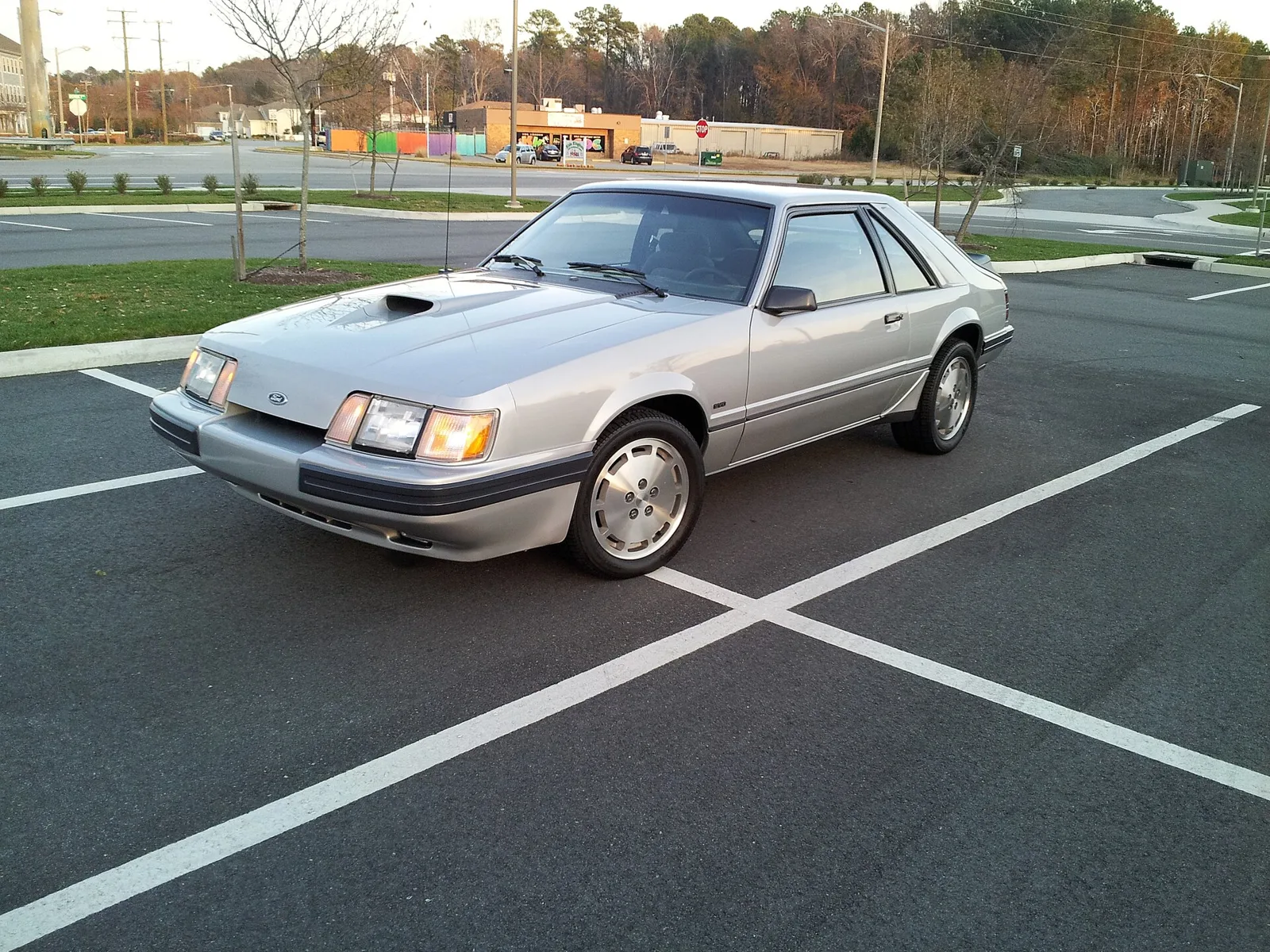
The SVO used a unique grille and hood, and its front end took both sealed beam and composite headlamps. The hood scoop was functional, not decorative. The NHTSA took its time approving composite headlamps with replaceable 9004 bulbs, so the 1984 car kept sealed beam capsules.
Composite headlamps arrived for the 1985 1/2 and 1986 cars, which also gained a functional intercooler scoop on the hood. The body had thinner side mouldings, smoother sail panels, small rear wheel spats and a biplane spoiler unique to the car.
Its drag coefficient was 0.39, falling to 0.38, or 0.37 by Ford's figure, with the composite headlamps. The pinstriped taillights were later reused on the 1993 Cobra.
How quick was the Mustang SVO?
With the standard 3.45:1 axle, the 1984 1/2 SVO reached 0-60 mph in 7.5 seconds and ran the quarter mile in 15.5 seconds at 90 mph (140 km/h). Popular Science measured 11.2 seconds to 60 mph with a driver, a passenger and test kit aboard.
Popular Mechanics measured a 15.8-second quarter mile at 90.1 mph (145.0 km/h), and a 1985 car with the 3.73:1 axle managed a 94 mph (151 km/h) quarter mile in 15.0 seconds.
Fuel use in a 10-way comparison test at Lime Rock Park came to 11.2 mpg-US, against EPA's city figure of 17 mpg-US. On the highway, the EPA gave 38 mpg-imp (7.4 L/100 km), or 32 mpg-US.
What did the critics say about the SVO?
Popular Mechanics praised the SVO's ride and handling, judging it a lot better through corners than the Mustang GT despite having 30 hp less. It also warned that the turbo power came on so suddenly that the car was dangerous on public roads.
Road & Track found the car's balance transcended its individual strengths, and suggested it may be the best all-round enthusiast car the US industry had produced. Motor Trend praised its boldness and its intelligent execution.
Car and Driver felt the car was right the moment it was strapped on, and called it an important vehicle that would point the way to what came next. Autoweek ran the SVO against a BMW 320i and called the result no contest, with congratulations to SVO.
Mustang SVO specifications
| Specification | Detail |
|---|---|
| Built | 1984 to 1986; fewer than 10,000 cars |
| Production by year | 4,508 in 1984; 1,954 in 1985; 3,382 in 1986 |
| Engine | 2.3 L Lima turbo inline four |
| Peak output, 1984 | 175 hp (130 kW) at 4400 rpm, 14 psi boost |
| Peak torque | 210 lb ft (280 N m) at 3000 rpm |
| 1985 1/2 and 1986 output | 200 or 205 hp (153 kW) for 1985 1/2; 200 hp (149 kW) for 1986 |
| High Output 5.0 V8, 1984 | 175 hp at 4200 rpm; 245 lb ft (332 N m) at 2400 rpm |
| Transmission | Borg-Warner T-5 five-speed manual, 3:73 rear ratio from 1985 |
| Steering | Power-assisted rack-and-pinion, 15:1 ratio |
| Rear axle | Limited-slip 3.45:1, 7.5-inch Traction-Lok in the first year |
| Wheels and tyres | 16 x 7-inch aluminium, P225-50R16 |
| Launch price | US$15,585 (equivalent to $48,000 in 2025) |
| 0-60 mph, 1984 1/2 | 7.5 seconds |
| Drag coefficient | 0.39, falling to 0.38 (0.37 per Ford) |
| Competition Prep | Option 41C, 123 cars built |