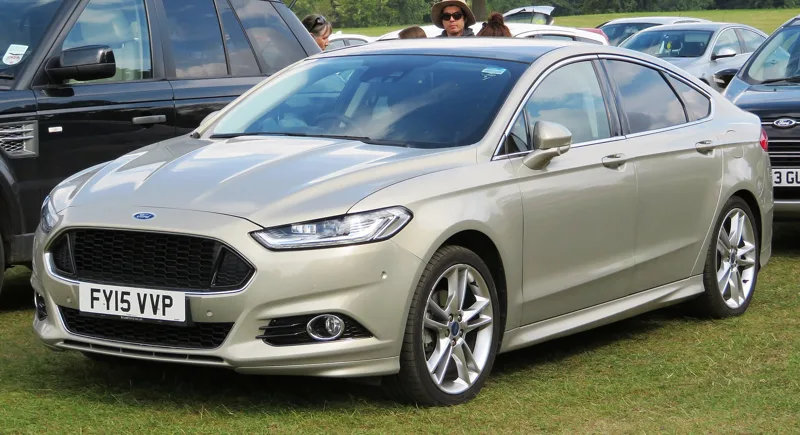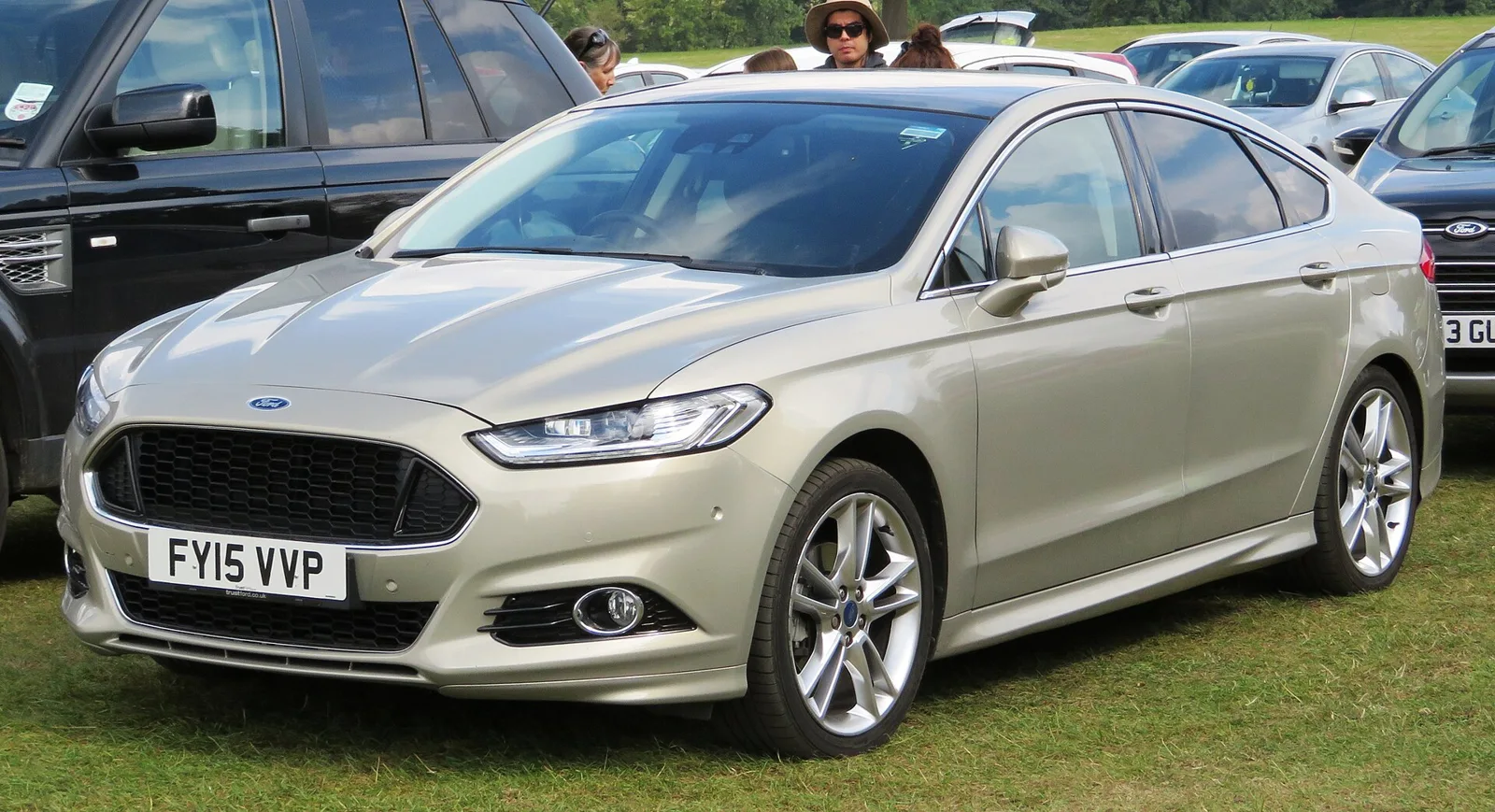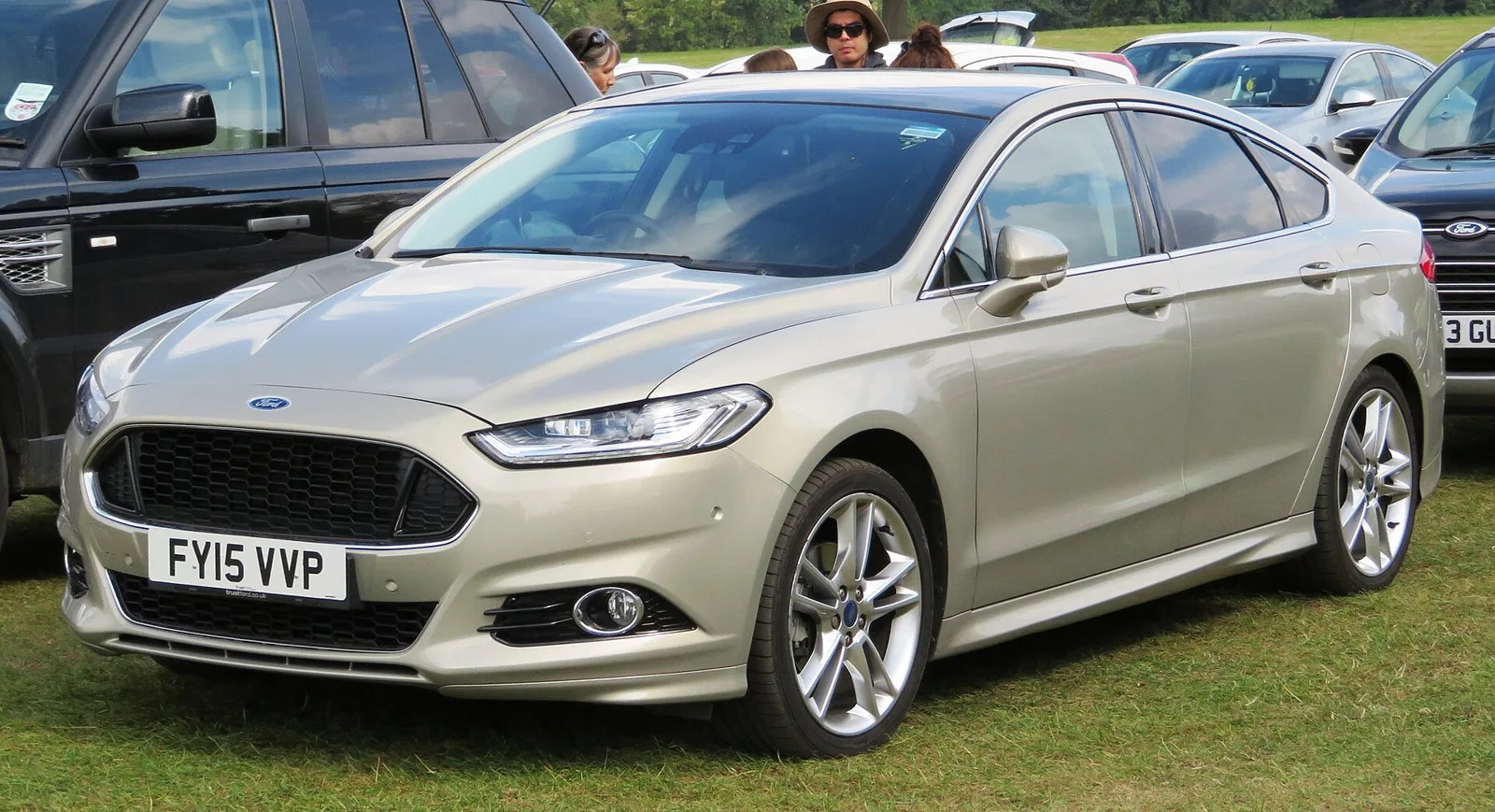
A rebadged American Fusion that became a European mid-size family car, with a hybrid, a five-star safety record and an end in Valencia in 2022.
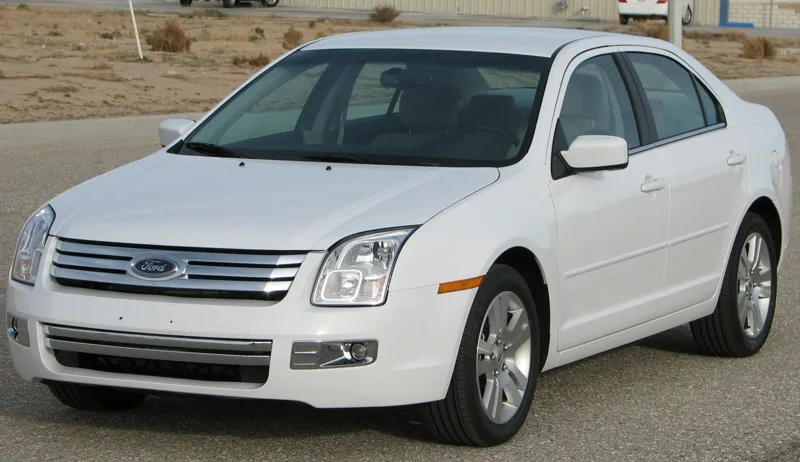
Launched in Detroit in 2012 as a sibling of the American Fusion, the fourth-generation Mondeo was built on the C/D platform. It reached European buyers in late 2014 with four-cylinder engines and a hybrid option, and production in Europe ended in 2022.
The fourth-generation Ford Mondeo was a mid-size family car that Ford built from 2013 to 2022, known as the Mk 5 in the UK. It was a rebadged version of the American Fusion, built on a reworked C/D platform. European cars reached showrooms late, in October 2014, and production in Europe ended in 2022.
Where did the Mondeo come from?
Ford unveiled the Mondeo on 9 January 2012 at the North American International Auto Show in Detroit, and the car was closely tied to the American Fusion. It rode on a reworked version of the C/D platform, which also carried the Galaxy and S-Max large MPVs.
The Fusion began production in 2012, about a year before the Mondeo did. The Mondeo served as Ford's flagship in China, where it was tested on roads in 2013 before the wider rollout.
Steve Pintar, who handled line direction for the C/D vehicles, said the clean-sheet architecture could carry the brand's large cars and SUVs, which mattered once Ford Australia replaced the Falcon and Territory in 2016. Those cars had used a straight-six, rear-drive layout, and a transverse front-drive platform would end it.
Initial plans listed Belgium, the US, Mexico, Russia and China for production. In practice the Mondeo came from Spain and China, while the Fusion was built only in North America.
A rebadged American Fusion that became the last Mondeo built in Europe, after a run of hybrid and five-star models.
Why did the European launch slip?
The European start date slid from early summer 2013 to late 2014 after the 2012 Paris show, as Ford worked through quality problems during the ramp-up. The closure of the Genk plant in Belgium in 2013 also meant European sales would be held back by at least a year.
Ford had already said in October 2012 that production would move to Valencia. Genk, which had built 14 million vehicles over 50 years, shut its doors, and the Spanish plant needed significant development and reinvestment to take on the car. The launch team started with 150 engineers at Valencia.
The European cars that finally appeared in October 2014 used four-cylinder engines, and Valencia assembled sedans, liftbacks and estates.
Which body styles and engines did the Mondeo offer?
The Mondeo came as a sedan, a liftback and an estate, and the European range used four-cylinder petrol and diesel engines. The team had to add the liftback and estate styles, right-hand drive and a restyled interior to set it apart from its American sister.
Mike Rogers, Ford's Engineering Launch Manager, led much of that work. He had to fit new petrol and diesel powertrains, and the car was developed as a global vehicle, with teams in North America, Europe and Asia involved from the start.
The One Ford strategy behind the launch called for single global models rather than regional ones, so that engineering and sales could gain efficiency and scale.
A 1.0-litre engine was listed as available. Rogers's team admitted that such a small unit was unlikely for a car of this size, but they promised acceptable noise, vibration and harshness, along with low CO2 emissions.
How was the Mondeo's body built?
The brand says the Mondeo was the first car to use hydro-formed high-strength steel, and that steel reinforced the pillars and roof rails. About 61 per cent of the body structure used high-strength steels, and the body came out 115 kg (254 lb) lighter than the car it replaced.
Hydro-forming pushes metal into a die with high-pressure fluid. Ford considered it more efficient than stamping, and it gave better strength for the weight, along with improved bending rigidity.
Ford said the platform and body structure were 10 per cent stiffer. The overall weight saving was only 25 kg (55 lb), so Ford put 90 kg (200 lb) into safety, comfort and convenience instead.
Chris Hamilton, British chief exterior designer, led the primary parts, and Kemal Curic and David Dillon also worked on the car. Hamilton's shapes were said to follow Aston Martin's sculpting, while the detailing drew on the Evos concept shown at the Frankfurt Motor Show in 2011.
How much luggage did the Mondeo carry?
The liftback offered 541 litres (19.1 cu ft) of boot with the seats up, and folding the seats opened 1,437 litres (50.7 cu ft). The sedan and wagon offered 500 litres (18 cu ft) seats up, and the wagon reached 1,605 litres (56.7 cu ft) seats down.
The hybrid had less room, with 383 litres (13.5 cu ft) in the liftback and 403 litres (14.2 cu ft) in the estate. Its battery pack meant the rear seats could not fold.
The seats folded in a 60:40 split. Mat Watson of Carwow said the quality was good but the infotainment could not match a VW Passat.
How did the infotainment change?
Early cars had SYNC2, which offered navigation, traffic alerts, climate controls for temperature and seat heating, and a Wi-Fi hotspot built into the car. SYNC3 was fitted to all Mondeos after the second quarter of 2017.
SYNC3 added Apple CarPlay, Android Auto and Applink, so a phone could connect through the USB socket and be controlled from the 8.0-inch touchscreen without being picked up. The Vignale trim, in some countries, added active noise-cancelling technology.
How safe was the Mondeo?
The Mondeo earned a maximum five-star Euro NCAP rating. The 2014 test car was a 2.0-litre diesel Trend estate weighing 1,634 kg (3,602 lb), and the 2019 facelift was tested as a 2.0-litre diesel Titanium estate at 1,852 kg (4,083 lb).
Its specification changed too. Before the facelift, the Titanium had lane departure warning and traffic sign recognition, while after it those features, tyre pressure monitors, cruise control, extra airbags and electronic stability control became standard across the range.
Choosing the Driver Assistance Pack brought self-parking, blind-spot monitoring and a reversing camera. All models used Auto Start-Stop, which shut the engine when the car was stationary.
What were the UK trim levels?
The UK range had six trims: Style, Zetec, ST-Line, Titanium, Titanium X and Vignale. The Vignale was pitched at Audi A4, BMW 3 Series and C-Class buyers, and it added quilted leather, chrome door handles and a new grille.
The Style had an 8-inch colour touchscreen and 16-inch alloys. Zetec added power-folding mirrors and a heated windscreen, and the ST-Line brought a body kit, a black honeycomb grille and 18 or 19-inch alloys.
Titanium added 17-inch alloys, sporty seats, standard satellite navigation and lane-keeping assistance, while the Titanium X added LED headlights, leather trim, heated front seats and tinted glass.
What did Australia get?
Australia and New Zealand sold three grades, the Ambiente, Trend and Titanium, all as liftbacks and wagons. The range was cut to just the base Ambiente for 2020, before the Mondeo was discontinued in Australia that year.
The Ambiente had 17-inch alloys, privacy glass and satellite navigation. The Trend added adaptive cruise control, memory driver seats, a blind-spot warning and the Pre-Collision Assist system that detects pedestrians. The Titanium brought 18-inch wheels, adaptive LED headlamps and a panoramic sunroof.
How did the Mondeo Hybrid work?
The hybrid's 2.0-litre Atkinson-cycle petrol unit made 105 kW (143 PS), with 128 lbf ft (173 N m) of torque, and a 35 kW (47 hp) motor sat alongside it. Combined output reached 138 kW (187 PS) and 220 lbf ft (300 N m), and the battery was the same 1.4 kWh lithium-ion unit used in the Fusion Hybrid.
Regenerative braking recovered energy that would otherwise have been lost, and the engine could also act as a generator to charge the battery. The electronically controlled CVT and the SmartGauge with EcoGuide helped the driver save fuel.
Ford quoted CO2 emissions of 103 g/km and combined economy of 50.4 mpg, or 49.6 mpg for the estate. The hybrid was the first Ford hybrid built and sold in Europe, and orders opened in Germany in August 2014.
Production began at Valencia in November 2014. After the facelift the petrol engine disappeared, leaving the full hybrid as the only petrol-based option, and a hybrid estate arrived in 2020.
What did the facelift change?
The facelift came out on 18 January 2019, a 2020 model year car, and it reshaped the grille and bumper and added chrome linking the taillamps. It brought the Ford 8F40 eight-speed automatic, adaptive cruise control and EcoBlue diesels at 150 PS, 190 PS and 210 PS.
The facelifted car debuted at the Brussels Motor Show in Belgium and went on sale for Europe in March 2019. Ford also added a hybrid estate to widen the range, and it hoped hybrids would make up about half of sales.
In China the facelift took its exterior from the facelifted Fusion, with a six-point grille, restyled LED lamps and a revised bumper. It gained SYNC 3 with Android Auto and Apple CarPlay, and it was discontinued in China in 2021.
How did reviewers rate the Mondeo?
Reviewers mostly liked the Mondeo's driving, looks and interior. What Car? gave it 8.8 out of 10, Top Gear gave it six out of ten and Auto Express gave it three out of five stars.
Carwow's Mat Watson called it pleasant to drive and inexpensive to run, and he pointed to the 2.0-litre diesel as the one to choose for driving pleasure. He also said the 1.5-litre diesel could return 70.6 mpg.
What Car? praised the handling, comfort, value and space, and it criticised the interior finish. Top Gear compared the car with the Vauxhall Insignia, Mazda6 and Volkswagen Passat, all rated similarly, and said it looked a bit like the old car but offered solid gains in comfort and tech.
Auto Express was less impressed by the build quality, pointing to a broken parcel shelf in a car of this price. It also said the panoramic roof let so much light in that the touchscreen showed every fingermark.
What recalls affected the Mondeo?
Ford recalled Mondeos three times in the car's early years. The largest affected 219,738 UK cars in October 2018 over a driver's airbag inflator that could rupture, and the late 2019 recall covered 56,154 UK cars with battery terminal corrosion.
In October 2016 a recall covered Mondeos built between 16 October 2014 and 22 December 2015, because the headlight control module could switch off adaptive LED headlamps. A total of 582 cars were affected in Australia and 9,705 in the UK.
The airbag problem involved propellant wafers that could absorb moisture, and the metal inflator housing could rupture and throw fragments into the cabin. The car also suffered other faults, including oil sump cracking from engine overheating and a clutch pressure plate that could fracture.
How did the Mondeo win awards?
The Mondeo won the 2015 What Car? Award a month after going on sale. It also took the Honest John crown for the best car of 2015 and the category for the most popular large family car, plus the UK Car of the Year Best Family Car award.
The UK award was credited to technology such as Active Park Assist and Dynamic LED headlights. In Ireland the car won the Continental Irish award on 20 November 2016.
When did production of the Mondeo end?
Ford said in March 2021 that it would end Mondeo output in Europe and Argentina, leaving no successor for the model. The final European car was completed on 30 March 2022.
The last car was painted grey, and it left the Valencia line on 4 April 2022. It was the last Mondeo built in Europe.
What were the Mondeo's core specifications?
| Specification | Detail |
|---|---|
| Codename | CD391 (Mk 5 in the UK, MD in Australia) |
| Production | 2013 to 2022 |
| Platform | Ford C/D, shared with the Galaxy and S-Max |
| Wheelbase | 2,850 mm (112 in) |
| Dimensions against the previous car | Longer by 15 mm (0.59 in), narrower by 34 mm (1.3 in) and lower by 24 mm (0.94 in) |
| Body weight | Down 115 kg (254 lb) on the previous model |
| Drag coefficient | 0.27 Cd |
| Liftback boot | 541 litres (19.1 cu ft) seats up; 1,437 litres (50.7 cu ft) seats down |
| Hybrid output | 138 kW (187 PS); 220 lbf ft (300 N m) |
| Hybrid CO2 | 103 g/km |
| Euro NCAP | Five stars |
| Final European car | 4 April 2022, Valencia |
Across the range the Mondeo kept a 2,850 mm (112 in) wheelbase and shed 115 kg (254 lb) from its body. Its hybrid version produced 138 kW (187 PS) and was rated at 103 g/km of CO2, and the car earned five Euro NCAP stars.
Was the Mondeo still sold after 2022?
By late 2023 the Mk5 was sold only in China and the Middle East, after Ford Europe chose to move towards crossover SUVs. Europe saw the nameplate retired in March 2022, ending 30 years of production.