A One Ford supermini built on a new global platform, which gave the range its hot-hatch Fiesta ST and a long run across five continents.
The Ford Fiesta Mk6 was the sixth-generation Fiesta, launched in 2008 on Ford's global B-car platform. Built in Cologne and several other plants, it produced the Fiesta ST hot hatch and sold more than 940,000 cars in its first two years.
The Ford Fiesta Mk6, also called Mark VI and known as the Mk7 in the United Kingdom, was the sixth generation of Ford's supermini. Ford launched it in 2008 under its One Ford strategy, which called for global models instead of regional ones. It was built on the new Ford global B-car platform and went on to spawn the Fiesta ST, a hot hatch that won Top Gear's Car of the Year for 2013.
Where did the sixth-generation Fiesta come from?
The sixth Fiesta grew out of the Ford Verve concept, which first appeared at the Frankfurt Motor Show in September 2007. It was developed under the project codes B299 and B409. Ford's One Ford strategy aimed to sell single models worldwide to gain economies of scale, and production started at the Cologne plant in August 2008.
Ford gave the new car a platform developed for it specifically. Production soon spread: Valencia in Spain began building the car in early 2009, and plants in China, Thailand and Mexico started between late 2008 and 2010. Brazil began making the hatchback in 2013, after importing the sedan from Mexico.
A One Ford supermini that gave Ford a global platform and a hot hatch that still defines the badge.
What were the Verve concepts?
The Verve concepts were a family of subcompact show cars that previewed the sixth Fiesta. The first was a three-door hatchback, unveiled at Frankfurt in 2007, with a panoramic glass roof and LED headlamps. Two four-door versions followed, one shown in November 2007 and another for North America in January 2008.
The Frankfurt car carried Ford's Kinetic Design language, first seen on the S-MAX, with pillarless side glass, an integrated tailgate spoiler and 18-inch low-profile tyres. Martin Smith, then executive design director at Ford of Europe, described the Verve as a chic and individualistic statement. Designers at Dunton in England and Cologne in Germany worked on it together.
The North American version was finished in Rouge Red and had a modified front, with a deeper upper grille carrying the three-bar graphic. The first car's interior mixed leather in several hues with multimedia equipment.
Which body styles did the Mk6 Fiesta come in?
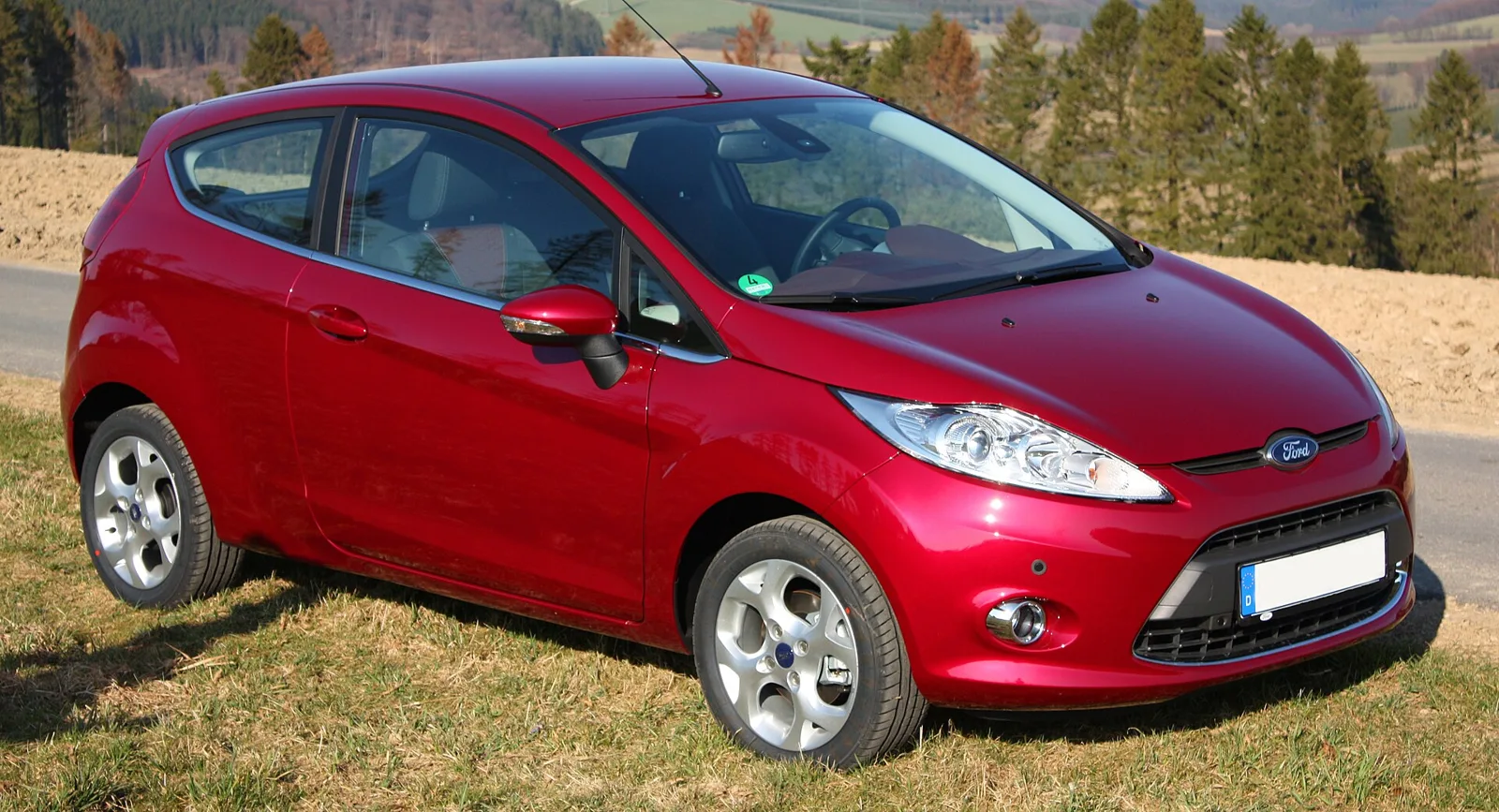
The Mk6 Fiesta was offered as a five-door hatchback, a three-door hatchback, a three-door van and a four-door sedan. The five-door sold almost everywhere except India, while the three-door was offered in Europe, Australasia and parts of Asia such as Singapore. Only Europe received the van.
The van used the same shell as the three-door hatchback. Solid panels replaced the rear quarter windows, and the rear seats gave way to a flat load floor. It stayed inside Europe throughout its life.
The sedan was revealed at the Guangzhou Auto Show in November 2008, went on sale in China the following year and reached much of Asia and North America from 2010. It was almost 50 cm longer than the hatchback but kept the same wheelbase. Ford also built it in Russia from 2015, though it was never sold in Europe.
What equipment did the Mk6 Fiesta offer?
The Mk6 Fiesta introduced Ford's Convers+ menu system, which could be run from steering wheel buttons. Keyless entry with a Ford Power starter button, electric power steering and a USB port were also new. Ford expected more than 85 per cent of buyers to choose the multifunction display.
Ford's Easyfuel capless refuelling system, first seen on the Mondeo, was also fitted, and ambient lighting casting a soft red glow was optional. For the 2011 North American model, the Sync in-car communications and entertainment system could be added.
How was the Fiesta updated during its life?
The first facelift was shown at the Paris Motor Show in September 2012 and reached European showrooms in 2013. It introduced Ford's trapezoidal grille, and the 1.0-litre EcoBoost arrived with 100 PS and 125 PS outputs, plus a naturally aspirated 80 PS version. The North American update followed as the 2014 model year.
The 2017 Brazilian update was a second facelift, made because the seventh-generation car was never sold in Latin America. It added a 1.0-litre EcoBoost, a new bumper, alloy wheels, headlights and LED taillights, plus SYNC 3 infotainment. Brazilian production ended in February 2019 with no direct replacement.
What made the Fiesta ST a hot hatch?
The Fiesta ST used a 1.6-litre EcoBoost turbo engine producing 182 PS (134 kW; 180 hp) and 177 lb-ft of torque. It reached 0-100 km/h in under 7 seconds and was electronically limited to 220 km/h (137 mph). Top Gear named it Car of the Year for 2013.
The ST came with a redesigned front fascia similar to the Focus ST, a large rear spoiler, a dual exhaust and 17-inch Bridgestone Potenza tyres. Inside it had heavily bolstered Recaro front seats, optional with partial leather in North America. The engine's overboost mode allowed up to 200 PS for 15 seconds, and Ford was permitted to advertise that figure in the US. The engine used Ti-VCT variable camshaft timing, and other territories could specify Recaro seats in partial leather or cloth, while North American cars came with the MyFord Touch system.
The North American car was a five-door built in Cuautitlan Izcalli, Mexico, while European cars were three-door hatchbacks built in Cologne. The car had a six-speed manual, Torque Vectoring Control and three ESP modes, with the system braking the inside front wheel to aid agility.
In 2016 Ford added the ST200 in Europe, with 200 PS (147 kW) and 290 N-m (214 lb-ft) of torque, cutting 0-62 mph (0-100 km/h) to 6.7 seconds. It came in one grey paint shade with 17-inch black alloys, and Recaro bucket seats were standard inside. Power and torque were both increased over the standard ST.
What was the Fiesta ECOnetic?
The ECOnetic was a 2009 eco variant that used the 1.6-litre Duratorq TDCi diesel with a particulate filter. Ford rated it at 98 g/km of CO2, and it qualified for exemption from UK vehicle excise duty. Its estimated 65 mpg-US (3.6 L/100 km; 78 mpg-imp) fuel economy was claimed to beat the Toyota Prius on highway tests.
Ford never sold the ECOnetic in the United States. Business Week reported that the company doubted it could charge enough to make money on an imported car, and that the 350,000 annual sales it estimated would not justify US$350 million of upgrades at its Mexican plant.
How did the Fiesta sell in North America?
The North American Fiesta was unveiled at the 2009 Los Angeles Auto Show and went on sale as a four-door sedan and five-door hatchback, with a manual or a dual-clutch automatic. Production started in May 2010 at Ford's Cuautitlan plant in Mexico, and Canadian sales began that June.
The launch was delayed. Dealers reported in June 2010 that cars they expected in May had not arrived, and Ford blamed weather for delays of up to two weeks. Ford sent gift certificates to buyers, and a later quality problem briefly held back some shipments.
Ford ran a Fiesta Movement campaign in 2009, lending European cars to applicants who shared their experiences online, then taking the cars to public events for 100,000 test drives over eight months. American Idol finalists painted custom graphics on a Fiesta in March 2010, and the car later topped U.S. News and World Report's list of affordable subcompacts in 2014. Production in North America ended on 19 August 2019.
Which trims and markets built the Fiesta?
North American trims ran from base S through SE, SES, SEL and Titanium to the ST performance model. UK buyers could choose Studio, Edge, Metal, Style and Zetec variants, and the range was reworked after the 2013 facelift. Thailand and India built their own versions for local buyers.
In India a saloon arrived in July 2011, assembled in Chennai and sold alongside the older Fiesta, which was rebadged as the Ford Classic. Production ceased in September 2015 due to low demand. Thailand launched the car in September 2010 at the AutoAlliance plant in Rayong, alongside the Mazda2, and Thai-made cars used a 100 mm wheel pitch circle diameter unlike the 108 mm of other global versions.
Brazil imported the sedan from Mexico from 2010 and began making the hatchback at Sao Bernardo do Campo in 2013, using Sigma flex fuel engines. The facelifted version gained an imported 1.0-litre EcoBoost option.
What problems affected the Fiesta?
The Fiesta's PowerShift dual-clutch automatic, fitted to 2011 to 2016 cars, became the subject of US class actions after owners reported shudder, slipping and delayed downshifts. Ford extended warranty coverage to 600,000 owners in 2019, and a 2020 settlement offered at least US$30 million in cash reimbursement.
A Free Press investigation of July 2019 published internal documents suggesting Ford knew of the transmission defect before mass production. Ford said the newspaper's conclusions were not based in fact, but complaints continued to reach the National Highway Traffic Safety Administration. The 2019 extension was already the second warranty extension, after one in 2014.
Ford also recalled 2014 to 2015 Fiesta ST cars with 1.6 EcoBoost engines in 2017 over a risk of engine fires from poor coolant circulation. The recall partly contributed to a US$300 million charge for Ford.
How did the press and buyers receive the Fiesta?
Motor Trend called the new generation a superb little car in late 2008, and What Car? named it Car of the Year in its February 2009 issue. More than 940,000 Fiestas were bought in the first two years after the car went on sale in October 2008, with 86 per cent of them sold in Europe.
Auto Express called it a new class leader, and Top Gear put it through a series of serious road tests, including an amphibious beach assault with the Royal Marines. Euro NCAP awarded the European car 5 stars in 2012.
Ford Fiesta Mk6 specifications at a glance
| Specification | Detail |
|---|---|
| Generation | Sixth (Mk6), built from 2008 |
| Platform | Ford global B-car |
| Body styles | Five-door and three-door hatchback, three-door van, four-door sedan |
| Fiesta ST engine | 1.6-litre EcoBoost, 182 PS (134 kW; 180 hp) |
| Fiesta ST torque | 177 lb-ft (240 N-m) |
| Fiesta ST 0-100 km/h | Under 7 seconds |
| ST200 power | 200 PS (147 kW) |
| ECOnetic CO2 | 98 g/km |
| Last North American build | 19 August 2019 |