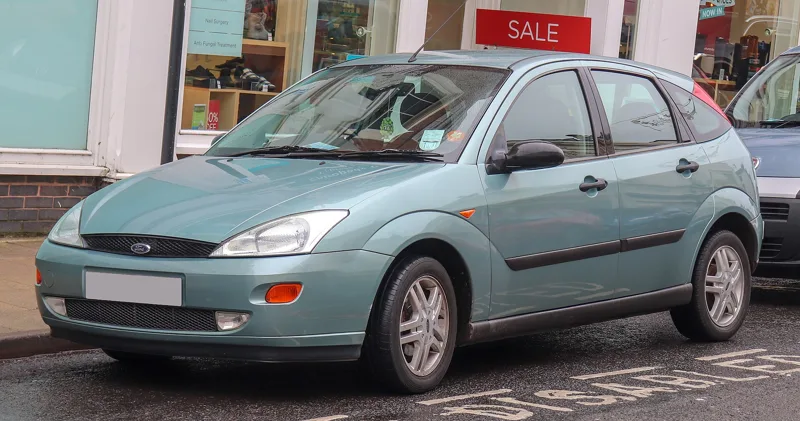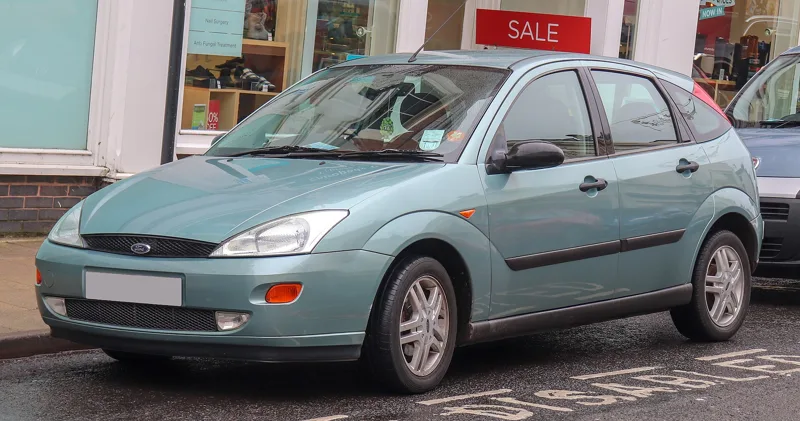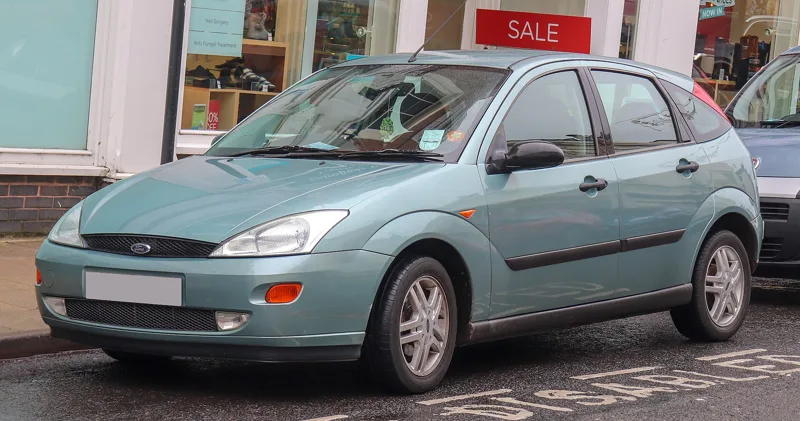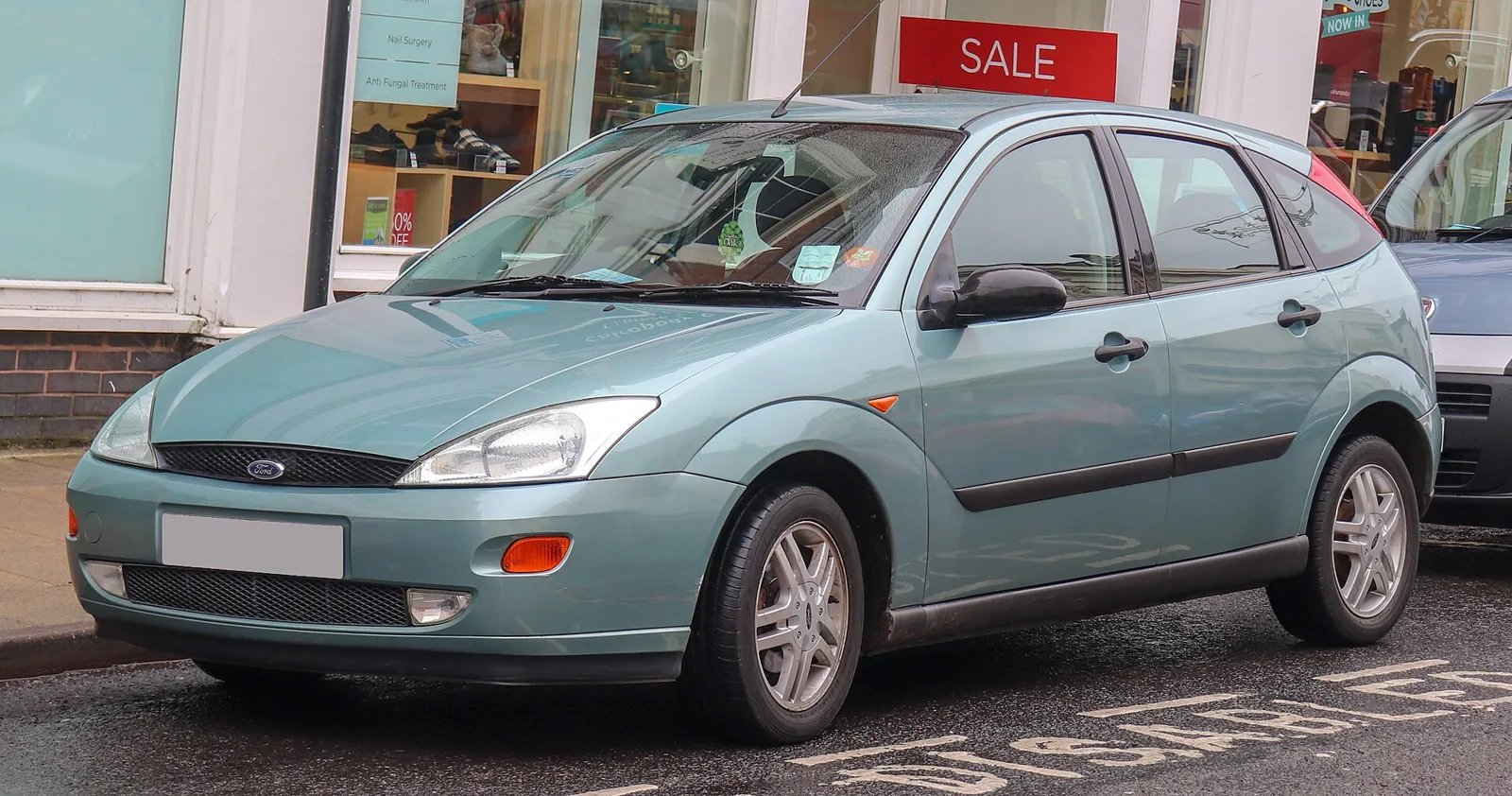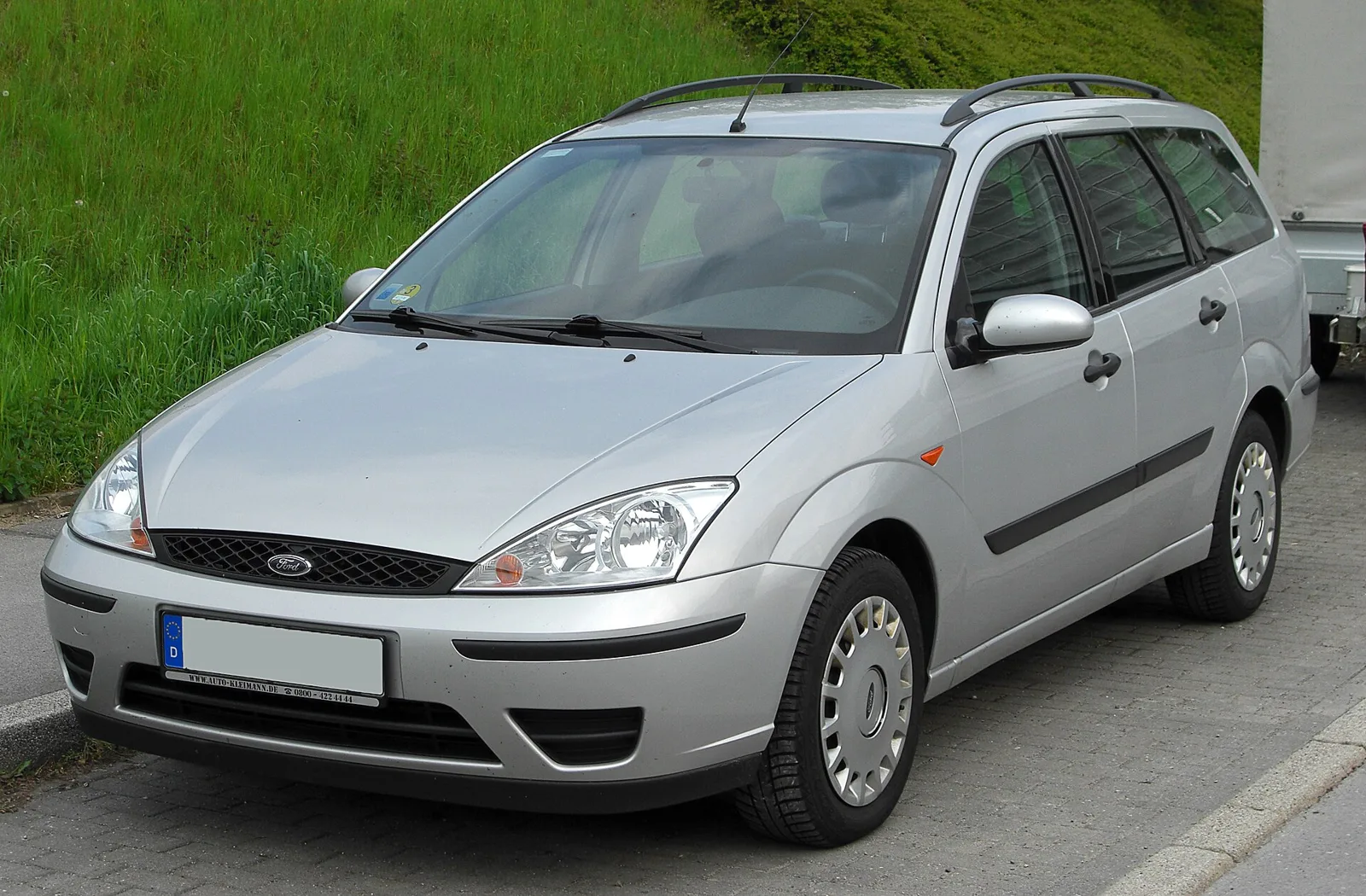
A New Edge styled hatchback with Control Blade rear suspension that replaced the Escort, sold worldwide from 1998 and named European Car of the Year in 1999.
Revealed at Geneva in March 1998, Ford's Mk I Focus was a compact that took over from the Escort. Its New Edge body and independent rear axle set it apart, and it won European Car of the Year in 1999.
The first generation Ford Focus was a compact car that Ford built in Europe between 1998 and 2004, and in North America until 2007. It replaced the Escort in Europe and South Africa, and it became the Focus that stopped Ford's European market share from sliding. Its New Edge styling and Control Blade rear suspension set it apart from its rivals.
What was the first generation Ford Focus?
The Focus was a compact car sold by Ford from July 1998 in Europe and from 1999 in North America, where it arrived as a 2000 model year car. Argentina kept building the car until 2008, and Brazil continued selling it until 2009. In Asia and Australia it took over from the Laser.
Engineers gave the car the codename C170 during development. The eventual name came from a Ghia concept car unveiled at Geneva in 1991, and the car was officially revealed at the same show in March 1998.
A New Edge compact with Control Blade rear suspension that replaced the Escort and became the world's best-selling car from 1999 to 2004.
Why was the Focus named after a concept car?
Ford had intended to retain the Escort badge for its next small family cars. The decision to name the car Focus came in early 1998, and it replaced the Escort name in Europe and South Africa.
A court in Cologne intervened in July 1998 and told Ford to drop the Focus name for German cars. The name was already used by a publisher's magazine, but the dispute was overcome and the car launched without a separate German name.
Ford also wanted the Focus to act as a true world car, sold in disparate markets with little modification. Earlier attempts had been less successful, since the 1981 Escort split into two different cars for Europe and North America.
How did the Focus's styling come about?
The Focus carried Ford's New Edge design language, which debuted on the Ka in 1996 and appeared on the Cougar in 1998. Jack Telnack oversaw the look, while Claude Lobo and the Australian designer John Doughty executed it; approval came in January 1996.
Critics often described the look as polarising. Some editors loved it and others hated it, and a writer for USA Today called the result a collision of curves and lines. Even so, the car won European Car of the Year in 1999, which many saw as a vindication of the risky design.
Some design elements had been seen earlier in prototypes that showed new safety features, including eye-level rear lighting clusters.
What made the Focus's rear suspension special?
Richard Parry-Jones and his team created a space-saving independent multi-link rear axle, sold under the Control Blade name. It mixed a trailing arm's packaging with a double wishbone's geometry, and it was adapted from the system used in the Mondeo estate.
Most rivals in the compact class used cheaper semi-independent twist-beam rear axles. Control Blade offered firmer body control, sharper steering whatever the car's attitude, and a quieter ride over bumps, which gave it a clear edge in the class.
The design used a wide pressed-steel trailing arm with a hub carrier, which replaced two longitudinal locating rods and removed an expensive cast knuckle. Its lower centre of gravity and lower production cost made it viable for a mass-market vehicle.
Motor Trend's Jack Keebler clocked a 62.6 mph slalom average in 2000, outpacing a Jaguar XJ8L costing $62,000 and a Bentley Continental at $300,000 through the cones. Other makers followed the example, and the Volkswagen Golf V later offered a multi-link rear in the compact class.
How did the Focus make the most of its interior?
Focus engineers used a computer-modelled interior, a long wheelbase, tall doors and a raised roofline. Raised rear seating and higher front H-point seating gave better sight lines and more rear footroom than rivals in the class.
The high seating position later became known as Command Seating. The company said the higher seating position made drivers feel more comfortable behind the wheel.
The car also carried a long list of safety and comfort items for the time, including driver and passenger airbags, optional head-and-chest side airbags, rear ISOFIX child-seat anchors and load-limiting belt pre-tensioners. A battery saver switched off the lights automatically after 10 minutes.
Where was the Focus built?
In Europe the Saarlouis and Valencia plants built the Focus, while the Halewood plant was switched to Jaguar X-Type production. The sixth and final Escort stayed in production at Halewood until 2000 as a budget alternative, and the Escort vans lasted until 2002.
The Focus was also built in Santa Rosa in the Philippines, purely for export, along with plants in General Pacheco in Argentina, Chungli City in Taiwan and Vsevolozhsk in Russia. Its global footprint was a sign of the world-car ambition behind the programme.
What changed with the 2001 facelift?
The Mk1 facelift arrived in late 2001, often called the Mk1.5. It brought revised headlamps with integrated indicators, revised bumpers and a new grille with fog lamps, and optional xenon headlights were offered.
Other changes included a modified centre console, new seat trims, a damped and lit glovebox and optional navigation. A TDCi diesel joined the range, and a flexfuel version of the 1.6 L Zetec was sold only on the Swedish market, running on petrol or bioethanol.
How did the Focus sell in North America?
Sales began in October 1999, starting with three-door hatchback, four-door sedan and five-door wagon bodies for the 2000 model year. The five-door hatchback arrived for the 2002 model year.
It quickly ranked among America's best sellers. Its early model years brought special editions, such as the Sony Limited Edition, the Kona Mountain Bike Edition and the Street Edition, each offered in limited numbers.
The Sony Limited Edition had 7000 examples in January 2000 at an MSRP of $15,535. The Kona Mountain Bike Edition followed in May 2000 with 5000 cars, while the Street Edition added European suspension and 7,500 cars were built, most of them sedans.
Which special editions did the Focus receive?
The Street Edition had black trim, 16-inch polished aluminium wheels and a six-disc CD changer, with 85% of the 7,500 units sedans at a $15,750 MSRP. The Mach Audio sedan added 460 watts of audio and a $16,975 price.
The S2 was a three-door ZX3 package of 2001 with European-tuned suspension, grey body trim and a rear spoiler. The Centennial Edition celebrated Ford's 100th anniversary with 3000 examples built as black 2003 sedans, timed around the December 20, 2002 date.
How did the Focus perform in the model years 2002 to 2007?
In 2002 Ford added the ZX5 five-door hatchback and all Focus models gained the Personal Safety System. The 2003 model year brought heated seats, a refined 110 hp (82 kW) engine and a recalibrated throttle.
The 2004 model year saw the 2.3 L Duratec engine offered nationwide. The 2005 mid-cycle facelift for North America brought the ZX4 ST sedan and new body styling, with the 136 hp (101 kW) Duratec 20 engine and the 151 hp (113 kW) Duratec 23.
The 2006 model year added a Street Appearance Package priced at US$1295, and 2007 cars dropped their body-style tail badges. Wagon production ended at the end of 2007, bringing the North American run to a close.
How did the Focus perform in Europe?
The Focus was the world's top-selling car for the years 1999 to 2004. It beat GM's new Astra to the European Car of the Year title in 1999, and it helped Ford regain ground after its share slipped by 25% between 1995 and 2000.
The hatchback was the biggest selling body style in Europe, and Ford tried selling the saloon as a mini-executive car by offering it only in the Ghia trim. Later the company gave up that approach and began selling lower-specification saloons as well.
German surveys in 2002 ranked the European Focus as the most dependable car aged one to three years in Germany.
What engines and transmissions did the Focus offer?
Petrol choices in Europe were Zetec engines borrowed from the Mondeo, in 1.8 and 2.0 litre sizes, plus 1.4 and 1.6 litre Zetec-S and Zetec-SE units. The Endura TDDI diesel gave way in 2002 to the Duratorq TDCI.
European transmissions included the 5-speed MTX-75 manual, the 5-speed IB5 manual, the 6-speed Getrag 285 manual on the ST170 and a 4-speed 4F27E automatic on the 1.6 and 2.0 cars. North American cars used the 5-speed MTX-75 on the ST and the 6-speed Getrag MT285 on the SVT.
What was the SVT and ST170?
In late 2001 Ford's performance group, the Special Vehicle Team, introduced the three-door Focus ZX3 SVT for the 2002 model year. It had 17-inch five-spoke alloys and a reworked 2.0-litre Zetec developed with Cosworth, with a special cylinder head and forged connecting rods.
Power rose from 130 to 170 horsepower, helped by a 10.2:1 compression ratio and a six-speed manual shared with the Mini Cooper S. The SVT wore larger discs and sharper steering, and a five-door ZX5 SVT followed in 2003.
In Europe the ST170, codenamed Piranha, went on sale in 2002 as the first Focus sport model developed by a joint global team. A wagon version, codenamed Swordfish, followed in 2003 with self-levelling rear dampers.
What was the Focus RS?
The Focus RS Mk1 was built from 2 October 2002 to 11 November 2003 and brought the RS badge back after the Escort RS Cosworth. Production was capped at 4501 cars, with 2147 sold in the United Kingdom, its largest market.
The RS used a turbocharged 2.0-litre engine producing 212 hp (158 kW), a steady 0.98G of lateral acceleration and a standard Brembo brake set with 324 mm (12.8 in) front discs. The car also used a Quaife torque-biasing differential to manage front-wheel traction.
Clarkson and other journalists noted torque steer on bumpy British roads, but the handling was praised by most observers. In a Top Gear review he said it handled like it was in a cartoon, and cited that as the reason it was quick round the track.
How did the Focus do in rallying?
The Focus RS WRC debuted in the 1999 Monte Carlo Rally, when Colin McRae and Simon Jean-Joseph drove the cars, and it was quickly on the pace. McRae won its first event on the Safari Rally in Kenya, finishing over 15 minutes clear of the second-placed Toyota.
In 2003 the RS WRC 03 was introduced with a lighter body shell and an enhanced front bumper. Markko Martin drove it to two world rally victories, and the RS WRC 04 went on to win three events. By 2005 the car had fallen off the pace, and the works team went without a win that year.
How did the Focus Mk I fare in safety testing?
Euro NCAP gave the Mk1 Focus 4 stars for occupant safety and 2 stars for pedestrian safety. Its scores were 69% frontal, 83% side and 28% pedestrian protection.
In Australia the 2002 to 2005 car was rated as offering average occupant protection in the 2006 Used Car Safety Ratings. In a 2003 frontal test by the Russian ARCAP programme, it scored 11.6 points out of 16.
What awards and recalls did the Focus receive?
Over 60 prizes have gone to the Mk1 Focus since 1998, among them 13 Car of the Year awards across Europe and North America. Autocar UK later named it the best family car ever in 2003, and in 2000 it took Automobile magazine's Automobile of the Year.
The Focus earned the R.L. Polk and Co. Automotive Loyalty Award for the highest share of repeat buyers from 2000 through 2003. Early recalls and complaints were numerous, and Lemon-Aid called the car glitch ridden until 2004, though reliability improved steadily.
Car and Driver's Ten Best list featured the Focus for five years running, from 2000 to 2004. By 2005 it had also received a Consumers Digest Best Buy rating, and AutoPacific named it its top-rated compact car for 2006.
What are the Ford Focus Mk I specifications?
| Specification | Detail |
|---|---|
| Launch | Geneva, March 1998; European sales from July 1998 |
| Production | Europe 1998 to 2004; North America 1998 to 2007 |
| Rear suspension | Control Blade independent multi-link |
| Euro NCAP | 4 stars occupant, 2 stars pedestrian |
| Focus RS | 1,998 cc turbocharged, 215 PS (158 kW; 212 hp) at 5,500 rpm |
| RS torque | 310 N-m (229 lb ft) at 3,500 rpm |
| RS production | 4501 units, 2147 sold in the UK |
| ST170 power | From 127 to 170 hp, Cosworth-developed engine |
| Escort replacement | Europe and South Africa; Laser replaced in Asia and Australia |
| Best-selling run | World's best-selling car from 1999 through 2004 |
| Awards | European Car of the Year 1999; over 60 awards overall |