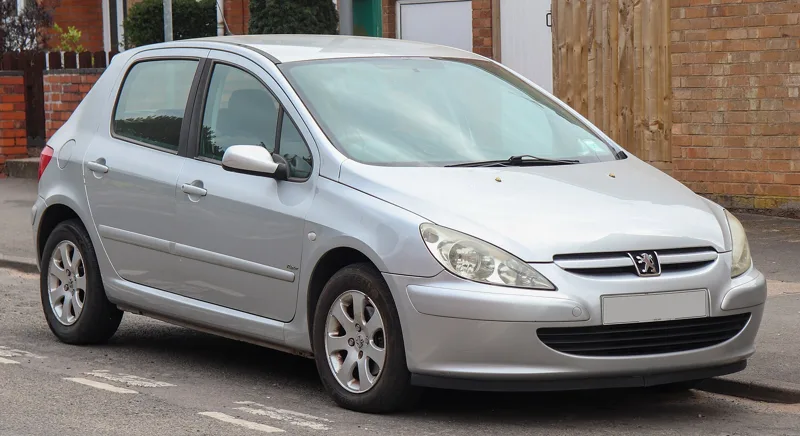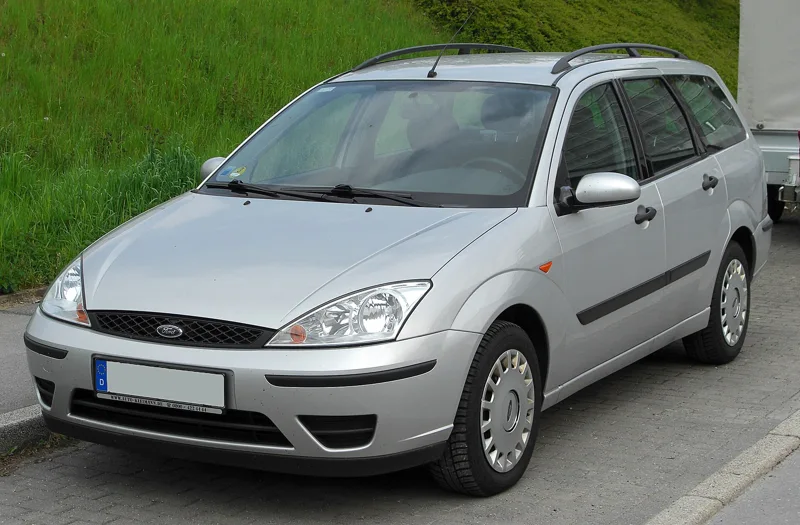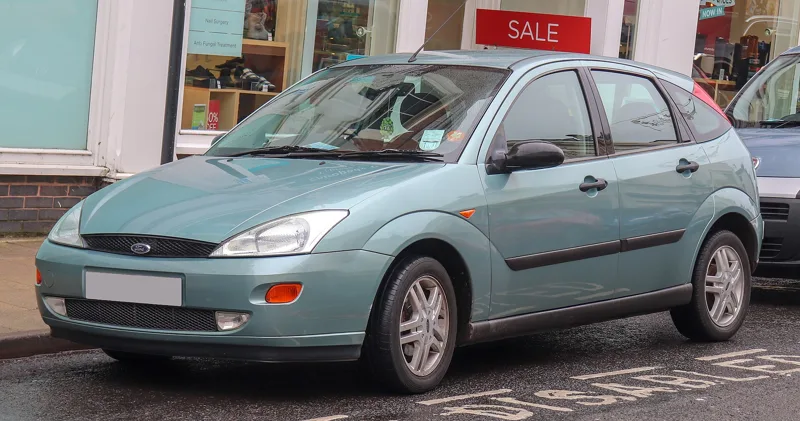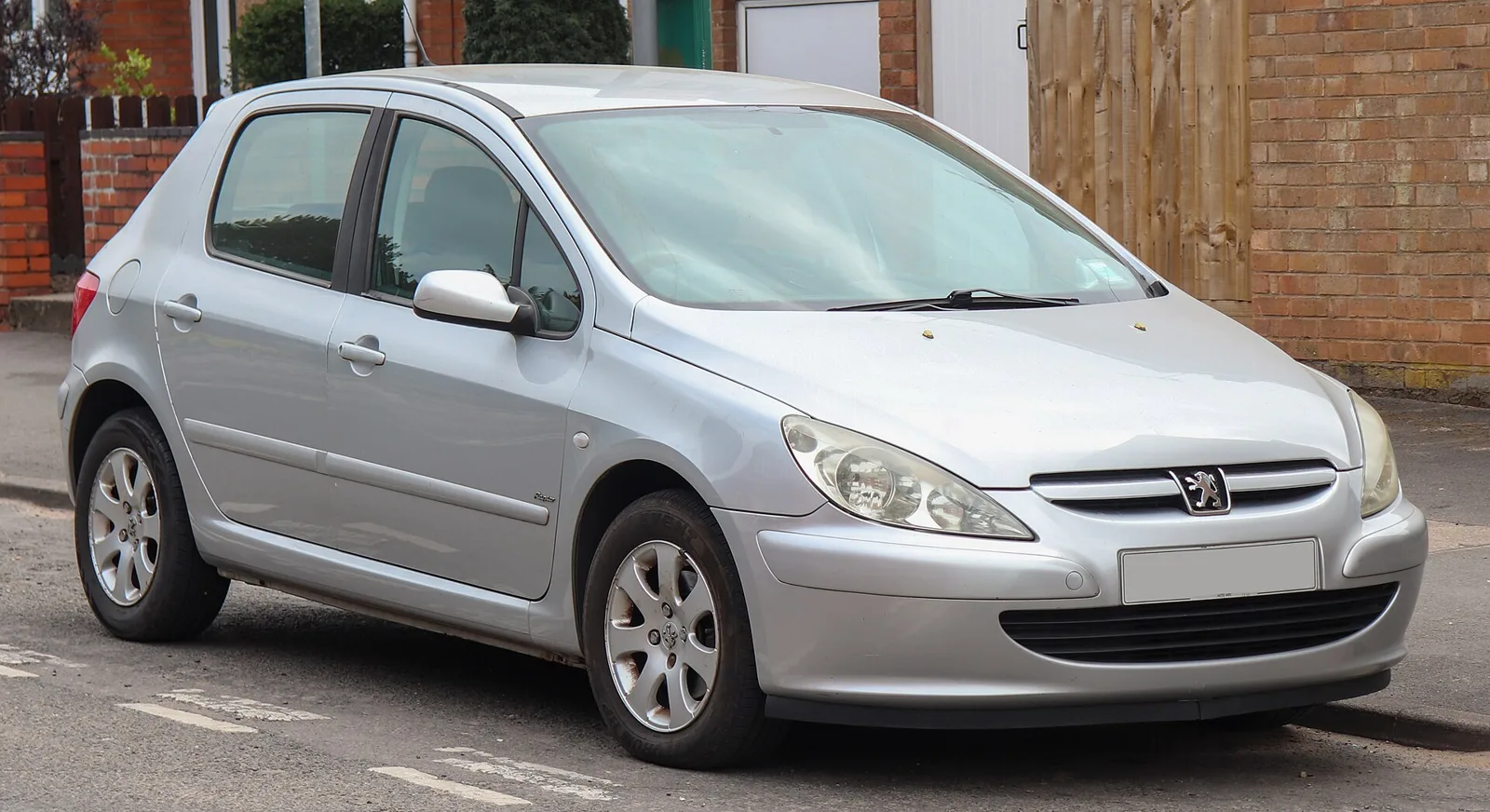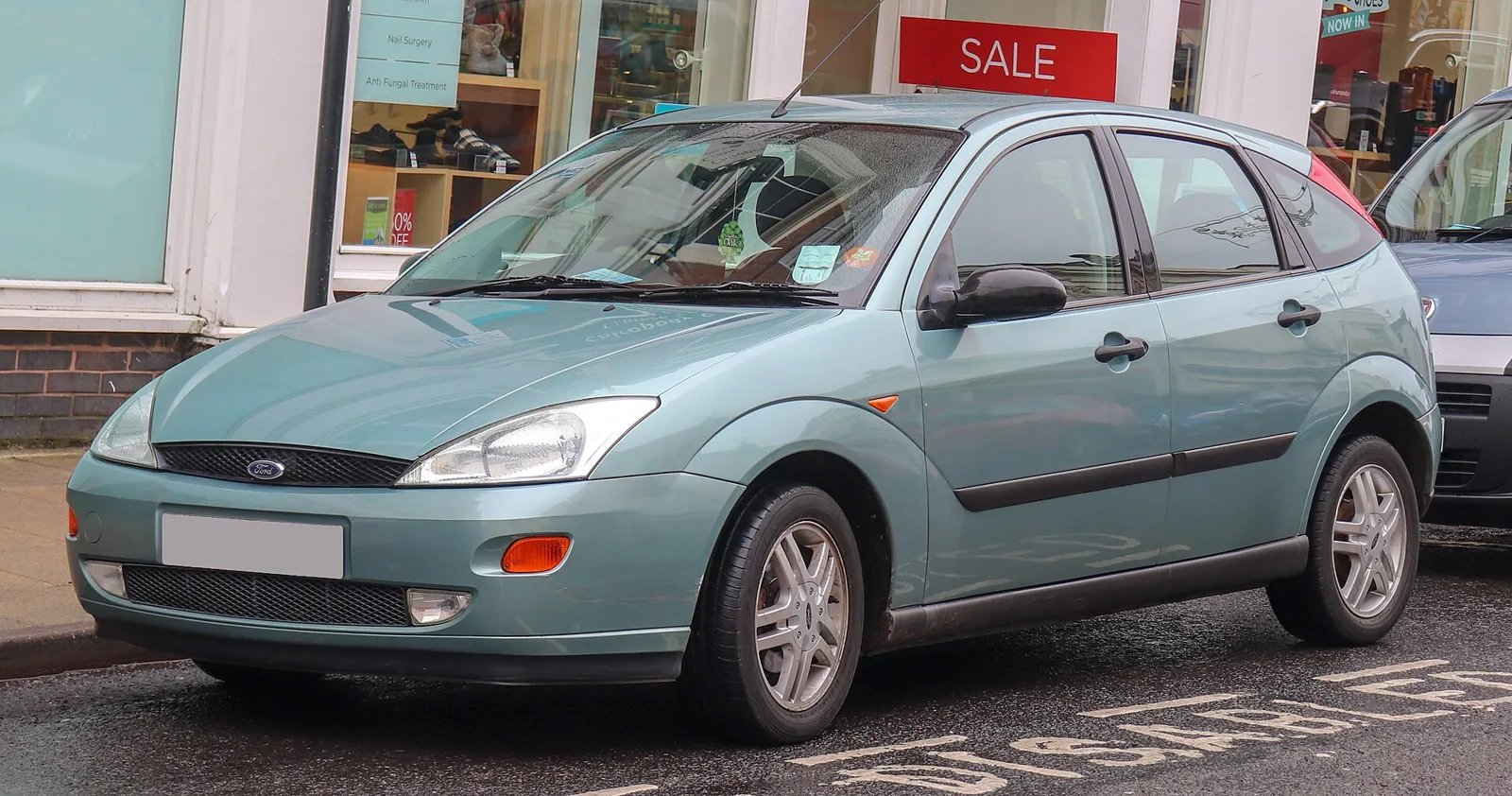
Two European family hatchbacks from the turn of the century, one a Ford whose bold styling split opinion and one a Peugeot that won a road test and the 2002 European Car of the Year title.
The Ford Focus Mk1 launched in Europe in 1998 with New Edge styling and Control Blade rear suspension, winning European Car of the Year for 1999. The Peugeot 307 arrived in 2001, won a Top Gear test that year and took the 2002 European Car of the Year title.
The Ford Focus Mk1 and the Peugeot 307 were both family hatchbacks that reached showrooms around the turn of the century, and both were aimed at the same European buyer. The Focus made its name with bold New Edge styling and a class-leading rear suspension, while the 307 won a 2001 road test against the Focus and went on to win the 2002 European Car of the Year title.
Where did each car come from?
The Focus was codenamed C170 during development and took its name from a Ghia concept shown at the Geneva Motor Show in 1991. Ford first revealed the production car at Geneva in March 1998, and European sales began in July 1998. It replaced the Escort in Europe and South Africa, and the Laser in Asia and Australia.
The name nearly caused a problem. In July 1998 a Cologne court, responding to a case from the publisher Burda, ordered Ford to avoid the name Focus for German-market cars, because the publisher already used it for a magazine. Ford overcame the dispute and launched the car without a separate German name.
The 307 was announced as a prototype called the Promethee at the 2000 Mondial de l'Automobile. Its production hatchbacks reached European showrooms on 26 April 2001, as the successor to the Peugeot 306, which had been discontinued in 2002 after nine years in production.
The Focus was meant to be a true world car, sold in disparate markets with little modification. Earlier Ford attempts had met limited success: the 1981 Escort split into two different cars for Europe and North America, and the 1993 Mondeo and Contour/Mystique still differed too much to count as one car. The 307 was a PSA product built on the PF2 platform, and both makers were chasing the same compact market.
A bold Ford with a class-leading rear suspension against a Peugeot that won its road test and the 2002 European Car of the Year title.
How did the designs compare?
The Focus's styling was marketed as New Edge design, a language first seen on the Ford Ka in 1996 and the Ford Cougar in 1998. Jack Telnack and Claude Lobo oversaw the design, and John Doughty executed it, and the result was described as polarising from the start.
Critics were divided on the look. An Edmunds writer said the car's interior and exterior both showed the New Edge philosophy, and editors were split on loving or hating it. Yet after the car won the European Car of the Year title for 1999, a New York Times writer said the prize vindicated Ford's risky design.
The 307 took a different path. Its upswept front lights and steeply rising bonnet led to a highly sloped windscreen, and its upright rear doors came from the 206. It departed from the Pininfarina themes of the earlier Peugeots, and at 1,510 mm (59.4 in) tall it sat between a small family car and a compact MPV.
In size the 307 was larger than the 306 in every direction. It used a reworked 306 platform that also underpinned the Citroen Xsara, and a 2001 launch advert used Labi Siffre's song Something Inside So Strong.
How did the suspension and packaging differ?
The Focus had a class-leading independent multi-link rear suspension called Control Blade. It combined the packaging of a trailing arm with the geometry of a double wishbone, and it was developed from the system in the Mondeo estate but made simpler and cheaper.
Control Blade used a pressed steel trailing arm with a hub carrier, which replaced two longitudinal locating rods and removed an expensive cast knuckle. Ford said the system gave strong body control, sharp steering and a quiet ride over bumps, while costing less than a conventional multi-link.
Focus engineers also gave the car a tall, roomy interior. They used a long wheelbase, tall doors and a raised roofline, and Ford marketed the higher seating as Command Seating. Motor Trend's 2000 test recorded an average speed of 62.6 mph through its slalom, which the magazine said was faster around the cones than a Jaguar XJ8L and a Bentley Continental.
The 307 was built on a reworked 306 platform and came as three- and five-door hatchbacks at launch. Estates arrived in February 2002 as the Break and the SW, and the SW offered an optional third row of removable seats that gave it an MPV-like flexibility.
Specifications side by side
| Feature | Ford Focus Mk1 | Peugeot 307 |
|---|---|---|
| European launch | Revealed March 1998; sales July 1998 | Hatchbacks from 26 April 2001 |
| Body styles | Three- and five-door hatchback; sedan; wagon; ZX5 five-door from 2002 | Three- and five-door hatchback; Break and SW estates; CC cabriolet; saloon for China |
| Platform | Focus, C170 | PSA PF2, reworked from the 306 |
| Rear suspension | Control Blade independent multi-link | No figure |
| Height | No figure | 1,510 mm (59.4 in) |
| Petrol engines | Zetec family, including a 110 hp engine refined for 2003 | 1.4 TU3 at 75 PS; 1.6 TU5 at 110 PS; 2.0 EW10 at 136 to 177 PS |
| Diesel engines | TDCi introduced in 2001 | 1.4 HDi 68 PS; 1.6 HDi 90 and 109 PS; 2.0 HDi 90, 107 and 136 PS |
| Top Gear test (June 2001) | Second behind the Peugeot | Won the test, ahead of the Focus and Civic |
| Awards | European Car of the Year, 1999 | European Car of the Year, 2002 |
| Motorsport | No figure | 307 WRC; three WRC victories and 26 podiums |
| Ending | European production to 2004; North America to 2007 | European production to 2008; replaced by the 308 |
Which car won the road tests?
In a June 2001 report, Top Gear put the new Peugeot 307 1.6 16v against the Ford Focus 1.6 Zetec SE and the Honda Civic 1.6 VTEC. The Peugeot won the test, and it was praised across the board, beating both rivals on price, space, handling, running costs and refinement.
The Focus finished second, ahead of the Civic in third place.
The 307 later collected the 2002 award, a sign that its reputation reached beyond that one road test.
How did the engines compare?
The 307's petrol range started with a 1.4-litre TU3 at 75 PS (55 kW; 74 hp) and a 1.4-litre ET3 at 90 PS. The 1.6-litre TU5 made 110 PS (81 kW; 108 hp), and the 2.0-litre EW10 came in 136, 140 and 177 PS forms.
The diesel line-up ran from a 1.4-litre HDi at 68 PS up to a 2.0-litre HDi at 136 PS. From September 2007 a 1.6 BioFlex could run on E85 ethanol, and in Brazil the 307 was sold with 1.6 and 2.0 flex-fuel engines.
The Focus's engines were built around the Zetec family, with the 2001 facelift adding a TDCi diesel. The 2003 model year refined the 110 hp engine, and the 2.3-litre Duratec became available nationwide in North America in 2004.
In January 2006 Peugeot announced a prototype diesel-electric hybrid for the 307, quoted at 83 mpg-imp (3.4 L/100 km; 69 mpg-US). It was never put into production, and the 307 had been replaced by the 308 before any hybrid could reach showrooms.
How did the cars perform in rallying?
The 307 WRC, a rally car derived from the 307 CC cabriolet, took over from the 206 WRC, which had won the championship, in the 2004 season. The car was plagued by transmission problems, and the works drivers did not always suit its handling.
In 2004 the car took seven podiums and a maiden win at Rally Finland. In 2005 Peugeot led the manufacturers' championship after round 10 before the challenge faded, and it finished second in the end. Marcus Gronholm won Rally Finland and Rally Japan that year.
The factory effort ended when PSA withdrew its Citroen and Peugeot teams at the end of 2005. A private team, OMV Peugeot Norway World Rally Team, ran the cars in 2006, and the 307 WRC finished with three WRC victories and 26 podiums.
The 307 WRC's history also carries a tragedy. On 18 September 2005 Markko Martin lost control of his 307 WRC on stage 15 of Wales Rally GB and hit a tree, and his co-driver Michael Park was killed. It was the first WRC fatality since Rodger Freeth in 1993.
How did the reliability records compare?
The Focus was one of the ten best-selling cars in America shortly after its arrival, and its production spread to plants in the Philippines, Argentina, Taiwan and Russia as well as Saarlouis and Valencia in Europe.
The 307 had a more mixed reliability reputation. It finished near the bottom of German Automobile Club breakdown statistics for three to five-year-old small family cars in 2009, though the June 2005 facelift was said to improve matters, and the 2006 and 2007 cars were considered more reliable.
How did the 307's body styles develop?
The 307 launched as a three- and five-door hatchback, and in February 2002 it gained two estates, the Break and the SW. The two estates looked almost identical from the outside, but the SW's silver roof bars and panoramic glass roof set it apart.
Peugeot did not follow Citroen's route with a compact MPV spinoff, the Xsara Picasso. It offered the SW instead, a version that kept the handling of an estate while adding the flexibility of an MPV layout.
The 307 CC arrived in August 2003, a cabriolet with a retractable hardtop meant to compete with the new European coupe cabriolets. Since the 307 had no saloon in Europe, one was designed for emerging markets, and a four-door saloon went on sale in China in June 2004.
What changed in the 2005 facelifts?
In June 2005 the European 307 was revised to meet newer rivals. The front was restyled with mildly revised lights, a new bonnet and an updated instrument cluster, and the trademark Peugeot grille between the headlights was removed in favour of a larger air intake.
Ford's North American Focus received its own mid-cycle facelift for 2005, developed under chief engineer John Sidelko and designer Larry Erickson. The ST model arrived on the ZX4 sedan, replacing the SVT models of the ZX3 and ZX5, and the body-style names changed to ZX4, ZX3, ZX5 and ZXW.
Which buyer should choose which?
A buyer who valued the Focus's rear suspension, its roomy interior and the way its styling stood out from the crowd would look at the Ford. Its Control Blade system gave the car a class-leading ride and handling reputation in its era.
A buyer who wanted the car that won a 2001 road test, a wider range of diesels and the rally-bred 307 WRC's road-car connection would find the Peugeot more appealing. Its estates and the SW's flexibility added to its appeal, and in China the saloon was built locally by Dongfeng Peugeot-Citroen until 2014.
On the early facts, the 307 had the stronger road-test and awards record, while the Focus had the more distinctive engineering story and its American sales success. Neither is a clear overall winner, and the buyer's priorities decide the choice.