A compact family car built from 1997 to 2006, with unusual rear suspension tricks, a mild hybrid prototype and an early Windows-based in-car system.
The Xsara was a compact Citroen family car sold from 1997 to 2006, built on the ZX and 306 platform. It came as a hatchback, estate or coupe, and its facelift in 2000 added safety and styling changes. Citroen also explored hybrid and computer technology in prototypes.
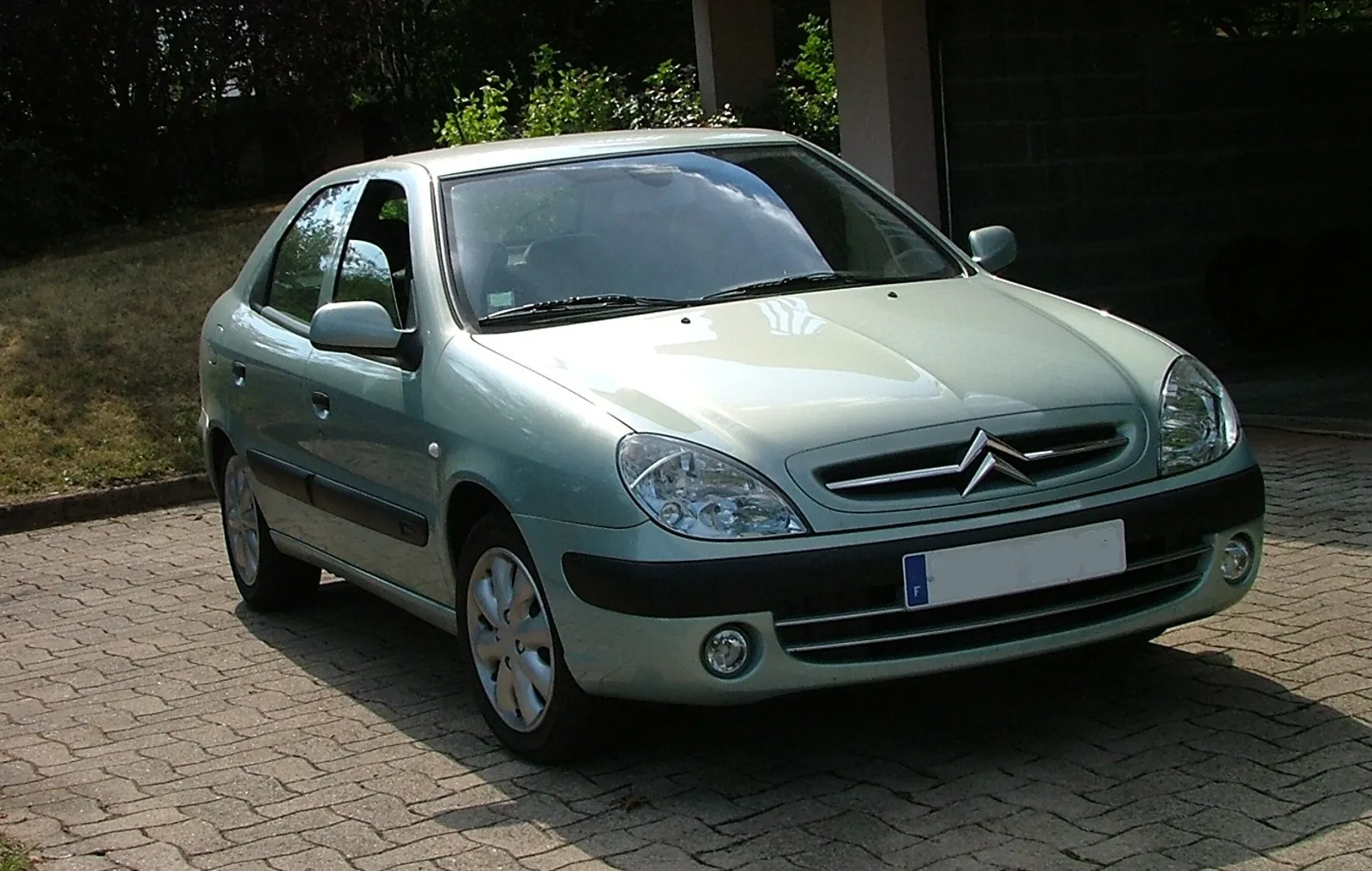
The Citroen Xsara is a compact C-segment family car that Citroen built from 1997 to 2006, using the PSA group's familiar running gear. It shared its platform with the ZX and the Peugeot 306, and it came as a hatchback, an estate or a three-door coupe. Its most distinctive traits were an unusual rear suspension and a run of in-car technology experiments.
The car is remembered as a conventional family hatch that carried a few unusual engineering choices, from its rear suspension to its prototype hybrids and early computer systems.
Where did the Xsara come from?
The Xsara was developed from the Citroen ZX and the Peugeot 306, which shared a platform and running gear with it. Its styling picked up cues from the larger Xantia, which Bertone had designed, but the motoring press regarded the result as bland. The car launched in September 1997 with a range of PSA engines.
The Xsara was named Semperit Irish Car of the Year in 1998. Its mechanical base was shared with the ZX and 306, so the three cars drew on the same running gear.
A conventional family hatch with unusual rear suspension, and a few technology firsts that looked ahead of their time.
Body styles and the launch line-up
The Xsara came as three-door and five-door hatchbacks with notchback styling, along with a five-door estate that Citroen marketed as the Break. The three-door was known as the Coupe, and the estate proved the most durable body style of the family, staying on sale in Europe until 2006. Each body style used the same front and rear mechanical layout, which kept production simple across the range.
At launch the 1.6 TU5JP made 66 kW (90 PS; 89 hp), while the 1.8 XU7JB made the same output and the 2.0 litre XU10J2C delivered 92 kW (125 PS; 123 hp). Diesel buyers could choose the 1.5 litre TUD5 with 43 kW (58 PS; 58 hp), or the 1.9 litre XUD9TE turbodiesel with 66 kW (90 PS; 89 hp).
How did the Xsara's chassis work?
The front suspension used a MacPherson strut layout with an anti-roll bar, while the rear used the fully independent trailing arm and torsion bar set-up first seen on the Peugeot 305 estate. That combination gave the car a conventional front and an unusual rear. The same mechanical base was used across the ZX and 306, so the layout was common throughout that group of cars.
Citroen's engineers added a few unusual touches. Compliance bushes in the rear suspension gave passive rear wheel steering, though it was less pronounced than on the ZX. The company also developed and built its own shock absorbers in-house.
The diesel and larger petrol engines were canted as far back as possible in the bay. That placed more weight behind the front axle line, lowered the centre of gravity and reduced the understeer that a heavy nose can bring.
What wear should Xsara owners expect?
Wear is worth knowing about at high mileage. The axle mounting bushes can wear, but that is easily fixed. Worn bearings in the rear trailing arms are more serious, because they wear the axle tubes and can mean an expensive rebuild or a replacement axle assembly.
Both faults trace back to the rear trailing arm arrangement, which was the most unusual part of the Xsara's suspension and the part most worth inspecting on an older car.
Engines, diesels and the VTS
The Xsara offered petrol engines of 1.4, 1.6, 1.8 and 2.0 litres, along with diesels of 1.4, 1.8, 1.9 and 2.0 litres in both naturally aspirated and turbocharged forms. In Portugal a 1.5 litre TUD5 diesel was also available, which gave the car a wider spread of choices than many rivals.
The performance model was the Xsara VTS, which used a 2.0 litre XU10J4RS making 123 kW (167 PS; 165 hp). It sat at the top of the petrol range, above the 1.4 to 2.0 litre engines that formed the rest of the line-up.
Diesel buyers had a narrower choice, but the turbodiesel versions gave useful pulling power for a family car. The 1.9 litre XUD9TE with 66 kW (90 PS; 89 hp) was one of the diesel units offered across the range.
What changed with the 2000 facelift?
In September 2000, for the 2001 model year, the Xsara received a substantial facelift. It gained a new bonnet, wings, bumper, grille and headlamps with integrated fog lights, and the rear light cluster and tailgate were updated. The car was 80 kg heavier and 21 mm longer than before.
Structural changes went with the styling. The A-pillars and side-door beams were reinforced, the tracks were widened, and 15-inch wheels became standard. The new steering wheel borrowed from the Citroen C5 allowed a larger airbag, and side and curtain airbags became available on higher trims. The facelift also introduced multiplex wiring.
The 16-valve 1.6 TU5JP4 made 81 kW (110 PS; 109 hp), and a 2.0 litre EW10J4 with 101 kW (137 PS; 135 hp) replaced the older XU10 unit. The earlier 1.8 engine was removed from the lists, while the 2.0 turbodiesel was updated to 79 kW (107 PS; 106 hp).
A short-lived 1.4 litre HDI diesel also appeared in 2004, producing 50 kW (68 PS; 67 hp) for that year only. It gave buyers a more economical diesel option during the car's final production phase.
Did the Xsara ever come as a hybrid?
Citroen built a mild hybrid prototype, the Xsara Dynalto, in 1998, shortly after the 1997 Toyota Prius arrived. It used an integrated starter alternator between the engine and gearbox to start the engine, provide a short overboost and stop the engine after two seconds of idle.
Overboost was the most direct performance benefit of the system, adding 8 hp during acceleration. It was a modest gain, but it showed how an electric assist could be layered onto a conventional petrol engine.
The Xsara Dynactive followed at the 2000 Geneva Motor Show as a parallel hybrid. Based on the estate, it paired a 55 kW (74 hp) 1.4 litre petrol engine with a permanent magnet motor, and it could drive on electric power alone for 20 km (12 mi) using a ZEV selection on the gear lever. Stop and Start later reached the Citroen C3.
On the Dynactive, a computer decided when the electric motor was needed, and it could add or recover power as the driving demanded. That control logic is the link between the prototype and the stop and start systems that followed.
How advanced was the Xsara's in-car technology?
Citroen partnered with Intel in 1997 to explore computer integration in cars. A demonstration Xsara showed DVD playback with surround sound, RDS traffic updates and email read aloud, building on the 1995 Evasion Windows 95 edition that Citroen had already produced. The Xsara's computer work therefore ran in steps: a demonstration in 1997, the Auto PC head unit in 1998, and a production edition in 2000.
The Auto PC prototype followed at the CES show in Las Vegas in January 1998. It used a head unit designed with Microsoft and Clarion, with voice recognition from Lernout and Hauspie and the Windows CE 2.0 operating system. The Auto PC head unit reached the public in 1999.
With the Auto PC, a driver could ask for GPS data, request a call to a named contact, and obtain weather and stock market information. Emails could be read aloud, and contacts could be loaded from a PDA through an infrared link.
In 2000 Citroen produced the Xsara Windows CE edition, with 500 examples built after three years of development with Microsoft. It claimed to be the first Windows-capable car, with a dual band GSM system, a colour navigation unit that ran GPS from a disc, and voice control of the information system.
The kit also included an Ericsson T28S phone for hands-free calls and text messages, plus a six-disc CD changer in the boot. Together those parts made the edition a complete information and communication package for its time.
What did the 2002 and 2003 updates change?
In 2002 the sound system became controllable from the steering wheel, which changed how drivers adjusted audio without taking a hand off the wheel.
In February 2003 the Xsara received exterior changes, including a new front bumper and an instrument panel that switched from Futura to Eurostile typeface. Its dial design borrowed from the Peugeot 307, which refreshed the interior look in the car's final years.
How did Xsara production end?
The hatchback was discontinued in Europe and replaced by the C4 in November 2004. Dongfeng Peugeot-Citroen, a joint venture between Dongfeng and the PSA Group, continued building the hatchback for one more year.
The estate remained in production in Europe until 2006 and never received a direct replacement. The Xsara Picasso small MPV carried on for a while alongside its C4-based successor, and Picasso later became the name for MPV versions of Citroen models. That naming choice meant the Xsara's MPV derivative left a lasting mark on the brand's range.
What are the Xsara specifications?
The table lists the core figures for the Xsara's production run, including the facelift, the end of the hatchback and the Windows CE edition. Engine outputs vary by year, so each row names the version it applies to rather than giving a single figure for the whole car. The smallest petrol unit, the 1.4 litre TU3JP at 55 kW (75 PS; 74 hp), carried over into the facelifted range with its output unchanged.
| Specification | Detail |
|---|---|
| Production | 1997 to 2006 |
| Platform | Shared with the Citroen ZX and Peugeot 306 |
| Launch 1.6 engine | 1.6 TU5JP, 66 kW (90 PS; 89 hp) |
| Performance engine | Xsara VTS, 2.0 litre XU10J4RS, 123 kW (167 PS; 165 hp) |
| Facelift | September 2000, for the 2001 model year |
| Facelift 2.0 engine | 2.0 litre EW10J4, 101 kW (137 PS; 135 hp) |
| Hatchback replacement | C4, November 2004 |
| Estate end | 2006, with no replacement |
| Windows CE edition | 500 examples, 2000 |
Frequently asked questions
Which Xsara was the sporty one?
The Xsara VTS was the performance model. It used a 2.0 litre XU10J4RS engine producing 123 kW (167 PS; 165 hp), making it the most powerful petrol choice in the line-up.
Was there an estate version?
Yes. The five-door estate was marketed as the Break and stayed in production in Europe until 2006, without a direct replacement.
Did the Xsara have a hybrid?
Citroen built hybrid prototypes, including the Dynalto in 1998 and the Dynactive in 2000. Neither was sold as a production car, but the stop and start idea later reached the C3.
What was the Windows CE edition?
It was a 2000 special edition with 500 examples. It offered GPS navigation, email reading and voice recognition, and it was an early example of a car running Windows.
When did the hatchback stop?
The hatchback was replaced by the C4 in November 2004 in Europe. Dongfeng Peugeot-Citroen built it for one more year.