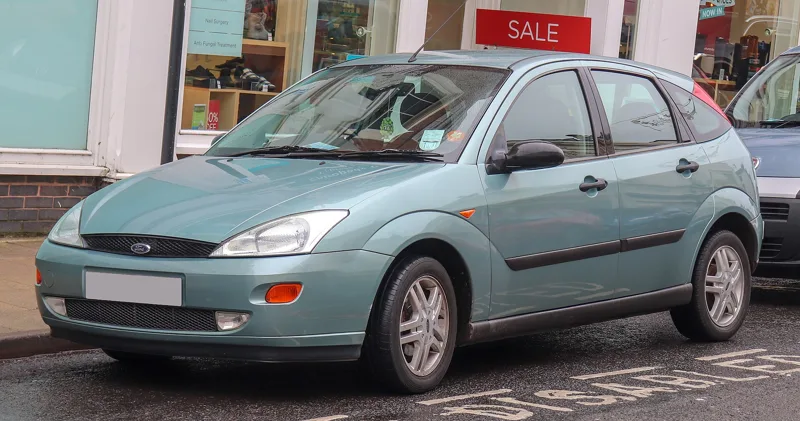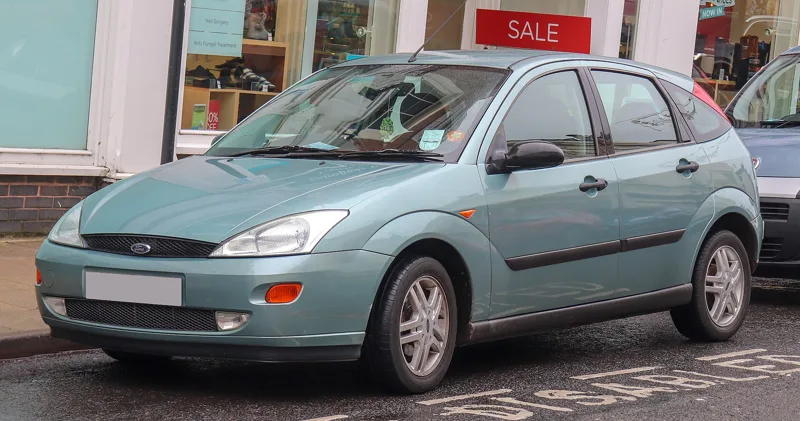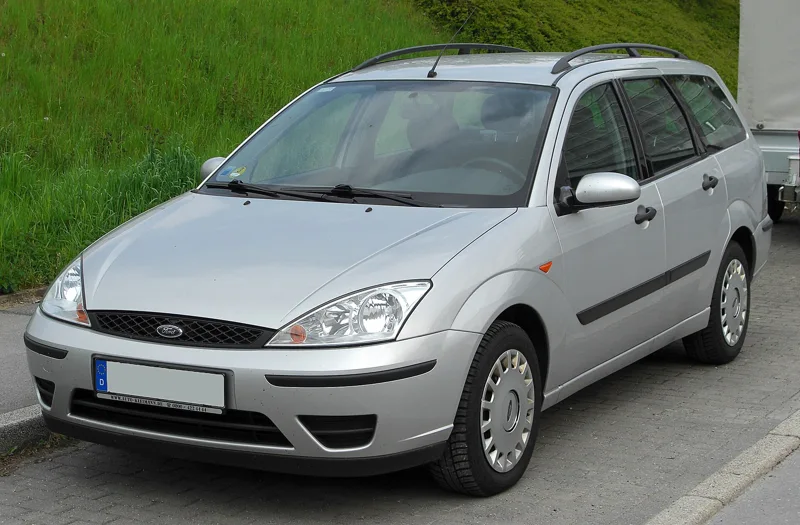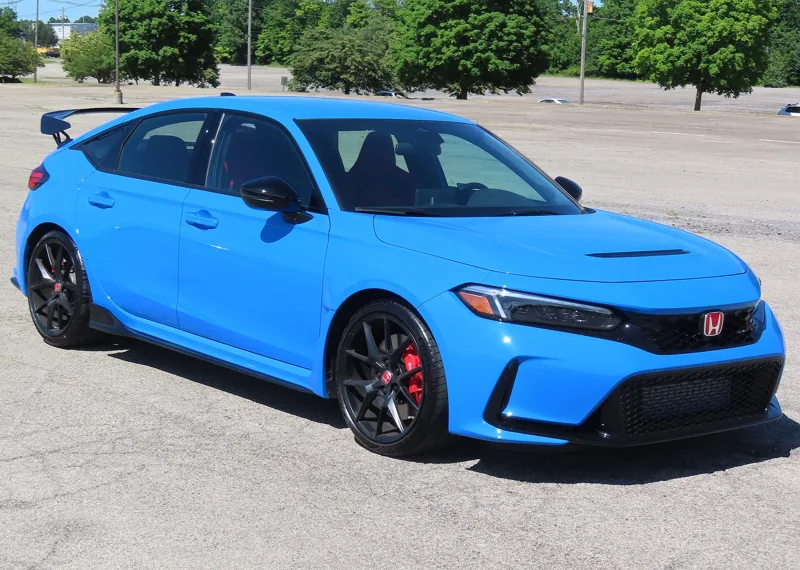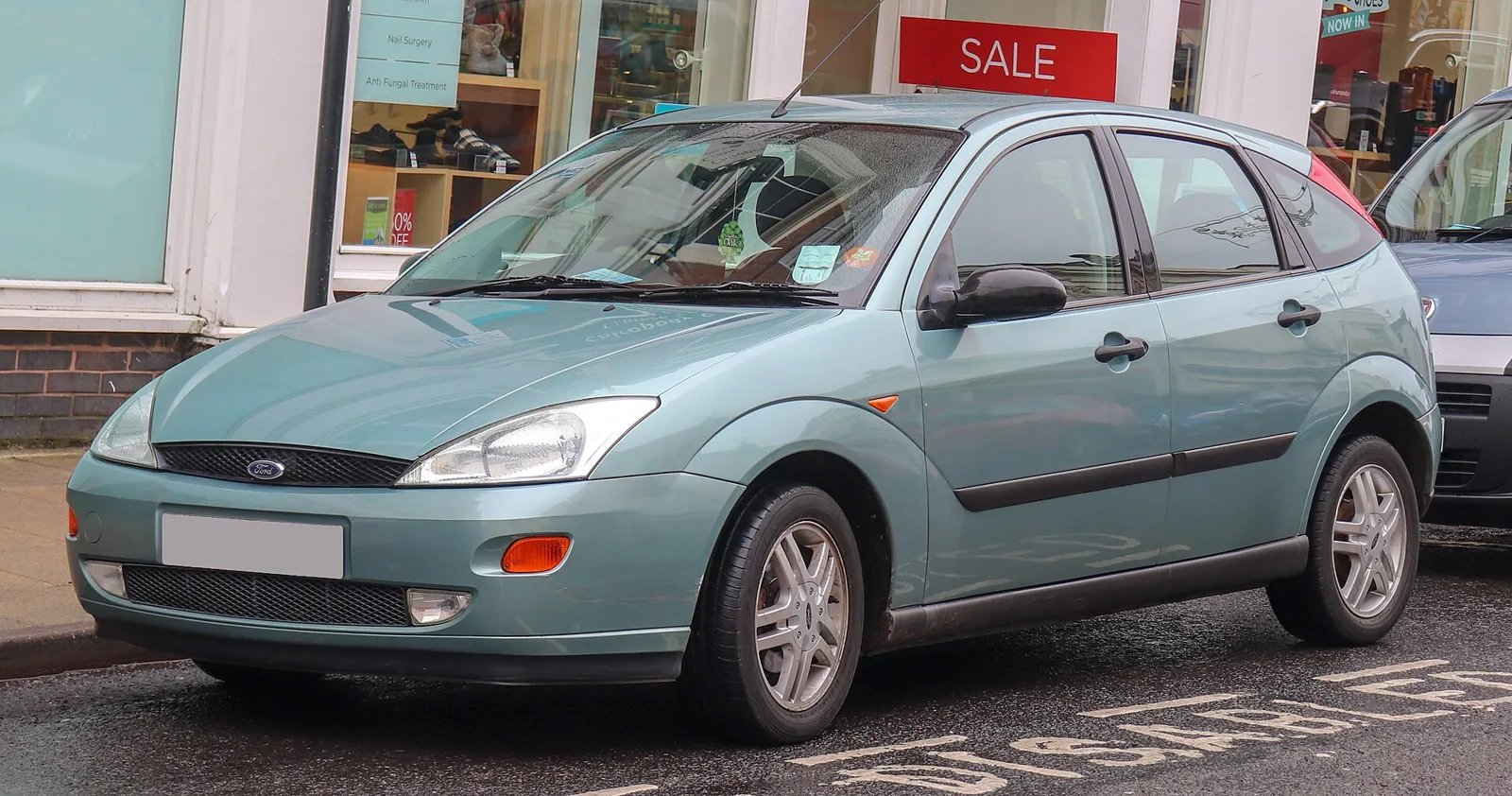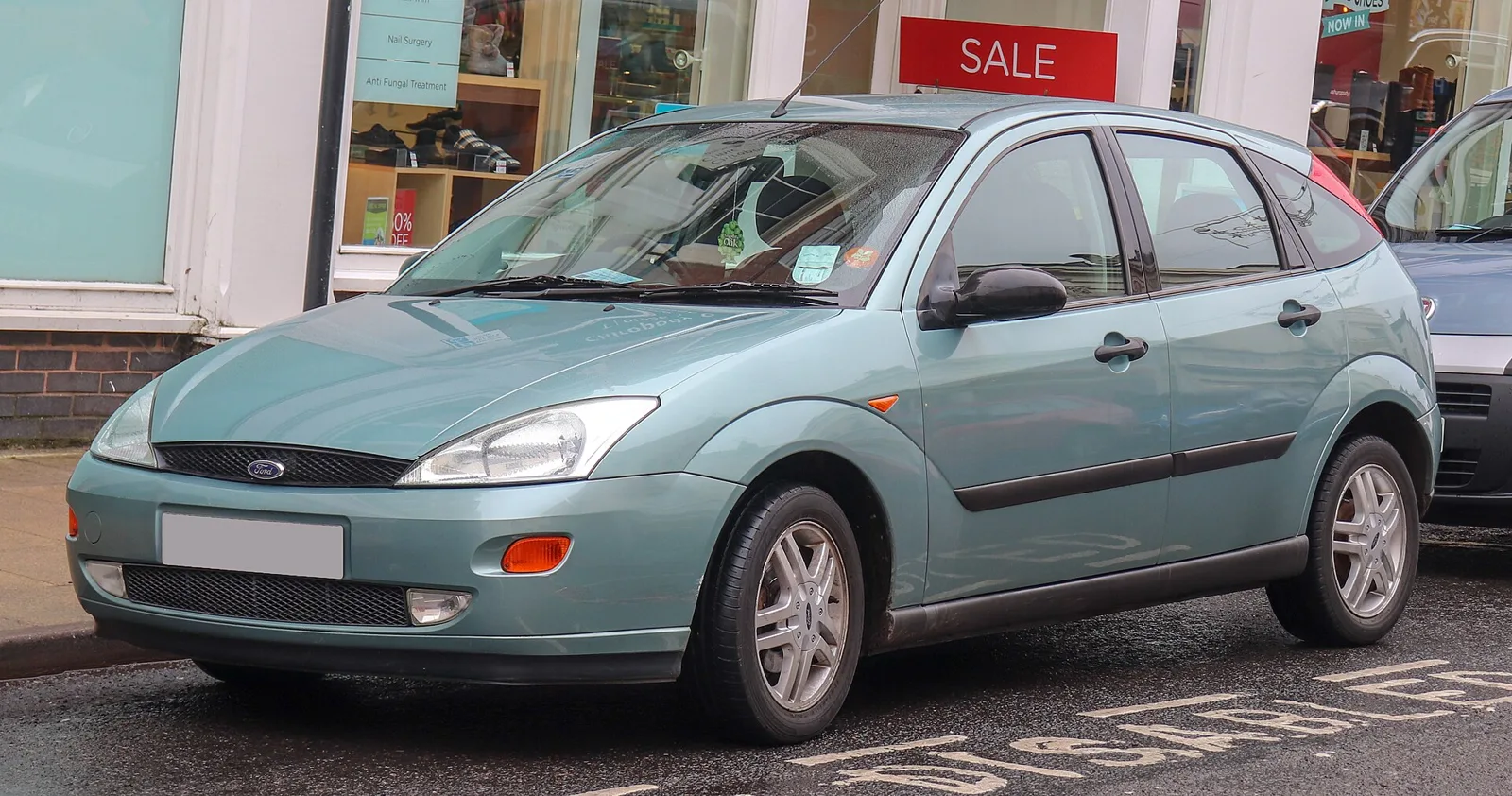
A mainstream family hatch that changed how compacts were engineered, set against the Honda performance hatch that grew out of a compact body, judged on suspension, engines and limited editions.
The Ford Focus Mk I, sold in Europe from 1998, won European Car of the Year in 1999 and used Control Blade rear suspension. The Honda Civic Type R began with the EK9 in 1997, a Japan-only hot hatch with a 1.6-litre engine making 182 hp.
The Ford Focus Mk I was a mainstream compact that sold in large numbers from 1998, while the Honda Civic Type R was a performance hatch built on a Civic body. The Focus is remembered for its Control Blade rear suspension and European Car of the Year title, and the Type R for its high-revving engines and limited editions. Set side by side, they show how far a compact family body could be pushed in two different directions.
Why were these two cars compared?
Both are compact hatchbacks from the late 1990s and early 2000s, and both gained reputations for how they handled. One was built as a mass-market family car, and the other as the most focused version of a family car that Honda sold.
The Focus was Ford's attempt at a true world car, sold in disparate markets with little modification. The Civic Type R was a different kind of product, built to raise the performance of a standard Civic rather than to be sold widely.
A world car with a clever rear suspension, set against a Honda hot hatch that spent its life chasing the next second on track.
Where did the two cars come from?
The Focus was codenamed C170 during development, and it took its name from a Ghia concept car shown at the Geneva Motor Show in 1991. Ford first planned to keep the Escort nameplate, but the name Focus was chosen in early 1998 and officially revealed at Geneva in March of that year.
In Europe and South Africa the Focus replaced the Escort, and in Asia and Australia it took over from the Laser. A German court ordered Ford to avoid the name in Germany after a dispute with a publisher, but the car launched without a separate German name.
The Civic Type R began with the EK9 on 19 August 1997, the first Civic to carry the Type R badge. It was built on the sixth-generation EK Civic SiR, and it was the third model to wear the Type R badge after the NSX and Integra.
The EK9 was sold only in Japan, and it shared many traits with the Integra Type R, including the omission of sound deadening and other weight-saving measures, a hand-ported B16B engine and a close-ratio five-speed manual.
How did the Focus's design and suspension stand out?
The Focus used Ford's New Edge styling, a philosophy first seen on the Ka in 1996 and the Cougar in 1998. Jack Telnack oversaw the design, Claude Lobo and John Doughty executed it, and Richard Parry-Jones led the engineering. The styling drew mixed reactions, and critics often described it as polarising.
Other makers followed the lead. Volkswagen with the Golf V was among those that began offering multi-link rear suspension in the compact class after the Focus popularised it.
The Focus's most important engineering was its Control Blade independent multi-link rear suspension. It combined the packaging of a trailing arm with the geometry of a double wishbone, and it was adapted from the suspension used on the Mondeo estate, with simpler and cheaper parts.
Control Blade used a wide, pressed steel trailing arm with a hub carrier in place of two longitudinal rods and an expensive cast knuckle. That gave the Focus a lower centre of gravity, reduced road noise and lower production costs, while keeping strong body control.
Motor Trend's testers in 2000 recorded an average slalom speed of 62.6 mph, which they said beat a $62,000 Jaguar XJ8L and a $300,000 Bentley Continental around the cones. Engineers also reworked the front suspension to remove friction in its components.
The Focus also carried a long list of safety and convenience kit for its class. Driver and passenger airbags were standard, head-and-chest side airbags were available, and rear ISOFIX seat anchors were fitted, along with pre-tensioning belts and a battery saver that switched the lights off after 10 minutes.
Critics wrestled with the styling. Edmunds' Karl Brauer wrote in 2000 that editors were split on loving or hating the New Edge look, while MachineDesign's Sherri Koucky said it mixed round shapes with geometric ones.
Which had the more advanced interior packaging?
The Focus was built with a computer-modelled interior, a long wheelbase, tall doors and a raised roofline. Its raised rear seats and higher front seating gave better sight lines and more rear footroom than most rivals of its class.
USA Today's James R. Healey said the Focus was bigger inside than cars much larger outside. Ford marketed the higher seating as Command Seating, arguing that a higher H-point meant a more comfortable driving position.
The Civic Type R was not designed to offer that kind of practicality. Its brief was lightweight performance, so the interior was a race-inspired space with red Recaro seats and a titanium shift knob in the EK9.
How did the Type R engines evolve?
The EK9's 1.6-litre B16B peaked at 185 PS (136 kW; 182 hp) at 8,200 rpm, and torque of 160 N-m arrived at 7,500 rpm. It is still remembered as one of the highest specific outputs for a naturally aspirated engine of its time.
The EP3 moved to a 2.0-litre K20A2 making 200 PS (147 kW; 197 hp) in Europe, with the regular Type R treatment of seam welding, a close-ratio six-speed gearbox and upgraded brakes. The Japanese K20A made 215 PS (158 kW; 212 hp) and had a helical limited-slip differential and red Recaro seats that the European car lacked.
The EP3 was updated in 2003 with quicker steering, revised suspension, projector headlamps and a lighter clutch and flywheel. Honda intended these changes to fix understeer at the limit, a numb steering response and a shortage of low-end torque.
The FD2 was introduced in Japan on 30 March 2007 as a four-door sedan rather than a three-door hatchback. It produced 225 PS (165 kW; 222 hp) at 8,000 rpm in Japan, against 201 PS (148 kW; 198 hp) in the European FN2, and it rode on a longer 2,700 mm (106.3 in) wheelbase.
Specifications side by side
| Specification | Ford Focus Mk I | Honda Civic Type R (EP3) |
|---|---|---|
| Production | Europe 1998 to 2004; North America 1998 to 2007 | UK-built EP3 from 2001 to 2005 |
| Body | Hatchback, sedan and estate bodies; ZX5 five-door hatch in North America from 2002 | Three-door hatchback |
| Engine | 1.6-litre Zetec flexfuel (Sweden); 2.3-litre Duratec in North America from 2004 | 2.0-litre K20A2, 200 PS (197 hp) in Europe; K20A, 215 PS (212 hp) in Japan |
| Transmission | Not given | Close-ratio six-speed manual |
| Rear suspension | Control Blade independent multi-link | Not given |
| 0 to 97 km/h | Not given | Not given for the EP3; EK9 achieved 6.7 seconds |
| Safety | Personal Safety System from 2002 in North America | Not given |
| Recognition | European Car of the Year 1999 | Not given |
| Units built | Not given | 25,798 for Europe and Japan |
How did the Type R perform on track?
The EK9 reached 97 km/h (60 mph) in 6.7 seconds and covered the quarter mile in 15.3 seconds, with a top speed of 225 km/h (140 mph).
Honda's later FD2 proved quicker than the Integra Type R in back-to-back runs, averaging one second faster at the Tsukuba Circuit and four seconds faster at Suzuka. On the UK's Fifth Gear, the FD2 beat the European FN2 by three seconds around a wet Castle Combe, although the FN2 posted a 13.1-second quarter mile at Killarney Raceway.
Control Blade gave the Focus strong body control on the road. Motor Trend's slalom result showed that the mainstream compact could move through a course with surprising pace.
Which limited editions did the Type R produce?
The EK9 Type R Motor Sports edition arrived in 1998, with steel wheels, a grey EK interior, manual windows and no air conditioning. The Type Rx that followed in 1999 added a CD player, power windows, auto air conditioning and aluminium sports pedals, and production of the EK9 totalled 16,000 units.
Honda's EP3 had several special editions. A 30th Anniversary model marked 30 years of the Civic in 2003 with 300 cars, 100 in each of three colours, and a Premier Edition in 2005 added Recaro Trendline seats and a MOMO wheel. Japan's C Package in 2004 brought HID lights, privacy glass and an automatic air conditioner.
The final EP3 year produced 132 Vivid Blue Pearl cars for the European market, all left-hand drive. Mugen also built 300 Civic Mugen RR models in Milano Red for Japan in 2007, which weighed 1,255 kg (2,767 lb) with carbon-fibre bumpers.
How did the Focus change through its life?
The European Focus received a major facelift in late 2001, with revised headlamps, bumpers, grille and fog lights, optional Xenon headlights and a TDCi diesel engine added to the range. A flexfuel 1.6-litre based on the Zetec was introduced, although only the Swedish market received it. The update also added a Versatility Pack option and a rear power point.
In North America the Focus was sold from October 1999 as a three-door hatchback, four-door sedan and five-door wagon, with a five-door hatch arriving for 2002. It became one of the ten best-selling cars in America shortly after launch.
North American Focus models gained AdvanceTrac stability control in 2001, a Personal Safety System with dual-stage airbags in 2002, and a 2.3-litre Duratec nationwide in 2004. The mid-cycle facelift for 2005 introduced the ST variant of the ZX4 sedan in place of the SVT models.
Where were the two cars built and sold?
The Focus was built at Saarlouis and Valencia in Europe, and it was also made in Santa Rosa in the Philippines, in General Pacheco in Argentina, in Chungli in Taiwan and in Vsevolozhsk in Russia. The Santa Rosa cars were exported and never sold in the Philippines.
Focus production in Argentina ran until 2008, with Brazilian showroom sales lasting until 2009. Escort-based vans carried on in Europe until 2002, when the Focus-based Transit Connect took over.
The EP3 Type R was built at Swindon in England for all its markets, with 24,334 cars going to Europe and 1,464 to Japan. The FD2 was a Japanese domestic model, and production stopped in August 2010 with 14,062 units built.
Which car suits which buyer?
On the figures, the Focus suits a buyer who wants a widely sold family hatch with a well-regarded rear suspension, an award-winning design and a choice of body styles. The Civic Type R suits a buyer who wants a dedicated performance car with a high-revving engine and a tight, track-focused chassis.
The Type R's special editions were small runs. A buyer of an EP3 Vivid Blue Pearl or a 30th Anniversary car is buying something scarce, while the Focus was built in far larger numbers.
Neither car is the clear winner. The Focus has the Control Blade suspension and the European Car of the Year title, while the Type R has the stronger performance record. The choice depends on whether a buyer wants a family car with a sporting edge or a performance car with family practicality.