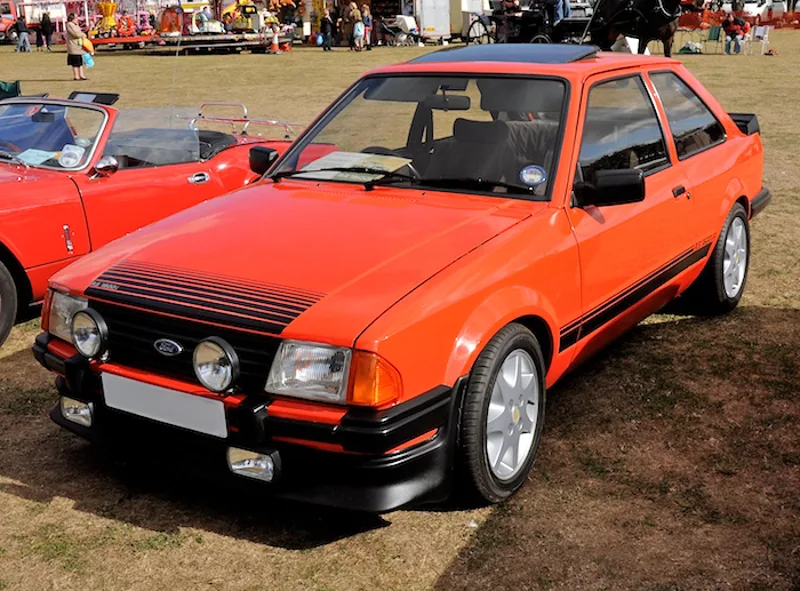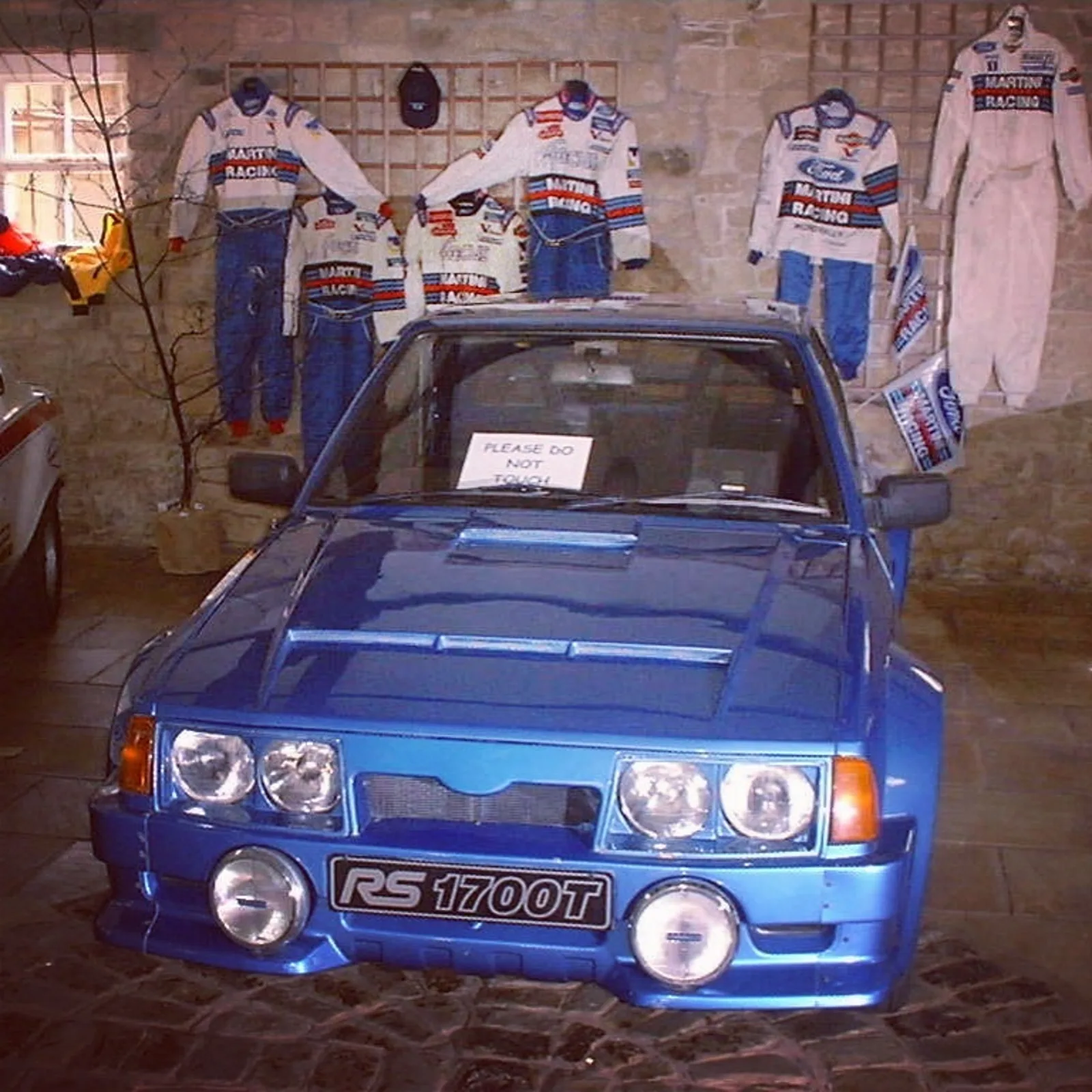
Ford of Europe's Group B rally car of the early 1980s, built as 18 prototypes on the third-generation Escort and revived in South Africa.
Developed by Ford of Europe from 1979, the RS1700T was a Group B rally car based on the third-generation Escort. Its turbo engine produced 257 kW (350 PS; 345 hp) and more, and only 18 cars were built in total, all of them prototypes.
The Ford Escort RS1700T was a turbocharged rally prototype that Ford of Europe developed in the early 1980s for the World Rally Championship. It was a heavily modified third-generation Escort with its engine mounted longitudinally, and only 18 were ever built.
Where did the RS1700T come from?
Ford of Europe started work on the RS1700T in 1979 at Boreham in England, under the codename Columbia, once it was known that the Escort would be replaced in August 1980. The aim was marketing: a rally car taken from current production, because a front-wheel-drive car was not seen as a winner.
The Escort already had a rally pedigree. Bjorn Waldegard, driving an Escort RS1800 as a works driver, became the first official world champion in 1979, and two years later Ari Vatanen won the title in the same model, run by the Rothmans Rally Team.
Because the car needed to win, the Escort went through numerous technical changes that the Group B rules allowed from 1982. Like its predecessor, the RS1700T had its engine mounted longitudinally and drove the rear axle, through a transaxle gearbox that balanced the weight.
Ford brought in John Wheeler, who had helped develop the Porsche 924 and 928 transaxle cars. Early runs began in winter 1981/82 on Rally Wales roads.
A turbo rally car that beat the RS1800 on test, then lost its future to a four-wheel-drive rival.
What made the RS1700T's engine special?
The turbo engine, known as the BDT, was a turbocharged version of the BD engine that Ford had already fitted naturally aspirated to the Escort RS1600 and RS1800. Its 1,778 cc (108.5 cu in) gave 257 kW (350 PS; 345 hp) and more, with about 515 Nm (380 lb ft) of torque.
The displacement stayed below 2.5 litres (152.6 cu in) even after the turbo factor of 1.4 used at the time was applied. The FIA set a minimum weight for Group B cars according to effective or virtual displacement, so makers matched engine size and car weight closely.
Both engines had four cylinders, two overhead camshafts, 16 valves and dry-sump lubrication. The BDT block and cylinder head were aluminium, and toothed belts drove the camshafts and the oil pump.
Fuel injection replaced the twin carburettors of the RS1800 on both engines. Testing tried several systems, starting with a continuous-injection system of the kind Ford also used on its production fuel-injected cars, and the cars later received more powerful electronic injection. The turbocharger was a T3 unit.
Unlike the production third-generation Escort, whose engines were always mounted transversely, the RS1700T's engine ran longitudinally, as in the rear-drive first and second generations.
How did the turbo car compare with the RS1800?
Six weeks before the planned debut at the 1982 Rally Corsica, Ari Vatanen and Pentti Airikkala tested a turbo RS1700T and a naturally aspirated RS2300 on Rally Portugal stages, comparing the times with an Escort RS1800. The turbo car was about two seconds per kilometre quicker, which made it a serious rival.
Vatanen did not rate the naturally aspirated car highly. Its engine, the 420R, was derived by Brian Hart from the BD unit, and it had first been used in Formula 2 as a two-litre engine. Displacement was 2,290 cc (139.8 cu in), with about 220 kW (300 PS; 296 hp) and about 327 Nm (241 lb ft) of torque.
That engine would also have suited the class up to 2.5 litres, yet the turbo unit clearly came out ahead in trials. That pace made the turbo car a serious rival for the Fiat 131, the Opel Ascona, the Lancia 037 and the Renault 5 Turbo.
Audi's quattros were not yet reliable enough to dominate in 1981 and 1982. Walter Rohrl won the 1982 title in an Opel Ascona, the last driver to win it in a car without four-wheel drive.
Why did the RS1700T project end?
The project effectively ended when Hannu Mikkola won the drivers' world championship in an Audi quattro in 1983. Plans to run the RS1700T and develop a four-wheel-drive car at the same time were dropped for cost reasons. That was the definitive end of the project.
Costs had already risen sharply. Building the 200 units the regulations required would have pushed them higher still, and Ford had no means of building such a car in small series.
A joint build with the Escort '81 at the Saarlouis plant was also considered, but it would have added further costs and difficulties there. Saarlouis had not been involved in the early development, although the 200 units were planned to be built there.
The turbo engine and the transaxle gearbox nevertheless formed the basis for the RS200. That car was designed from the outset as a four-wheel-drive machine and made full use of what the Group B rules allowed.
How was the RS1700T built and suspended?
The RS1700T used the bodywork of the third-generation Escort, but much of the floor pan was removed and modified, and the shell was stiffened with a tubular space frame to make room for the drivetrain. Front and rear suspension were also substantially reworked.
The front subframe with MacPherson struts and wishbones, the engine mounts and the rack-and-pinion steering were carried over from the predecessor. At the rear, the wheel carriers sat on a wheel-locating strut, a triangular steel-tube wishbone and an adjustable link tied to an anti-roll bar. The front and rear struts could be adjusted several times for damping and ride height.
The brakes were four-piston fixed-caliper units at the front and rear, working on internally ventilated discs. The gearbox was a manually operated five-speed transaxle, placed in the tail just in front of the rear differential.
A custom aluminium tube carried the propshaft through the cabin above the exhaust tunnel, adding stiffness as well. Some outer panels were replaced by aramid-fibre parts.
Escort RS1700T specifications
| Specification | Detail |
|---|---|
| Maker | Ford of Europe, development at Boreham, England |
| Base car | Third-generation Ford Escort, modified for racing |
| Turbo engine | BDT, 1,778 cc (108.5 cu in) |
| Turbo output and torque | 257 kW (350 PS; 345 hp) and more; about 515 Nm (380 lb ft) |
| Naturally aspirated engine | 420R (RS2300), 2,290 cc (139.8 cu in) |
| Naturally aspirated output and torque | About 220 kW (300 PS; 296 hp); about 327 Nm (241 lb ft) |
| Engine layout | Longitudinal, four cylinders, two overhead camshafts, 16 valves |
| Gearbox | Five-speed manual transaxle |
| Turbo factor and class limit | Factor 1.4; under 2.5 litres (152.6 cu in) |
| Cars built | 18, numbered P1 to P18 |
| Regulations quota | 200 units |
How many RS1700T cars were built?
Ford built 18 RS1700T cars, numbered from P1 to P18. P1 was a first-generation Fiesta fitted with parts from an Escort RS1800, while P2 and P3 served as mock-ups for checking how components fitted and how wide the wheel-arch extensions had to be.
P4 was the first running car and still used the drivetrain of a Porsche 924. P5 was a show car that was also displayed at the 1982 Paris Motor Show, and it was the most developed in appearance.
The other 13 cars were both road-legal and race-ready rally cars. On a disused airfield, P9 rolled at 206 km/h (128 mph) while project manager Mick Jones was testing it, and the wreck went for scrap.
What happened to the cars after 1983?
Ford had intended to scrap the remaining RS1700T cars. Instead, project manager Mick Jones moved to Ford South Africa and bought them for its motorsport department, and they started in national rallies in 1984, after an early period of faults.
After the 1984 season the cars were overhauled to save weight. Sheet metal on the underbody was removed, parts of the bodywork were made from resin reinforced with aramid fibre, and polycarbonate panes replaced glass. The rear suspension was reworked, engine and charge-air coolers were modified, and a pair of external oil coolers for engine and gearbox sat on the tailgate.
Vito Bonafede rode alongside Serge Damseaux when they took the Nissan International Rally 1985 near Cape Town. Ivor Peltz was the co-driver at the Scholle All Night Rally 1985, and in 1986 an RS1700T still took second place in a South African hill climb, between two Audi quattros.
Which RS1700T cars survive today?
At least four survive. One belongs to Malcolm Wilson and is in the M-Sport museum, one belongs to a US collector, and the last is in Britain under restoration.
P18, given as P7 in some other sources, is the car that came back to Britain by a roundabout route. It was the only car in which a race was won, and Serge Damseaux drove it to that result in 1985 near Cape Town.
Malcolm Wilson and Pentti Airikkala also drove the car at various points in its history. Simon Nutter owned it for a long period and entered it in national rallies. After he sold it to Brian Betteridge, Betteridge restored it with help from his co-driver Paul Moulson, the engine builder Wayne Mitchell and former project manager Mick Jones. Since 2017 it has been driven regularly at classic rallies.
A fifth car may be in Ford's development department at Boreham in Essex, and a sixth is said to be at the Saarlouis plant, though neither is likely. Ford Germany keeps prototypes, production cars and race cars at its Cologne museum, yet no RS1700T has been shown there or at Ford Germany's events, and no visitor has published a photo of one from Boreham or Cologne.