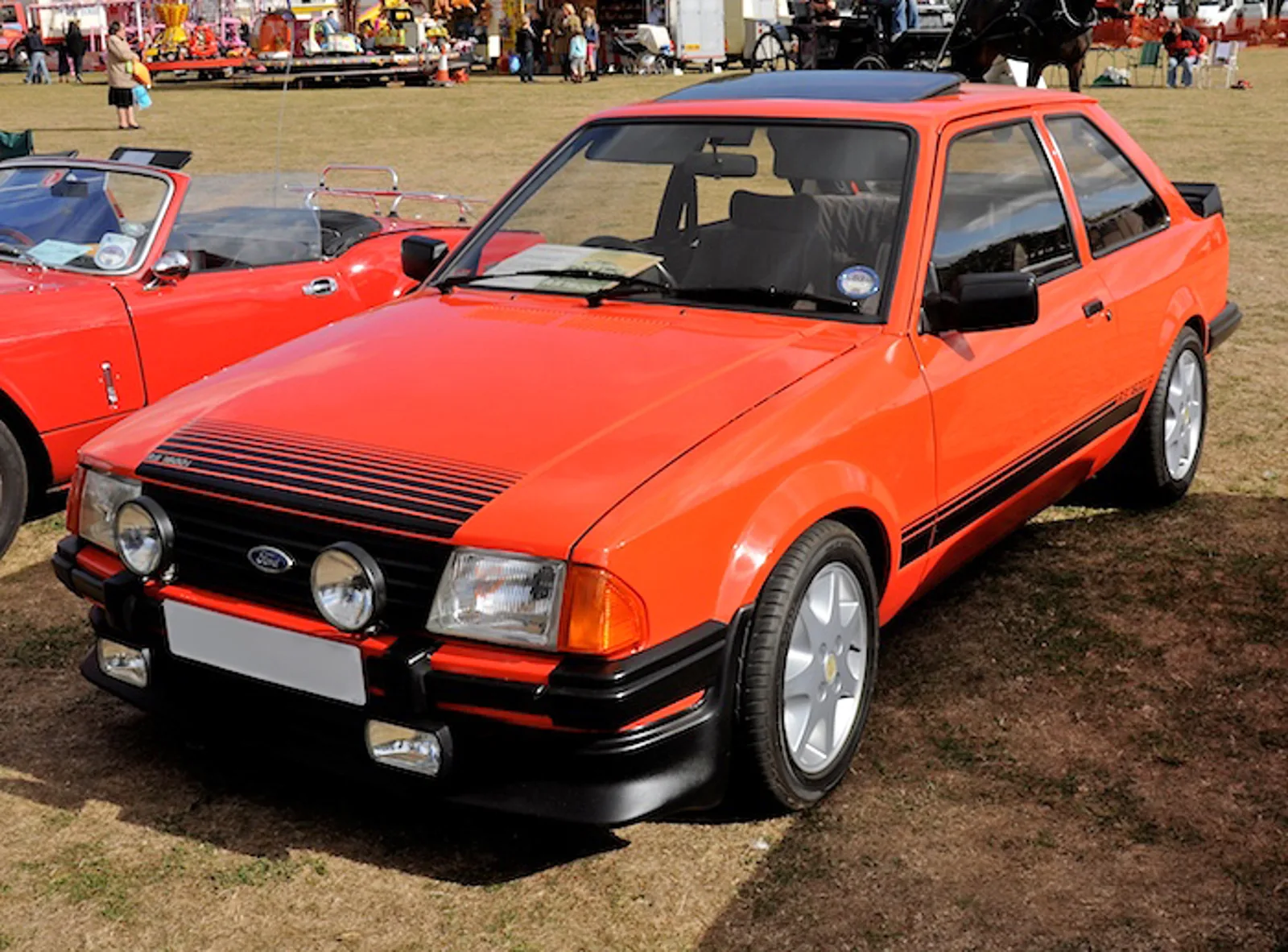
A near-standard touring car from Ford Germany, built in 8,659 examples with a reworked CVH engine, electronic ignition and front-wheel drive.
The Ford Escort RS1600i was a touring car built in 8,659 examples on the third-generation Escort, with a 1.6-litre CVH engine, K-Jetronic fuel injection and front-wheel drive. It was developed in Cologne for Group A and Group N racing and used electronic ignition.
The Ford Escort RS1600i, also called the Escort RSi, was a special model of the third-generation Escort that Ford Germany developed in the early 1980s for touring car racing. Ford built 8,659 of them. It was the first RS model with front-wheel drive, the first Ford series car with computer-controlled ignition, and the first Escort with fuel injection.
Why did Ford Germany build the RS1600i?
The earlier rear-drive Escorts had been very successful on circuits and in rallying, but the future of touring car racing in Germany looked uncertain. A new FIA rule for Group C sports cars in the German championship from 1982 suited neither the Escort nor the Capri Turbo, so Ford Motorsport in Cologne developed the RS1600i for Group N and Group A touring car racing.
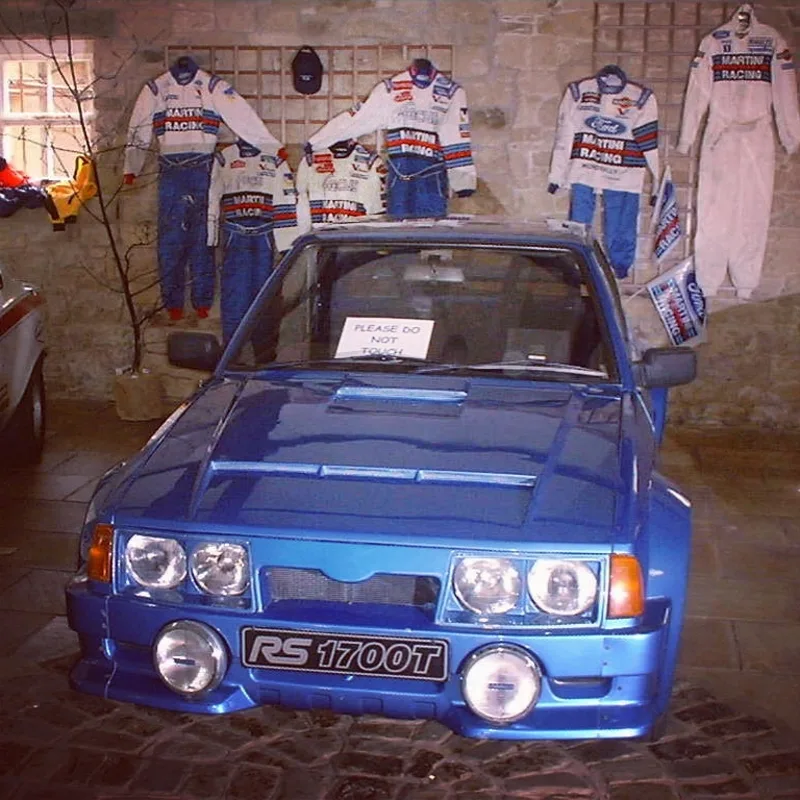
Ford of Britain took another path. Its Escort RS1700T used a longitudinal engine with a transaxle to drive the rear wheels, but that project never got beyond development, and it was dropped at the end of 1983 in favour of the all-wheel-drive RS200.
The change came with the 1980 Escort, which replaced rear-wheel drive with front-wheel drive. The two motorsport departments then stayed with the fields they preferred, Ford of Britain with rallying and Ford Motorsport in Cologne with circuit racing.
The first RS with front-wheel drive, and the first Escort to wear fuel injection, built for touring car racing.
How was the RS1600i built from the Escort?
The car was based on the Escort 1.6 Ghia, taking its interior and bodywork from that model. Its engine block matched the Escort XR3, the range's previous top model, whose 1.6-litre (98 cu in) CVH engine had a register carburettor and produced 70 kW (96 PS; 95 hp).
Races in Group A and Group N required 5,000 series-built vehicles, so Ford could not give it the elaborate changes of the RS1700T, a car in development alongside it. Those would have pushed up the price, and they had to be workable on the Saarlouis production line. The RS1600i was therefore built as a near-standard car.
Demand led Ford to extend production beyond the original plan. In the end 8,659 cars were sold, about 2,600 of them in the United Kingdom.
What did the model name mean?
The name combines Ford's customary shorthand for RallyeSport with the engine capacity, rounded off. The letter i is short for injection, and it helps tell the car apart from the first-generation Escort RS1600 with its Cosworth BD engine.
Ford was not consistent about the spelling. The brochure cover and some technical literature use RS 1600 i with a half space, while the interior of the brochure, the rear badge and the decals show RS 1600i. For the British market, RS1600i is used throughout marketing and specialist writing.
What changed in the engine?
The CVH was reworked for injection. Compression rose from 9.5 : 1 to 9.9 : 1, the inlet and exhaust ports were machined, and the exhaust ports were also enlarged and made round. A camshaft (272 degrees duration, 110 degrees lobe separation) came with adjustable tappets, reworked valve springs and altered inlet valves.
Injection also needed new parts outside the engine. The inlet manifold looks clearly different from the later XR3i manifold, and the 55 mm throttle body came from the Capri and Granada 2.8i. The K-Jetronic injectors sit in an extra spacer plate between cylinder head and manifold, and the same plate holds the thermo-time switch that controls the cold-start valve.
The five-bearing crankshaft sits in a grey cast iron block. Those control pistons carry squish edges and are cast from an aluminium alloy. They have no slots, but each side is pierced with two oil drain holes, and a spray hole in the connecting rod feeds oil to each one.
The engine was not approved for unleaded petrol and had to run on fuel with an octane rating of 98 or higher. Its aluminium rocker cover carried finned cooling ribs and the inscription Ford Motorsport.
How did the fuel injection system work?
The injection was a Bosch K-Jetronic, a mechanically and hydraulically controlled system that needs no drive of its own and works as an indirect single-point injection. Ford had already used it on the Capri and Granada 2.8i, and many manufacturers adopted it from the late 1970s, with the individual parts supplied directly by Bosch.
The RS1600i system differs from that of the first Golf GTI in only a few small details.
Unlike the later XR3i, the RS1600i warm-up regulator does not sit between the cylinder head and the manifold. It sits below the manifold, where the engine block meets the gearbox. If the electric heating of its bimetallic spring fails, the regulator is still heated externally by the cooling circuit as the engine warms, so injection keeps working.
What was special about the ignition?
The RS1600i was the first series-production Ford with electronically controlled ignition. A ring gear sensor reads a foil-covered reference tooth on the flywheel, and a control unit from AFT in Werdohl calculates the timing from engine speed and load, measured by an integrated MAP sensor.
The ignition works on the wasted-spark principle, with each of its two separate coils firing two cylinders. The control unit also manages overrun fuel cut-off through the throttle switch and the overrun cut-off valve.
What changed in the exhaust and bodywork?
The exhaust system of the XR3 was adapted in a few details. The cast manifold gained two outlet ports with enlarged passages, the pipe run near the rear axle was slightly straightened, and the exhaust gasket was matched to the larger, round exhaust ports.
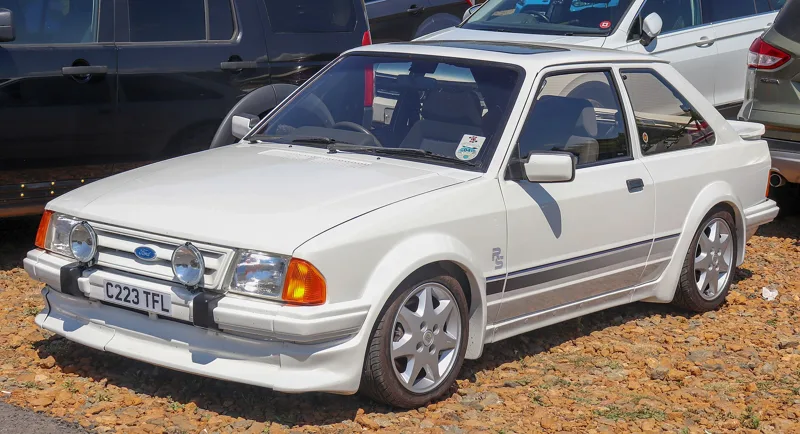
The bodywork was carried over almost unchanged. Apart from altered fixings for the exhaust, the fuel pump and the wiper and washer reservoir, the visible differences were a slightly altered radiator grille, front and rear spoilers, rear wheel arch covers and stuck-on decals.
What were the key specifications?
| Item | Specification |
|---|---|
| Engine | 1.6-litre (98 cu in) CVH four-cylinder |
| Fuel injection | Bosch K-Jetronic mechanical-hydraulic system |
| Compression | 9.9 : 1 |
| Bore and stroke | 79.96 mm and 79.52 mm |
| Camshaft | 272 degrees duration, 110 degrees lobe separation |
| Fuel | Octane 98 or higher; not approved for unleaded |
| Gearbox | Five-speed type BC, front-wheel drive |
| Clutch | Single-plate dry clutch, 200 mm |
| Front brakes | 240 mm internally ventilated discs, single-piston floating calipers |
| Rear brakes | 180 mm drums, 36 mm lining width |
| Wheels | 6 x 15 inch alloys, 195/50 R 15 tyres |
| Spare wheel | 155 R 13 emergency wheel |
| Price (July 1982) | 22,950 Deutsche Mark (DM), about 11,735 euros |
How did the chassis differ from the rest of the range?
The front suspension differed in many details. A special aluminium cross member carries the trailing arms and the additional anti-roll bar, which is 25.5 mm in diameter. The ball joint on each trailing arm also allows the caster to be adjusted.
Only the RS1600i came with adjustable Koni dampers as standard, and its front spring plates sat 23 mm lower. The rear suspension was the same as on the other models, apart from reinforced rubber bearings on the inside of the transverse links.
What was the brake and wheel package like?
The brakes matched the Escort XR3, with internally ventilated front discs of 240 mm and rear drums of 180 mm. The standard wheels were 6 x 15 inch alloys on 195/50 R 15 tyres, while 5.5 x 14 inch alloys on 185/60 R 14 tyres were available at no extra cost.
Because the RS1600i was developed as a left-hand-drive car, the right-hand-drive versions for Britain had trouble with the linkage between the brake pedal and the brake booster. The XR3's linkage could not be used, because the fuel injection left too little room.
How much did it cost and what could buyers add?
In July 1982 the RS1600i cost 22,950 Deutsche Mark (DM), about 11,735 euros, with its extensive standard equipment. Customers could order it in any colour available for the Escort, and Ford offered extras such as electric windows, central locking, a sunroof and fog lamps.
Exclusive to the RSi were a three-spoke leather steering wheel for 145 DM and RS reclining sports seats with better side support for 875 DM.
Did the RS1600i race successfully?
Factory-supported outings were few. In 1982 the women's team of Gisela Blume and Petra Schuster contested the German rally championship, and in 1983 Michael Werner and Matthias Feltz did the same, both in Group A up to 1,600 cc. Annette Meeuvissen raced several European touring car championship rounds in 1985, mostly with Jorg van Ommen, for the Ford Gerstman Racing Team.
The car also ran in the British Saloon Car Championship, then still called that and later the BTCC, from 1983. Six different drivers ran it in 1983. Richard Longman took the class title in 1984 with a 29-point lead, and he finished runner-up in the championship, seven points behind Andy Rouse, who drove a much more powerful Rover Vitesse in Class A.
In 1984 only one Golf GTI and one Alfa Romeo Alfasud ti were entered alongside the six RS1600i cars. In 1985 eight drivers used an RS1600i, and Richard Belcher finished second in Class C, 17 points behind Chris Hodgetts on a Toyota Corolla Coupe GT. Those Toyotas had a newer, more powerful DOHC engine. Longman contested only the second half of the 1985 season, driving the Escort RS Turbo in Class B, and the RS1600i made its last BTCC appearances in 1988.
Why is the car still remembered?
Longman's red Escorts in the Royal Mail Datapost livery still have cult status among Ford fans in the United Kingdom. The RS1600i is remembered as the first RS with front-wheel drive and the first Escort with fuel injection, both firsts recorded in its history.