Two turbocharged series of the Escort RS, built at Saarlouis from 1984 to 1990, with a 1.6-litre CVH engine and Class B titles in the BTCC.
Ford built the Escort RS Turbo at Saarlouis in two series from 1984 to 1990, pairing a 1.6-litre turbo engine with a sporty body kit. It competed in the BTCC's Class B from 1985 to 1988, and Richard Longman took that class's 1986 title.
The Ford Escort RS Turbo was a turbocharged special version of the Escort, built at Ford's German plant in Saarlouis in two series between 1984 and 1990. Its 1,596 cc (97.4 cu in) CVH engine gave it a sporty edge, and it raced in Class B of the British Touring Car Championship from 1985 to 1988, which made it familiar to Ford fans. The model was built as a homologation car for Group A racing and as the top sporting model of the Escort line.
Why was the Escort RS Turbo developed?
Ford developed the RS Turbo as a homologation car for Group A and Group N circuit racing, and as the sporty top model of the Escort range. Turbo engines dominated Formula One when the project began. Ford had planned 5,000 units to satisfy the homologation rules, but demand was high, and 8,604 first-series cars were eventually built.
The RS name goes back to 1970, when it began marking Ford's sportiest models, and the RS Turbo carried it onto the Escort's third and fourth ranges. Engineers at SVE, a Ford development department in England, also worked on the turbocharged Escort. The Sierra RS Cosworth, with a turbo engine of its own, was close to production at the same time.
Planned as a 5,000-unit homologation car, the turbo Escort ended with 8,604 first-series builds.
What were the two series?
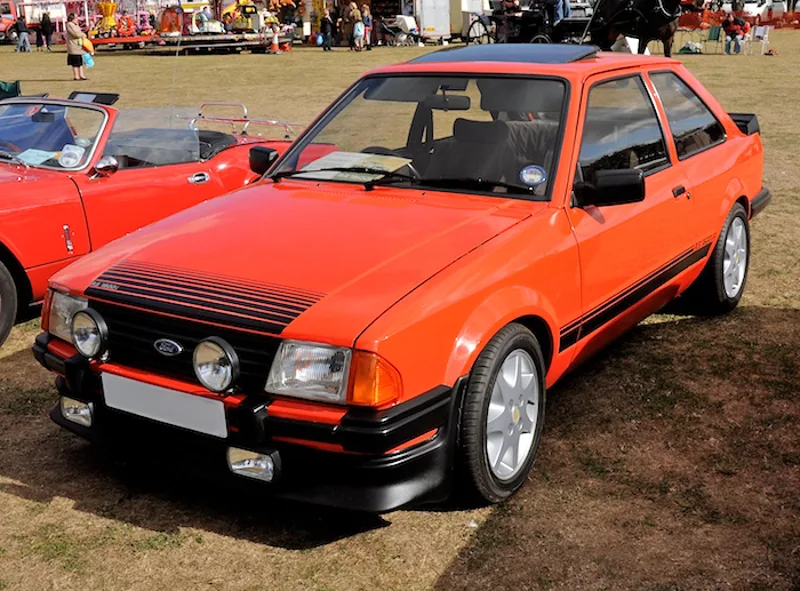
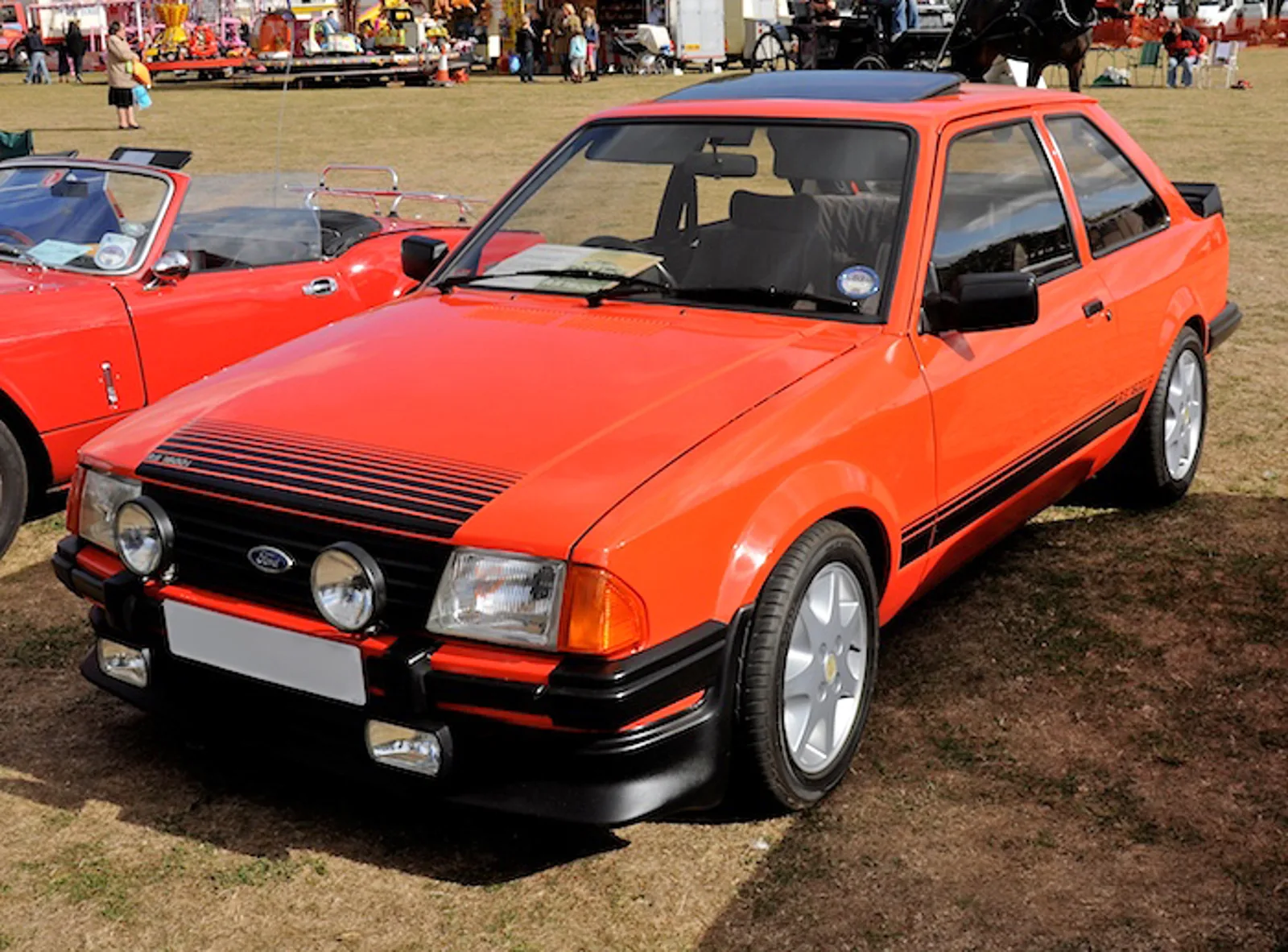
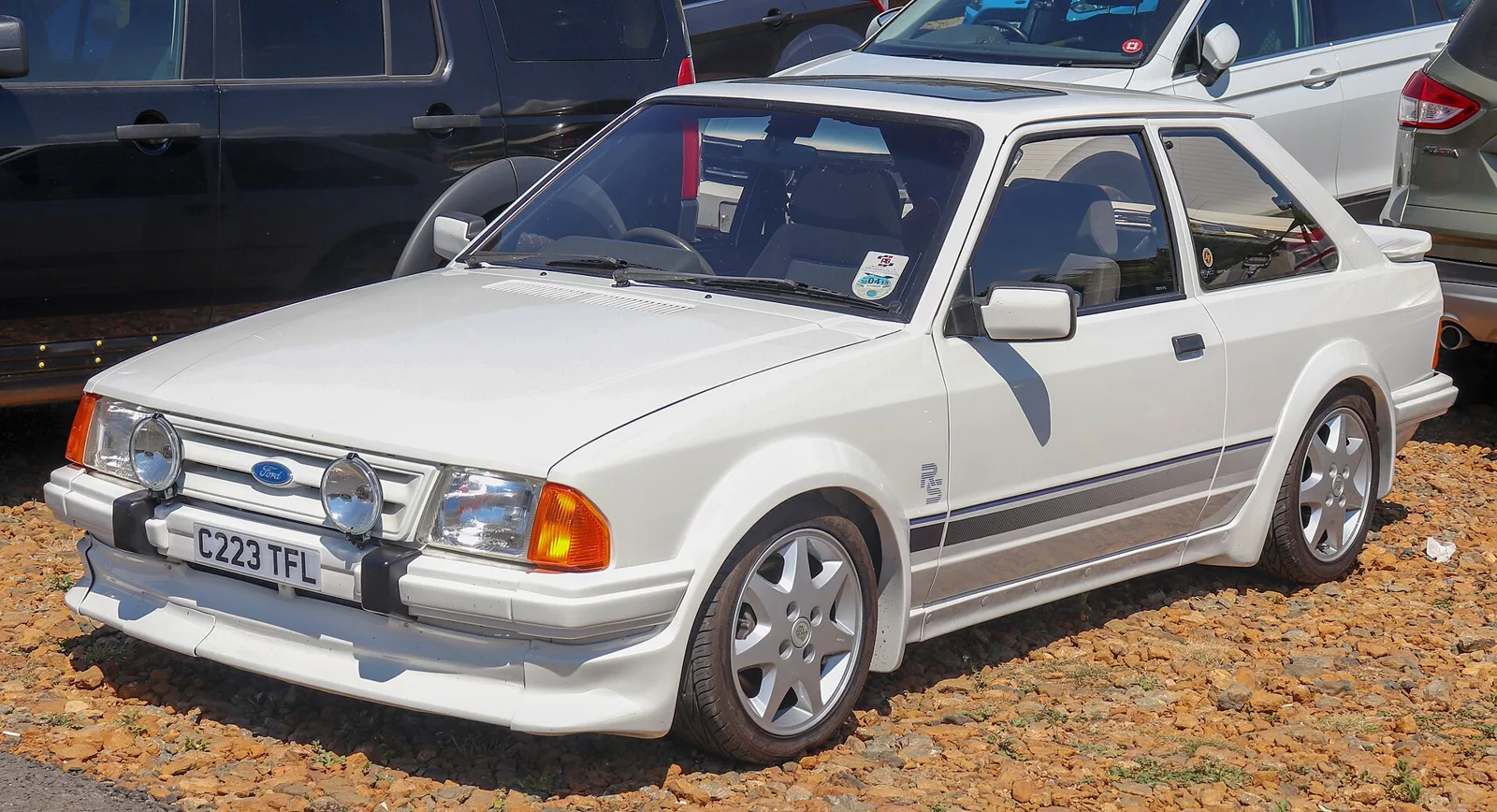
The first series, built from September 1984, was a single trim level sold in Diamond White, with a full body spoiler kit and wheel arch extensions fitted at the factory. The second series, from early 1986, kept the same engineering but had a redesigned front and interior, four colours to choose from, and about 22,000 units built across its run.
Series 1 came very well equipped. Standard kit was comparable to the XR3i, and all Turbos had sports seats and a three-spoke sports steering wheel. The body carried a body-coloured radiator grille from the Ford Orion and a rear spoiler on the tailgate. Customers could add only one accessory package, with a sunroof, central locking, electric windows and tinted glass.
Series 2 kept the engineering of its predecessor but had less standard equipment, with two halogen driving lights as its main extra. Options included a headlamp washer, a heated windscreen, electric mirrors and a trip computer. A new front apron and rear spoiler came in 1990, when the RS Turbo received the same changes as the EFI version of the XR3i.
Why do the two series get different nicknames?
Ford did not use official names for the two series. Enthusiasts call the third-range car Series 1 or S1, and the fourth-range car Series 2 or S2, to tell them apart. Both came only as three-door hatchbacks, a body style Ford called the Aero-Heck.
The Escort RS Turbo was offered only in that body style, and the same engineering ran through both ranges.
How did the 1,596 cc engine work?
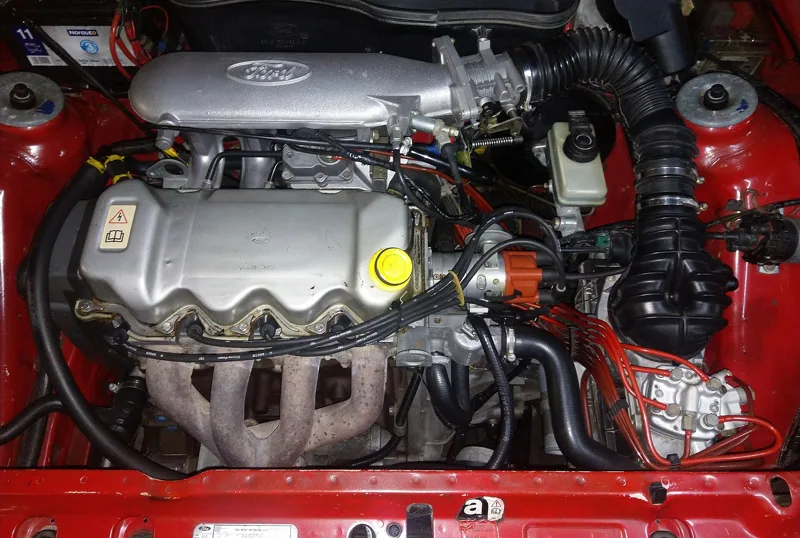
The 1.6-litre CVH engine is a four-cylinder with a cast-iron block and an aluminium cylinder head. Its bore and stroke measure 79.96 mm and 79.52 mm respectively, and a turbocharger added 0.5 bar of boost. Series 1 carried engine code LNA and Series 2 engine code LNB, and both could run on unleaded petrol, although Ford specified 98 octane fuel for Series 1.
The engine block of the RS Turbo gained an oil feed for the turbocharger and a return bore from it.
The turbo's oil supply and drain were added to the block, and the cast pistons were made flatter to lower compression. The bearings and gudgeon pins were reinforced. Series 1 kept the cylinder head of the RS1600i with reworked ports, but used the camshaft of the 1.3-litre CVH. Every RS Turbo had an intercooler, and a larger T3 turbocharger was chosen over a smaller T2 because the turbocharger used in motorsport had to be fitted to the production car.
How were the fuel and ignition controlled?
Fuel was metered by a KE-Jetronic injection system, developed from the K-Jetronic used on the RS1600i and XR3i. A separate ESC-II ignition computer with a built-in MAP sensor set the timing from engine speed and boost pressure. Both units worked independently, and the injection control only acted once the engine turned.
Control units differed by build period, with different maps and different maximum boost values. If boost passed its limit, the ignition timing changed and boost was limited to protect the engine. From the second series a knock sensor was added. Tuning meant replacing the soldered control chips with EEPROM chips, which could then be written with individual data. This chip tuning was slow and labour-intensive, and in Germany the last specialist to offer it ceased trading around 2020.
How did the chassis and brakes differ between series?
Both series shared the Escort's front-wheel-drive chassis, with a five-speed BC gearbox and a limited-slip differential that worked like a viscous coupling. Series 1 had adjustable front tie-rods and 240 mm ventilated front discs. Series 2 had a thicker rear anti-roll bar, larger 260 mm front discs and a standard mechanical anti-lock braking system.
The limited-slip unit was developed by an outside research company and fitted as standard to the RS Turbo's BC gearbox. The gearbox was operated mechanically, with a 220 mm single-plate dry clutch operated by cable. Series 1 had a relatively short-ratio gearbox, which was criticised in everyday use, so Ford raised the final drive for Series 2. As part of the Fiesta '84 model update in 1986, the gear selector gate moved from the linkage into the gearbox.
Series 1 used the brake system of the XR models, while the rear drums on Series 2 came from the Sierra V6. Two modulators on the gearbox controlled brake pressure by speed, and the rear axle was left outside the system. Every RS Turbo rode on 6 x 15 alloy wheels with 195/50 R 15 tyres. Series 1 had the seven-spoke wheels of the RS1600i, and Series 2 had a design that resembles a turbocharger turbine.
How did the RS Turbo perform in motorsport?
Ford never raced the RS Turbo with its works team. The Sierra RS Cosworth took over that role, and it was developed at the same time. Instead the Escort appeared in the Ford Escort RS Turbo Rally Cup in 1985 and 1986, and in the BTCC's Class B from 1985 to 1988.
Alongside the Fiesta Ladies Cup, the Rally Cup created a second manufacturer trophy for young rally drivers.
In Class B, Richard Longman won nine class victories in 1985 and 1986 and took the 1986 title, finishing only six points short of the overall champion, Chris Hodgetts. Andy Rouse, who finished third overall, drove the far more powerful Sierra XR4Ti and ended seven points adrift of Longman. Mark Hales won the 1987 Class B title, and seven Class B races that season went to RS Turbos. In the BTCC the RS Turbos produced between 270 and 300 bhp.
The car also made occasional appearances in the German touring car series, the DTM. Manfred Burkhard, Beate Nodes and Traudl Klink entered seven races in 1985 and 1986 without reaching the top ten.
How did the Series 2 look compared with the XR3i?
The second series differs from the XR3i variants through the absence of black frames around the side windows, and through extra wheel arch extensions and side skirts. The front and interior redesign came with the fourth Escort range in 1986.
The Series 2 kept the mechanical base of the first series, so the look changed far more than the underpinnings did.
Who owned a black RS Turbo?
One owner on record was Lady Diana, who had a black RS Turbo from 23 August 1985 to 1 May 1988. It was an exception, because the first series was otherwise offered only in Diamond White. The car became well known among British Ford fans during its Class B years.
Key specifications
| Specification | Detail |
|---|---|
| Series 1 built | From September 1984, 8,604 cars |
| Series 2 built | From early 1986 to 1990, just over 22,000 cars |
| Engine | 1,596 cc (97.4 cu in) CVH, four cylinders, turbocharged |
| Bore and stroke | 79.96 mm x 79.52 mm |
| Boost | 0.5 bar |
| Fuel | KE-Jetronic injection, 98 octane recommended for Series 1 |
| Gearbox | Five-speed BC, front-wheel drive, limited-slip differential |
| Front brakes | 240 mm ventilated discs (Series 1); 260 mm discs (Series 2) |
| Wheels and tyres | 6 x 15 alloy, 195/50 R 15 |
| Series 2 list price | 27,425 Deutsche Mark (DM) at launch |