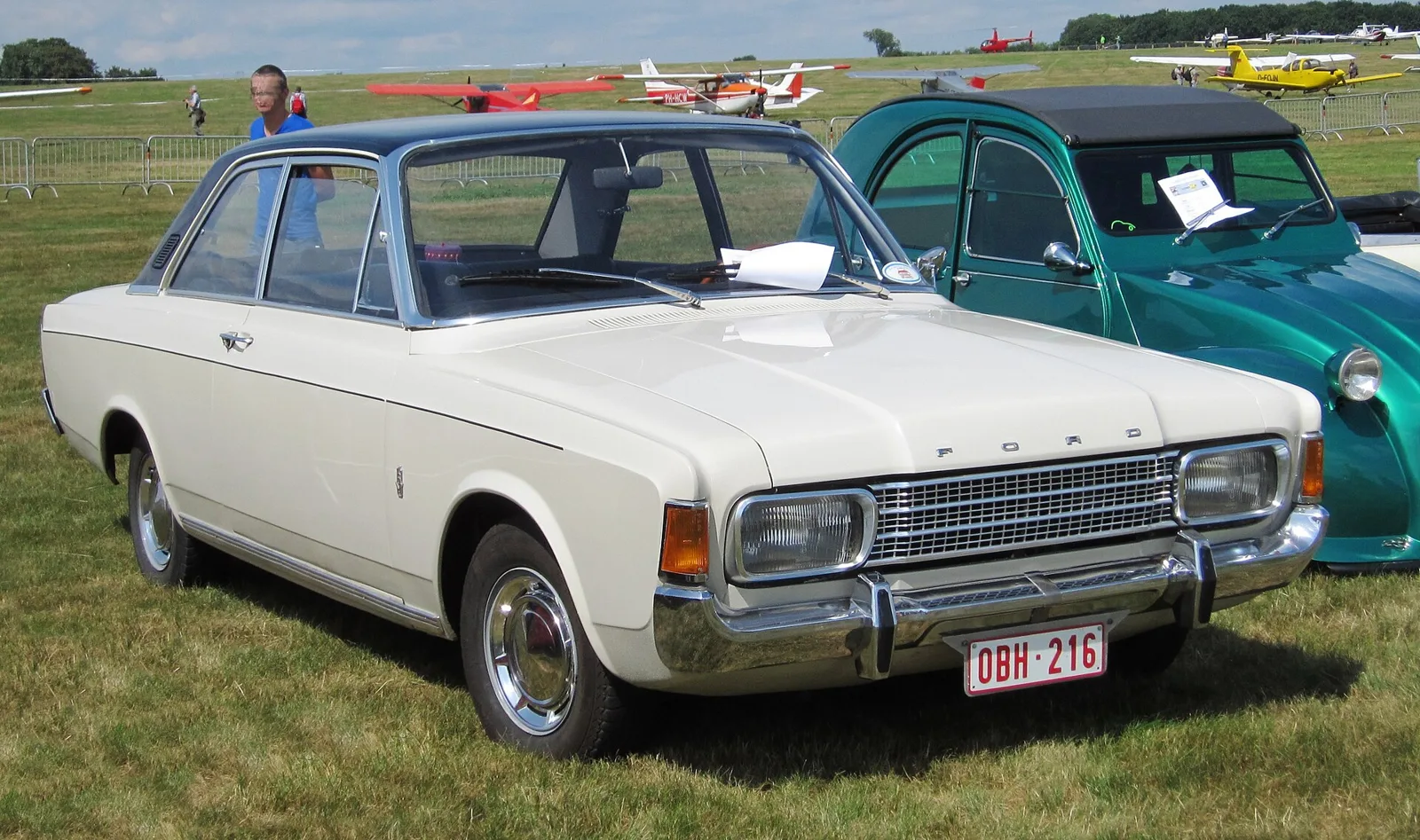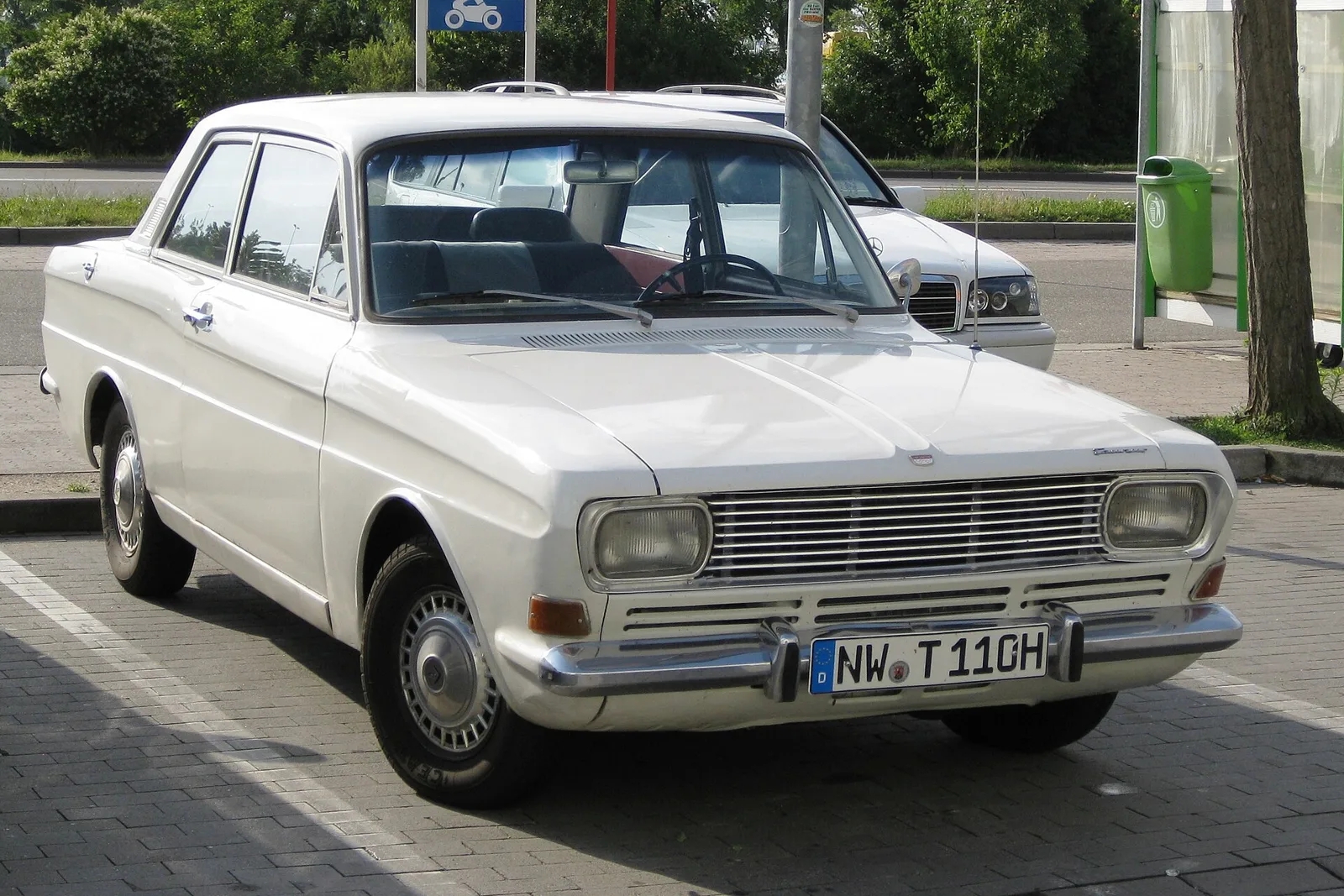
Ford Germany's front-wheel-drive family car of 1966 to 1970, offered as the 12M and 15M, with four engine sizes and a cult sports saloon.
The Ford Taunus P6 was a front-wheel-drive family saloon built by Ford Germany from 1966 to 1970 as the 12M and 15M. It used V4 engines from 1183 cc to 1699 cc, sold 668,187 cars, and was replaced by the rear-wheel-drive Escort and Taunus TC.
The Ford Taunus P6 was a range of large family saloons built by Ford Germany from 1966 to 1970 in 12M and 15M forms. It was front-wheel drive, unusual for a German mainstream car at the time, and it used a V4 engine with MacPherson struts at the front. Its internal name was Project 6, and the Taunus name was dropped in 1967.
What was the Ford Taunus P6?
The Taunus P6 was the sixth newly designed German Ford to be launched after the war. It was first shown in September 1966 as the 12M and 15M, and in August 1967 the name Taunus was removed, so the cars became the Ford 12M and 15M.
Between September 1966 and August 1970, when it was replaced, Ford built 668,187 P6s. That was almost exactly the 672,695 units of the predecessor built between 1962 and 1966. About 385,000 were the smaller 12M, and about 285,000 were the larger-engined 15M.
A front-wheel-drive family car that Ford built in its hundreds of thousands and sold for four years before a rethink.
How did the P6 compare with its predecessor?
The P6 inherited the predecessor's wheelbase and kept its front-wheel-drive layout with a V4 engine. The new body was longer and wider but lower, reflecting the design trends evident across western Europe at the time. The most significant change was choice, as the P6 came with four engine sizes where the predecessor had offered two.
Front-wheel drive had been a defining feature of the earlier model. In France and Britain it was gaining ground through cars such as the Peugeot 204 and the Morris 1100, but in Germany it was still seen as idiosyncratic, with only the Auto Union brands applying it widely.
What engines did the P6 use?
The entry 12M used a 1183 cc V4 with a claimed 45 PS, the engine that had powered its predecessor. Most 12Ms were sold with a newly introduced 1305 cc V4, which was an enlarged version of the same engine and was offered at launch. Two outputs were offered, 50 PS or 53 PS.
The 1498 cc engine was an option on the 12M and standard on the 15M, sharing the same stroke as the smaller engines but with a larger bore. In 1967 a 1699 cc V4 arrived for the faster 15Ms. That larger engine had first appeared in 1964 in the Taunus 17M, and it needed super-grade petrol because of its 9:1 compression ratio.
Ford's engines were labelled LC for low compression and HC for high compression. Oil companies were introducing higher-octane 'super' petrol at higher prices, which encouraged manufacturers to offer improved versions with higher compression ratios. Buyers who chose the high-compression engines had to pay more at the pump for the fuel they required.
How was the P6 bodied and sized?
All models shared a steel monocoque body. Most buyers chose the two-door or four-door saloon, and a three-door Turnier station wagon and a two-door coupe were also offered. The coupe had a shortened roofline and a raked rear window, which reduced rear headroom noticeably.
The P6 was the first post-war Taunus design for which Ford offered no coachbuilt cabriolet. Ford stressed the car's interior roominess in its advertising.
How were the P6's running gear and brakes?
In most respects the P6's underpinnings followed the previous model. A four-speed all-synchromesh manual, which had been optional before, became standard. The gearlever sat on the column, though from February 1968 a floor-mounted lever could be specified at extra cost between the individual front seats.
Disc brakes remained at the front and drums at the rear. Twin braking circuits arrived in September 1967, and servo assistance became an option in February 1968. The front suspension geometry was developed from the P4, with MacPherson struts, and the class-leading track width of 1,321 mm (52.0 in) was used to promote the car's handling.
What upgrades did the P6 receive?
The first and most extensive facelift came after a year. From September 1967 the cars appeared with restyled grilles and dashboards, and the 6-volt electrics were replaced with a 12-volt system that had been optional since 1966. Fuel tanks grew from 38 litres to 45 litres, which reduced boot space slightly, and the cooling system lost its expansion tank.
Autumn 1967 also brought the 15M Rallye Sport, usually called the 15M RS. It became a cult car among enthusiasts, especially in coupe form. In spring 1968 the RS was revised with a standard floor-mounted gear change. Later facelifts were restricted to rearranging the dials and reworking the options list.
How did the P6 sell and what competed with it?
Between 1966 and 1970 Ford produced 668,187 P6s, which worked out to around 167,000 cars a year. Between 1965 and 1973 Opel produced 2,691,300 Kadett Bs, roughly 336,500 a year, so the German market was growing and the P6 was not keeping pace.
The Volkswagen Beetle outsold both the P6 and the Kadett in Germany, according to monthly statistics published by Auto, Motor und Sport. The Beetle still appeared unstoppable in key export markets, which made the sector harder for Ford in its home market.
Why was the P6 replaced by two different cars?
The P6 failed to keep pace with the growth of the German market, which prompted a major rethink. In 1970 Ford stopped making front-wheel-drive cars and returned to rear-wheel drive, which it kept until the arrival of the Ford Fiesta in 1976.
The P6 was replaced by two models. The smaller one was the Ford Escort, adapted from the British design and built at Saarlouis from 1970. The larger was the Taunus TC, a rear-wheel-drive car sharing its footprint with the British Cortina Mark III. The Taunus TC sold strongly against Opel's Ascona.
Ford Taunus P6 specifications at a glance
| Specification | Detail |
|---|---|
| Production | September 1966 to August 1970 |
| Models | 12M and 15M saloons, Turnier estate, two-door coupe |
| Layout | Front-engine, front-wheel drive, monocoque steel body |
| Entry engine | 1183 cc V4, 45 PS |
| Main 12M engine | 1305 cc V4, 50 or 53 PS |
| 15M engine | 1498 cc, then 1699 cc V4 from 1967 |
| Front track | 1,321 mm (52.0 in) |
| Units built | 668,187 |
What was the 15M RS?
The 15M RS was a Rallye Sport model launched in autumn 1967, and it became a cult favourite among enthusiasts, especially in coupe form. Ford revised it in spring 1968, when a floor-mounted gear change became standard on the model.
How did the 12M and 15M differ at the front?
The 12M and 15M shared a body, but their grilles and headlamp treatments differed. From the outside the 15M was identified by its grille and rectangular headlights, while the 12M had round front lights. The 15M was the faster model, with a larger engine as standard.
The rear light clusters also set them apart. Those on the 12M took the form of an extended lozenge, reminiscent of the previous model, while the 15M's were rectangular. Buyers could also pay extra for one of the 15M's larger engines in a 12M.
How did the P6 stack up against the Kadett?
Opel had noticed Fords getting larger. Its Kadett B, which appeared in 1965, was 100 to 200 mm longer than the Kadett A, but the P6 launched in 1966 was 200 to 300 mm longer even than the new Kadett.
Ford's advertising pushed the car's interior roominess, and its less powerful versions were priced squarely against the Volkswagen and the Opel Kadett.