A rear-drive family car that shared its bones with the UK Cortina, sold well through the oil crisis and lived on in Argentina and Turkey.
The Ford Taunus TC was a rear-drive family car from Ford Germany, built across three generations from 1970 to 1982. It shared most of its components with the UK Cortina and spawned the TC2 and TC3, plus long runs in Argentina and Turkey.
The Ford Taunus TC was a family car that Ford Germany sold across three generations between 1970 and 1982. Its name, with the TC standing for Taunus Cortina, reflected its close relationship with Ford UK's Cortina, which was almost identical from the second generation onward. The car was a major seller in Germany during the early 1970s before the oil crisis and rising competition began to bite.
Where did the Ford Taunus TC come from?
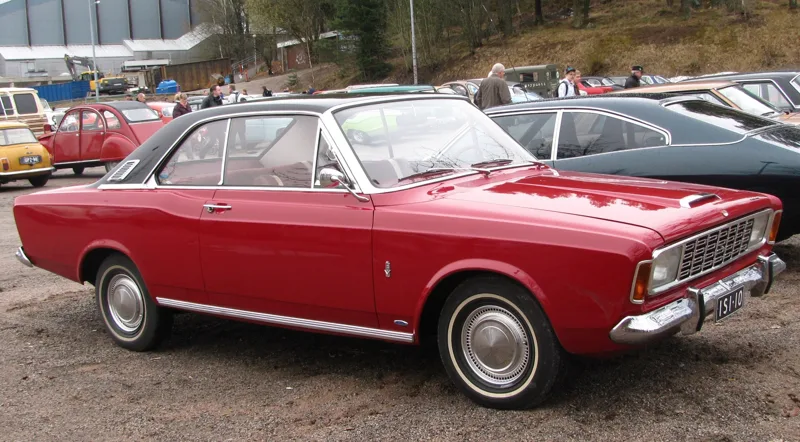
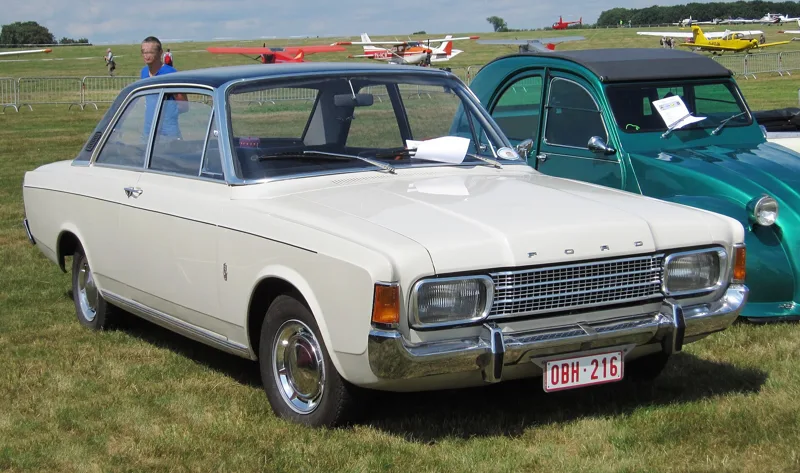
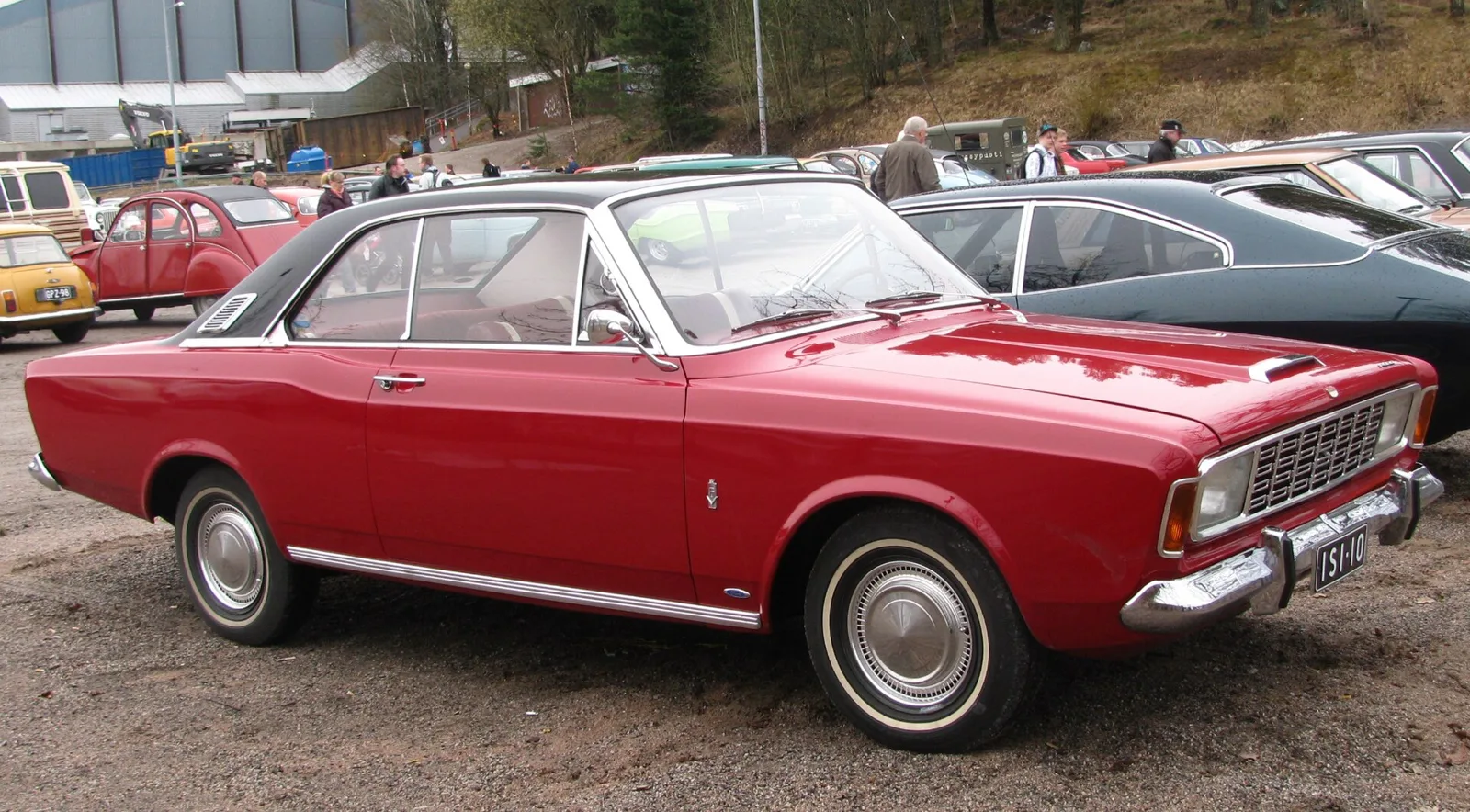
The Taunus TC was introduced in September 1970 as the Taunus Cortina, replacing the Taunus P6. It came as a two- or four-door saloon and as a five-door estate, which the German range called the Taunus Turnier. A fastback coupe was also offered between 1970 and 1975, aimed at buyers who wanted something more sensible than the Capri.
The TC was conceived in the late 1960s as a world car, developed alongside the Cortina Mk III, with design work on both sides of the Atlantic. Semon E. "Bunkie" Knudsen oversaw the project. He had been a senior General Motors executive and then, from early 1968 until autumn 1969, Ford's chairman in Dearborn. The bonnet scoop that became the car's trademark was reportedly his personal request, which is why the car earned the nicknames Knudsen-Taunus and Barock 2 in Germany.
Designer Luigi Colani is also said to have contributed to the design. Colani later produced concept work for BMW's motorcycle arm in the late 1970s. The TC took over from the P6, which ceased production in August 1970, and it was positioned slightly higher in the market than its predecessor, while the smaller Escort had been targeting the lower end since 1968.
Its rear-drive chassis, Pinto engines and reskinned later generations kept the Taunus selling long after its design had begun to age.
How was the Taunus TC sized and built?
The wheelbase measured 2,578 mm (101.5 in), which was 51 mm (2.0 in) longer than the P6's. The TC's overhangs were shorter, so overall it was slightly shorter than its predecessor. Buyers liked the way it looked larger than it really was, and the car's proportions helped that impression.
The interior lost the flat floor the P6 had enjoyed, because the TC kept a transmission tunnel. Ford Germany had decided to drop front-wheel drive for this class and stay with rear-wheel drive, which it considered cheaper and simpler to build and maintain. Opel's rival Ascona also kept rear-wheel drive until 1981.
How were the trim levels arranged?
The basic car was called the Taunus N, and from 1970 the range used the suffixes L, XL, GT and GXL to mark progressively fuller or sportier equipment. Most customers chose a higher trim, so the base version was never built in large numbers. Opel had introduced a similar options-package approach in Germany at the same time.
The L was a more comfortable base model. The XL added height-adjustable front seats, a clock and larger headlights. The GT, which the 1.3 could not have, came with bucket seats whose headrests were built in, complete dials, a leather-rimmed wheel and twin headlamps. The GXL brought together the comforts of the XL with the sporting kit of the GT, along with a vinyl roof, a dual-tone horn and deeper carpeting.
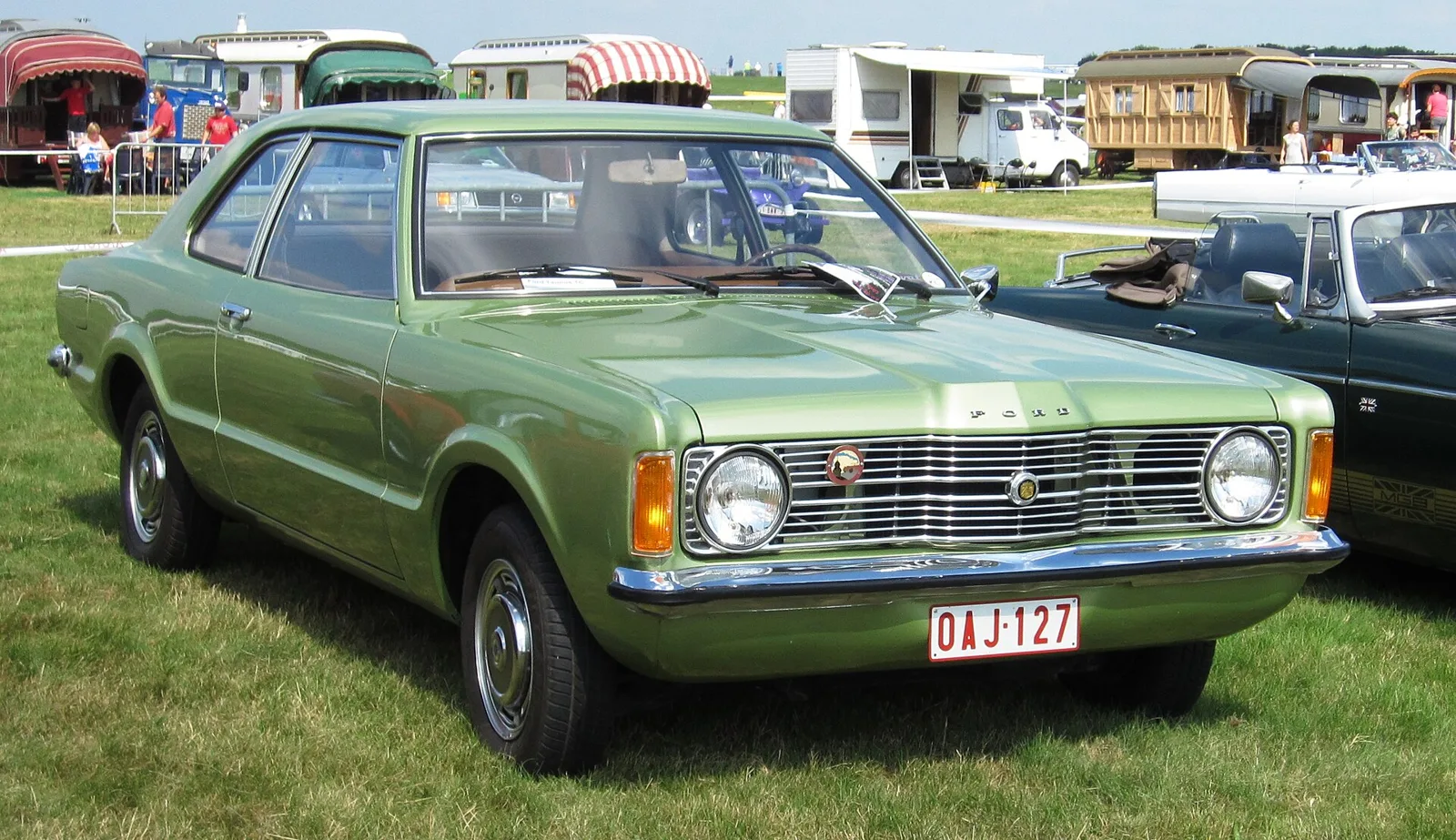
The same body also underpinned the Cortina Mk III in Britain. That version differed in door skins and rear wing shapes from the Cortina's coke-bottle look. The unification of Ford's European range began with the Escort and Capri and continued, to a lesser degree, with the Taunus and Cortina, so the two cars shared most major components, including the entire floorpan.
What changed in the chassis?
The TC brought a major change at the rear. The previous large Taunus had used a rigid axle on leaf springs, but the TC adopted coil springs with the axle located by two longitudinal and two lateral links. The front wheels, no longer driven, used conventional wishbones, and the arrangement eschewed shock absorbers, giving a soft, long-distance ride.
That softness had a cost. With the heavier six-cylinder engines the car tended to understeer heavily, and press criticism soon turned into a wider complaint that Ford had launched the car before development was finished. The company took several years to answer that criticism convincingly.
Safety also moved forward. A telescopic steering column designed to collapse in a frontal impact, rather than push into the driver's chest, was already common on Opel and Volkswagen models. Ford now fitted the same feature across its new mid-size range for Germany and mainland Europe.
Which engines powered the Taunus TC?
The smaller Taunus TCs used a new four-cylinder overhead-cam engine shared with the American Ford Pinto. It came in 1294 cc and 1593 cc sizes at launch, and a 1993 cc version followed for the TC2 in 1976. Ford did not use the UK Cortina's Kent engine in the Belgian-built German car, and the V4 that had powered the earlier P6 was also passed over.
Customers who wanted more power could choose one of the compact V6 units carried over from the P7 range. Those six-cylinder engines came in 1999 cc and 2294 cc. The change marked a move away from the P6 strategy, when Ford had offered fewer high-output choices.
Was an automatic transmission available?
Yes. Every engine except the smallest 1.3-litre could be combined with a Borg-Warner B35 three-speed automatic in place of the standard four-speed manual. Later, the automatic changed to Ford's own C3 unit, which was built at the transmission plant in Bordeaux opened in 1973.
What changed in the 1973 facelift?
The TC had one significant facelift, in September 1973. Opel had set the pace in frequent model changes through the 1960s, but Ford had settled into roughly four-year cycles. By 1974 sales were dropping sharply as buyers waited for a new Taunus. The new model was not ready yet, so the existing car received a facelift instead.
The new grille carried a second pair of front lights, and rectangular headlights, previously limited to the XL and higher trims, became standard across the range. The dashboard was also redesigned. Its steeply sloping, stylised original gave way to a plainer, more angular layout with better ergonomics, and that fascia continued into the TC2 and TC3.
Lateral stabiliser bars were fitted front and rear, which answered long-running criticism that the original car wallowed when changing direction or crossing uneven roads. The gear ratios for second and third were also adjusted on the 1593 cc manual cars.
How well did the Taunus TC sell?
The TC was a commercial success in its early years. Roughly 250,000 cars were built in each of 1971, 1972 and 1973, and it was Ford Germany's top seller throughout those years. Opel built 691,438 Ascona As between 1970 and 1975, but the Taunus had outsold its Opel rival in the first three full years of production, which was unusual for a German Ford.
The 1973 oil crisis hit car makers hard. Ford Germany's output in 1974 fell by slightly under 40% on the year before, against a 33% drop at Opel. The Taunus stayed the top model, though only narrowly ahead of the smaller Escort. Taunus output recovered to 181,530 in 1975, but by then the Escort had taken the lead with 215,760 cars built, after the less cramped Mk II arrived in December 1974.
What was the Taunus TC2?
At the end of November 1975, in time for the 1976 model year, production started on the second generation, known as the GBTS, or Ford Taunus TC2. The TC2 was essentially a reskin of the TC, and in most markets it was presented that way. The Cortina version differed a little more, because its coke-bottle line was removed.
Ford of Britain kept building the Cortina Mk III for over half a year after the TC2 launch. In September 1976 the Cortina Mk IV arrived, and from then on the TC2 and Mk IV were almost identical apart from local specification and trim differences. Left-hand-drive cars were badged Taunus and right-hand-drive cars were badged Cortina, almost regardless of where they were assembled.
The TC2 kept the silhouette of the TC, but the principal outer panels were newly shaped, and so were the rear and side windows. The rear corners became visible from the driver's seat, making parking easier. The most obvious change at the front was the loss of the Knudsen nose, which gave a less individual but more harmonious shape.
How did the TC2's mechanics change?
Under the skin little changed. The suspension stayed as it had been after the 1973 changes, and the braking system still used discs at the front and drums at the rear. Servo-assisted brakes became standard across the range, and power steering could be specified on the six-cylinder cars from August 1977.
The main engine addition was the 1993 cc version of the Pinto. The four-cylinder had an advertised 98 PS (72 kW; 97 hp), while the six-cylinder produced 90 PS (66 kW; 89 hp). The four had more torque, but the six reached its peak at lower revs, and some commentators found it more relaxing to drive.
The dashboard, instruments and switches had already been redesigned for the 1974 model year, so the TC2 changed little inside. New steering wheels and updated trim materials were the main visible differences. The automatic was no longer the Borg-Warner unit, and the three-speed was now Ford's own C3 gearbox.
How did the TC2 and TC3 compete on sales?
From 1973 the Taunus faced a three-way fight with the Opel Ascona and the Volkswagen Passat. Comparable production figures are hard to find, but Ford's Taunus TC2 and TC3 produced 1,583,699 cars between 1976 and 1982, which narrowly beat the rivals on volume. Opel built 1,316,459 Ascona Bs between 1975 and 1981, and Volkswagen produced 1,360,312 Passats between 1976 and 1982.
The figures shift depending on how the rivals are counted. Adding 196,512 Vauxhall Cavaliers built at Opel's Antwerp plant, and 534,634 Opel Mantas that shared the Ascona line, pushes Opel ahead. Adding 1,290,164 Audi 80s to the Volkswagen total puts the Volkswagen group in front. By 1980, new rivals from Volkswagen and Opel suggested the TC's basic design was starting to show its age.
The car sold well in a sector where many buyers were trading down from larger cars such as the Opel Rekord during the cash-strapped 1970s. Its good looks and aggressive pricing carried it along. It was regarded as dependable and conservative, although it never fully shed some irritating defects that a more rigorous development programme should have caught.
What was the Taunus TC3?
In 1979 the Taunus TC3, also known as the GBFS, replaced the TC2. Its major components stayed largely the same. In Britain the facelifted car was sold as the Cortina Model 80 and quickly became known informally as the Cortina Mk 5, with the differences emphasised more on the Dagenham-built Cortina than on the Belgian-built Taunus.
The TC3 brought a new in-house Ford economy carburettor, which drew many complaints. Bumpers wrapped round the sides as far as the wheel arches, the roofline rose slightly on the two- and four-door saloons, and larger rear lights adopted the sawtooth design used across the Ford range. The radio moved down into an extended centre console, and central air vents took its former place. At the top of the range the 2.3-litre cars lost the Taunus Sport, and an S options package with a stronger anti-roll bar and firmer suspension became available across the line.
When did European production of the Taunus end?
European production of the TC3 and the Cortina 80 ended in July 1982. It was replaced in October that year by the Ford Sierra, which kept the Pinto engines and rear-wheel drive but was otherwise a new car with independent suspension all round.
The Taunus lived on elsewhere. Argentine production continued until 1984, and the fastback coupe that Europe had dropped in 1975 stayed in the Argentine range to the end. South Africa built the TC3 until 1984 under the Cortina name, and the P100 pickup stayed in production there until 1987, when it was replaced by a Sierra-bodied version. Otosan in Turkey built a TC3 with remoulded ends until 1994.
How was the Taunus TC built in Argentina and Turkey?
The Taunus TC was made in Argentina from 1974 to the end of 1984, and Otosan in Turkey built it from 1984 to 1994. Before the Argentine launch, the first TC underwent a year of testing. Critical chassis parts were swapped for tougher versions to cope with rural roads, and most components still came from European Ford plants. The Argentine cars used Dana Type 30 rear axles, unlike the Atlas or Salisbury units used in Europe.
The Argentine models were four-door saloons, the 2000L, 2000GXL and 2300GXL, and a two-door fastback coupe in 2300GT and 2300GT/SP forms. No Taunus TC estates or two-door saloons were built in South America. The TC3-style Cortina 80 range replaced the earlier cars in 1980, and an updated fastback with the SP and SP 5 names arrived with a five-speed option.
Argentine cars used the Lima engine, derived from the Pinto, in 2.0 and 2.3 litre forms, and none of them came with a six. In total 197,031 Taunus were built in Argentina. In 1984 the Argentine line was sold to Ford Otosan in Turkey, which made a truck version, the P100, with foldable sides. Turkish cars were recognised by their sculpted front panel and square headlights.
What are the Ford Taunus TC specifications?
| Specification | Detail |
|---|---|
| Production span | 1970 to 1982 in Europe; Argentina to 1984; Turkey to 1994 |
| Wheelbase (TC) | 2,578 mm (101.5 in), 51 mm (2.0 in) longer than the P6 |
| Four-cylinder engines | 1294 cc or 1593 cc at launch; 1993 cc from 1976 |
| Six-cylinder engines | 1999 cc or 2294 cc V6 from the P7 range |
| Automatic gearbox | Borg-Warner B35 three-speed, later Ford C3 |
| 2-litre four (TC2) | 98 PS (72 kW; 97 hp) |
| 2-litre six (TC2) | 90 PS (66 kW; 89 hp) |
| Output, 1973 and 1974 | 245,955 cars in 1973; 138,357 in 1974 |
| Output, TC2 and TC3 | 1,583,699 cars, 1976 to 1982 |
| Argentine production | 197,031 cars, 1974 to 1984 |