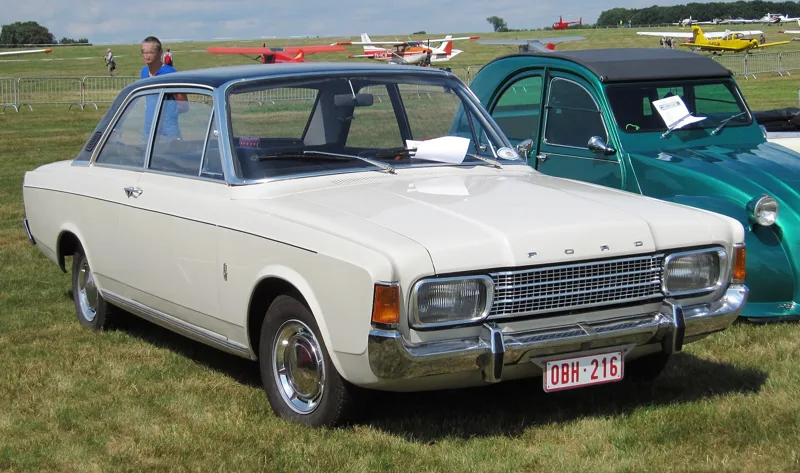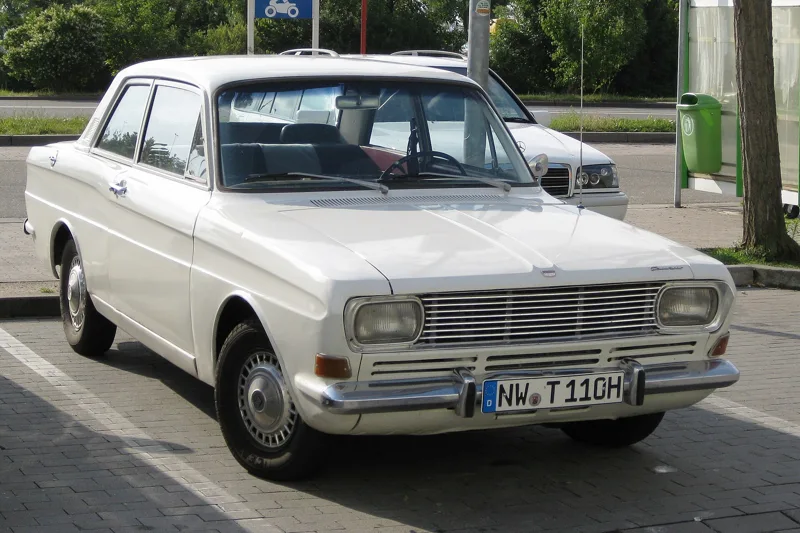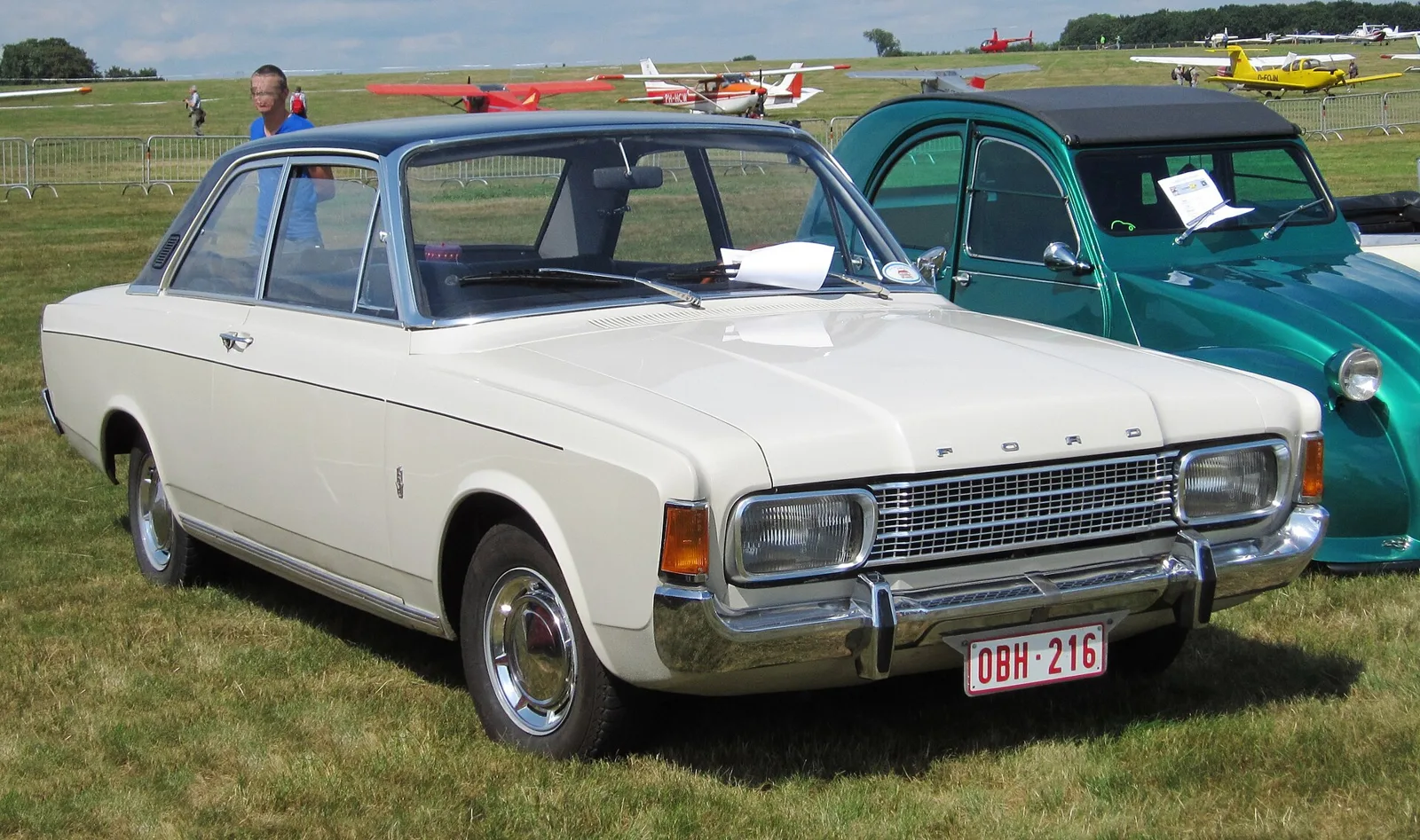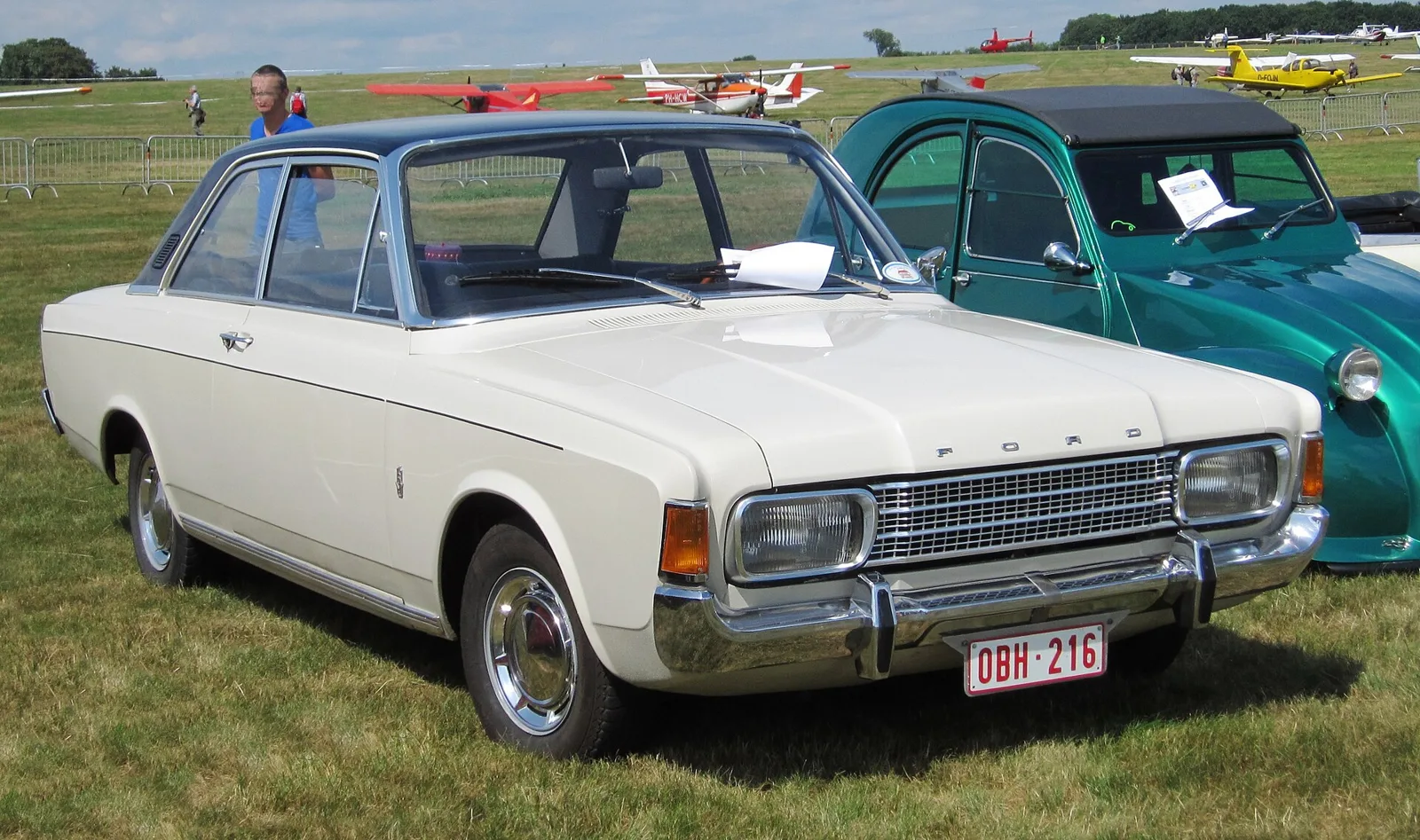
A wide, long German saloon that Ford sold as the 17M, 20M and 26M between 1967 and 1971, then replaced with the Granada after a lukewarm reception.
The Ford P7 was a large family saloon built by Ford Germany from 1967 to 1971. It was sold as the 17M, 20M and 26M, used rear-wheel drive and a range of V4 and V6 engines, and was replaced by the Consul and Granada.
The Ford P7 was a range of large family saloons built by Ford Germany from autumn 1967 until December 1971. It was sold as the Ford 17M, 20M and, from 1969, the 26M, with the 'Taunus' name dropped at launch. It was wide, long and rear-wheel drive, and it struggled against the Opel Rekord and the new Audi 100 before Ford replaced it with the Consul and Granada.
What was the Ford P7?
It was Ford Germany's seventh all-new post-war design, which is why the company called it Project 7, or P7, internally. The Taunus 17M name had appeared on family saloons since 1957, but the 1967 car dropped it. Retrospectively it is called the Ford P7 to avoid confusion with its predecessors.
At launch the 17M offered four engine sizes, ranging from 1.5 to 2.3 litres, and the more luxurious 20M came with the larger two. From 1969 the 26M joined the range with the same body, a bigger engine, automatic transmission as standard and extra luxury features. Ford built 155,780 P7a cars before August 1968 and 567,482 P7b cars afterwards.
A wide, long German saloon that arrived with four engines, a fast facelift and a market that never fully warmed to it.
Why was the P7 not called a Taunus?
The Taunus name had been attached to a succession of family saloons, so dropping it in 1967 was a deliberate break. Ford's first German managing director since the war, Max Ueber, a former sales director, is thought to have judged the longer name too much of a mouthful.
The P7 kept the predecessor's wheelbase, but its body was longer and wider. Various theories have been put forward for the name change, and the most likely explanation is the one above.
What engines did the P7 offer?
As on the previous Taunus 17M, the engine sat at the front and drove the rear wheels. At launch the base engine was a 1498 cc low-compression V4, though most 17Ms used the 1699 cc V4. A 1998 cc V6 was offered, and it was the entry engine for the 20M.
A 2293 cc high-compression V6 was available in both the 17M and the 20M. Its cylinders were bored out, and it offered a claimed increase of about 5 PS in maximum power, but it needed higher-octane fuel. Across the range the advertised output ranged between 60 and 125 PS. High-compression engines offered a claimed gain of about 5 PS, but they required super-grade fuel, which cost more at the pump.
The 1968 facelift broadened the range with an 1812 cc high-compression V6 producing 82 PS, fitted to a cheaper 17M priced from 9150 marks. A new 2293 cc V6 with 125 PS also arrived that year. The 26M then used a 2550 cc V6 with the same 125 PS, but torque was increased by 10 per cent.
How was the P7 designed and bodied?
The P7 used an all-steel monocoque structure, following the pattern of the larger European makers. Its 1,756 mm (69.1 in) width gave a spacious interior and a large boot, and Ford credited the wide track with good handling. Promotional material made much of the spacious interior and massive boot. The press found its styling more Anglo-American than mainstream European.
Body styles mirrored the earlier Taunus 17M. Two- and four-door saloons sold best, and the three- and five-door Turnier estates were heavily promoted. A two-door coupe was offered, and a steel-panelled van version of the Turnier suited people who needed a small van for work but preferred a car. The P7 was also the last German Ford offered as a two-door coachbuilt Karl Deutsch cabriolet, at considerable extra cost.
How did the press react to the P7?
A review in August 1967 called the car a 'Volksstrassenkreuzer', or people's boulevard cruiser, and doubted it suited the European market. Those doubts mattered because the 17M did not win a warm welcome in the showrooms. The reviewer's view may have matched buyers better than Ford's marketing did.
The press reaction suggested that the car had grown too large for its market. Ford's own marketing later framed the 1968 facelift as a return to a simpler look, using a slogan first applied to the 1960 Taunus P3. The intention, as ten years earlier, was to contrast a newly simplified 17M with an over-decorated predecessor.
What changed in the 1968 facelift?
Ford's emergency facelift arrived less than a year after launch, as sales were disappointing. The cheese-grater grille gave way to thin parallel bars, the bumpers were redesigned and the fake scoop on the 20 TS bonnet was dropped, along with the TS name. A kink in the panel near the C-pillar was removed, and the overall impression was calmer.
The updated cars are split into two groups. The P7a covers production before August 1968, with a 72 mm (2.8 in) longer front overhang on the four-cylinder and six-cylinder models. The P7b that followed did away with that difference and was built until December 1971.
What running gear did the P7 have?
The underpinnings changed little from the previous model. A four-speed all-synchromesh manual was standard, with a column lever on cheaper models and a floor lever on more expensive ones. The automatic gearbox was floor-mounted between the two front seats. Disc brakes at the front and drums at the rear carried over, now with twin braking circuits and servo assistance.
The 1967 cars brought a 12-volt electrical system at no extra cost, which Ford had finally adopted at this level of the market. The front suspension used MacPherson struts developed from the P5, while the rear kept a steel beam axle and leaf springs. That rear axle was outdated, and Ford kept selling it to Capri buyers until 1984.
Ford P7 specifications at a glance
| Specification | Detail |
|---|---|
| Production | Autumn 1967 to December 1971 |
| Models | Ford 17M, 20M and 26M |
| Layout | Front engine, rear-wheel drive |
| Body width | 1,756 mm (69.1 in) |
| Engine range at launch | 1498 cc and 1699 cc V4; 1998 cc and 2293 cc V6 |
| 1968 additions | 1812 cc V6, 82 PS; 2293 cc V6, 125 PS |
| 26M engine | 2550 cc V6, 125 PS (92 kW; 123 hp) |
| Built | 155,780 P7a; 567,482 P7b |
How did the P7 sell against its rivals?
The P7 was aimed at a broader market segment than the Taunus P5, and the large family saloon sector was a bigger share of the German market than in most other European countries. The Opel Rekord was Germany's best-selling large family car, and it was second only to the Volkswagen for several years.
The P7a sold 155,780 units in its ten-month life, a slower rate than the Taunus P5 achieved. The P7b built up over slightly more than three years, with 567,482 cars produced. The dominance of the Rekord was not challenged, and the arrival of the Audi 100 in 1968 made the market harder for Ford.
How did the P7 end and what replaced it?
Production ended in December 1971, although some accounts give 1972 because Ford could still register cars built the previous year. Sales had failed to keep pace with the growth of the German market, which prompted a major rethink. Ford's plant in Genk, Belgium, was less than ten years old, and Saarlouis had begun large-scale production only in 1970.
Ford in Germany had less trouble building cars to plan than Ford in Britain, so the problem was losing market share rather than production.
Prelaunch pictures appeared soon after production ceased, and Ford presented the successor, the Consul and Granada, at the Geneva Motor Show in March 1972. It had engines from 1.7 to 3.0 litres and a longer wheelbase than the Opel Rekord in Germany, but it was shorter than the P7, which acknowledged that the earlier car had taken up more road space than buyers expected.
Why did the P7b sell better than the P7a?
Ford's promotion of the car, the simplified P7b lines and a relatively benign economic backdrop accounted for the improved rate of production after August 1968. Those gains mattered because the P7a had been built far more slowly than the less ambitious Taunus P5.
How did the P7 compare with the Zephyr in Britain?
Ford of Britain's Zephyr Mk IV also drew national press comment for taking up far more road space than its predecessor, much as the P7 did in Germany. By the time the Granada arrived, 102,417 Zephyrs and 48,846 Zodiacs had been built since the Mk IV launched in spring 1966.
The Granada was shorter and narrower than the Zephyr, despite aiming to replace both the P7 in Germany and the Zephyrs and Zodiacs in Britain. Ford presented it with European styling, a response to market criticism of both the last Ford 17M and the last Z-cars. The large British Zephyrs had been criticised for becoming too large for the niche their predecessors had established.
What did the 26M add to the P7 range?
The 26M, launched in 1969, shared the body and most parts of the 20M but added a long list of luxury features. These included automatic transmission, power steering, a sunroof, twin headlamps, bigger front brakes and tinted windows. It was Ford's bid to reach the territory of the smaller Mercedes-Benz models.
Its 2550 cc V6 shared cylinder dimensions with the 1699 cc V4 from the 17M, which helped standardise components. Its output matched the top 125 PS of the 2293 cc unit, but torque rose by 10 per cent. Top models came as a four-door saloon or two-door coupe, with black vinyl roofs and more chrome and wood trim.
How was the P7 built in South Africa?
South Africa received a right-hand-drive 20M, which was unusual for a German-designed Ford of the period. It was offered with a 3.0-litre Essex engine, while a 17M used a locally built 2.0-litre Essex V4 and another version used the Essex 2.5-litre V6.
Why did Ford's European operations start to integrate?
From 1967 a new transnational structure, headed by Ford of Europe, pointed the way to closer integration between Ford's principal European businesses in Germany and Britain. The Granada shows that shift, since it was a joint project between Ford of Britain and Ford of Germany.