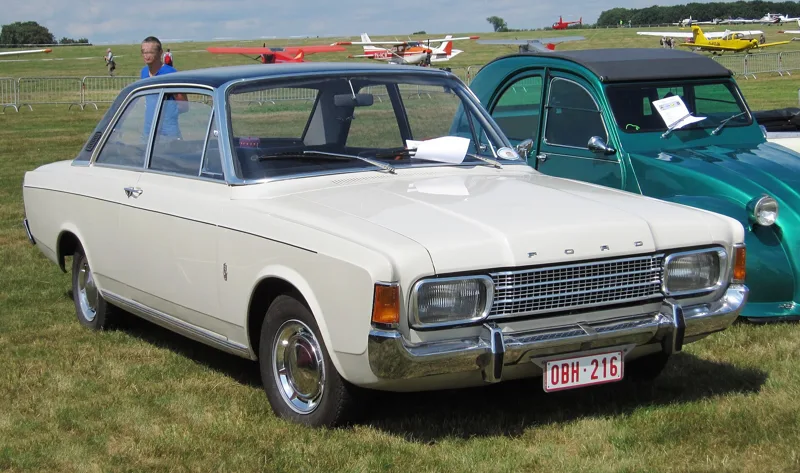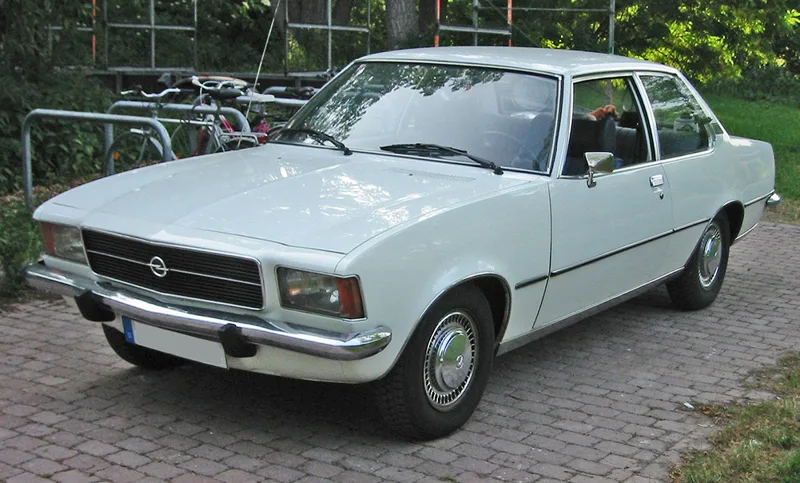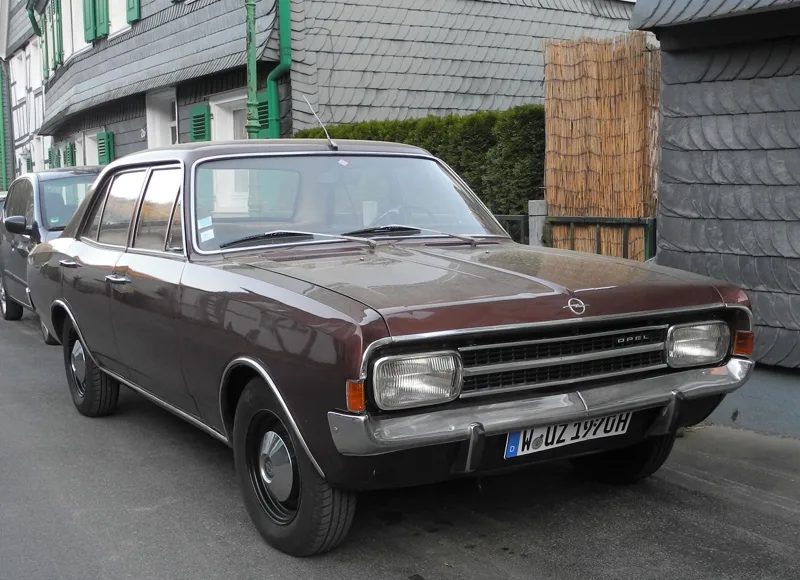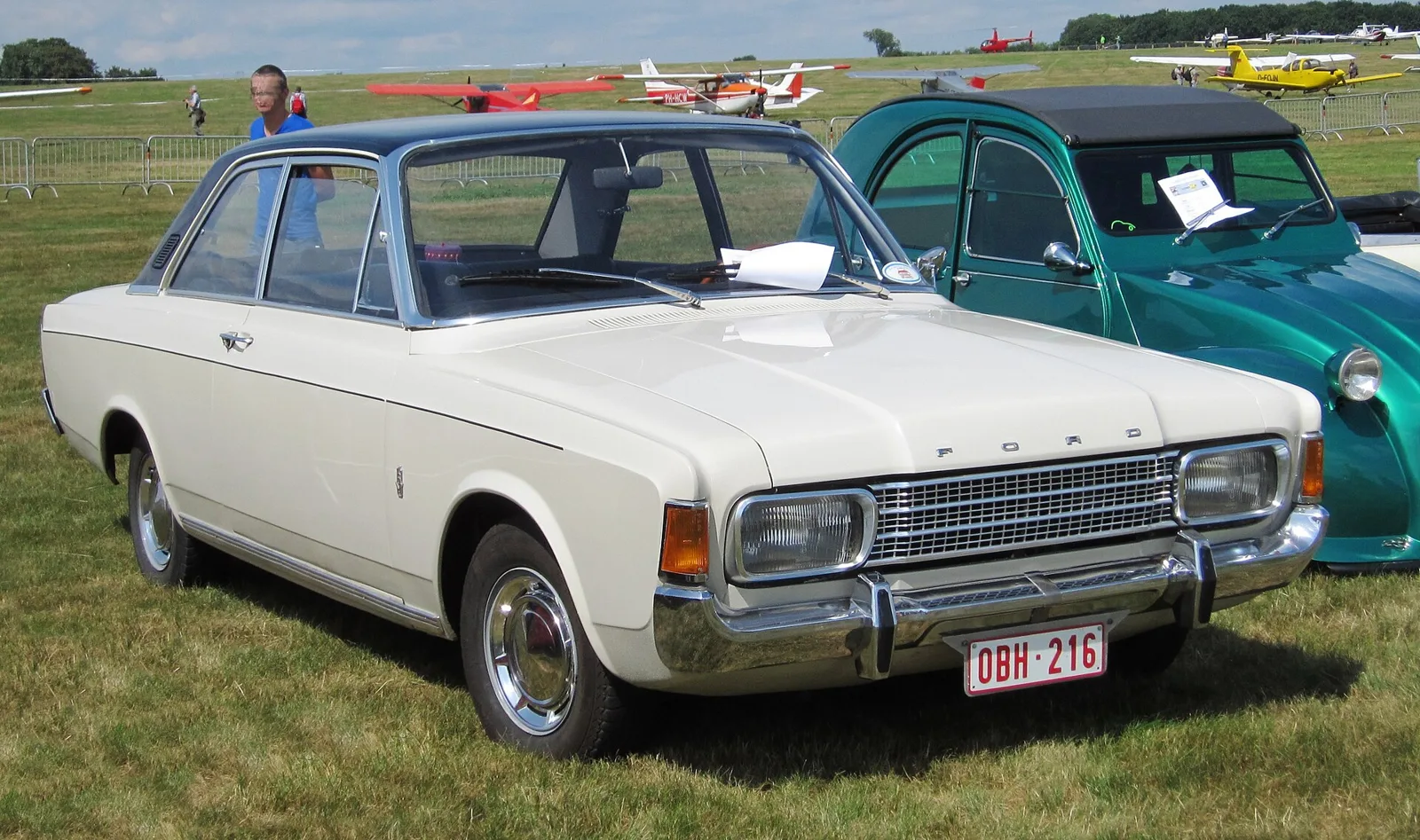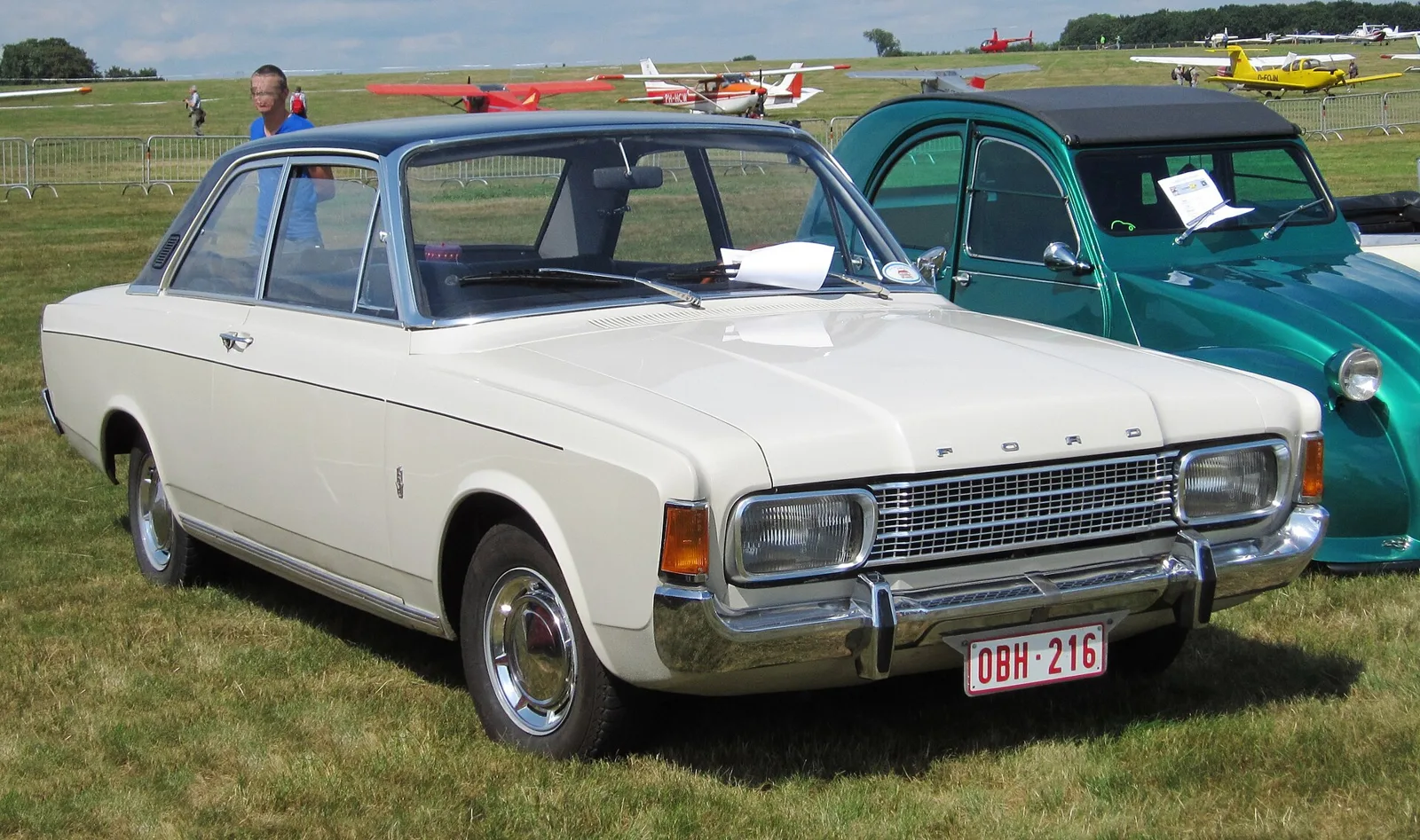
Ford's wide P7 range against the Opel Rekord D, compared on engines, bodies, design, production and the sales race in West Germany.
A large family saloon from Ford Germany, sold under three model names until late 1971, faced Opel's Rekord D from 1972. The Opel model reached 1,128,196 units built and sold far more copies, while the P7's bigger 26M engine gave it the edge on power.
The Ford P7 and the Opel Rekord D were both large family saloons built for German buyers in the early 1970s. The P7 ran from 1967 to 1971 under three model names, while the Rekord D arrived as the P7 was ending and went on to sell far more copies. The two cars shared a segment and a decade, but their engine lines and sales records were very different.
Which was the bigger family car, the Ford P7 or the Opel Rekord D?
The Ford P7 was the wider of the two, at 1,756 mm (69.1 in) across, and it was longer and wider than the Opel Rekord of its day. The Rekord D kept its predecessor's wheelbase but had an all-new body, and no width is given for it.
Both cars were built to a generous scale for their time. The P7 aimed at a broader market than the Taunus it replaced, with engines running from 1498 cc upward. The Rekord D was heavier than the Rekord C before it, and by the 1970s the Rekord had grown to the top of the medium-sized class in northern Europe.
Two German family saloons from the same era, with a short overlap and very different sales records.
Why were the Ford P7 and Opel Rekord D rivals?
Both cars competed for the same German large family car buyers, a segment that took a bigger share of the market in Germany than in most European countries. The Opel Rekord was the segment's leader for years, and the P7 was launched against that standard. Market leadership was the Rekord's to lose.
The rivalry was less direct than the names suggest. The P7 was built from autumn 1967 to December 1971, while Rekord D production began in the closing weeks of 1971 and the car went on sale in West Germany early in 1972. The two overlapped only briefly, so the P7's real rival was the Rekord then on sale.
New entrants also mattered. The Audi 100 and the imported Peugeot 504 both drew a warm welcome from buyers in 1968, at a time when P7 sales were disappointing. The P7 never fully recovered its early momentum, although the later P7b cars sold well.
When and where did each car compete?
The P7 was built by Ford Germany from autumn 1967 to December 1971. The Rekord D was built at Ruesselsheim from late 1971 and sold in most European markets from early 1972, with some cars made at General Motors plants outside West Germany.
The P7 also found a market in South Africa, where the 20M was built with right-hand drive and a 3.0-litre Essex engine. The 17M was offered there with a locally built 2.0-litre Essex V4 and a 2.5-litre Essex V6. The Rekord D was sold more widely still, and Japanese buyers received only the 1900 S engine.
Many markets received local tax specials. Austria, for example, had windowless vans based on the Rekord D, while Italy received a sub-two-litre diesel from December 1974 to suit its tax rules.
How did the designs compare?
The P7 used an all-steel monocoque body with a cheese-grater grille, and its 1968 facelift simplified the front. The Rekord D was styled by Chuck Jordan, dropped the coke-bottle look of the Rekord C and shared its principal floor panel pressings with the Vauxhall Victor.
The P7's first styling drew criticism for Anglo-American influence, including a body kink near the C-pillar. The P7b dropped many of those fussy details, and Ford's marketing team revived an old slogan, rational form, to sell the calmer look.
The Rekord D kept a discreet nod to the Hofmeister kink and had a larger glass area. Early advertising called it the Rekord II, and the D suffix was kept even though it might suggest a diesel, as the letter did on Mercedes-Benz models.
What engines did each car offer?
The P7 offered four engine sizes at launch, from a 1498 cc V4 to a 2293 cc V6, and added a 2550 cc V6 in the 26M in 1969. The Rekord D used the CIH petrol range introduced with the Rekord B in 1966, from a 1698 cc unit to the 1979 cc engine, plus a diesel from 1972.
On the P7 the 1699 cc V4 was the most common unit in the 17M, while the high-compression 2293 cc V6 topped the 20M. Power across the 1967 range ran from 60 to 125 PS (92 kW; 123 hp). A 1812 cc V6 joined the range in the 1968 facelift with 82 PS (60 kW; 81 hp).
Rekord D petrol engines all shared a stroke of 69.8 mm, and bore size set the displacement. The 1698 cc base unit produced 66 PS (49 kW), the 1700 S with twin carburettors made 83 PS (61 kW), and the 1900 S reached 97 PS (71 kW) with a top speed of 165 km/h.
Which version was the most powerful?
The P7 26M's 2550 cc V6 gave 125 PS (92 kW; 123 hp), the most power of any P7 engine, with torque 10% higher than the 20M's top unit. The Rekord D's strongest petrol engine was the 1979 cc unit in the 2000 S, rated at 100 PS (74 kW) from September 1975.
The 26M was the only P7 with an automatic gearbox as standard. Opel's 1900 S was the fastest Rekord D on launch, and no six-cylinder Rekord D was offered, so buyers wanting six cylinders had to look at the Commodore.
The 1975 lead law reduced the power of Rekord D engines. The 1900 S fell from 97 to 90 PS (71 to 66 kW), and Opel raised the bores to create the 2000 S. In Sweden and Switzerland the new 1900 S made only 88 PS (65 kW).
How did the two cars handle and brake?
The P7 used MacPherson struts at the front and a rigid rear axle with leaf springs, while the Rekord D had unequal-length double wishbones at the front and a live rear axle with trailing arms and coil springs. Both used discs at the front, drums at the rear and dual braking circuits.
The P7's rigid rear axle was seen as dated next to Opel's set-up, and it undermined the 26M's ambitions. Ford kept the same rear arrangement on the Capri until 1984, which was unusual among Germany's mainstream makers.
The Rekord D's steering used a recirculating ball system with a collapsible column, and its larger engines gained a brake force limiter for the rear brakes. The 26M had bigger front discs, power-assisted steering and twin halogen headlights.
How practical were the body styles?
Both families offered saloons with two or four doors and estate cars, which suited family and trade buyers. The P7 added a two-door coupe, a coachbuilt cabriolet and a small-van Turnier, while the Rekord D offered a factory coupe and a delivery van for export markets.
The P7 26M came only as a saloon or coupe, with a black vinyl roof and extra chrome and wood trim. The Rekord D's Caravan estate, with three or five doors, was the core of its estate range, and the Rekord D lost its coachbuilt cabriolet option when Karl Deutsch stopped its conversions in 1971.
Did either car offer a diesel?
Yes, the Rekord D did. Opel introduced a 2068 cc four-cylinder diesel with 60 PS (44 kW) in September 1972, and a smaller 1998 cc diesel with 58 PS (43 kW) followed in December 1974. No diesel version is given for the P7.
The diesel was aimed at the taxi trade, where Mercedes-Benz had a strong grip in West Germany and several export markets. A five-door diesel estate was added at the 1973 Frankfurt Motor Show, and the diesel is easy to spot from a raised ridge down the centre of the bonnet.
Which car sold more?
The Rekord D sold far more, with 1,128,196 built over five and a half years against the P7's 155,780 P7a and 567,482 P7b cars. The Rekord D was the second Opel Rekord to pass one million units, and it reached that mark in 1976.
The P7 started slowly, and its P7a cars were built at a slower rate than the Taunus P5 had been. The 1968 facelift and the simpler P7b look lifted output, but the Rekord kept its dominance in the sector. The Ascona then challenged the Rekord D from below after 1975.
What are the Ford P7 and Opel Rekord D specifications?
| Specification | Ford P7 | Opel Rekord D |
|---|---|---|
| Production years | Autumn 1967 to December 1971 | Late 1971 to 1977 (sales from early 1972) |
| Models | Ford 17M, 20M and 26M | Rekord base, Rekord L, Rekord Sprint, Rekord Berlina from 1975 |
| Units built | 155,780 P7a; 567,482 P7b | 1,128,196 |
| Width | 1,756 mm (69.1 in) | not recorded |
| Smallest petrol engine | 1498 cc V4 | 1698 cc, 66 PS (49 kW) |
| Largest petrol engine | 2550 cc V6, 125 PS (92 kW; 123 hp) | 1979 cc, 100 PS (74 kW) |
| Diesel | not recorded | 2068 cc, 60 PS (44 kW); 1998 cc, 58 PS (43 kW) |
| Manual gearbox | Four-speed all-synchromesh | Four-speed all-synchromesh |
| Automatic gearbox | Optional; standard on the 26M | Three-speed TH180, optional on all but the smallest engines |
| Front suspension | MacPherson struts | Double wishbones with anti-roll bar |
| Rear suspension | Rigid axle with leaf springs | Live axle with trailing arms and coil springs |
| Brakes | Discs front, drums rear, twin circuits, servo | Discs front, drums rear, dual circuit, servo |
| Body styles | Saloon, Turnier estate, coupe, cabriolet by Karl Deutsch | Saloon, Caravan estate, delivery van, coupe |
| Successor | A successor is referenced but not named | Rekord E from 1977 |
Which car suits which buyer?
On these facts, the P7 suits a buyer who wanted width, a 2550 cc engine and an automatic in the top trim. The Rekord D suits a buyer who wanted a proven volume model with a diesel option, a longer production run and estate and van versions.
Neither set of figures settles which car was better overall. The P7 was the more lavish of the two at the top end, while the Rekord D was the more successful in the showroom. Buyers who value sales and a long production history would look at the Rekord D, while buyers wanting the larger engine and standard automatic would look at the 26M.