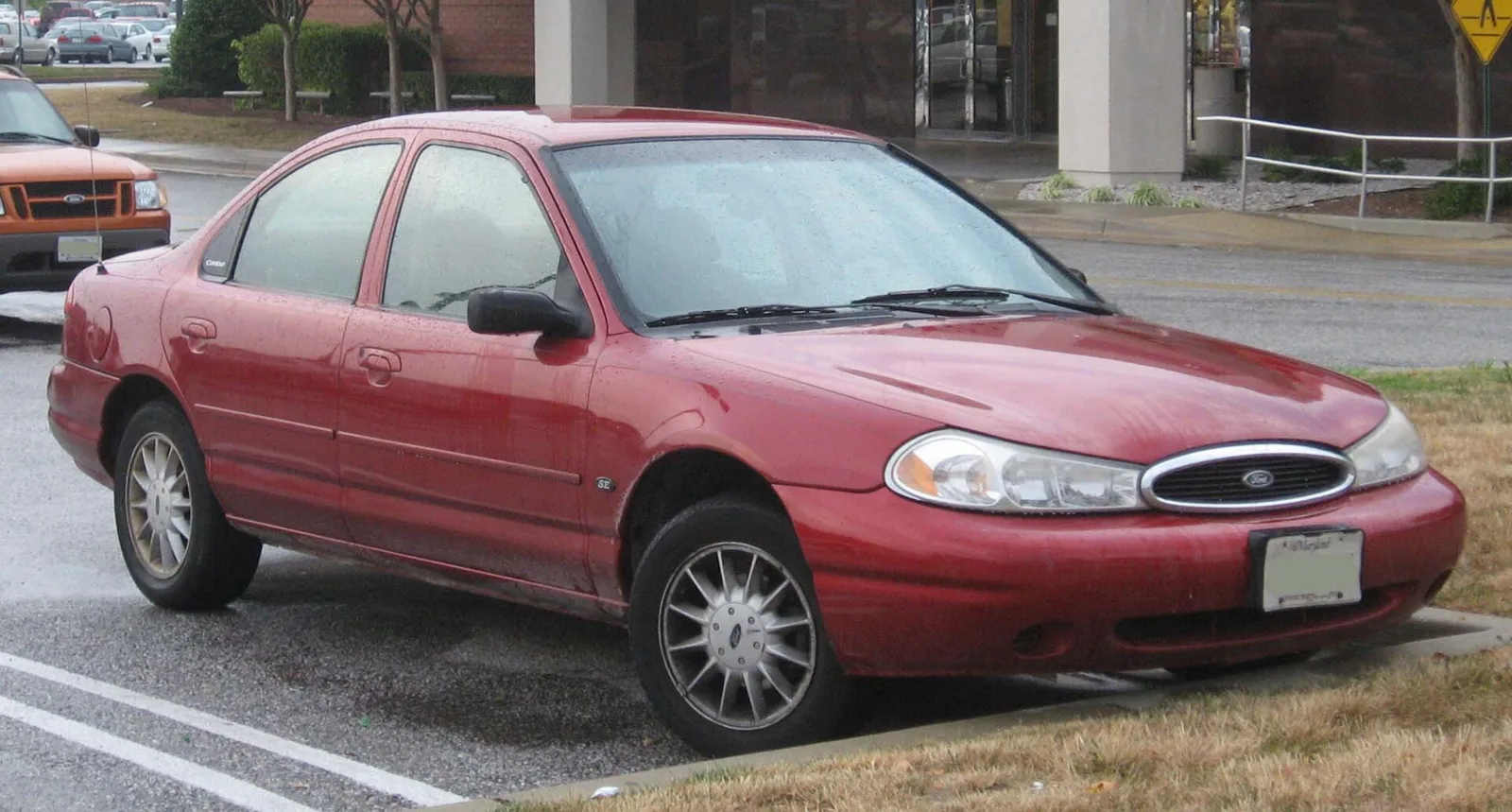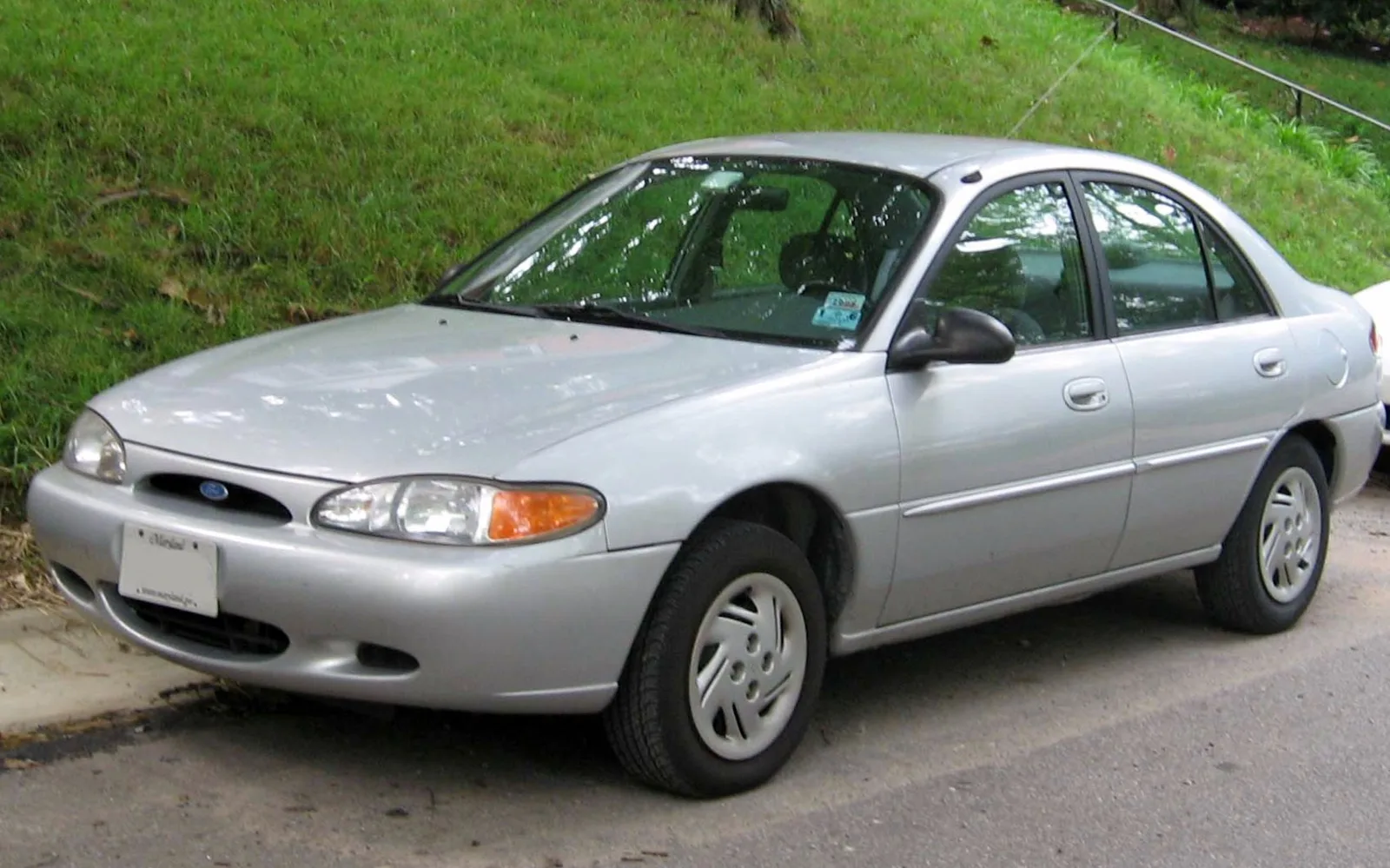
Ford's front-wheel-drive successor to the Pinto, the best-selling car in the United States after 1982, sold alongside the Mercury Lynx until the ZX2 ended the line in 2003.
The Ford Escort was a small Ford that succeeded the Pinto, built from 1981 until 2003. It topped US sales after 1982 and stayed there for much of the decade, appeared as the Mercury Lynx and Tracer, and ended as the ZX2 coupe.
The Ford Escort was a range of cars sold by Ford in North America from the 1981 to 2003 model years. It was the direct successor of the Ford Pinto and topped US sales from 1982, remaining on top for much of the decade. Over three generations it was offered as a hatchback, wagon, sedan and coupe, and it was sold under the Mercury Lynx and Mercury Tracer names as well.
Where did the North American Escort come from?
The Escort began as a planned world car from Ford in North America and Ford of Europe. Ford of Europe had sold cars under the Escort name since 1968. Earlier attempts to sell European models in America, such as the Capri and the Mk I Fiesta, had been single products, not true world cars. The new Escort was to use front-wheel drive, following the success of the smaller Fiesta.
The programme aimed to replace both the North American Pinto and the European Escort Mk II with one architecture. The first generation was to launch for the 1981 model year with a common chassis for both markets, but the two design teams gradually diverged.
A Pinto successor that became America's best-selling car, shared its platform with Mazda and ended its run as the ZX2 coupe in 2003.
Why did the American and European Escorts end up so different?
The 1981 American Escort and the European Escort Mk III had the same basic shape, but almost no interchangeable body parts. Their only shared major components were the CVH inline-four engine and the ATX automatic transmission. The suspension followed a similar basic design, though its parts were not interchangeable either.
Both cars used a 94.2 inch wheelbase, but the American car was longer and wider. Most American versions carried more chrome trim, which gave them a heavier and more ungainly look than the European sister car. Europe also received three body styles never offered in North America: a three-door estate, a two-door convertible and a two-door van. A four-door derivative was sold there under the Orion name.
How did the first-generation Escort launch?
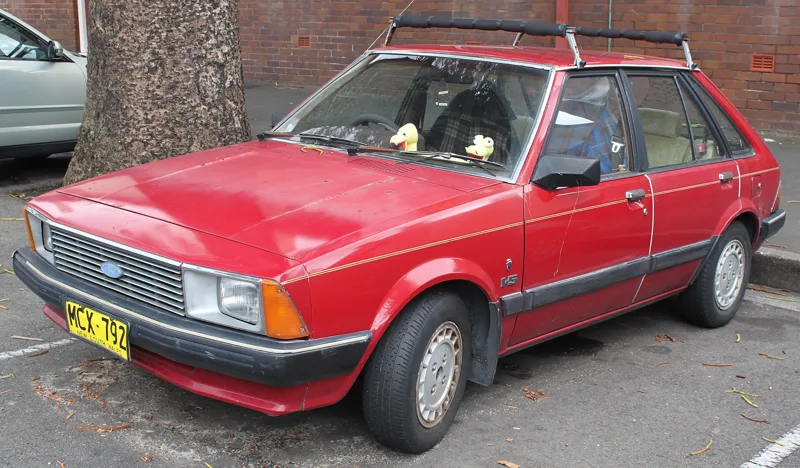
The first-generation Escort went on sale on 3 October 1980 for the 1981 model year, with Lincoln-Mercury selling its version as the Mercury Lynx. It was nearly six inches longer and over three inches taller than the Pinto it replaced, and it used front-wheel drive with a transversely mounted engine. Trim levels were a base model, L, GL, GLX and SS.
For 1981 the car came as a three-door hatchback and a five-door wagon, and a five-door hatchback followed in May 1981. Ford fitted a globe-shaped Escort badge to the front wings to showcase the world car idea, but that badge was used for 1981 only. The wagon could be ordered with an imitation woodgrain Squire package in the GL and GLX trims.
How did the Escort sell so well in the early 1980s?
In 1982 the Ford Blue Oval replaced the older lettering on the North American line, and the SS package gave way to the GT. The 1982 Escort started at $5,518, and it became Ford's best-selling model line and the best-selling automobile nameplate in the United States.
The Escort also gained a two-seat coupe in 1982, the EXP, which is covered below. Even so, the core strength of the range was the affordable hatchback and wagon sold in large numbers to private and fleet buyers.
What changed through the 1980s revisions?
For 1984 the GLX was dropped and replaced by a fuel-injected LX, offered on the five-door hatchback or wagon. The interior received a new dashboard and new shift boots, and automatic models got straight-line gear selector levers instead of the twisting question-mark pattern. The horn moved from the turn signal stalk to the steering wheel, in line with other Fords.
A mid-1985 revision, described as the 1985 1/2 model, changed the front fascia with a smaller grille and flush-mounted aerodynamic headlamps. The 1.6 litre engine gave way to a 1.9 litre. In 1986 the Escort Pony became the cheapest version. For 1987 the range was trimmed to Pony, GL and GT, and that year the Mercury Tracer replaced the Lynx. The 1987 model year was also the last in which the Escort was built in Canada.
The mid-1988 facelift, known as the 88.5 year, smoothed the front and rear. It brought integrated plastic bumpers, larger 14 inch wheels on non-GT models and automatic shoulder belts for passive restraint rules. The Pony was the least expensive US-built Ford before the Festiva arrived. It had plainer trim, four-speed manual transmissions as standard, and no power steering or factory air conditioning.
Which engines powered the first Escort?
The CVH transverse inline-four began life as a 1.6 litre engine for North America. It produced 65 hp (48 kW) at launch and was tuned to 69 hp (51 kW) for 1982. A 1.3 litre version was prototyped but never reached production, because it lacked power and could not be certified. Transmissions were a four-speed MTX-2 and five-speed MTX-3 manual, or a three-speed ATX/FLC automatic.
In March 1982 a high-output version appeared, first in the EXP and with an automatic, and soon with a manual and in the GT. It produced 80 hp (60 kW), and fuel injection took it to 88 hp (66 kW) in 1983. A five-speed manual first appeared on the US Escort in the 1983 GT.
For 1984 Ford added two new engines. A Mazda-sourced 2.0 litre diesel gave 52 hp (39 kW) on the non-GT trims, while a turbocharged 1.6 produced 120 hp (89 kW) for the EXP Turbo, and then moved into the GT. In the 1985 revision the 1.6 became a 1.9 litre making 86 hp (64 kW), and the high-output GT engine reached 108 hp (81 kW). Roughly 1,000 Turbo GTs were produced in the abbreviated 1984 model year.
The diesel did not last. It was discontinued for 1987 because American buyers had largely given up on diesel cars. Diesel sales had peaked at 6.1 percent of the market in 1981 and fell to 0.37 percent in 1986, and less than 1.2 percent of Escort and Lynx sales were diesels.
What was the Escort EXP?
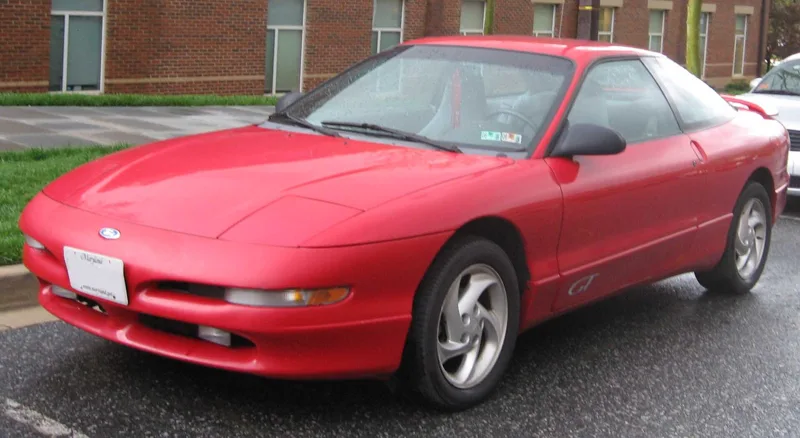
The EXP arrived in 1982 as a two-seat coupe variant of the Escort, and it was the first production two-seat Ford since the Thunderbird. It had a sportier look than the three-door liftback but few performance upgrades. Lincoln-Mercury sold it from 1982 to 1983 as the Mercury LN7, which differed slightly in grille and hatchback design.
After the 1985 update the EXP was restyled to take the front of the liftback Escort, and it was discontinued after the 1988 model year. Ford then focused its money on the four-seat Probe, which began development as the intended 1989 Ford Mustang.
How did the Escort SS become the GT?
For 1981 Ford introduced the Escort SS as a performance version, offered as a three-door liftback and five-door wagon. It had blacked-out trim, stripes, SS decals, upgraded brakes, suspension and seats. The drivetrain was unchanged, and 6,842 SS cars were built for 1981.
During the 1982 model year the SS was renamed the GT. That removed the clash with Chevrolet's SS option package and matched the Mustang GT name. The GT added the new HO engine, GT badges, improved brakes, a close-ratio four-speed gearbox, TR sport alloy wheels with Michelin TRX tyres, fog lights and spoilers. A fuel-injected 1.6 with 88 hp followed for 1983, and a Turbo GT with 120 hp (89 kW) arrived that year too.
The GT went on hiatus during the 1985 1/2 revision and returned for 1986 with a 1.9 litre rated at 108 hp (81 kW). It had an asymmetrical grille, body-coloured bumpers, 15-inch alloy wheels and optional two-tone paint.
What was the Mercury Lynx?
The Lynx was the Mercury version of the first-generation Escort. It was the successor to the Mercury Bobcat, and it took its name from wild cats. The Lynx shared its entire body with the Escort but differed in grille styling, lamp lenses and the use of more chrome. It came in base, L, GL, GS, LS and RS trims, and the Mercury LN7 was the divisional counterpart of the EXP.
In October 1982 Mercury added the Lynx LTS, a luxury touring sedan that was the five-door counterpart of the Lynx RS. It had blacked-out trim, TRX aluminium wheels, low-back bucket seats and upgraded suspension. In 1986 the Lynx RS was renamed the XR3, to match the Cougar XR7. The Lynx was retired after 1987.
Its replacement was the Mercury Tracer, which came from Mazda's 323 and marked the first Mercury without a Ford twin in North America since 1960. It was built in Mexico and Taiwan, and it shared its body with the Asian-market Ford Laser.
What did the second generation bring?
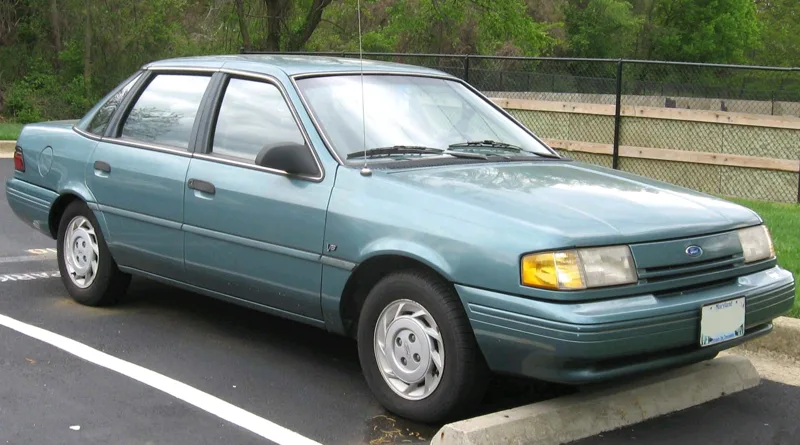
The second-generation Escort arrived in April 1990 as an early 1991 model. It largely dropped its European lineage, and it adopted the front-wheel drive Mazda B platform, known as BG and CT120 at Ford, shared with the Mazda 323 and Protege in North America. Ford held a 25 percent stake in Mazda at the time.
The wheelbase grew to 98.4 inches, almost within an inch of the Tempo. A rear anti-sway bar was added, and the car gained independent rear suspension. The body was shared with the Ford Laser sold in Asia and Oceania, and the Mercury Tracer took the Escort body in North America. A four-door sedan joined for 1992, sharing its underpinnings with the Mazda Protege.
The station wagon was the only version of the Mazda platform sold as a wagon. After the 1991 model year, the Escort became half of Ford's station wagon line in North America alongside another Ford wagon, and the GT returned with an asymmetrical grille and alloy wheels.
How did the second-generation engines work?
The standard Escort kept the 1.9 litre CVH, retuned to 88 hp. For 1991 it gained sequential fuel injection, and the engine was tilted forward to allow a lower bonnet line. The GT dropped the CVH and used a Mazda 1.8L DOHC engine producing 127 hp, shared with the Protege LX and the MX-5. The three-speed automatic and four-speed manual were dropped, and a five-speed manual became the standard transmission for both engines.
The 1.9 litre was one of the first Ford engines with distributorless ignition, known as EDIS. The GT had four-wheel disc brakes. Airbags were added in stages, with a driver airbag standard in 1994 and dual airbags in 1995.
What did the third generation change?
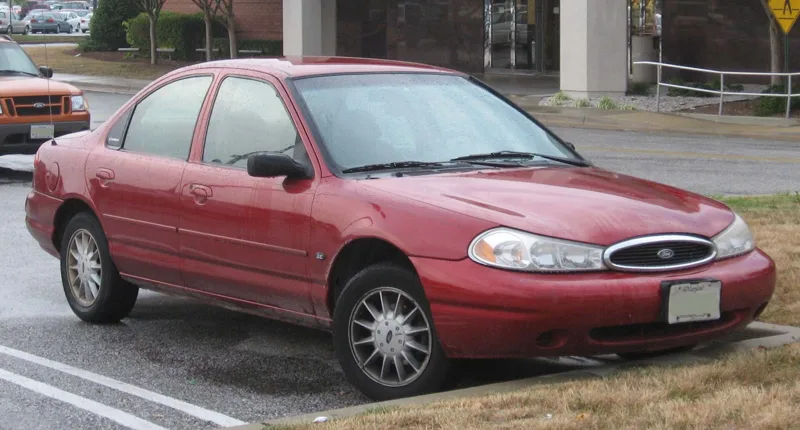
The third-generation Escort arrived for 1997 on the same Mazda-derived chassis, but its look and interior were substantially revised. Ford sold the car only as a sedan and station wagon, retiring the three-door and five-door hatchbacks that had been offered since 1981, and the GT was discontinued. The chassis was stiffened by 25 percent, and 14-inch wheels became standard.
The sedan was styled in line with the 1996 Taurus, with a curved roofline, flat oval headlamps and a half-oval grille. Inside, the dashboard had a tiered layout and an oval control panel similar to the Taurus. The station wagon kept most of the previous body and was discontinued for 2000, when it was replaced by the Focus wagon.
The sedan and wagon used a new 2.0 litre SPI2000 inline-four, which raised output from 88 hp to 110 hp with a variable-length intake manifold. A five-speed manual was standard, with a four-speed automatic as an option.
What was the ZX2?
For 1998 Ford introduced the Escort ZX2, the first two-door coupe in the Escort line. It replaced the Escort GT and succeeded the Tempo and Probe coupes. It was a four-seater, slotted below the Mustang, and it came in base Cool and deluxe Hot trims at launch.
The ZX2 shared its chassis and 98.4 inch wheelbase with the sedan, but it had sportier suspension tuning and a sleeker body. It used rear drum brakes, while the GT had discs. Its Zetec 2.0 litre inline-four made 130hp, a different design from the SPI2000 despite the same displacement. For 2003 its torque rose by 8 ft lb (11 N m). The name became simply Ford ZX2 in 2000.
At the end of the 2003 model year Ford retired the ZX2, which ended the Escort line in North America.
What was the ZX2 S/R?
The ZX2 S/R (Sport/Rally) was a limited-production variant of the 1999 and 2000 ZX2. It was the first product developed jointly by Ford Racing and the Small Vehicle Center's product development team, and it debuted at SEMA's Import Auto Salon in Pomona in 1999. It was inspired by factory sport compacts such as the Honda Civic Si and Dodge Neon ACR.
The S/R package added firmer springs and struts, a Ford Racing engine computer, a more efficient intake, rear disc brakes, a stronger clutch, a short-throw shifter and a unique blue valve cover. Engine power rose 10 percent to 143 bhp (107 kW; 145 PS). Some cars left the factory without the full set of parts, because the suspension bushings were packed for fitting at the dealership. The upgrade cost $1,500 in both years.
Ford's final production count was 2,110 cars. There were 110 yellow S/Rs for 1999, and for 2000 Ford built 500 black, 500 red and 1,000 yellow examples. Only about 35 of the 2000 cars were sold in Canada.
How did the Focus replace the Escort?
The Focus arrived in North America for 2000 as Ford's third world car, taking over from the Escort. After 2000 the four-door Escort was sold mainly to fleets, while the coupe stayed on sale. The final Escort sedan left the line in June 2002, and the final ZX2 was built in June 2003.
The Focus was far more unified across markets than the first Escort had been. Its differences between Europe and North America were largely limited to drivetrains and trim, so it became the world car Ford had first intended with the Escort.
Escort key figures
| Item | Detail |
|---|---|
| Launch | 3 October 1980, 1981 model year |
| Wheelbase | 94.2 inches (first generation); 98.4 inches (second and third) |
| 1981 SS production | 6,842 cars |
| 1982 starting price | $5,518 |
| CVH launch output | 65 hp (48 kW) |
| HO output | 80 hp (60 kW) in 1982, 88 hp (66 kW) in 1983 |
| 1985 1.9 litre | 86 hp (64 kW); GT 108 hp (81 kW) |
| 1991 GT engine | 1.8L DOHC, 127 hp |
| 1997 SPI2000 | 2.0 litre, 110 hp |
| ZX2 Zetec | 2.0 litre, 130hp |
| ZX2 S/R | 143 bhp (107 kW; 145 PS), 2,110 built |