Light aluminium panels from a Turin workshop, a handful of Ferrari chassis and a separate story for each car, from Mille Miglia results to a US$231,000 rediscovery.
Motto-Ferrari is the collective name for Ferrari sports cars bodied by Carrozzeria Motto. The Turin firm built only three new bodies for Ferrari chassis, in 1950 and 1951, and converted one older racing car, using light aluminium sheet.
Motto-Ferrari, also called Ferrari Motto, is the name given to Ferrari sports cars that wore bodies from the Turin coachbuilder Carrozzeria Motto. Motto worked on Ferrari chassis only in 1950 and 1951, under the leadership of Rocco Motto, and the lightweight aluminium panels made the cars well suited to racing.
Who was Rocco Motto and where did his workshop come from?
Rocco Motto, who lived from 1904 to 1996, trained as a tinsmith and worked for Martelleria Maggiora, the firm that later gave rise to the coachbuilder of that name. Together with siblings Ernesto and Clemente, he set up the Martelleria Fratelli Motto in Via Orta, Turin, which became the Carrozzeria Fratelli Motto in 1932.
Before the Second World War the firm made body panels and shells for bigger names, including Battista Pininfarina and Ghia, and for makers such as SPA and Lancia. Shortly before the war it also worked for Siata.
After the war the workshop moved to Via Bardonecchia. Between 1946 and 1949 it bodied mainly Alfa Romeo, Cisitalia and Fiat chassis, along with a few from Bandini and Ermini. By then it traded simply as Carrozzeria Motto and used the telex name CA-MO as a short form.
Three new bodies and one conversion, built from light aluminium sheet that suited the cars to racing.
Why did so many coachbuilders clothe Ferraris in 1950 and 1951?
Ferrari began building its own sports and racing cars in 1947. The 166 Inter entered small-series production in 1948, and the 195 and 212 series followed in 1950 and 1951. Ferrari at that stage still worked with numerous coachbuilders, who shaped open or closed bodies largely to the wishes of each buyer.
Hand finishing took a long time, and the established coachbuilders had limited capacity. Their orders were concentrated in 1950 and 1951, when many small and large workshops, Motto among them, took on the work of clothing Ferrari sports cars.
According to some accounts, Rocco Motto had a manner of his own: clean, simple lines that were gentle and flowing and almost free of unnecessary detail. His focus on racing cars invites comparison with Sergio Scaglietti of Modena, who from chassis 0440M in 1954 became Ferrari's preferred builder of racing bodies.
What was the 166 Inter Motto Spider?
In 1950 Motto drew and built a pontoon spider body for a Ferrari 166 Inter. Chassis 002C had begun life in 1947 as a V12 racing spider with a 1.9-litre engine, and it was only the fifth car to carry the Ferrari name, after 01C to 04C.
Its early career was busy. Franco Cortese and Raymond Sommer drove it for the Scuderia Ferrari in 1947, and its engine was later enlarged to 2.0 litres. Two Milan drivers bought it in 1948, and in 1949 it went to Luigi de Filippis, whose sister was Maria Teresa de Filippis.
In 1950 Renato Nocentini, a Florence dealer who ran the Garage La Rotunda, fitted the car with the Motto spider body. The pontoon body sat on a 2,420 mm (95.3 in) wheelbase and looked stretched out. The only real flourish was at the front, where the chrome grille surround ran out in slim triangular points beside an air scoop on the bonnet.
Piero Scotti raced the car in hillclimbs during 1950, then moved on for the following season to the 212 Export Motto Spider, chassis 0094E.
In 1951 a New York plastic surgeon bought the spider in Florence and took it to the United States. Several American owners followed, among them the collector and restorer Richard O'Hare. An enthusiast in Detroit had the car rebuilt in early 1969 with a fresh body modelled on the original C Wing Spider Corsa. The Motto body itself was kept and sold for US$300, and the New York Ferrari collector Ed Williman later acquired it.
In the mid-1970s Williman had the Motto body fitted to chassis 031S, a 1949 Ferrari 166 Inter that had originally carried a berlinetta body by Stabilimenti Farina, and a Ferrari 212 engine went in. By the early 1970s the car had been left to decline on New York streets.
What was the 195 Inter Motto coupe?
The 195 Inter coupe, chassis 0117S, was bodied around the turn of 1950 and 1951 in light alloy and delivered early in 1951 to the Turin racing driver Salvatore Ammendola. Its 2,341 cc V12 produced 135 PS (133 hp; 99 kW), peaking at 6,000 rpm.
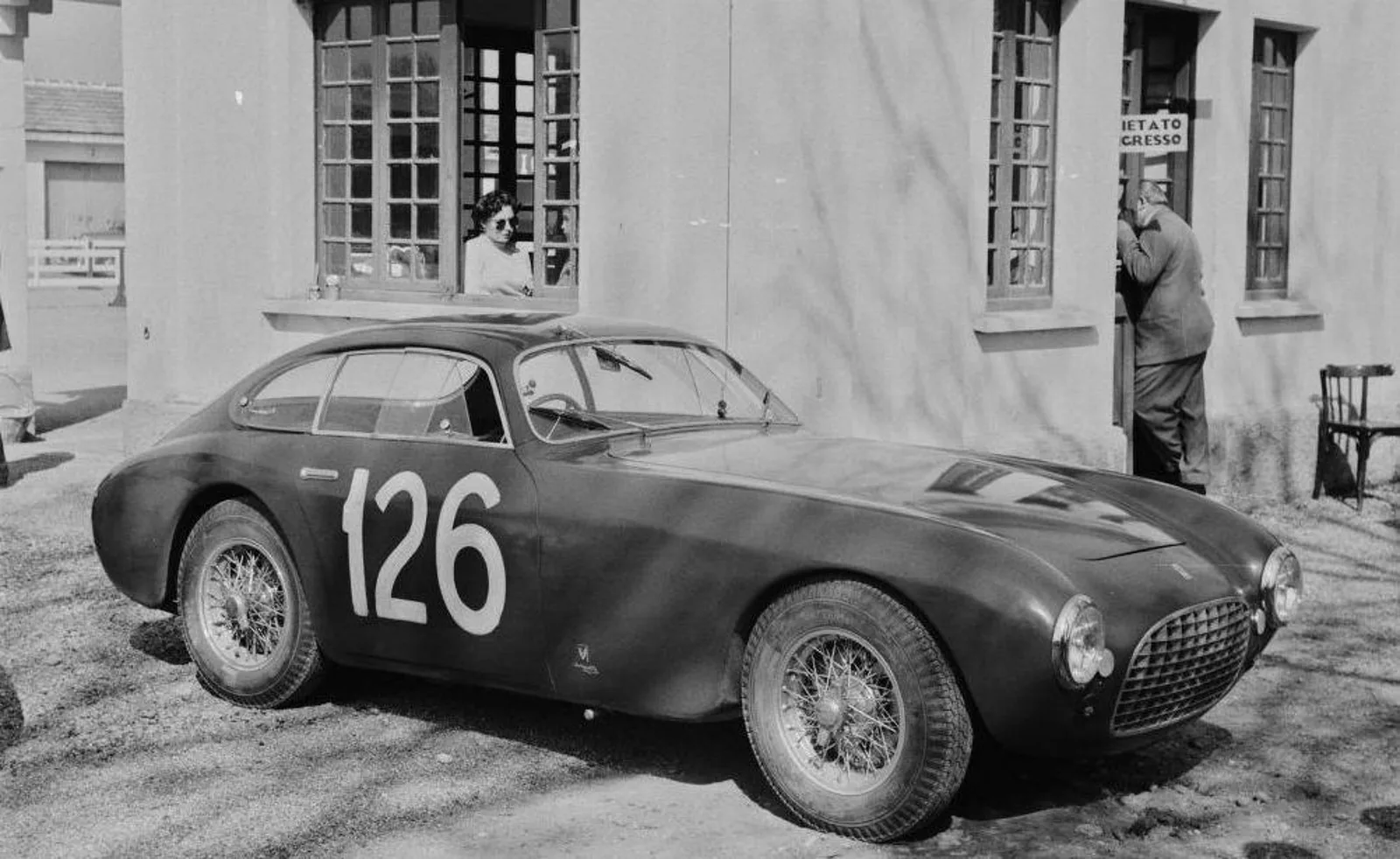
The body was a rounded fastback, drawn relatively far back, that resembled the Touring coupes of the period. The lines were calm and plain, with little chrome, and the grille was wide and low, a lattice of horizontal and vertical bars that made small rectangles.
Slim and set close to the body, the front bumper reached nearly to the wheel arches and curved gently under the grille. Ferrari's own factory publications showed a Vignale coupe in its place, and one source puts this down to the unusual Motto design.
The 2,500 mm (98.4 in) wheelbase did not stop the car racing. At Monza's two-hour race in 1951 Ammendola took second, beaten only by the Scuderia works car of Luigi Villoresi and finishing ahead of Louis Chiron's Delahaye.
Only 27 of the 195 Inter were produced across 1950 to 1952, and every one was a closed car. Vignale bodied twelve, Ghia ten, Touring three, and Ghia-Aigle one.
The car no longer exists in its original form. Scaglietti rebodied the chassis in 1956 in the style of the 750 Monza or the 121 LM Scaglietti spider, and a 3.0-litre V12 from a 1962 250 GTE 2+2 went in later. In the 1960s it was owned for a time by Peter Helm, an actor and Ferrari collector from Canada. Its original engine ended up in a 212 Inter Vignale coupe.
The modified car was found again in 2006 in Southern California, after 40 years out of view. A European collector bought it at auction for US$231,000, with its condition at that point in mind.
What was the 212 Export Motto Berlinetta?
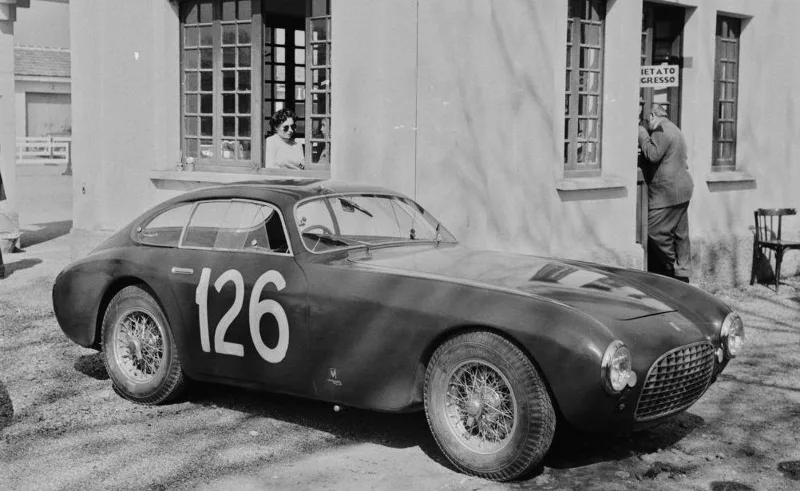
Chassis 0074E, a 212 Export, received a Motto berlinetta body in 1951. Its 2,562 cc V12 developed 170 PS (168 hp; 125 kW), peaking at 6,500 rpm, and its 2,250 mm (88.6 in) wheelbase was 25 cm (9.8 in) shorter than that of the 195 coupe.
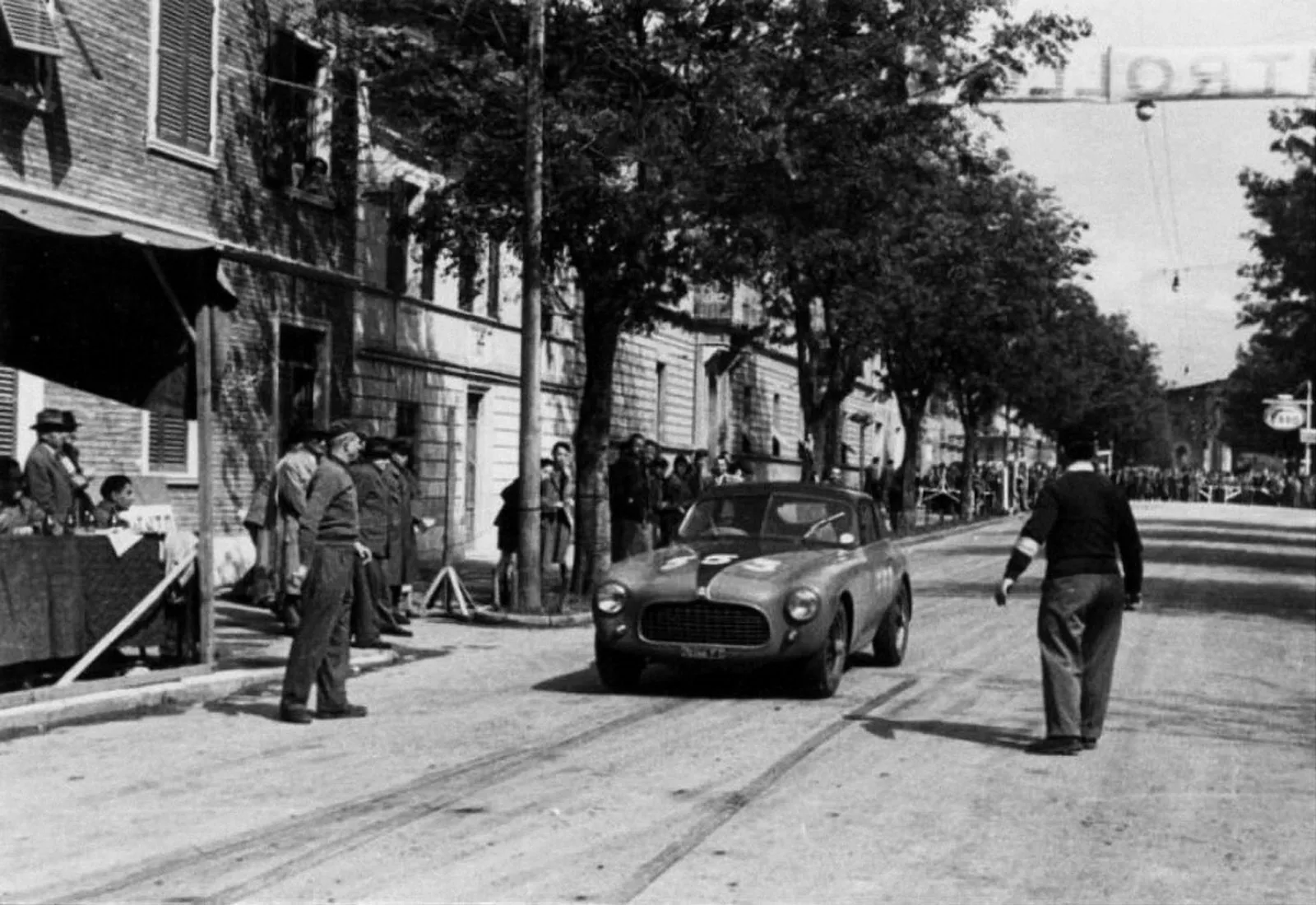
After a works outing for the Scuderia, Elio Checcacci took the car over. With its shorter wheelbase and stronger engine it was built for competition, and it placed third at the 1951 Tour de France Automobile, shared by Checcacci and the American Harry Schell.
It retired from the 1951 Mille Miglia and again the following year under a new owner. In 1953 it passed to the Belgian team Ecurie Francorchamps, but Charles de Tornaco and his partner failed with engine trouble in the 24-hour race at Spa-Francorchamps.
Under the Italian Ilfo Minzoni in 1954 the berlinetta returned to form. It took third in class at the Mille Miglia, finishing 13th overall, and fourth and sixth overall at the three-hour race at Bari and the Targa Florio.
Twelve of the 27 Ferrari 212 Export built in 1951 and 1952 had closed bodies. Eight of those were Vignale designs, three were Touring and one came from Fontana.
After November 1954 the berlinetta cannot be traced with confidence. It was entered for the 1955 Mille Miglia but did not appear, and there are indications that a Brazilian owned it in 2002.
What was the 212 Export Motto Spider?
Chassis 0094E, the second 212 Export with Motto bodywork, was a compact spider from 1951 with the same 2,562 cc V12 and 170 PS (168 hp; 125 kW), peaking at 6,500 rpm. It went to the Florence driver Piero Scotti, who handed back the 166 Inter spider in exchange.
The body was unusually small and minimal, built to save weight and improve visibility. The radiator grille was narrow and tall, and a third headlight, placed low and centrally, straddled the grille and the lower front panel. The spider has sometimes been described as eccentrically styled.
Scotti and Amos Ruspaggiari finished third at the 1951 Mille Miglia, and the win of the 1951 Italian sports car championship came as well. At the end of the season it went to an Argentine driver, who used it regularly at home. Under later Argentine owners it took part in regional events until 1959, and it stayed in South America until 1984.
Today the right-hand-drive spider is back in its original silver paint with a dark red interior, after a lengthy restoration. The Swiss entrepreneur Antoine Midy, based in Paris, used it from 1984, first in historic racing from 1987 and later at concours events.
Following Midy's death in 2007, an auction the next year failed to find a buyer. The highest bid, 2.15 million Swiss francs, fell short of the estimate of 2.8 to 3.8 million francs.
Specifications at a glance
| Car | Chassis and body | Engine | Notes |
|---|---|---|---|
| 166 Inter Motto Spider | Chassis 002C (later 031S); body of 1950 | V12, originally 1.9 litres (116 cu in), later 2.0 litres (122 cu in) | Pontoon spider, 2,420 mm (95.3 in) wheelbase |
| 195 Inter Motto coupe | Chassis 0117S; body of 1951 | 2,341 cc (142.9 cu in) V12, 135 PS (133 hp; 99 kW) | Light alloy fastback, 2,500 mm (98.4 in) wheelbase |
| 212 Export Motto Berlinetta | Chassis 0074E; body of 1951 | 2,562 cc (156.3 cu in) V12, 170 PS (168 hp; 125 kW) | 2,250 mm (88.6 in) wheelbase |
| 212 Export Motto Spider | Chassis 0094E; body of 1951 | 2,562 cc (156.3 cu in) V12, 170 PS (168 hp; 125 kW) | Right-hand drive, third headlight |