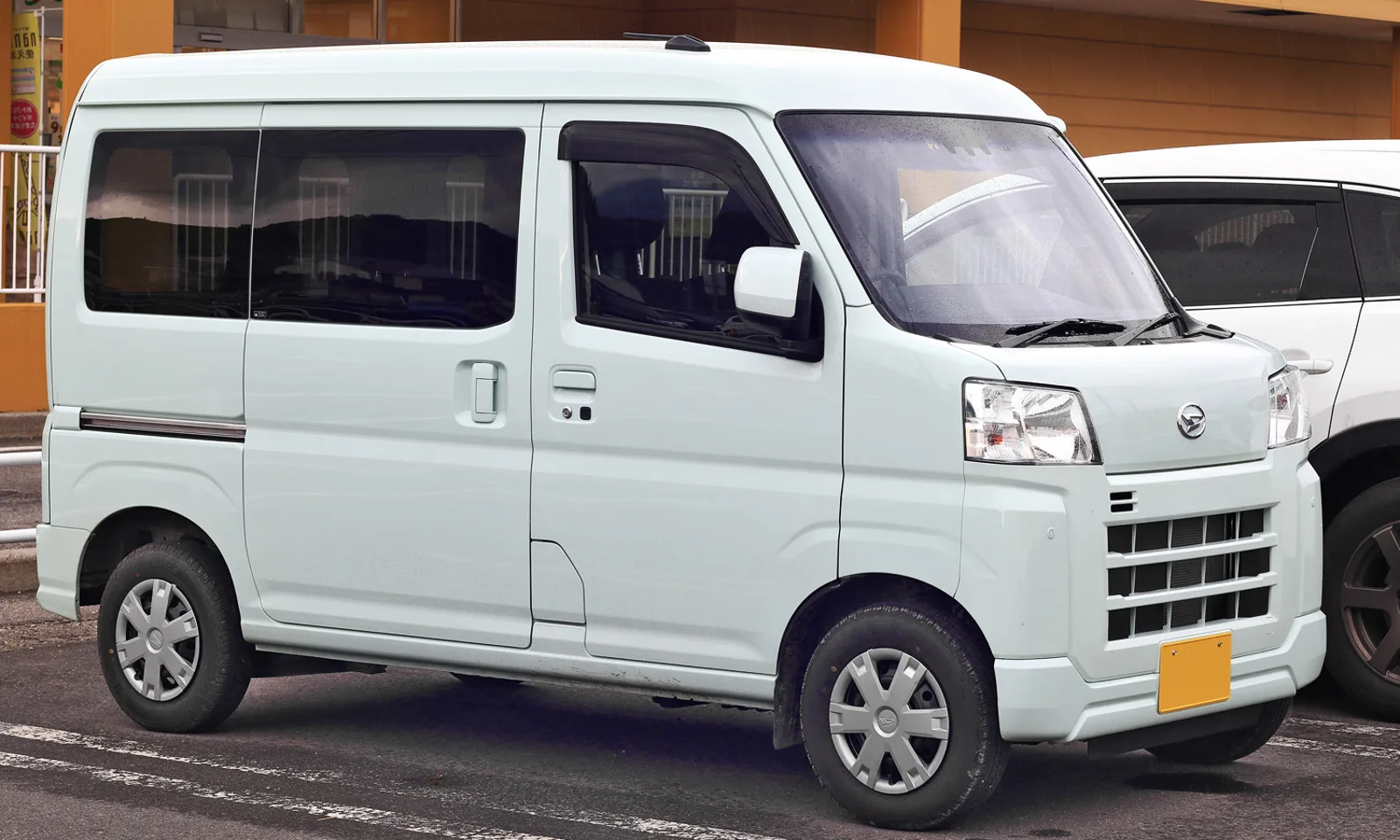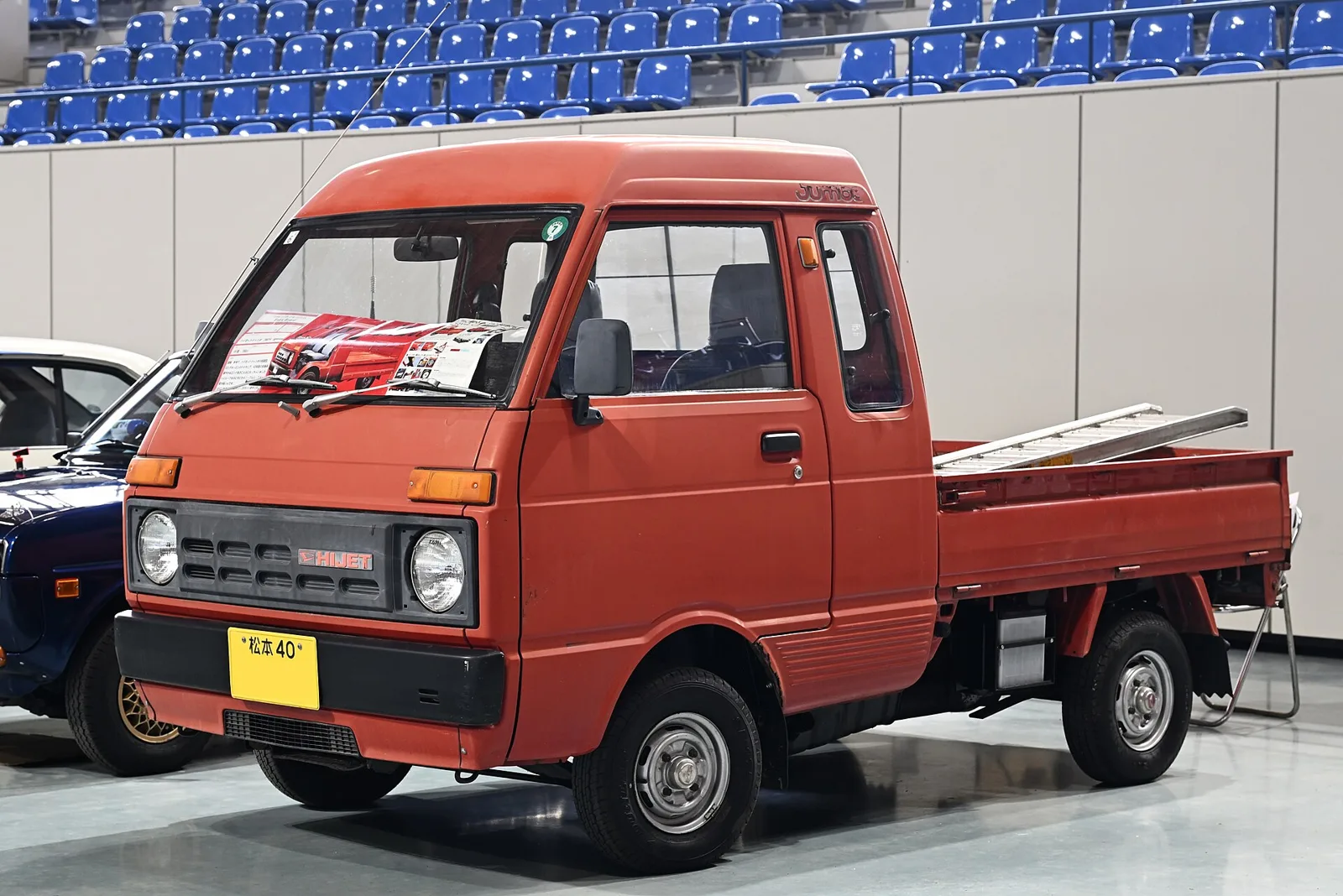
The kei truck with a stretched cabin, from its 1983 debut through several generations to the current CVT-equipped range.
The Daihatsu Hijet Jumbo is a kei truck grade with a stretched cab and a raised roof. It began in 1983 as the Hijet Truck's top grade, vanished with the 8th generation and came back with the 9th. The 10th generation has sold since 2014 and has used a CVT on automatic cars since December 2021.
The Hijet Jumbo takes Daihatsu's kei truck and pushes the cabin rearward, so the seats can recline and quarter windows can be added. Introduced in 1983, it disappeared with the 8th generation, returned with the 9th, and was still being revised in March 2026. Its story is a trade of cargo space for comfort, with an OEM arrangement that later put a version under the Subaru Sambar name.
Why does the Jumbo have a longer cabin?
Ordinary kei trucks use the space behind the B-pillar as a cargo bed, which leaves thin, upright seats unsuited to long journeys. The Jumbo moves the cabin's rear edge back and lifts the roof. That makes room behind the seats, lets them recline and adds quarter windows, and owners often do not use the whole bed anyway.
On the 10th generation the cabin reaches 270 mm (10.6 in) further back than the Extra SA IIIt, and the roof sits 90 mm (3.5 in) higher. Starting with the 9th generation, a gap in the front of the load area lets owners carry long items.
A kei truck that trades cargo bed space for seats you can recline in.
How did the Jumbo begin in the 1980s?
The Jumbo arrived in 1983 as the premium trim of the Hijet Truck, with a five-speed manual, four-wheel drive and a colour found nowhere else. Enthusiasts called it the eyebrow because of its appearance. With the Atrai's truck version in mind, it had an unusually rich range of dress-up options for a truck.
The extension's side windows could be opened, which helped ventilate cars without air conditioning. Air conditioning was an extra-cost option.
What changed in the 7th and 8th generations?
The 7th generation arrived in 1986 and again led the Hijet Truck range, with a five-speed manual model. Its extension windows became fixed, while the rear window slid open. From 1992 both 2WD and 4WD cars got standard front discs, and 2WD cars moved to 12-inch tyres.
The 8th generation vanished at the 1994 model change, then reappeared in 1997 as the Super Jumbo in the special-equipment range. Sales lasted roughly a year, the shortest run of any Jumbo, so it is rarely seen. Its longest cabin extension had no side window, which made rear-left vision poor.
How did the 9th generation change the formula?
The 9th generation arrived in January 1999 with a more modest cabin extension than its predecessors. Its side window returned as a tall, tinted quarter window that doubled as a security feature. A cargo-panel gap allowed 180 cm long items, something the 8th generation could not manage.
The price was a weaker version of one of the Jumbo's main draws: sitting back and stretching out. Because the base vehicle was the Special, five-speed manual models were limited to the EF-SE, a three-cylinder SOHC 6-valve unit with lower output.
Equipment arrived steadily through the 2000s. Hydraulic power steering and an intermittent two-speed wiper came in 2000, manual air conditioning in 2002, and fabric seats, power windows and keyless entry in 2004. A passenger-side under-mirror followed in 2006 to meet new visibility rules.
In January 2001 automatic cars received a resin engine under-cover as standard, and 4WD cars could fit a 13-inch radial tyre at the factory. The rope-hook shape on the guard frame was reworked, hooks were added to the rear gate, and the wheel housing was reshaped to ease getting in and out. June 2003 added an analogue-style electronic meter with an LCD odometer and trip meter, and December 2004 reworked the exterior and dashboard.
The engine changed in December 2007, when a new three-cylinder DOHC 12-valve unit, the KF-VE, replaced the old one. Output and torque rose sharply on the five-speed manual cars. A driver's airbag became standard on 1 December 2011, and a Jumbo Limited edition appeared in Pearl White III.
From April 2012, Fuji Heavy Industries sold a version as the Subaru Sambar Grand Cab. OEM supply to Toyota as the Pixis Truck began in December 2011, but that line is focused almost entirely on standard cabs for agricultural and fishing workers, and a Hijet Jumbo equivalent has never been offered.
In December 2012 a rear reflector was added for safer night-time loading and getting in and out, and the car was made compliant with JC08 fuel economy.
What did the 10th generation add?
The 10th generation went on sale in mid-September 2014 and became the top model in the catalogue instead of a special-equipment vehicle. Passenger airbags became standard, and set options were introduced. Fuel economy was improved enough to meet the fiscal 2015 standard.
The Eco Pack, added in December 2014 for 2WD five-speed manual cars, fitted a sub-transmission and a higher-ratio rear differential. It reached 20.4 km/L in JC08 mode, 10% above the standard, while also running quietly. Automatic cars became the only four-speed automatics among current kei trucks sold, excluding OEM models.
Even without the Eco Pack fitted, stopping the car and pressing the clutch pedal lets the driver switch the transfer lever to Lo.
The December 2021 minor change moved automatic cars to CVT and gave the 4WD CVT cars electronically controlled four-wheel drive with three modes. The grade line-up was consolidated around the Jumbo Extra, with a new entry grade, the Jumbo Standard. The Extra offered five Choose Your Colour Pack body colours.
Which special editions and colours did buyers see?
The 55th Anniversary Gold Edition, released on 28 October 2015 to mark 55 years of the truck, gave the front grille a gold-plated finish. It added 12-inch full wheel caps, top shade glass and anniversary badges on the doors and tailgate. Its eight colours matched the optional Choose Your Colour Pack, except that Blue Mica Metallic and Offbeat Khaki Metallic were dropped and two edition-only shades, Urban Night Blue Crystal Metallic and Muscat Green Metallic, were added.
What did the later updates bring?
On 3 October 2016 the optional Choose Your Colour Pack picked up the two shades from the anniversary edition. Door handles changed to body colour, and the built-in CD and AM/FM stereo was dropped in favour of a silver-trimmed audio and heater control panel.
In November 2017 the Jumbo gained LED headlamps, a first for a kei truck, along with standard ABS. Fine Mint Metallic replaced the two dropped pack shades, and the Eco Pack was dropped from the Jumbo.
The May 2018 Jumbo SA IIIt added the Smart Assist IIIt collision-avoidance system, another kei-truck first, together with VSC, TRC and hill hold on automatic cars.
The same update put IR and UV-cut glass into the Choose Your Colour Pack, while the Farm Woman Pack got top shade glass. The SA IIIt already had both as standard.
In August 2020 auto lights became standard, and the SA IIIt gained back sonar. The Jumbo moved to WLTC-mode fuel figures, so it no longer met the fuel economy standard; its rear window lost the sticker.
The December 2021 Smart Assist upgrade brought lane departure suppression, a road-edge warning, drowsiness alerts and sign recognition. Front seats gained an overhead shelf.
On 19 March 2026 Smart Assist gained pedestrian detection at intersections when turning right, and for people coming from the oncoming direction when turning left or right.
Who were the rivals?
Honda's Acty gained a Big Cab in 1982, a year ahead of the Jumbo, with its cabin stretched by about 10 cm and side windows about 5 cm wide. The half-measure proved its weakness, and it vanished with the full model change of 1988.
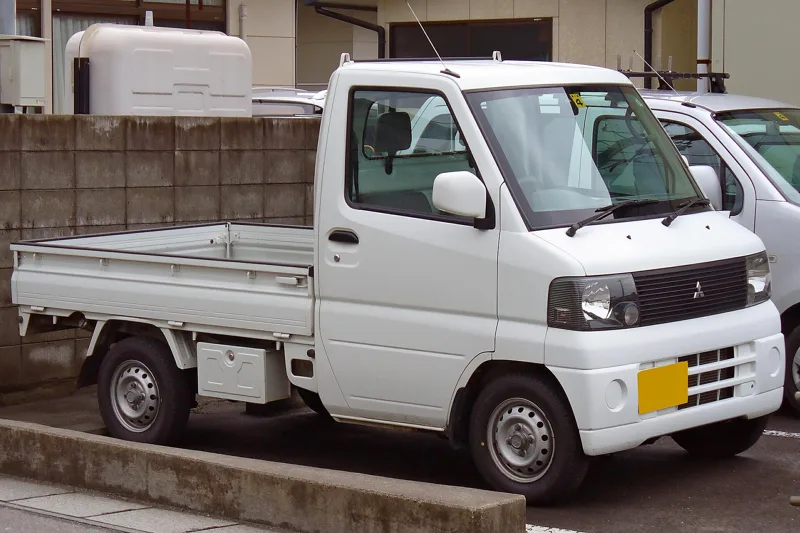
Mitsubishi's Minicab added a Super Cab in 2002, later also sold as the King Cab on the Nissan Clipper. Its low-profile roof did not suit buyers who wanted space, and it held only about a tenth of the Hijet's share. It disappeared when in-house production ended with the 2014 full model change.
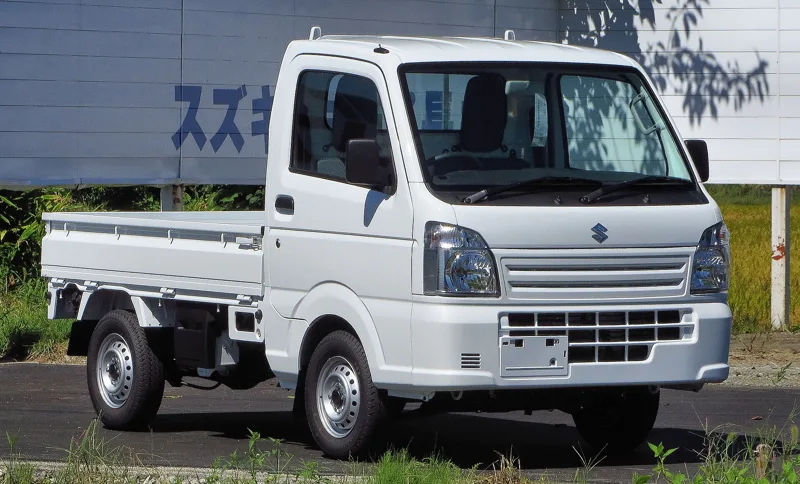
Suzuki's Carry derivative, the Super Carry, went on sale in 2018 and is the rival among models still in production as of January 2026. It has been improved six times, and the Hijet trails it in a few areas, including millimetre-wave radar and a digital speedometer.