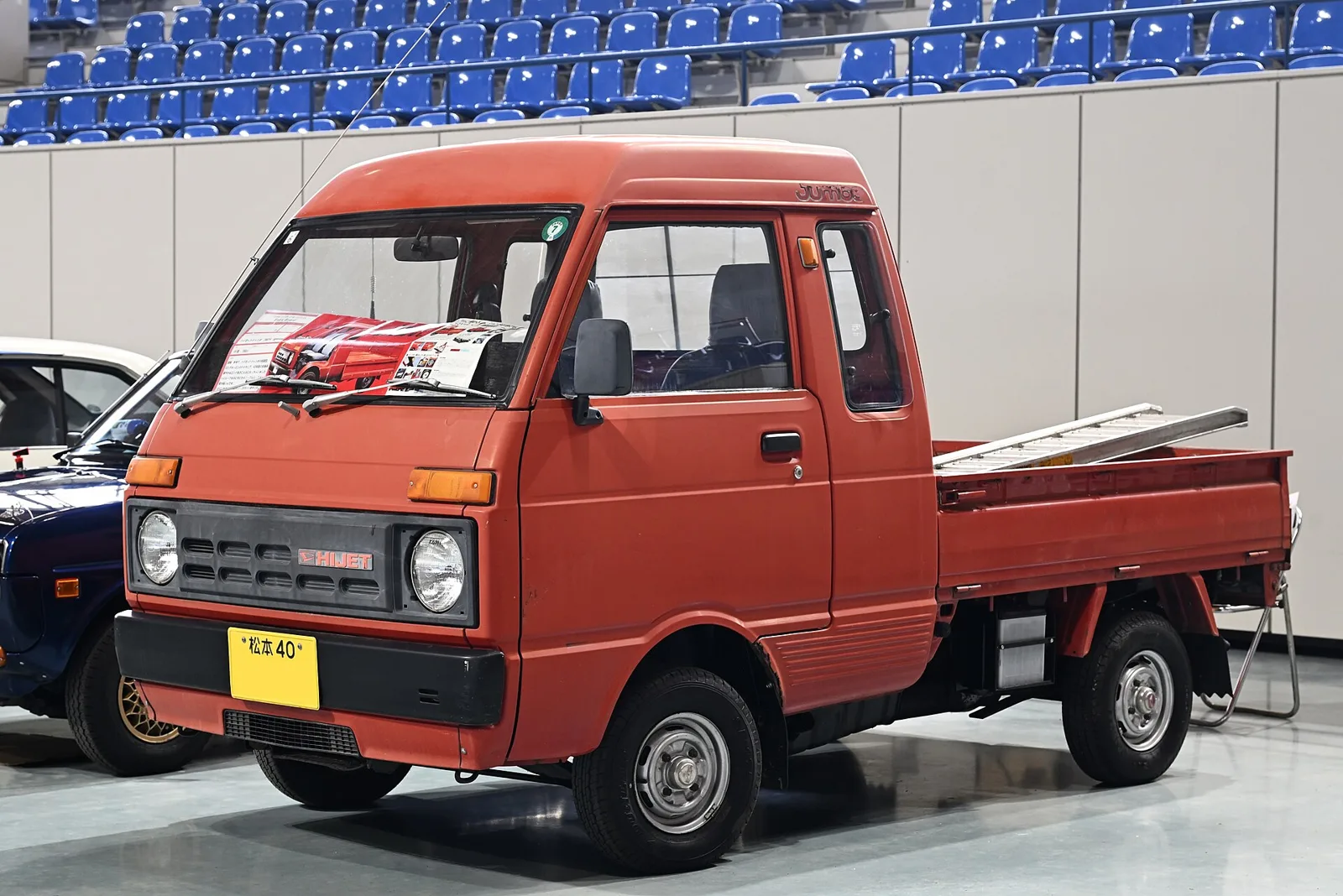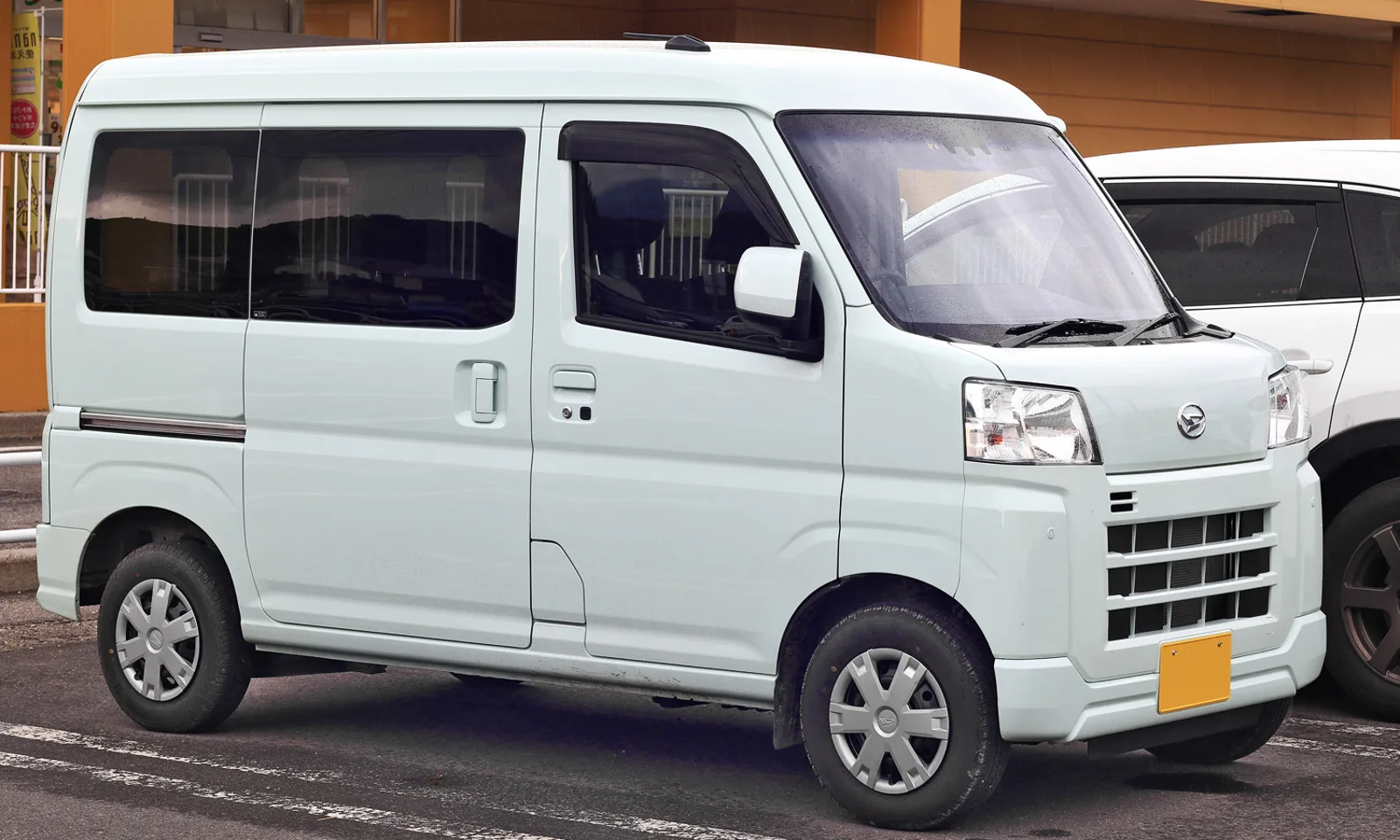
A Japanese microvan built to the kei rules, with cab-over and mid-engined layouts, a passenger spin-off, export engines and a 2026 battery electric version.
Built since 1960 under Japan's kei rules, the Hijet has passed 7.4 million sales in Japan. Its layouts moved between cab-over and front-engined designs, a passenger Atrai spun off in 1981, and a battery electric van arrived in 2026.
The Daihatsu Hijet is a Japanese kei truck and cab-over microvan that Daihatsu has built since 1960. By November 2020 around 7.4 million had been sold in Japan. Its layout has moved from a front-engined pickup to a cab-over van, then to a front-engined van and a mid-engined truck, largely within the size and power limits that Japan's kei rules allowed.
Where did the Hijet name come from?
The name dates from 1960, and it has been on Daihatsu's kei trucks and microvans ever since. It also resembles the naming of Toyota's HiAce and Hilux, but the Hijet has always been a Daihatsu product.
The name is close in Japanese to Midget, another of Daihatsu's mini-trucks. According to Daihatsu, Hijet was chosen to suggest higher performance than the Midget.
In Japan the Hijet competes with the Honda Acty, the Mitsubishi Minicab, the Nissan Clipper, the Subaru Sambar and the Suzuki Carry.
A kei van with a 1960 start, a cab-over body for most of its life and a battery electric version in 2026.
What did the first Hijet look like?
The first Hijet was a kei truck that arrived in November 1960, with an enclosed light van following in May 1961. It used a 356 cc engine producing 17 PS (12.5 kW), with a three-speed manual that gave a top speed of 75 km/h (47 mph). Those were typical numbers for the class at the time.
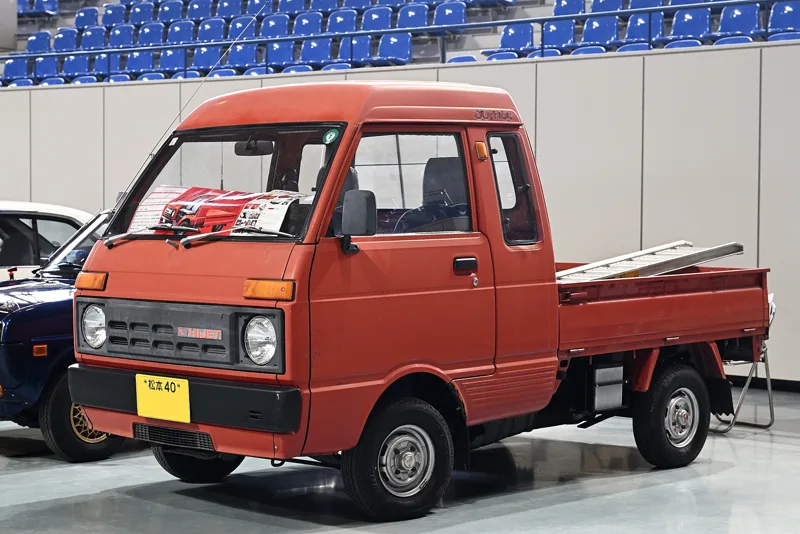
The first generation used a conventional front engine and rear-wheel drive, with the driver seated behind the engine in a pickup-style layout. A 1964 facelift replaced the body-coloured grille with a chromed unit, and the engine moved to a cab-over position in the same year.
A heavier New-Line model arrived in January 1963. It was half a metre longer and could carry 500 kg (1,102 lb) on an 800 cc engine with 41 PS (30 kW). It did not meet the strict kei standards of the time, so it sold only in small numbers.
How did the kei rules shape the Hijet?
The Hijet's development followed the evolution of Japan's kei regulations closely. Exterior dimensions grew from 3.0 m by 1.3 m (118 in by 51 in) at launch to 3.4 m by 1.475 m (134 in by 58 in) as the rules changed over the years. Engine size rose from 360 cc to 550 cc in 1976 and then to 660 cc for 1990.
Export versions were usually a little larger, because they carried bigger bumpers and sometimes wider bodies. The two millionth Hijet was built during 1980.
How did the Hijet 550 and Wide 55 change the range?
The four-stroke Hijet 550 arrived in October 1976 with the AB20 engine. The wider and longer Wide 55 followed less than a year later, and it became the first Hijet sold abroad in quantity.
The 547 cc AB20 was a water-cooled, four-stroke two-cylinder with a single overhead camshaft and a balance shaft. It produced 28 PS (21 kW) at 5,500 rpm in Japan, with 4.0 kg m of torque at 3,500 rpm. Export engines were tuned to 30 PS (22 kW) and 4.2 kg m at 4,000 rpm.
Export models could claim 105 km/h (65 mph), and a four-speed manual was the only transmission. The Wide 55 truck began production in April 1977, and vans with sliding doors followed later that year, along with a panel van that was not sold abroad.
The 1979 facelift gave the Wide 55 a single-piece grille and a more sculpted dashboard, with better seats that had adjustable backs. The two millionth Hijet was an S60 built during 1980.
The four-stroke 550 was dropped in April 1981. The two-stroke S38 stayed on sale until August 1981 as a low-cost version, and it remained popular in several South-East Asian markets, where emissions rules were looser and its lower price mattered more.
How did the earlier generations evolve?
The second generation switched to a cab-over body in 1964, which made the most of cargo space inside the kei rules. The New Line Cab of 1966 used the same idea on a larger truck, and the New Line Cab was built until March 1968.
The third generation was boxier, with square headlights in prominent dark shrouds and front doors hinged in the modern manner. Its ZM I engine produced 23 PS (17 kW) at 5000 rpm, enough for 85 km/h (53 mph). The generation was also offered as an all-electric truck and van.
The fourth generation arrived in September 1971 with all-new sheetmetal and was initially a truck only. A van with sliding doors on both sides, marketed at first as the Slide Van, followed in February 1972, and it had a top-hinged tailgate as well.
How did the sixth generation spread the Hijet?
The sixth generation arrived in March 1981 on a slightly longer wheelbase, still with the AB20 engine. A four-wheel-drive version followed in March 1982, and a turbocharged model in February 1984.
The four-wheel-drive S66 gained optional free-wheel front hubs and front disc brakes from October 1983. The Hijet Climber, offered with two- or four-wheel drive, wore bigger off-road tyres and a limited-slip differential.
Other makers built the car too. Indonesian-built Hijets from Astra International had a longer body and a one-litre engine, which was needed to meet a 1985 decree on the smallest engine built in the country. A variety of minibus bodies were fitted by local builders.
From 1984 a subsidiary of FAW Tianjin built the S65 as the TJ110, later the Huali Dafa. That version was popular as a taxi, and production ended in 2002. The Hijet Jumbo, a high-roofed extended cab pickup with a shorter bed, appeared in 1983.
What changed in the 1990s and 2000s?
The eighth generation went on sale in January 1994 after its debut at the 1993 Tokyo Motor Show. The Hijet EV, a fully electric van, appeared in May 1994, and a fuel-injected six-valve engine rated at 44 PS (32 kW) was standard on automatics.
The seventh generation, launched in May 1986, kept its engine just under 550 cc but switched to a more modern three-cylinder unit. It was the only generation marketed in the US for commercial off-road work, where it faced golf carts and light three-wheeled trucks.
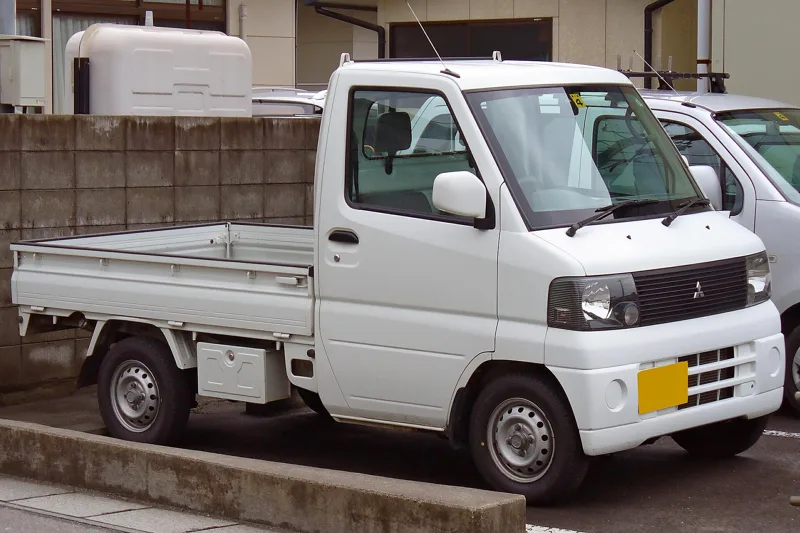
The ninth generation arrived in 1999, and the split between truck and van began.
The truck stayed a cab-over design built in-house, while the Hijet Cargo van adopted a front-engined semicab shape designed by Italdesign Giugiaro. The Atrai passenger version followed the van's front-engined layout.The December 2007 truck update brought a new front clip and the KF-VE engine, which cut fuel consumption by ten percent. A 1.3-litre seven-seat version, the Atrai 7, did not qualify as a kei car. A larger commercial version, the Hijet Gran Cargo, ran from July 2000 until November 2004 and was sold as the Extol abroad.
The Atrai's rear end used three links and independent wheels, unlike the leaf-sprung live axle of the Hijet, which is why it carries its own chassis codes. The Turbo SR and RT models had anti-lock brakes as standard, and the Atrai Classic arrived in October 1997 with leather seats and keyless entry.
Sales of the truck overtook the Suzuki Carry in December 2010, making the Hijet the kei truck market leader for the first time in 39 years. Toyota began selling the S201 truck as the Pixis Truck in December 2011, and Subaru sold the Hijet as the Sambar from April 2012.
Why did the truck and van lines split?
The divergence came from new crash protection rules for passenger cars, which forced the Hijet Cargo van to a front-engined layout. The Suzuki Carry lineup went through a similar change at about the same time.
In April 2015 the Cargo received a four-speed automatic and an electronic throttle. The Hijet and Atrai were thoroughly facelifted in November 2017, with a redesigned front and a prominent trapezoidal grille.
The tenth-generation van arrived in December 2004 and was only available as a van at first.
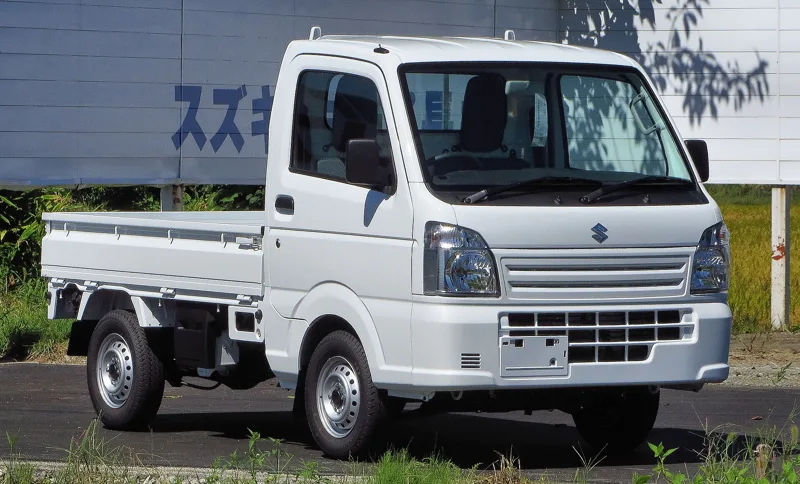
Its passenger version, the Atrai, used a 660 cc turbo engine rated at 64 PS (47 kW), while the trucks stayed in the older cab-over form until September 2014.The tenth-generation truck, introduced in September 2014, used a mid-engined cab-over layout with rear or optional four-wheel drive. A CVT option arrived for the truck in December 2021.
How did the Hi-Max and the electric Hijet differ?
The Hi-Max was an Indonesian-market version of the tenth-generation truck, launched on 10 November 2016. It used a 998 cc 1KR-DE engine, the same unit found in the Ayla hatchback, tuned for less output. It made 57 PS (42 kW; 56 hp) at 5,000 rpm, and its torque peaked at 85 N m (63 lb ft) with the engine at 4,000 rpm.
Low sales ended the Hi-Max. Production stopped in November 2019, and only 95 units reached dealers that year. The Gran Max, with nearly 36,000 units in the same year, outsold it by a wide margin, and a total of 1,731 Hi-Max units were sold.
The battery electric Hijet Cargo was announced in May 2023 and went into production on 2 February 2026. It also appears as the Pixis Van and the Suzuki e Every, the latter going on sale on 9 March 2026.
What variants were built outside Japan?
Several Hijet derivatives were sold abroad with 1.0 to 1.3-litre engines, and those cars were no longer kei vehicles because they were wider and longer. The Zebra, also called the Hijet Maxx or Citivan, began as a Japanese-market Hijet and later became a separate model, while the Perodua Rusa was a rebadged Zebra.
Piaggio built a licensed version of the seventh-generation Hijet at Pontedera in Italy from 1992 to 2021, with diesel, LPG, CNG and electric options. From 2013 the Porter was also built at Piaggio's Baramati plant in India. Its engines ran from a 48 PS (35 kW) 1.0 petrol to a 1371 cc diesel.
In 2021 Piaggio released the NP6 instead. It was not based on the Hijet at all, but was an Italian-built version of the Chinese Foton T3 van.
What was the hybrid Hijet?
Daihatsu debuted the Hijet Cargo Hybrid concept in 2002, a mild hybrid van with a 660 cc engine. The electric motor sat between the engine and the transmission, and Daihatsu said the van was 30% more fuel efficient than its petrol counterpart.
The Cargo Hybrid was discontinued in April 2010, because the hybrid system was too expensive for a microcar that already returned good fuel economy. Hybrid versions of the Atrai and FEV concepts were shown in 2002 but never reached production.
Hijet generations at a glance
| Years | Generation and detail |
|---|---|
| 1960 to 1964 | First generation, 356 cc engine, rear-wheel drive, cab-over from 1964 |
| 1971 to 1976 | Fourth generation, 360 cc two-stroke, Slide Van from 1972 |
| 1977 to 1981 | Fifth generation Wide 55, 550 cc AB20 four-stroke |
| 1981 to 1986 | Sixth generation, four-wheel drive from 1982, turbo from 1984 |
| 1986 to 1994 | Seventh generation, EB three-cylinder, Asia Motors and Piaggio builds |
| 1994 to 1999 | Eighth generation, first electric van |
| 1999 to 2014 | Ninth generation, front-engined van and cab-over truck |
| 2004 to 2021 | Tenth generation van, Atrai passenger version |
| 2014 onward | Tenth generation truck with 660 cc KF engine |
| 2021 onward | Eleventh generation Cargo and Atrai on the New Global Architecture |