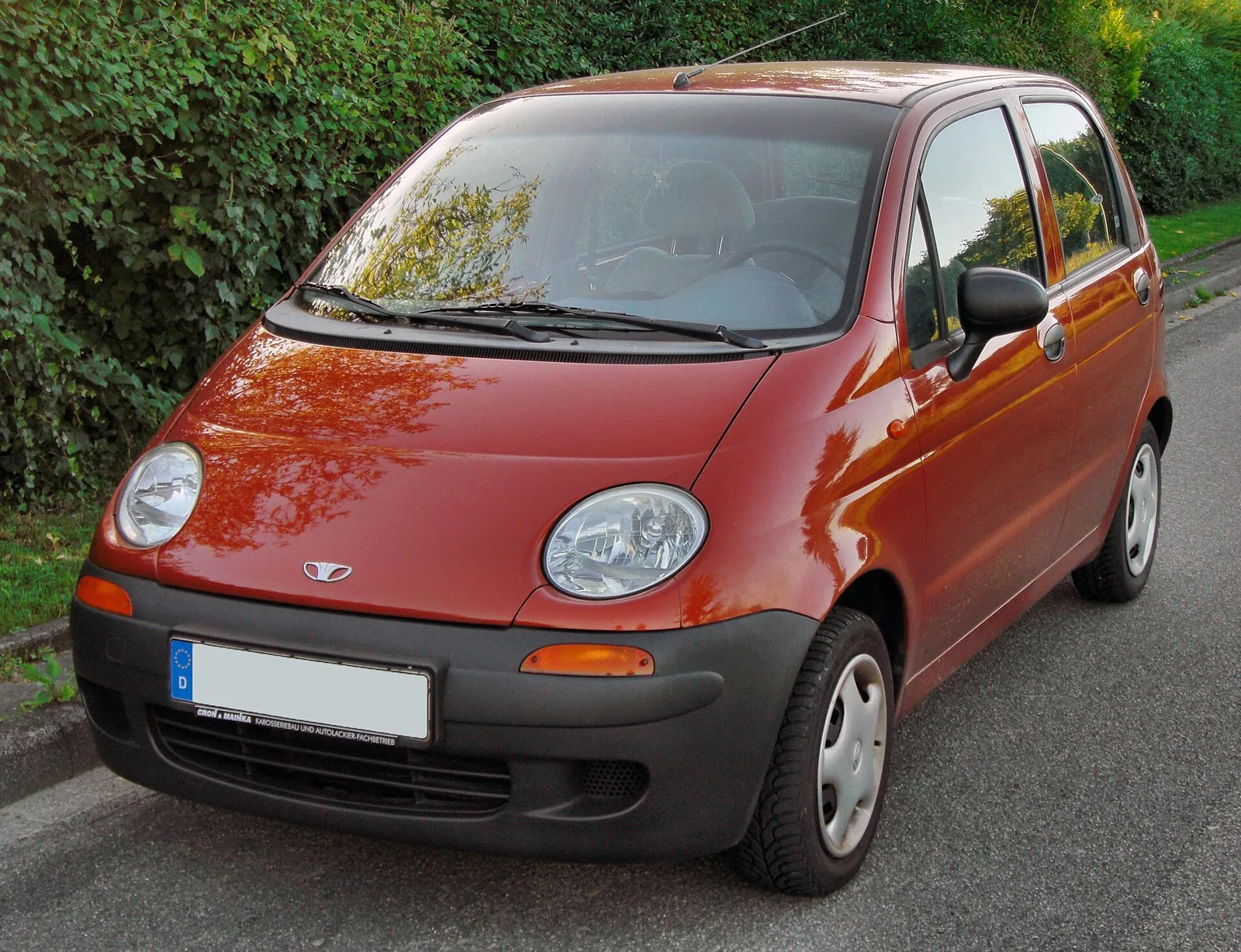
A five-door mini people carrier that sold in large numbers in Italy, carried the Daewoo badge, then switched to Chevrolet.
The Daewoo Matiz was a compact five-door people carrier produced from 1998, later sold under the Chevrolet badge and as the Spark in some markets. Designed by Giorgetto Giugiaro, it grew out of the 1992 Italdesign Lucciola concept. Its engines were a 0.8 three-cylinder and a 1.0 four-cylinder.
The Daewoo Matiz was a five-door mini people carrier from the South Korean carmaker, sold from 1998 as the successor to the Tico. Giugiaro's styling and a tight price gave it strong sales in Italy, where it first carried the Daewoo badge and later the Chevrolet one.
Where did the Matiz come from?
The Matiz was the final result of the Italdesign Lucciola project, developed in 1992 in the studios of Giorgetto Giugiaro and shown at the Geneva Motor Show in 1993. The concept was pitched to Fiat as a possible successor to the Cinquecento. Its hybrid layout paired two 7 kW electric motors with a two-cylinder diesel of 0.49 litres producing 8 PS at most, and its body was built from recyclable materials.
The final car differed little in shape from the 1992 concept, but Giugiaro reworked the body around a classic five-door layout to gain interior flexibility. Fiat turned the idea down, largely because its solutions were too costly for the period. Giugiaro, who had begun designing the Lanos and Leganza for Daewoo, offered it to the Korean firm instead. Who Woo Choonga, Daewoo's president at the time, was after a small city car with a five-door people-carrier body to succeed the old Tico, so the project found a home.
The programme was known internally as the M Series, with M standing for microcar. The number 100 that followed marked the first generation. Development of the M100 was complete in 1997, and sales began in Korea before the car was launched in Europe.
Assembled in over two million three hundred thousand examples between 1998 and 2008, the Matiz changed badge along the way.
What made the first-generation Matiz stand out?
The first-generation Matiz used a five-door layout that Giugiaro reworked for flexibility inside. That was one of the main reasons for its success in Europe. Measuring 3.49 metres (11.5 ft), it was approved for five people and was regarded as a mini people carrier, and it came in nine colours at launch.
The design was rounded and short-nosed, with no grille and round lamps. Only the top-of-the-range versions had the lamps and wide bumper pads painted. The flank had a light rib along the belt line and oval mirrors, while the tail carried oval light clusters that housed twin round projector lamps, and the boot had a lowered loading sill.
Mechanically it was an adaptation of a revised Suzuki Alto platform, a legacy of Daewoo's earlier joint venture with Suzuki. The engine sat transversely and drove the front wheels. The front used MacPherson struts with an anti-roll bar, and the rear used a torsion beam with trailing arms, while the steering was rack and pinion, power-assisted only on the top versions.
Safety was handled through a standard anti-lock braking system with four-channel sensors and electronic brake force distribution, plus anti-intrusion bars in the doors. The top versions added front airbags and ISOFIX mountings. Under Euro NCAP tests the first series earned three stars out of five, a result judged more than satisfactory for the time.
Where was the Matiz built?
Most Matiz were assembled at Bupyong in South Korea. Smaller runs for local markets were built elsewhere, including Warsaw in Poland, where Daewoo used the FSO facilities it had acquired at the end of the nineties, and the FSO Matiz was built there from 1999 to 2007.
Other plants made the car for their own regions. Asaka in Uzbekistan supplied the UzDaewooAuto Matiz for the local and Russian markets, and assembly also took place in Hanoi in Vietnam, Craiova in Romania and Karachi in Pakistan.
How did the Matiz trims and engines develop?
City, Planet and Star were the first trims, joined later by the cheaper Smile and by a Van approved as a two-seat light commercial vehicle. Standard kit on the Planet and Star was generous, and with low running costs and a very competitive price it ensured success particularly in Italy, which saw the most Matiz registrations in Europe.
The small three-cylinder engine was known as the M-Tec, or S-Tec, where M stood for mono and S for single, referring to its single-camshaft design. It was developed in the eighties with Suzuki for the Suzuki Alto and the Daewoo Tico, and it was used in the Matiz because it met the anti-pollution limits for homologation in both European and Asian markets. In 2001 all the Matiz were re-homologated to Euro 3 standards.
After the restyle, the 0.8 versions were called Lucky, Nice and Planet, and the 1.0 versions Energy and Star. In 2004 a sunroof was fitted on the Star trim alone, and a limited Matiz Cyber Green edition in metallic lime paint was also produced.
How did General Motors change the Matiz?
General Motors bought Daewoo Auto and Technology in 2002, after the firm had been hit by a deep financial crisis, and it overhauled the whole range. A 1.0 petrol engine had joined the line-up in 2003, and in 2005 the Matiz switched to the Chevrolet badge across Europe.
The 2001 facelift came first, styled by the Daewoo Worthing Technical Centre in England. It changed the headlamps, which became more elongated, and the indicators, now round. The bonnet was lowered and the bumper redesigned, while at the rear a number plate recess was built into the tailgate. Inside, the doors took the window controls and a cup holder was added to the centre tunnel.
Sales responded strongly. By the end of 2002 some 500,000 Matiz had been sold in Europe, of which 157,000 were in Italy. The first-series total reached 1.4 million cars, and 215,000 of them were sold in Italy alone.
From 1 January 2005 the whole range was sold in Europe under the Chevrolet name. The first-series Matiz, which had carried the Daewoo badge when it was restyled, spent more than two years with the updated GM Daewoo logo before ending its career as a Chevrolet.
What did the second generation bring?
The second generation was previewed by the Chevrolet M3X Concept at the Paris Motor Show in 2004 and revealed at the Geneva Motor Show in March 2005. Giugiaro redesigned it while keeping the family look of soft, rounded lines, with a more complex headlamp shape and a light grille that blended into the bonnet.
The flank was softened, with the belt line rising towards the glass and round mirrors, and the tail introduced round light clusters and a concave rear window. Inside, the redesigned dashboard placed the instrument cluster in the centre, as in its rival, the Lancia Y, while the plastics were only of modest quality, though the assembly had improved. The boot held 170 litres, expandable to 845 with the rear bench reclined.
Mechanically the car stayed close to its predecessor. The front suspension set-up was stiffened for more precise handling, and the torsion beam was redesigned to take up less luggage space. Some 51% of the shell was made of high-strength steels, which increased rigidity and cut the weight by 13 kg.
The second series was crash-tested by Euro NCAP in 2005 and scored only 2.5 stars, with limited resistance to side impacts. Its pedestrian result was positive, because the new front end was less aggressive in an impact. The AutoMatiz brought a four-speed automatic with torque converter, and it was available until 2007 also in a bifuel version running on petrol and LPG.
In 2008, to mark ten years of the model, Daewoo released limited Matiz 10th Anniversary versions in Korea. They came with chrome trim, specific interior finishing and alloy wheels as standard, and eight body colours airbrushed with comic-strip designs aimed at younger buyers. On the Chevrolet-badged cars for Europe, the top versions gained chrome around the air intake, the side skirts and the rear light surrounds, a change made to appeal to female buyers.
Between its debut in 1998 and 2008, the Matiz was assembled in over two million three hundred thousand examples. More than 500,000 are still on the road in South Korea alone, and about 300,000 were sold in Italy.
Which engines did the Matiz use?
The second-generation Matiz kept the 0.8 and 1.0 engines of the first series, both reworked. Emissions and consumption came down while performance improved, and at launch these were the first Chevrolet engines homologated to Euro 4 in Europe. The 0.8 three-cylinder gave 52 PS (38 kW; 51 hp) and returned 19.2 km/l, while the 1.0 produced 66 PS (49 kW; 65 hp) and averaged 17.0 km/l.
The manual gearbox had five speeds and was standard on every version. A four-speed automatic was available as an option, but only with the 0.8. The gas system from BRC was offered from the start in 2005, and it used multipoint sequential injection with a toroidal tank of 34 litres installed in place of the spare wheel.
From 2007 the dual-fuel versions were approved directly by the factory and renamed Eco Logic, so as to benefit fully from government eco-incentives.
Engine range at a glance
| Engine | Output | Consumption | Gearbox |
|---|---|---|---|
| 0.8 three-cylinder | 52 PS (38 kW; 51 hp) | 19.2 km/l | Five-speed manual, or four-speed automatic |
| 1.0 four-cylinder | 66 PS (49 kW; 65 hp) | 17.0 km/l | Five-speed manual |
What replaced the Matiz?
The Matiz was replaced in 2009 by the Chevrolet Spark, a completely new car that General Motors designed for sale worldwide, including the United States, a market where city cars were not well regarded. The Spark rode on the new GM Gamma second-generation platform, which was designed for the group's future compact cars.
Korea took a different course. There General Motors kept the Matiz name but added the suffix Creative, to set the new car apart from the older M250, which remained in production as the Matiz Classic. Sales in Korea continued through the Daewoo network, which was renamed GM DAT from the end of 2009.
The Daewoo brand itself was replaced by Chevrolet in Europe in 2005, and the name Matiz was kept across most of the continent. In the countries of the former Soviet bloc, however, it was renamed Spark, and in Poland the car was sold under the local FSO brand until 2007.
How did the Matiz travel across markets?
The Matiz was sold under several names in several places. In Taiwan it was marketed under the local Formosa brand, and in Mexico it was sold until 2009 as the Pontiac Matiz G2. The name changed from market to market.
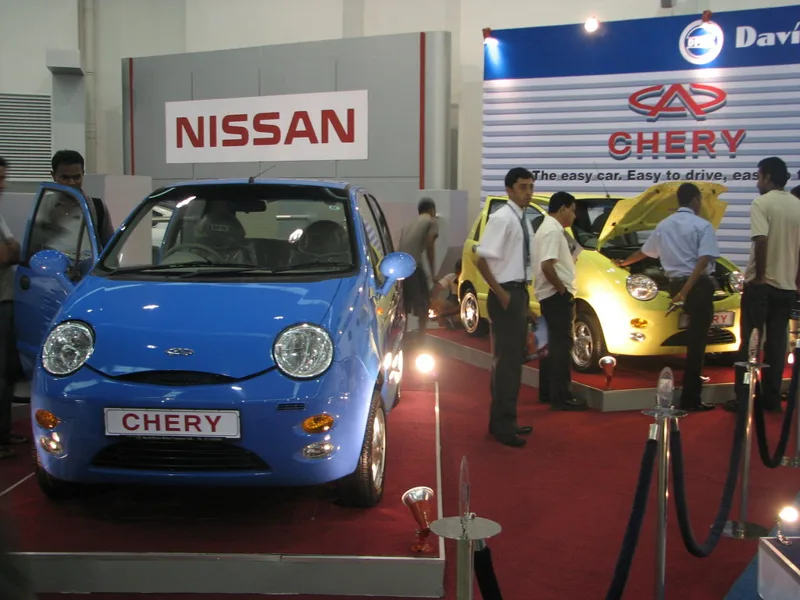
China added a legal dispute. The local firm Chery sold the QQ, whose first series was a clone of the small Korean car in shape but not in quality. In 2008 another Chinese firm, Haima, offered the H1 with styling copied from the first-series Matiz. Its only real differences were a shorter length of 3.35 metres (11.0 ft) and front lamps copied from the Smart Fortwo.
Even the copies travelled. In 2009 the German company Luis AG brought the Free to Germany, a small electric car built in China with a body design inspired by the first Matiz series.