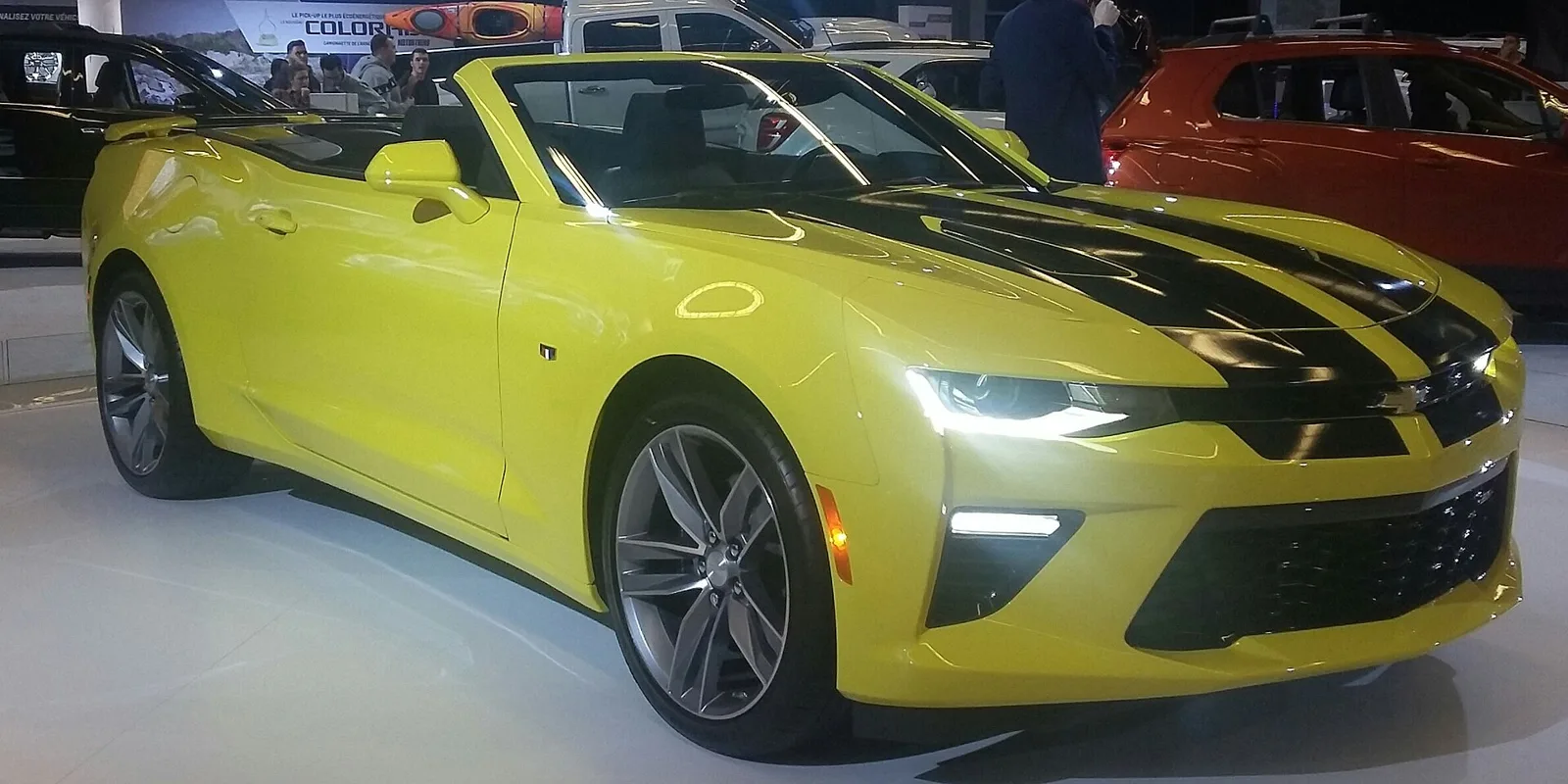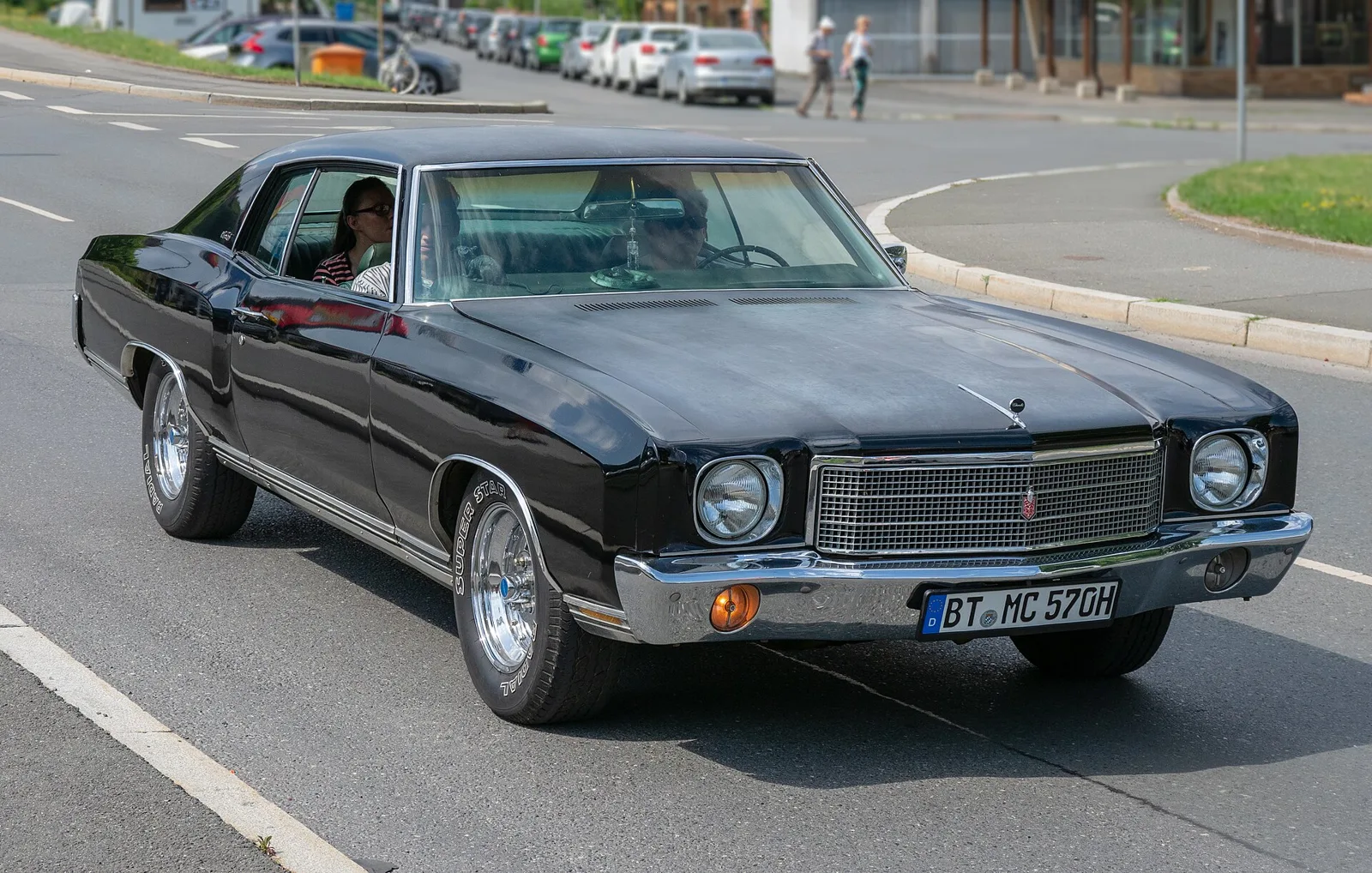
A G-body coupe built as the comfort-minded counterpart to Pontiac's sporty Grand Prix, with V8 power only and three model years.
The Chevrolet Monte Carlo of 1970 to 1972 was a two-door coupe that Chevrolet offered as a comfort-oriented counterpart to the Pontiac Grand Prix. It used V8 engines only, rode on General Motors' G-body platform shared with the Chevelle, and sold 439,393 cars in its first generation.
Chevrolet built the Monte Carlo as the counterpart to Pontiac's Grand Prix, and it launched at roughly 600 US dollars less than the Pontiac. Sold for the 1970 to 1972 model years, the first-generation coupe rode on General Motors' G-body platform, came with V8 power only and sold 439,393 examples across its run. Rivals noticed the car's success, and Chrysler and Ford later built personal luxury coupes of their own.
Why did Chevrolet build the Monte Carlo?
Chevrolet wanted a counterpart to the Pontiac Grand Prix, a successful intermediate coupe whose second generation reached the market for 1969. The Grand Prix was deliberately sporty, so the Monte Carlo borrowed its technical base and tuned the package toward comfort. At launch it cost about 600 US dollars less than the Pontiac.
The first series ran through the 1970 to 1972 model years, and during that stretch the engineering and styling changed only slightly. The second generation followed for 1973. It kept largely the same mechanical layout and similar dimensions, but it wore a new body.
the Chevrolet answer to the Grand Prix traded a little sportiness for comfort, and buyers came in six figures every year.
What was the first Monte Carlo built on?
The coupe used a lightly reworked General Motors A platform, which Chevrolet labelled the G-body. That made the Monte Carlo a close relative of the contemporary Chevelle intermediate. The two-door kept the full-length platform and wheelbase of the four-door Chevelle sedan, while the Chevelle coupe itself used a shortened version.
Technically, the first generation derived from the Chevrolet contemporary mid-size family cars. The finished car, however, is classed among the Personal Luxury Cars, and it wore its family origins with a more upmarket face.
A separate frame carried the car. The body structure from the bulkhead to the tail was welded as a single unit, and the front end was bolted onto a subframe. Independent front suspension used unequal-length wishbones, while the rear used a live axle located by trailing links. Both ends ran on coil springs.
Disc brakes sat at the front and drums at the rear. A brake booster and a dual-circuit system came as standard equipment on every car.
How did the Monte Carlo look?
Designer David Holls drew a four-seat, two-door notchback coupe. The rear wings anticipated the Cadillac Fleetwood Eldorado that appeared in 1971, and the narrow upright tail lamps borrowed a Cadillac motif too. Buyers could order the roof in vinyl covered in a contrasting colour.
The body was built from sheet steel. Every first-generation car had a laminated safety-glass windscreen, while the side and rear windows were made of toughened safety glass.
The 1970 car is recognised by its grille. The grille was a chrome rectangle filled with a fine lattice of 720 small squares, and a red emblem with a Corinthian helmet sat at its centre. Round headlamps sat in round chrome rings, with combined turn-signal and parking-light units set into the front bumper directly beneath them. The tail lamps were framed by a chrome strip.
Which engines and gearboxes did it offer?
Every first-series Monte Carlo was powered by a V8. Small-block and big-block engines displaced 5.7, 6.6 and 7.5 litres, and they differed in block length and cylinder bore. The LF-400 small-block of 6.6 litres (400 cu in) had a 4.126 in (104.9 mm) bore, while the others generally measured under 4 in (101.6 mm).
Three transmissions were offered. A two-speed Powerglide automatic went with the 5.7-litre engines, so engine and gearbox choices were linked, a three-speed Turbo Hydramatic was available at extra cost, and a four-speed manual completed the list. Most buyers ordered the Turbo Hydramatic.
Output varied from one model year to the next, so the same displacement could carry a different rating depending on the year.
Monte Carlo dimensions at a glance
| Dimension | Measurement |
|---|---|
| Wheelbase | 2,946 mm (116 in) |
| Overall length | 5,227 mm (205.8 in) |
| Track, front | 1,532 mm (60.3 in) |
| Track, rear | 1,506 mm (59.3 in) |
| Height | 1,336 mm (52.6 in) |
| Width | 1,897 mm (74.7 in) |
What did a 1970 Monte Carlo cost?
The 1970 model year began in the United States in September 1969, when the first version of the Monte Carlo coupe debuted.
The entry model started at 3,123 USD with the smallest V8. Options added the cost quickly: power steering with a variable ratio was about 100 USD, air conditioning 46 USD and electric seats about 110 USD. Electric windows, central locking, bucket seats and a centre console were also available for extra money, and a fully equipped car rose above 5,000 dollars.
The Super Sport was sportily dressed and sat alongside the basic model in the range. It was a variant of the same coupe, not a separate car. Engine options for the year ranged from a 5.7-litre V8 with 250 gross SAE hp up to the 7.5-litre V8 with 360 gross SAE hp in the SS 454.
How did the 1971 and 1972 cars differ from 1970?
The 1971 model changed mainly in its styling. The headlamp rings turned almost square with rectangular front parking lamps, the grille lost its horizontal dividers, and the grille badge carried the year in Roman numerals. The keyhole of the boot lock was ringed by the Monte Carlo crest, and the tail lamps carried two horizontal chrome strips and one vertical one.
Under the skin, compression was lowered so the engines could run on normal unleaded petrol, as GM's head office required. The car was otherwise largely unchanged technically.
The 1972 car received a Cadillac-like grille with larger openings, which resembled the 1971 Chevrolet Caprice. Its parking lamps moved to the outer edges of the grille beside the headlamps, and it gained a wider bonnet scoop and a metal rear trim strip. The SS package was dropped, but a one-year Monte Carlo Custom option took its place and was offered with every engine in the range. Its badge resembled the one fitted to the Impala Custom.
Chevrolet gave no gross horsepower figures for 1972. An industry-wide switch to net SAE ratings cut the quoted power of all Chevrolet engines, and with the SS 454 gone, the strongest engine was a 7.5-litre unit rated at 274 SAE hp (about 201 kW).
How many Monte Carlos were sold?
Chevrolet sold 439,393 first-generation cars across the three model years, including 5,742 SS 454s. The 1970 model year accounted for 145,975 units, 1971 model-year production reached 112,599 vehicles, and 1972 sales came to 180,819 Monte Carlos. The 1971 figure is a production count rather than a sales total, so the three years are not measured in exactly the same way. From autumn 1969 onward the car sold in mostly six-figure numbers every year.
What came after the first generation?
The second Monte Carlo arrived for the 1973 model year, and the 1972 car was the last year for the first generation's design. The second generation kept largely unchanged technology and dimensions similar to the first, but it came with a new body.
The first Monte Carlo opened a family of six series, which Chevrolet offered with interruptions until 2007.
Who else chased the personal luxury coupe market?
Ford and Chrysler had nothing comparable in the early 1970s. Their pony cars, the Mustang and the Challenger, were smaller and more overtly sporty, while expensive coupes such as the Ford Thunderbird were significantly larger. Watching the Monte Carlo sell, both companies saw good openings for higher-grade coupes of their own in the intermediate segment.
Ford introduced the Elite in 1974 as the comfort-oriented version of the sporty Mercury Cougar XR-7. Chrysler's two-door Cordoba appeared for the 1975 model year and was the smallest Chrysler car in more than ten years. Its near-identical sister, the Dodge Charger SE, shared the Cordoba's in-house B platform and was closely related to the Dodge Coronet. Both arrived only after the second Monte Carlo series was already on the market, yet both were shaped by the first generation.