A rounded full-size body on a new perimeter frame, a 1965 sales record that still stands, and the Super Sport years that followed.
Chevrolet's full-size Impala, built from 1965 to 1970, was a rounded new design on a perimeter frame. It set an annual sales record of more than one million units in 1965 and spawned the Caprice and the Impala SS.
The fourth-generation Chevrolet Impala was a full-size car built for the 1965 to 1970 model years. Its 1965 redesign sold more than a million cars in the United States in a single year, a record the Impala has never bettered. Later years brought new bodies on the same frame, a Caprice spin-off and the high-performance Impala SS, which carried a 427 cubic-inch V8 by 1969.
Why did the 1965 Impala sell more than a million cars?
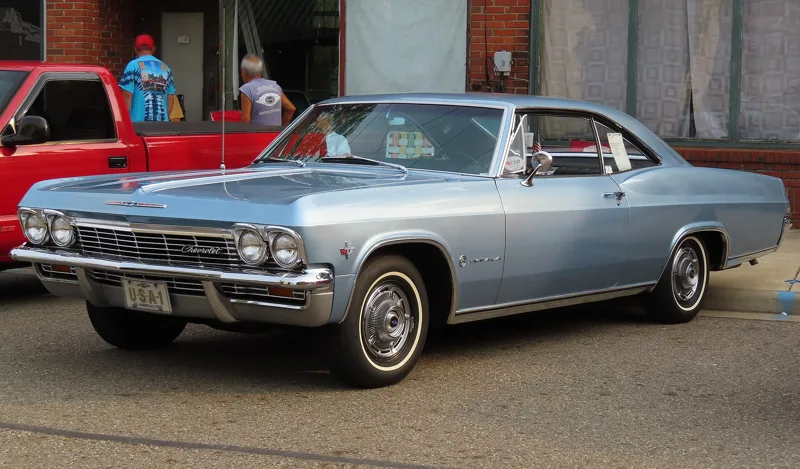
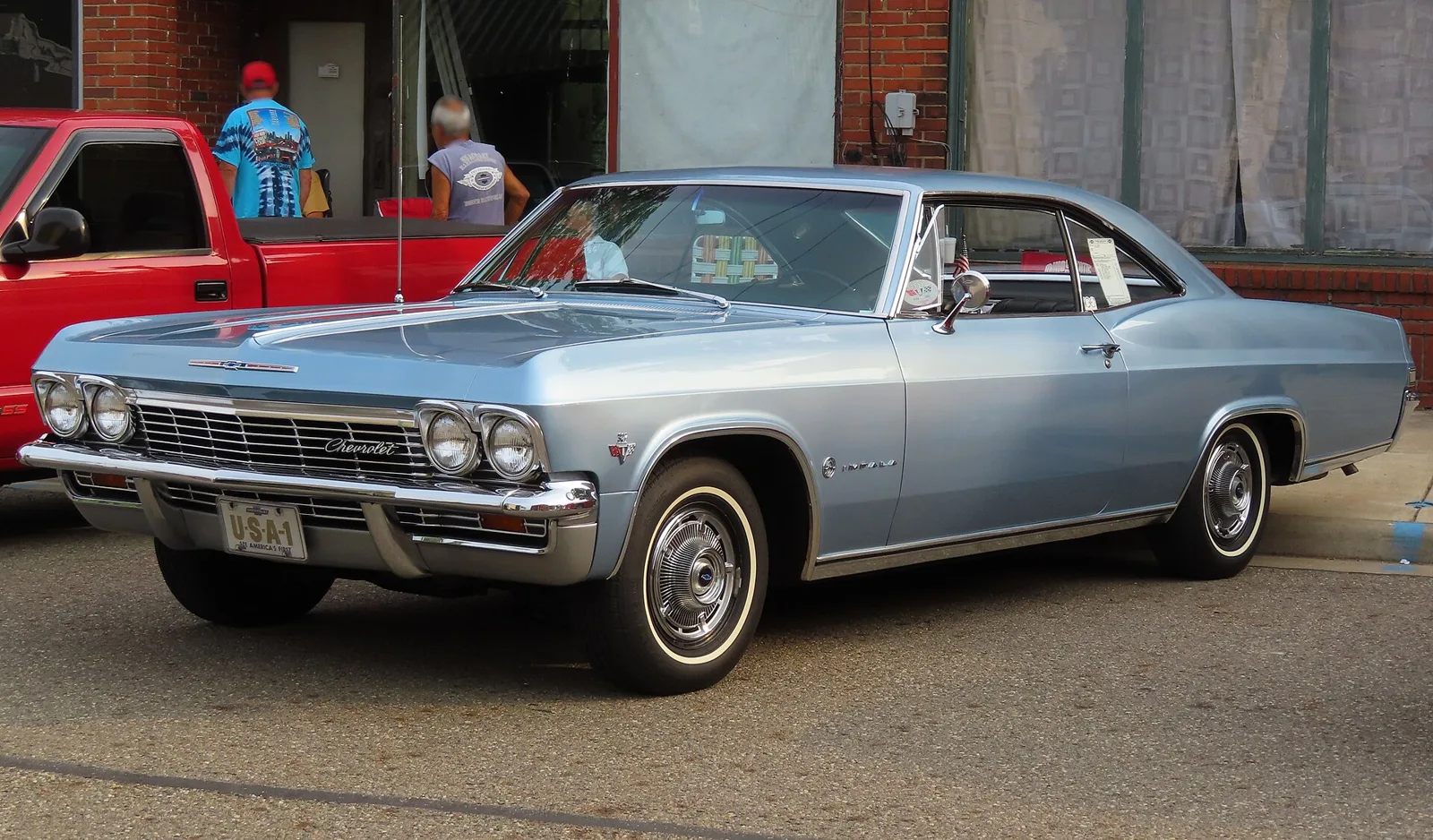
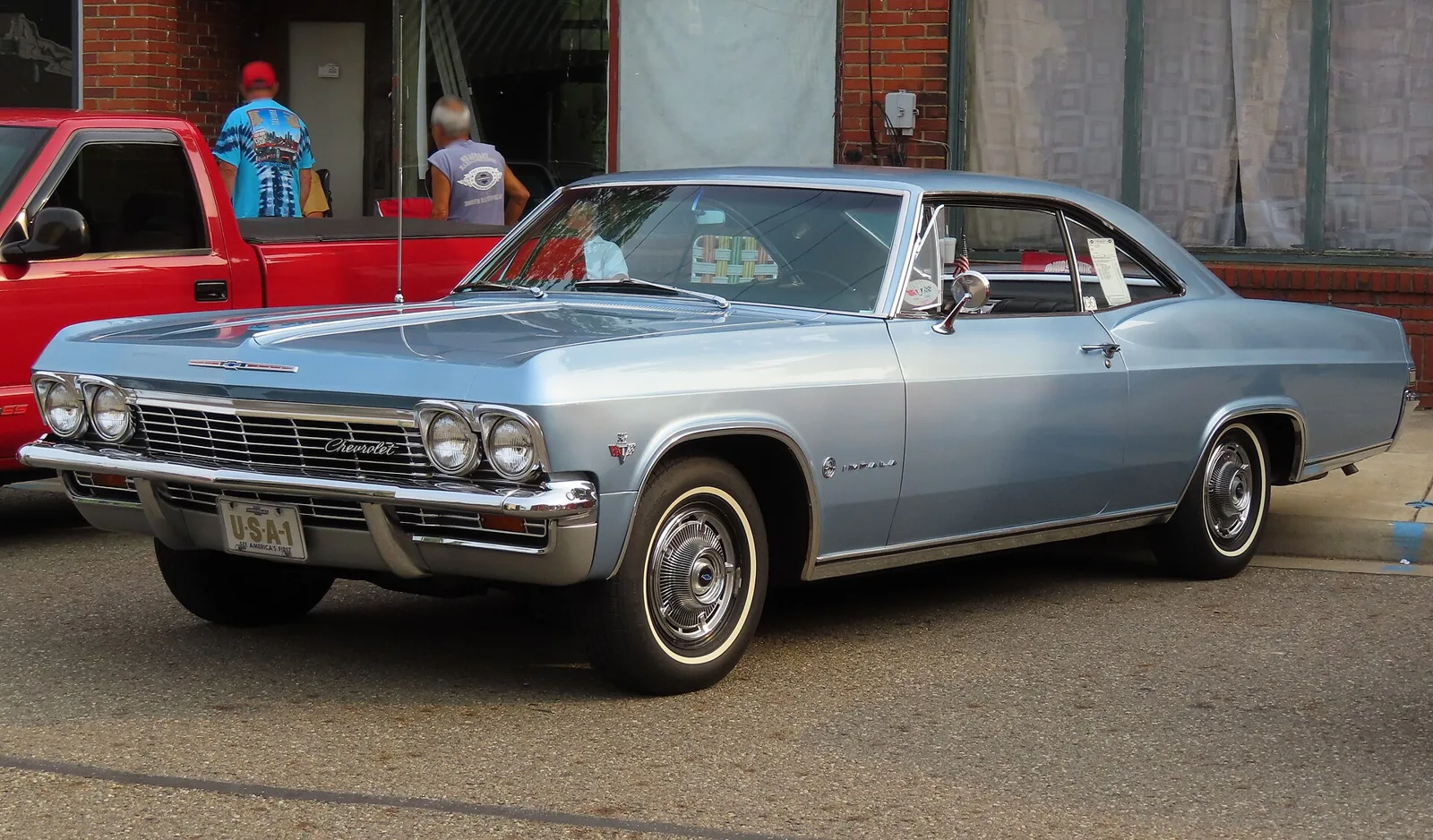
The 1965 Impala was all new, with rounded sides, a fresh front end and frameless side glass on pillarless models. It arrived on a Girder-Guard perimeter frame that replaced the old X frame and cut the size of the inside driveline tunnel. Chevrolet sold the car on its Wide-Stance design and bonded windshield, and buyers responded in large numbers.
The car also gave buyers more luxury than before. Chrome trim was added inside and out, the upholstery was pleated and tufted, and simulated walnut trim ran along the lower dashboard. Chevrolet had been moving its full-size range toward a Cadillac-like feel for years, and the 1965 Impala pushed that approach further.
The 1965 Impala sold more than a million cars in one year, and that record still stands.
What did the 1965 Impala look like inside and out?
Sport Coupes wore a semi-fastback roofline, and wheel-arch mouldings were revised. Gauges sat in a recessed pod in front of the driver on the two-tone dash, which made the layout clear and direct. The car's new suspension and frame made a more composed ride than the previous body could manage.
Gearbox choice was broad. Buyers could order the two-speed Powerglide or 3- and 4-speed Synchro-Mesh manuals, and the Turbo Hydra-Matic automatic was offered for the first time on this generation. Interiors kept the Impala's chrome-heavy character, with pleated tufted upholstery and door panels finished in simulated walnut.
Which engines did the 1965 Impala offer?
The 1965 range covered the inline six, the small-block and big-block V8s, and the new 396 cubic-inch Mark IV big block paired with Turbo Hydra-Matic. The 396 Turbo Jet was the first General Motors engine to carry the Rochester Quadra-Jet four-barrel carburettor, which became a fixture until the early 1980s. Early 1965 cars still had the old 409 cubic-inch W engine, rated 340 and 400 hp, before it was discontinued.
The standard 396 made 325 hp with 10.25 to 1 compression and hydraulic lifters. The high-performance version ran 11 to 1 compression, solid lifters and produced 425 hp. The 1966 range kept the 396 and added new 427 cubic-inch Turbo Jet V8s rated 390 hp and 425 hp.
How did the Caprice grow out of the Impala?
For $200 a buyer could turn a four-door Impala Sport Sedan into a Caprice, under Regular Production Option Z18. The package added a blacked-out grille, a vinyl roof bearing Fleur de lis badges, distinct wheel covers and slim sill trim. The interior was the most luxurious yet seen in a Chevrolet, with specially stitched cloth door panels and contour-padded seats in fabric and vinyl.
Sales were strong enough that Chevrolet promoted the V8-only Caprice to a series of its own in 1966. The name went on to outlive the Impala as a model in its own right, and it became the high-end car that customers moved up to.
What changed in 1966?
The 1966 car was only lightly restyled, gaining a horizontal bar grille and triple rectangular taillights. Chrome beltline strips were added after complaints about door dings in car parks on the clean-lined 1965 bodies. The taillights replaced the triple round lights that full-size Chevrolets had used since 1958, with the exception of 1959.
The standard three-speed manual was now fully synchronised, and a new 250 cubic-inch six replaced the old 230. The base V8 remained the 283 cubic-inch Turbo Fire rated 195 hp, and options included a 275 hp 327 and the 396 at 325 hp. The Impala was the second best-selling convertible in the United States in 1966, with 38,000 sold.
Why was the 1967 body called Coke bottle styling?
The 1967 Chevrolet full-size car was redesigned with a waisted, Coke bottle profile and its 119-inch wheelbase ran four inches past the mid-size Chevelle's. The Sport Coupe had a fastback roofline that flowed into the rear deck without a break. The engineers kept the dimensions close to the 1965 car while changing the surfaces.
Federal rules brought safety equipment to the 1967 and 1968 models, including a steering column that collapsed on impact, side marker lamps and shoulder belts on closed cars. Front disc brakes became standard with the SS-427 option, and an eight-track stereo and vacuum power door locks were new options. A black four-door 1967 car nicknamed Baby appears in the TV series Supernatural.
How did the 1968 model differ from the 1967 car?
The 1968 car wore a new nose that echoed the 1965 styling, and the rear bumpers held horseshoe-shaped taillights. The formal Custom Coupe, until then a Caprice-only body, could now be ordered as an Impala. Hidden windshield wipers spread across most Chevrolet models, and the interiors were refreshed with plusher trim.
The engine list ran from a 250 cubic-inch six and a 307 V8 to two 327s rated 250 and 275 hp, plus a 325 hp 396. The 427 remained at the top, rated 385 or 425 hp. Astro Ventilation, which used the air-conditioning vents, was an option for the Custom Coupe and gave the side glass full length.
What did the 1969 restyle bring?
The 1969 Impala and other full-size Chevrolets were restyled with crisper body lines, front bumpers wrapping around the grille and ventless front windows. The 119-inch wheelbase, inner body shell and framework carried over from 1965. The station wagon was renamed Kingswood, a return to the pre-1962 practice of giving wagons separate nameplates.
Federal rules made front seat headrests standard, and the ignition switch moved to the steering column, where it also locked the wheel once the key came out. GM also offered a variable-ratio power steering unit as an option, along with a rarely ordered Liquid Tire Chain, which sprayed ice melt on the rear tyres at the press of a vacuum-operated button.
Engine choices grew too. The standard engine became a 235 hp 327 cubic-inch V8, and options included a 350 cubic-inch Turbo Fire rated 255 and 300 hp, a 265 hp 396 and 427s rated 335 and 390 hp. The 1969 Impala was the first year that all V8s could take the three-speed Turbo Hydra-Matic.
Production that year totalled 777,000 units including Kingswood wagons, far ahead of the Caprice at 166,000 and the Biscayne at 68,700. Of the Impala total, 768,000 cars carried V8 engines, with 8,700 fitted with sixes.
What happened to the Impala in 1970?
The 1970 Impala received a minor facelift, with a more conventional bumper under the grille and new triple vertical taillights. Fibreglass-belted tyres on 15-inch wheels became standard, together with a 250 hp 350 cubic-inch Turbo Fire V8 that most cars received. Only the four-door sedan kept the six, a unit it shared with the cheaper Biscayne and Bel Air.
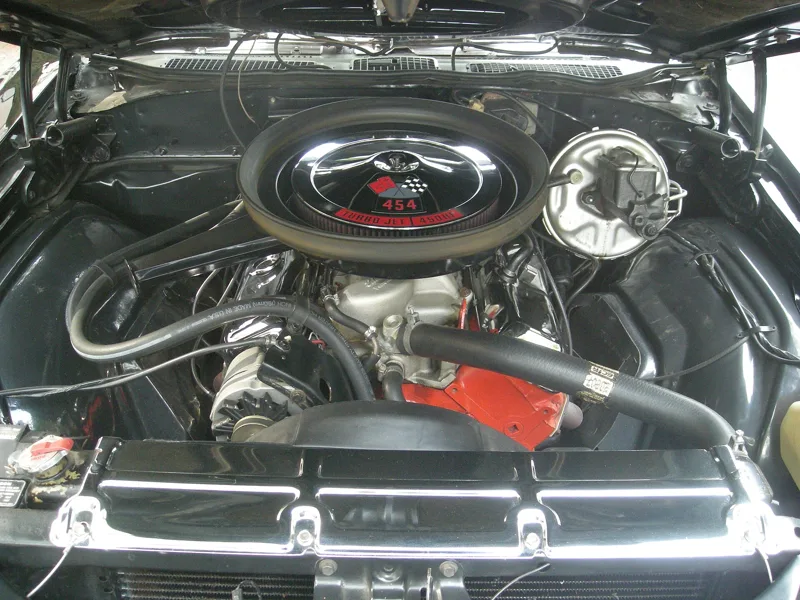
The 427 gave way to a 454 cubic-inch Turbo Jet, a longer-stroke design offered at 345 hp (257 kW) and 390 hp (290 kW). A 400 cubic-inch Turbo Fire rated 265 hp (198 kW) was added, and the 300 hp 350 and both 454s needed premium fuel. The four-speed manual, paired with a Hurst shifter, disappeared from the list, as did Strato buckets and the centre console on coupes.
The 1970 car was one of only three Chevrolet convertibles left, and just 9,562 were built. Interest in big open cars had faded, and the Impala Super Sport was abandoned. A 65-day strike in the autumn of 1970 hit full-size output, which fell below a million units for the calendar year, and the strike also affected early 1971 models.
Impala sales still led the range, with 612,800 cars built, of which 6,500 had sixes and 606,300 had V8s. The Caprice recorded 92,000 units, the Bel Air 75,800 and the Biscayne 35,400, while station wagons across all series totalled 162,000.
Was the Impala sold right-hand drive outside North America?
Right-hand drive cars were built in Canada for export to markets such as Australia and the United Kingdom until 1969. Those cars used a version of the 1965 dash panel until the end of production. Australian models were assembled locally from kits, which lowered the tax on each car.
New Zealand followed a similar route, but its bodies came from Canada fully welded, painted and trimmed.
How did the Impala SS develop?
The 1965 Super Sport looked much like a regular Impala, with rocker trim deleted and Super Sport scripts replacing the fender badges. A rally-style electric clock sat in the centre console, and the gauge cluster gained a vacuum meter. Production for 1965 reached 243,114 Impala SS cars across coupe and convertible bodies.
Sales fell by more than half in 1966, to around 117,000 units. Performance buyers were moving to intermediate cars such as the Chevelle SS396 and Pontiac's GTO, and the Ford Mustang had opened a new pony car market that Chevrolet would answer with the Camaro for 1967. The 1966 SS gained a new Strato-bucket front seat and an optional gauge package in the console.
The 1967 Impala SS wore less brightwork than the rest of the range, with black grille accents and an SS logo in the wheel covers. Of the 76,055 SS models built, only 2,124 carried the Z24 performance package. Z24 added heavy-duty suspension and the 385 hp 427 V8, and it was marketed as the Chevrolet SS427 with the Impala name removed.
In 1968 the Super Sport became a $179 option package, Z03, rather than a separate series. Only 38,210 Impalas carried it, including 1,778 Z24 cars. The 1969 Impala SS was sold only as the Z24 SS427, with a 427 V8 rated 335, 390 or 425 hp, and about 2,455 cars were sold. That was the final Impala SS until 1994, and 1969 was the only year that front disc brakes and 15-inch wheels were standard on the SS.
Where does the B platform rank in automotive history?
The 1965 to 1970 GM B platform, which carried the Impala, ranks fourth on the all-time list of best-selling car platforms. Only the Volkswagen Beetle, the Ford Model T and the Lada Riva sold more on a single platform. The platform's longevity is why the Impala became such a common sight across the decade.
Specifications
| Specification | Detail |
|---|---|
| Model years | 1965 to 1970, full-size |
| Wheelbase | 119 inches (3,023 mm) |
| 1965 sales | More than 1 million units, an annual industry record |
| 1965 V8 | 396 cubic inch Turbo Jet, 325 hp or 425 hp |
| 1967 SS | 76,055 built; 2,124 with Z24 package |
| 1969 Kingswood wagon | Renamed from the station wagon |
| 1970 V8 | 454 cubic inch Turbo Jet, 345 hp (257 kW) or 390 hp (290 kW) |
| 1970 convertible | 9,562 built |
| 1970 production | 612,800 Impalas |