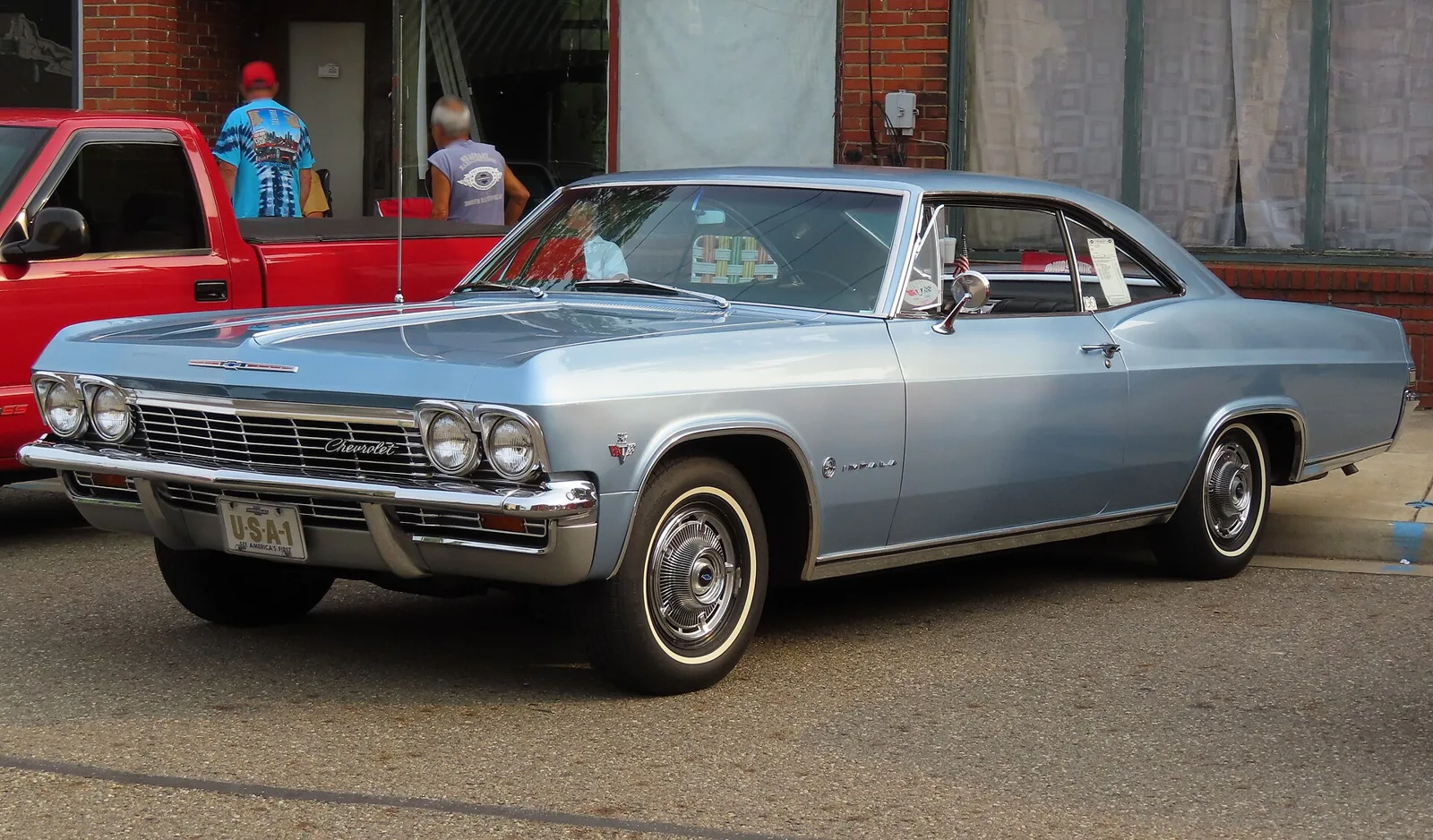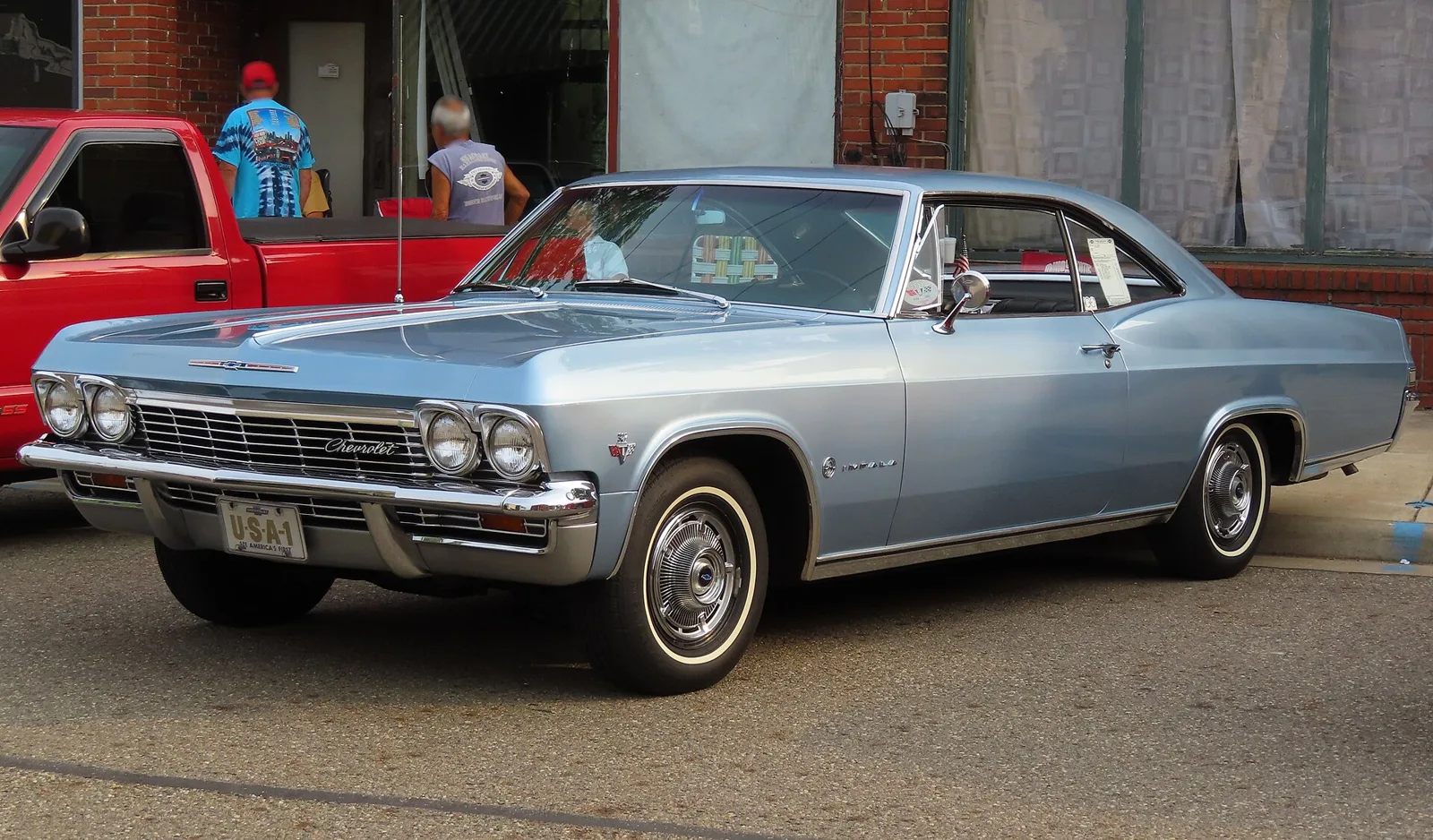
Two American full-size sedans from rival brands, set against each other through the Impala's 1965 redesign and the Galaxie's racing and mid-range years.
The Chevrolet Impala fourth generation ran from 1965 to 1970 and set an industry sales record of more than a million units in its first year. The Ford Galaxie, sold from 1959 to 1974, competed with it in the full-size segment and raced in lightweight form in 1962 and 1963.
The Chevrolet Impala and Ford Galaxie were rival full-size sedans from the 1960s. The Impala's fourth generation, built from 1965 to 1970, set an industry sales record in its first year, while the Galaxie spanned four generations from 1959 to 1974.
Both sat in the full-size segment, both offered V8 power and both came with automatic transmission options. They came from different brands and reached their generations at different times, so any fair comparison has to pin down which years each model is judged on.
Why were the Impala and Galaxie rivals?
The Galaxie competed head to head with the Impala in the full-size class, which also included the Plymouth Fury. Chevrolet was happy to let the Impala drift toward Cadillac territory, offering bright trim and the finest materials the company could supply for the cabin, and that positioning shaped how buyers judged the car.
The Galaxie name grew out of the excitement around the Space Race. Ford first showed a concept called la Galaxie in 1958, and the model joined the range as a 1959 trim level. From 1962 the name went onto every full-size Ford, which made it the umbrella for the whole range.
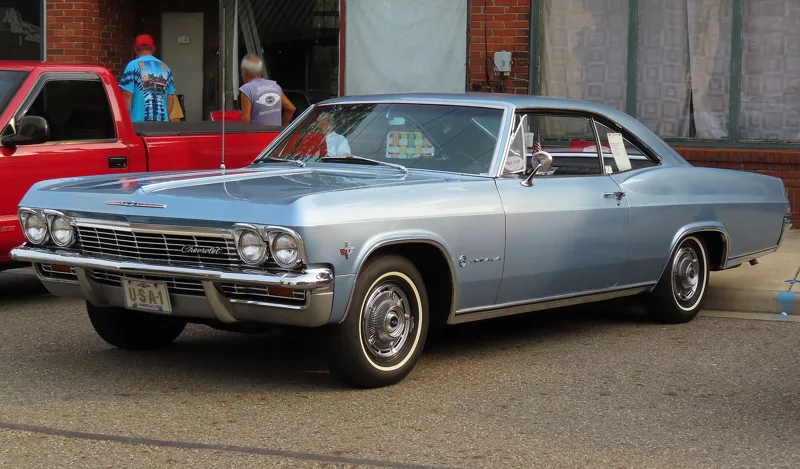
The Impala's 1965 redesign was a clean-sheet car, and in its first year it sold over a million units in the United States. That total remains the all-time annual sales record for the industry, a result that gave the model a flying start in the segment.
Two full-size rivals, one with a 1965 sales record and one with a racing side.
How did the two cars look?
The 1965 Impala had sides that bulged out in a rounded way, an entirely new nose and frameless side glass on its pillarless models. The Galaxie of 1960 went another way with the Starliner, a pillarless hardtop with a big curved rear window. By 1961 Ford had almost erased the tailfins from the Galaxie.
Underneath, the Impala gave up its X-shaped chassis frame for a full-width perimeter frame called Girder-Guard, which trimmed the space taken by the driveline tunnel inside the cabin. The 1967 car kept a 119-inch wheelbase, which sat four inches above the mid-size Chevelle's, and its overall dimensions were much the same as before.
The 1967 Impala adopted Coke-bottle styling, and its Sport Coupes wore a fastback roof that ran unbroken into the trunk lid. Two years later the body was crisper, with bumpers that curled round the grille and a station wagon that had been renamed Kingswood.
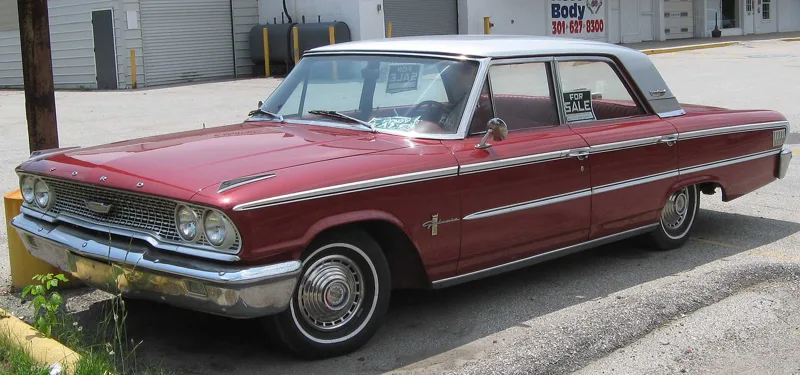
Ford's answer to the Impala's looks came in 1963, when the Galaxie 1963 1/2 model arrived as the industry's first official half-year model. It wore a lower fastback roof offered mid-year, and the lower roof cut drag and lift at speed, which made the big Ford more competitive on NASCAR circuits. Buyers responded, and the new sports hardtops outsold the square-roof boxtop models.
What engines did each car offer?
The 1965 Impala introduced the 396 Turbo Jet V8. It was the first General Motors engine to use the Rochester Quadra-Jet four-barrel carburettor, a unit that stayed in service into the early 1980s.
The 396 came in two tunes. The milder version made 325 hp with 10.25 to 1 compression and hydraulic lifters, while the high-performance version reached 425 hp at 11 to 1 with solid lifters.
Ford's Galaxie began the decade with a 352 V8 rated at 300 hp (220 kW; 300 PS) in 1959. The 390 V8 arrived in 1961, with a triple two-barrel option rated at 401 hp gross, a number that signalled Ford's new interest in performance.
Through the Impala's years the engine menu kept growing. The 1966 car offered a 283 V8 at 195 hp as its base engine, a 327 at 275 hp, the 396 at 325 hp and a pair of 427s at 390 hp and 425 hp, with four-speed manuals available behind every V8. By 1969 the base engine had become a 327 at 235 hp, while the 427 rose to 335 hp and 390 hp.
The final Impala years brought a 350 V8 as standard, rated 250 hp in 1970, with a 300 hp option, and a 454 big block at 345 hp and 390 hp replacing the 427.
How practical were they?
The Impala's 1967 and 1968 models gained safety equipment to meet federal rules: a steering column that collapsed to absorb energy on impact, side marker lights and shoulder belts on closed models. Ford's 1959 Galaxie offered seat belts and a padded dashboard as options, and it promoted safety anchorage on its front seats.
The 1959 Skyliner used a retractable hardtop that stowed in the trunk. The mechanism was costly and complicated, and when folded it left very little luggage room. Later luxury cars adopted power retractables too, though those had no rear seats and needed a far smaller mechanism.
By 1969 the Impala had standard front seat headrests, and its ignition had moved from the dash to the steering column, where it also locked the wheel when the key came out. That year Chevrolet offered a Liquid Tire Chain option, a vacuum-operated button that sprayed ice melt onto the rear tyres. Few owners ordered it.
Did either car go racing?
Ford took the Galaxie racing in 1962 and 1963. Late in the 1962 season its Experimental Garage built 11 lightweight Galaxies, and in 1963 the company produced 212 lightweight Galaxie 500 Sport Special Tudor Fastbacks for drag strips.
Those 1963 cars were finished in Corinthian White with red vinyl upholstery. Their gearbox was a Borg-Warner T-10 four-speed, the rear axle ratio was 4.11:1, and fibreglass covered the hood, trunk and front fenders. The first 20 cars had fibreglass doors that saved 25 lb (11 kg), though Ford deleted them over fears about highway safety.
A 427 engine built to NHRA and NASCAR 7-litre limits arrived in 1963 with two Holley four-barrels and a solid-lifter camshaft, rated at 425 hp. The 1962 Galaxie 500/XL had been Ford's reply to the Super Sport package that the big Impala received the year before.
The Impala kept a performance badge into its final phase. The 1967 SS-427 package came with front disc brakes as standard, a sign that the model still had a sporting side.
How well did the Impala sell?
The 1965 total of over a million cars in the United States is the headline figure, and output stayed very high to the end of the decade. Impala sales had been overwhelming the charts by 1968, and 1969 output reached 777,000, including Kingswood wagons.
Of that 1969 total, 768,000 cars had V8 engines and only 8,700 had six-cylinder engines. The 1970 model year produced 612,800 Impalas, of which 606,300 had V8s and 6,500 had sixes.
Output of the full-size Chevrolets fell sharply during that calendar year, partly because of a 65-day strike in the autumn, and the stoppage also hit production of early 1971 models.
Galaxie figures for the same years are missing from this comparison, so a direct sales contest cannot be judged. What can be said is that the Galaxie's racing and fastback efforts aimed at performance-minded buyers rather than the mass market.
What changed in the Impala's final years?
The 1968 cars brought a formal Custom Coupe into the Impala range, a body style that had previously been a Caprice exclusive, and most Chevrolets received hidden windshield wipers. An Astro Ventilation option for the Custom Coupe added fresh-air vents and full-length door glass.
The 1970 facelift replaced the wrap-around bumper with a more conventional unit under the grille and fitted triple vertical taillights. Fiberglass-belted tyres on 15-inch (380 mm) wheels became standard, and the four-speed manual with a Hurst shifter was dropped from the options list.
Interest in open cars and large sporty coupes had faded by then, which explains why the Impala Super Sport disappeared. The 1970 Impala was one of only three Chevrolet convertibles still listed, and just 9,562 of them were built.
How did the Galaxie develop from 1960 to 1963?
The 1960 Galaxie brought a cleaner design with less ornamentation, a pillarless Starliner and half-moon taillights that turned downward. Performance became a selling point by 1961, and the 1962 model year put the Galaxie name on every full-size Ford.
The 1960 car's A-pillar swept backward instead of forward, which made getting in and out easier. Its thin rear roof pillar carried three star emblems, the signature badge across the 1960 to 1962 models.
The 1961 Galaxie offered a 390-cubic-inch version of Ford's FE pushrod V8, with either a four-barrel carburettor or three two-barrels for more performance, the latter rated at 401 hp gross. The Starliner returned that year, but it was dropped at year's end when the square-roof hardtop Club Victoria took most of the sales.
In 1962 the Galaxie 500 and 500 XL joined the line with plusher interiors and more chrome. The XL, which Ford said stood for Xtra Lively, brought bucket seats and a console of the kind popularised by the Corvair Monza. A 292 V8 came as standard on the 500 XL, and a 406 engine came in single four-barrel or triple-carburettor form.
How did the Galaxie fit into Ford's range?
The Galaxie began as a chrome-heavy trim level that looked every inch a late-1950s American car, though it was somewhat tamer than its Chevrolet and Plymouth rivals. Ford then reshuffled its full-size line through the early 1960s, and the Galaxie's place in it kept shifting.
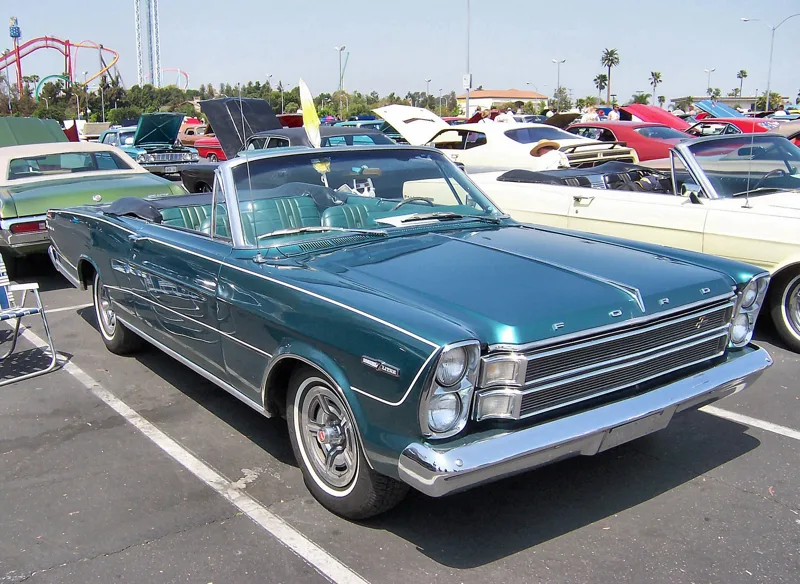
The Galaxie 500 LTD arrived in 1965 as a flagship. For 1966 the LTD name moved to its own model, and the Galaxie became the mid-level full-size series, sitting above the Ford Custom. It stayed in that middle position into the 1970s.
The Galaxie name was also attached to a no-frills big Ford called the Ford 300, offered for 1963 only at about $100.00 below the base Galaxie sedans. Ford discontinued the Galaxie and the Custom together after the 1974 model year, leaving the LTD to carry the full-size sedan range.
Specifications side by side
| Feature | Chevrolet Impala (fourth generation) | Ford Galaxie |
|---|---|---|
| Model years covered | 1965 to 1970 | 1959 to 1974, four generations |
| Wheelbase | 119 inches (3,023 mm) in 1969 | No figure |
| Largest engine named | 454 V8 at 390 hp (1970) | 427 V8 rated at 425 hp (1963, racing) |
| Transmissions | Three-speed manual, Powerglide and Turbo Hydra-Matic | Three-speed manual, Ford-O-Matic and Cruise-O-Matic |
| Convertibles | 38,000 sold in 1966; 9,562 built in 1970 | Skyliner (1959) and Sunliner (1962) |
| Performance and racing | SS-427 option with front disc brakes (1967) | Lightweight racers (1962) and 212 Sport Special drag cars (1963) |
| Safety | Collapsible steering column, side markers, shoulder belts (1967) | Seat belts optional (1959) |
| Other production | Right-hand drive built in Canada until 1969 | Also built by Ford Australia and Ford Brasil |
| Headline sales figure | More than 1 million units in 1965 | No figure |
Which buyer should choose which?
A buyer after the 1965 to 1970 design, a V8 that reached 425 hp and a convertible would look hard at the Impala. The Galaxie suited a buyer drawn to a Ford with a racing record and a fastback variant of the big sedan.
The facts do not settle which car was the better one. They show two full-size cars that suited different tastes, one riding a wave of mass sales and the other carving out a performance niche before settling into the mid-range.
Both lines came to an end within a decade of one another. The Impala's fourth generation closed in 1970, while the Galaxie carried on until 1974, when Ford gathered its full-size sedans under the LTD.