An Art Deco coupe with a 3.3 L engine, three survivors and a record-breaking 2010 sale, plus the story of each car.
The Bugatti Type 57SC Atlantic Coupe was a 1936 to 1938 Bugatti with an Art Deco body and a 3.3 L inline-eight. Only four were built, and a 2010 sale of one car set a record for the car market.
The Bugatti Type 57SC Atlantic Coupe, also called the Aero Coupe, was Bugatti's top-of-the-range sports coupe from 1936 to 1938, and only four were built. Three survive, and two of those remain almost original. Experts regard it as one of the most valuable and prestigious cars in the world, and it is often called the Mona Lisa of car collecting.
Where did the Atlantic come from?
The Atlantic grew out of the 1935 prototype Aerolithe, designed by Jean Bugatti. It used a shortened Type 57S chassis, and the first two production coupes carried the Aero Coupe name. Jean Bugatti later asked for the model to be renamed Atlantic Coupe.
The prototype was announced under the names Elektron Coupe or Competition Coupe. It was completed in July 1935 and shown four months later at the Paris Motor Show, but its unusual shape drew attention from only a few people. As a result, just four Atlantics followed in the years after.
The Aerolithe name came from passengers. The Bugatti racing driver William Grover-Williams took people around Paris in the car, and those beside him, amazed by its performance and looks, named it after the phrase Rapide comme une aerolithe, meaning as fast as a meteorite.
Four coupes from 1936 to 1938, three survivors and a 2010 sale that set a new record for the car market.
What made the Atlantic's design so unusual?
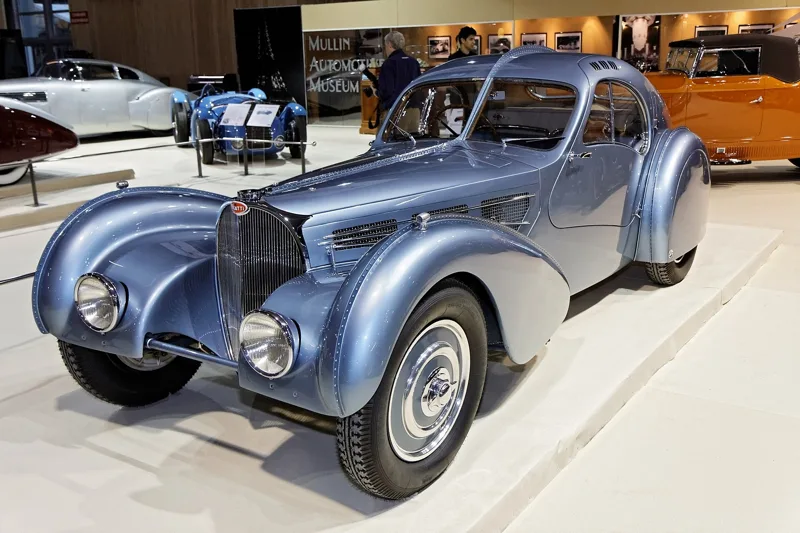
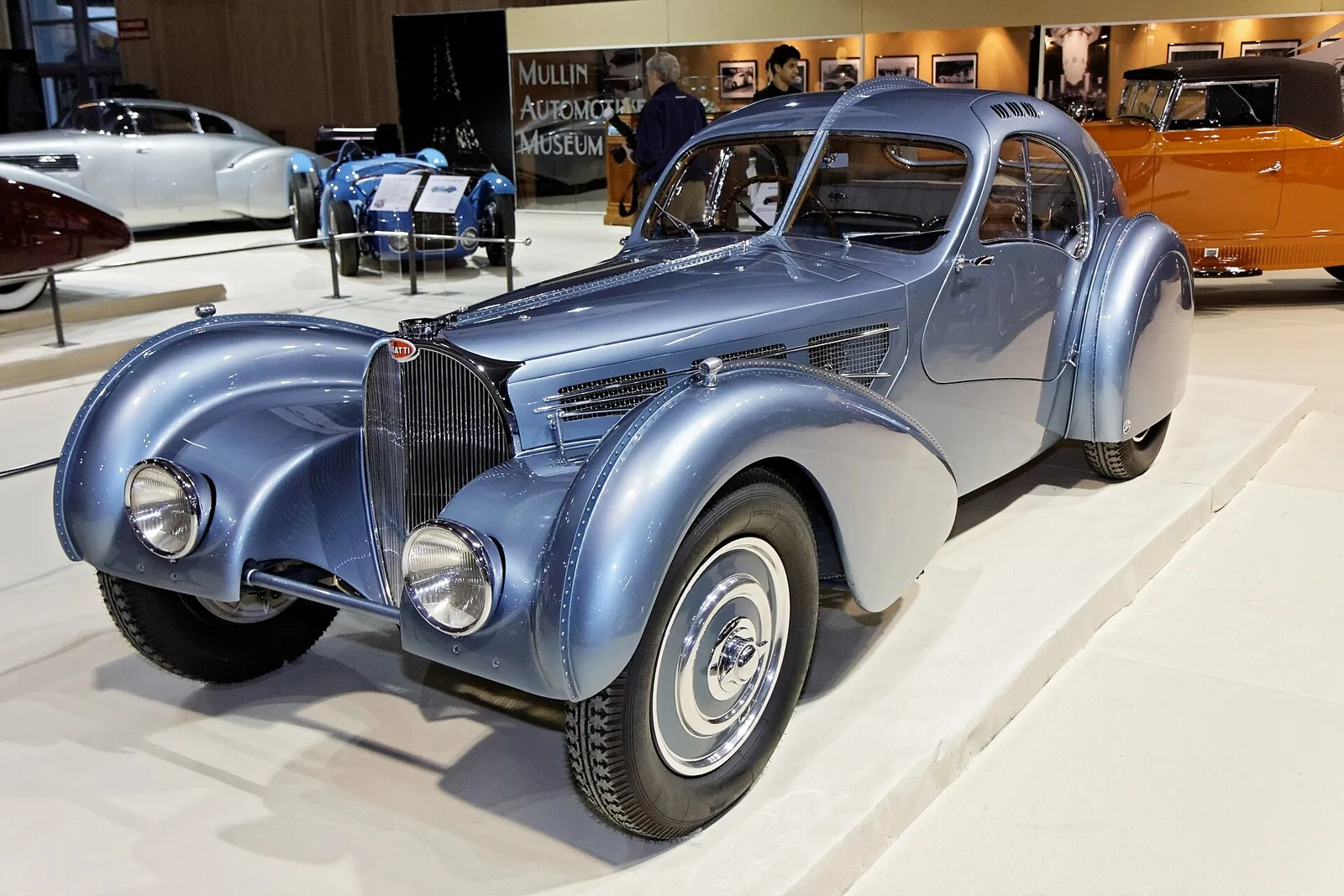
The prototype body used Elektron magnesium alloy and Duralumin. Because the material was flammable, the panels could not be welded, so engineers riveted them from the outside. The resulting seams, often likened to a dorsal fin, became a striking accent that ran on into the chassis.
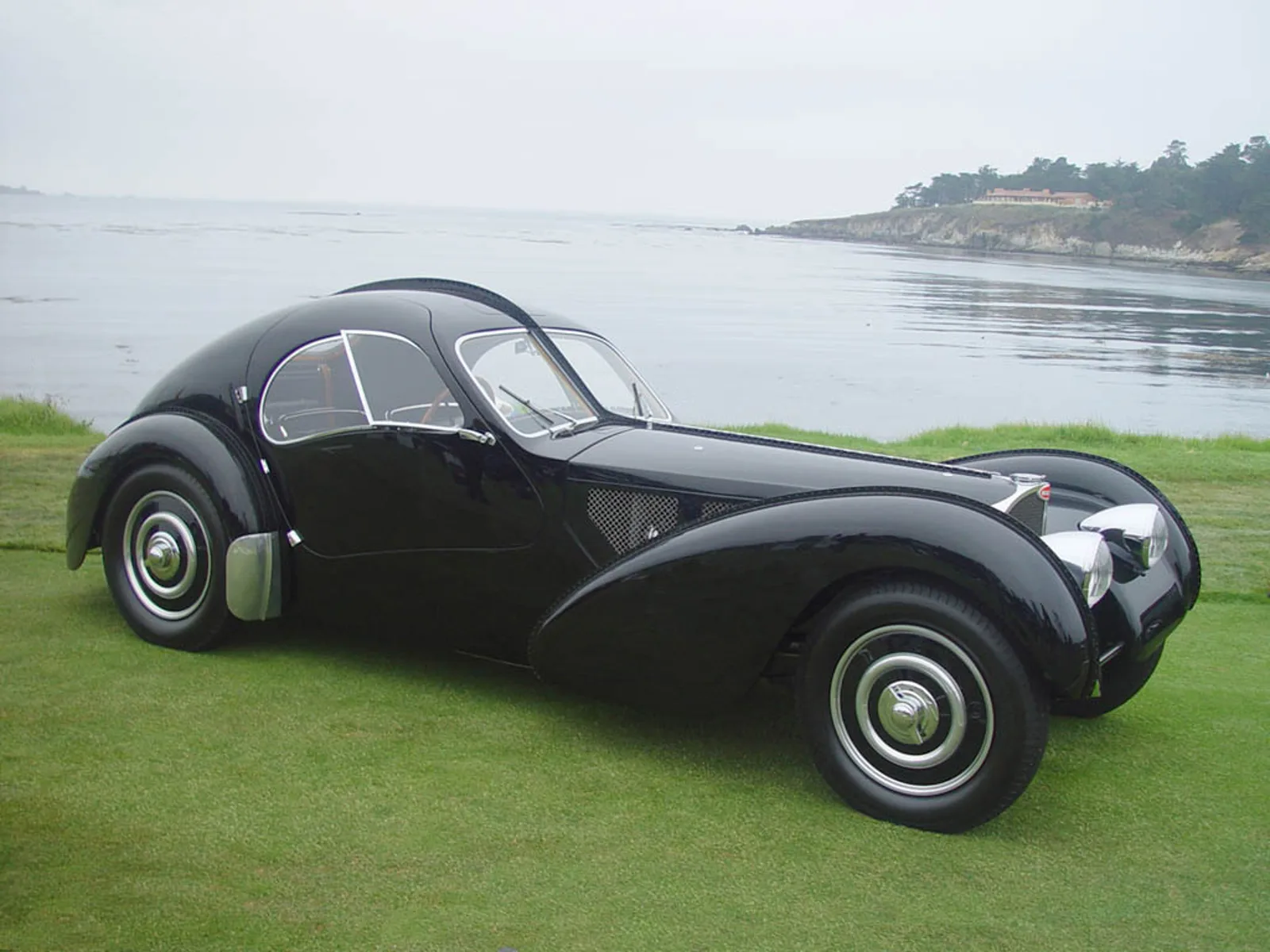
The four production cars were built in aluminium, but the seams stayed as a design feature. A curved windscreen, streamlined wings and a body that tapers toward the rear complete an Italian-French style. Coachbuilders such as Castagna and Figoni et Falaschi excelled at it, and aircraft design and aerodynamics shaped it heavily.
Inside, the car is a luxurious cabin with leather seats, a dashboard of polished Indian rosewood, and gauges and controls in brushed metal. The steering wheel has a dished design and a polished Indian rosewood rim.
How powerful was the Atlantic's engine?
The Type 57SC Atlantic used a 3.3 L (201 cu in) DOHC inline-eight petrol engine rated at up to 200 PS (147 kW; 197 hp). With a kerb weight of 950 kg (2,094 lb), the car was said to exceed 200 km/h (124 mph), which was astonishing for a grand tourer of its day.
Its chassis was the Type 57S, a shortened version of the standard Type 57. Some cars were fitted with the SC supercharger, and No.57453 was the only Atlantic to leave the factory with one.
Why was the Atlantic once thought to be only three cars?
For years the Atlantic was believed to have been built in just three examples, because chassis No.57453 and No.57473 were widely assumed to be the same car. The belief rested on their build dates and on their black paint at the Bugatti factory. In 2004 the Bugatti historian Pierre-Yves Rogez confirmed that they were separate cars.
Rogez set out his research in the book Bugatti: les 57 Sport, which pairs the history of each car with detailed illustrations. The pre-war and wartime history of Bugatti is often regarded as somewhat inaccurate, which explains the confusion.
What happened to No.57374?
No.57374 was finished on 2 September 1936 and went to Victor Rothschild, the 3rd Baron Rothschild. It is believed to have been built with components from the Aerolithe prototype, and in 1939 it was taken back to Molsheim to receive an SC supercharger at Rothschild's request.
Rothschild used the car until October 1941. A supercharger failure caused the engine to explode, and he abandoned the car in a field. After repairs without the supercharger, an affluent American doctor who had only just reached England acquired it in 1945.
A year later the doctor took the car to America and sold it to the Bugatti enthusiast Mike Oliver, who finished it to American specification and painted it dark red. In 1953 Oliver sent it back to Bugatti for a replacement supercharger. Before he died in 1970, Oliver sold the car to Briggs Cunningham, the American businessman, racer and pilot.
A year later the collector Peter Williamson paid US$59,000, a sum that made it the costliest car in the world at the time. He kept it for 32 years, restoring it to original form. It won Best of Show at the 2003 Pebble Beach Concours d'Elegance. Williamson died in 2004. In 2010 the car changed hands again at a figure between US$30 million and US$40 million (2.8 billion to 3.7 billion yen), with a collector linked to the Marin Automobile Museum in Oxnard, California. The exact price was not disclosed, but it was the highest recorded in the car market at that time.
What is the story of La Voiture Noire?
No.57453, known as La Voiture Noire, meaning the black car in French, was the second Atlantic built. Its later history and whereabouts remain largely unknown. Given its past and its exclusivity, experts put its value at US$114 million or more, which is around 100 million euros, or about 12.5 billion yen.
It was completed on 3 October 1936. That winter it was driven mainly by Jean Bugatti, by William Grover-Williams and by his wife Yvonne. The car was photographed for Bugatti's 1937 sales brochure and shown at the Nice and Lyon motor shows in spring 1937.
Back at Molsheim, Jean Bugatti drove No.57453 with pride until late July. The car was then presented to Robert Benoist, who had won the 1937 24 Hours of Le Mans for Bugatti. Benoist, a close friend of the Grover-Williams couple, used the car with them. In spring 1940, before German forces occupied France, all three fled to England and the car went back to the factory.
The record's final reference is a list dated 18 February 1941, naming cars to be shipped by rail to Alfred Daney Street in Bordeaux as France was being abandoned. One entry is a car registered 1244 W5 with chassis No.57454. Jean Bugatti died at 30 in a car accident on 11 August 1939. Before that, he had often named the Atlantic models, No.57453 above all, as his most innovative and valuable creations.
Who owned No.57473 and what became of it?
No.57473 was completed on 13 December 1936 and delivered to Jacques Holzschuh, a Paris businessman. He and his wife Yvonne drove it on the French Riviera and entered it at the Juan-les-Pins Concours d'Elegance, where it won first prize. Between 1939 and 1941 major styling changes set it apart from the other Atlantics, and the bodywork is believed to be the work of the Italian designer Giuseppe Figoni.
Holzschuh and his wife were captured by the Nazis and killed before the war ended. In 1949 Robert Verke, a Cannes businessman and mechanic, acquired the car along with a Monaco villa. In 1952 it was sold to the Bugatti enthusiast Rene Chatard and painted pale blue.
On 22 August 1955 a train hit Chatard and his passenger Janine Vacheron near Gien, France, and neither survived. The badly damaged car was sold to a scrap dealer. A French collector bought it in 1963, and it was completely rebuilt in 1977, when most of its original parts were replaced because of severe deterioration. That work reduced the car's value considerably.
In November 2006 an anonymous collector bought No.57473 and had it thoroughly restored by the American specialist Paul Russell, to return it to Chatard's specification. In 2010 it was shown at Pebble Beach, where it was regarded as a replica and missed out on an award. It now sits in the Torrota private collection in Spain.
What was special about the last Atlantic built?
The last production Atlantic, No.57591, was built for the British tennis player Richard B. Pope and handed over on 2 May 1938, when it was registered under the nickname EXK6. Its deep sapphire blue paint, unique front-end styling and lack of rear wing covers set it apart from the other cars.
Pope sent the car to Molsheim in 1939 to have the SC specification fitted. He owned it for nearly 30 years and sometimes lent it to Barry Price, a Bugatti specialist, who bought it in 1967 and kept it for ten years. A light crash at a commemorative event put the car in a ditch, and later it passed to the wealthy businessman Anthony Bamford before going to another collector.
In 1988 the fashion designer Ralph Lauren bought the car and asked the Paul Russell Company for a full restoration. He had it painted black, but it was restored to its 1938 condition. It won Best of Show at Pebble Beach in 1990 and at the Concorso d'Eleganza Villa d'Este in 2013.
Lauren has called the Atlantic probably the most beautiful car in the world, and he says his sense of awe grows every time he looks at it. The automotive journalist Sean Henry puts the value of No.57591 at around US$100 million.
How many replicas of the Atlantic were made?
Erik Cook, a Danish maker, produced at least 13 precise replicas of No.57591. He measured the original in 1974 with Barry Price's permission, and later he used the Paul Russell Company's help to study every part of the car's interior.
Every replica used original Bugatti parts and precisely reproduced duplicates. All but the first two carried a Type 57 engine converted to a dry sump and double oil pump. The comedian and car collector Jay Leno has owned a Cook replica of No.57591 for more than 30 years. In 2022 one sold at RM Sotheby's for US$1,155,000, or about 160 million yen.
From 2008 to 2013, a Canadian car restoration guild team led by David Grainger built a full-size 1/1 replica of the Aerolithe, No.57331. It drew the dimensions from 11 photographs, two blueprints and a painting. It was based on chassis No.57104, and its body was made entirely of Elektron alloy.
What modern tributes followed the Atlantic?
Bugatti Automobiles marked the Atlantic with several tributes. The 2015 Veyron 16.4 Grand Sport Jean Bugatti Edition, which paid tribute to No.57453, was built in just three examples at 2.28 million euros (about 300 million yen) each. That same year a concept called Atlantic was shown. It was meant to become Bugatti's entry-level production model, but the Volkswagen emissions scandal derailed the plan.
In 2019 the company presented a one-off called La Voiture Noire, based on the Chiron, which again pays tribute to No.57453. The reported price was 11 million euros, about 1.4 billion yen, or 16.7 million euros with tax, roughly 2 billion yen. In 2023 a one-off Chiron Super Sport 57 One of One followed for a customer captivated by No.57374, with a reported price of at least 5 million euros plus, more than 800 million yen.
Watches have paid tribute as well. Ralph Lauren's Automotive Collection, launched in 2011, honoured No.57591, which he owns, and in 2017 Parmigiani Fleurier introduced the Bugatti Aerolithe watch in honour of No.57331.
Did the Atlantic appear in film?
The 2017 film Scramble begins with a car-theft gang stealing an Atlantic Coupe. Filming used two cars built from moulds borrowed for No.57591's restoration. Like No.57591 it is black, and the engine was reportedly a Rover unit standing in for the original.
Bugatti Type 57SC Atlantic specifications
| Specification | Detail |
|---|---|
| Built | Four cars, 1936 to 1938 |
| Chassis | Type 57S, a shortened Type 57 |
| Engine | 3.3 L (201 cu in) DOHC inline-eight, petrol |
| Output | Up to 200 PS (147 kW; 197 hp) |
| Kerb weight | 950 kg (2,094 lb) |
| Top speed | Said to exceed 200 km/h (124 mph) |
| Body | Riveted Elektron and Duralumin prototype; aluminium production cars |
| Supercharger | No.57453 factory-fitted; No.57374 fitted in 1939 |
| Interior wood | Indian rosewood dashboard and steering wheel rim |
| Record sale | No.57374, 2010, US$30 million to US$40 million |