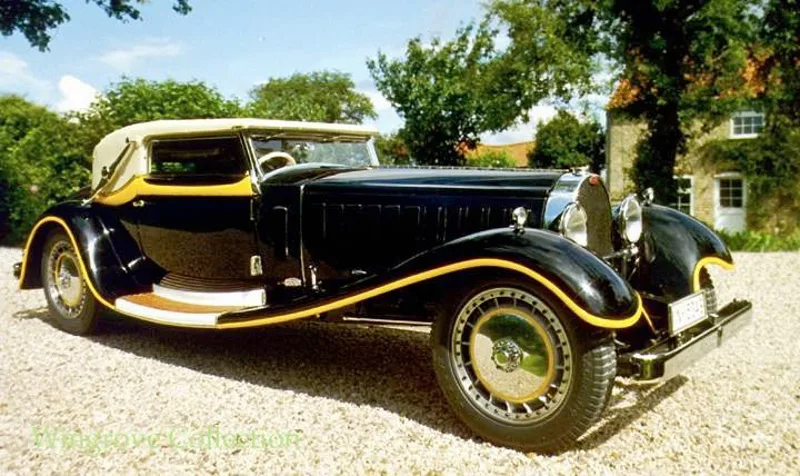
A 1934 to 1940 grand tourer with a twin-cam straight-eight, the lowered 57S and the Atlantic coupes that still set auction records.
The Bugatti Type 57 was a grand tourer built from 1934 to 1940, with a 3.3 litre twin-cam straight-eight and 710 cars produced. Its lowered 57S and Atlantic coupes became the best-known variants.
The Bugatti Type 57 was a grand tourer that Bugatti built from 1934 to 1940, with a twin-cam straight-eight at its core. Jean Bugatti, son of the founder Ettore, created the car as an entirely new design. Its later lowered and supercharged variants, including the Atlantic coupes, became some of the most valued cars in the marque's history.
Who designed the Bugatti Type 57?
Jean Bugatti created the Type 57 as an entirely new design, and he was the son of the company's founder, Ettore Bugatti. The car was built over a period of six years, from 1934 to 1940, and 710 Type 57s were produced in total.
Jean Bugatti also designed the 1935 Aerolithe concept, which later fed into the Atlantic body.
Ettore Bugatti strongly opposed one change made during the car's life. Hydraulic brakes replaced the cable-operated units in 1938, and that modification was one Ettore hotly contested.
The Type 57 chassis and engine were revived in 1951 as the Bugatti Type 101.
A straight-eight grand tourer whose Atlantic coupes still set the benchmark for collectors.
What engine did the Type 57 use?
The Type 57 used a straight-eight twin-cam engine of 3.3 litres (3,257 cc; 198 cu in). Its bore and stroke were 72 mm by 100 mm, a layout based on the Type 49 but heavily modified by Jean Bugatti.
The engine used the Type 59 Grand Prix car's 3.3-litre unit as its base. Unlike the single-cam engines of the Type 49, this unit was a twin-cam design.
The earlier Types 50 and 51 drove their camshafts through bevel gears at the front of the engine. The Type 57 used spur gears at the rear, with fibre gear wheels on the camshafts for quieter running.
The road car produced 135 hp (100 kW), which was enough for a top speed of 153 km/h (95 mph). The Type 57T, a tuned version, pushed the performance further and reached 185 km/h (115 mph).
That 135 hp (100 kW) output was the baseline for the whole family.
How did the road-going Type 57 differ from the sports models?
The original Type 57 was a touring car model built from 1934 to 1940. It rode on a 3,302 mm (130 in) wheelbase with a 1,349 mm (53 in) track, and the road-going versions weighed about 950 kg (2,090 lb).
The front of the road car carried a smaller version of the Royale's square-bottomed horseshoe grille. The sides of the engine compartment were covered by thermostatically controlled shutters.
A total of 630 road-going examples were built, which is the figure that separates the standard car from the wider Type 57 family. The rest of the 710 cars covered the lowered and supercharged variants, the racing cars and the coachwork specials.
What did the lowered 57S and the supercharged cars involve?
The Type 57S/SC was the lowered version. The S stood for Surbaisse, the French word for lowered, and the C stood for Compresseur, the supercharger that Bugatti introduced in response to customer demand for more power.
Lowering the car was a major undertaking. The rear axle ran through the frame instead of beneath it, and the engine needed dry-sump lubrication to sit under the lower bonnet. The 57S also had a nearly independent suspension at the front, although Ettore despised that idea.
Most 57S owners wanted the extra power that the blower delivered, so most of the original cars returned to Molsheim for a supercharger to be fitted. Once fitted, the car made 200 hp (147 kW) instead of 170 hp (125 kW), and its top speed climbed from 125 mph (201 km/h) to 135 mph (217 km/h).
The lowered car had a wheelbase of 2,979 mm (117 in), while the track stayed at 1,349 mm (53 in). The shorter wheelbase is a dimensional difference from the standard road car.
What was the Type 57C racing car?
About 96 Type 57C racing cars were built between 1937 and 1940. They used the same 3.3-litre engine as the road car, uprated to 160 hp (119 kW) by a Roots-type supercharger, against 135 hp (100 kW) in standard form.
The 57C therefore sat between the road car and the lowered 57S in the family's performance range.
The Tank, a second incarnation based on the Type 57C, won Le Mans again in 1939. The Type 57G Tank had earlier won the 1936 French Grand Prix, and three of the cars were produced.
Chassis 57335, the Le Mans winner, is the only one of the three Tanks known to survive. It is currently on display at the Simeone Foundation Automotive Museum in Philadelphia, in the United States.
Jean Bugatti died on 11 August 1939, at the age of 30, in a crash on a test run.
What were the Atlantic coupes?
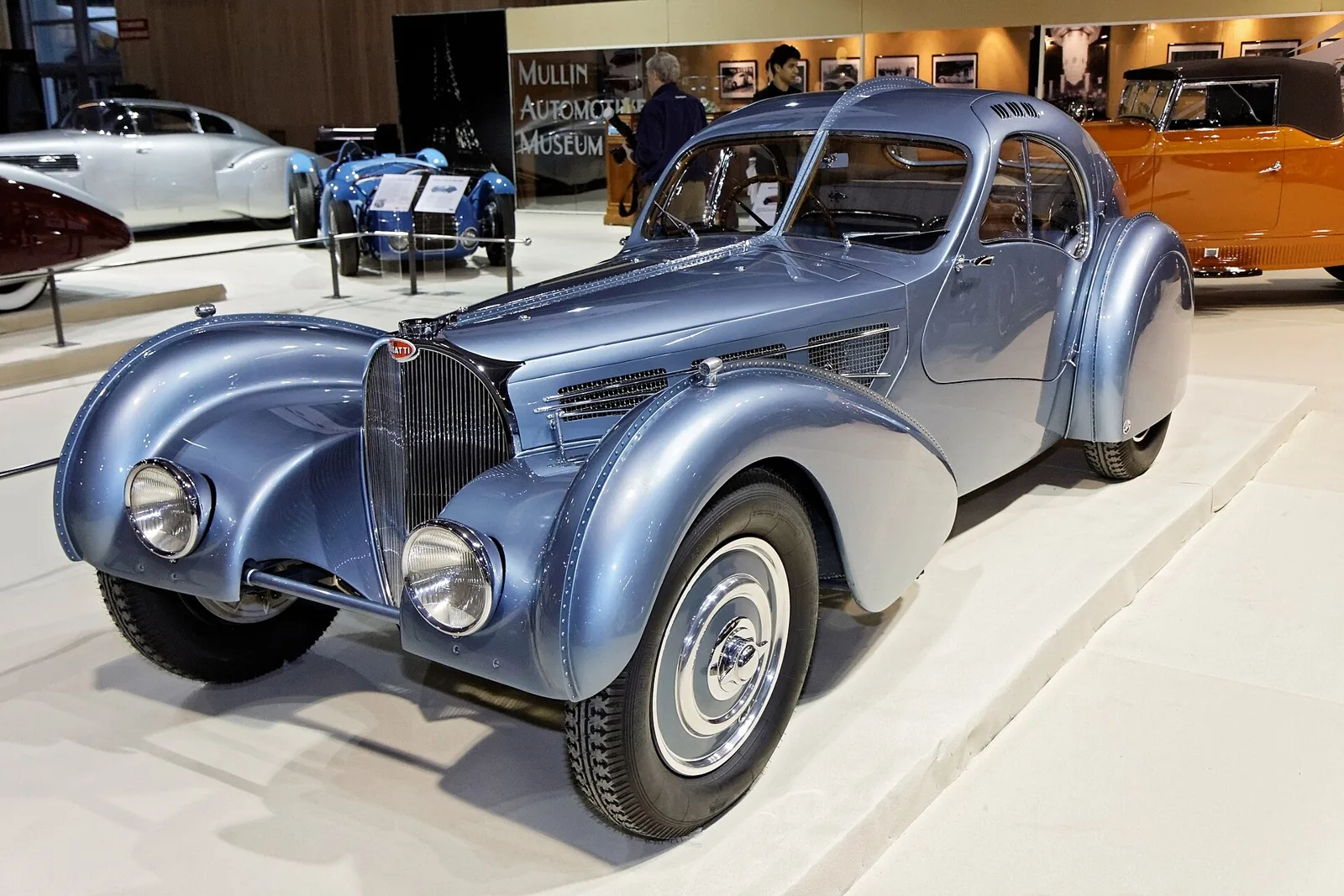
Only four production Atlantics were built, and they used plain aluminium bodies. The dorsal seam running along each car was retained for style, and it is the feature that has made the car so famous. Three of the four survive, and each has been restored.
The Atlantic body had flowing coupe lines with a pronounced dorsal seam running from the front to the back. Its design came from the Aerolithe, a concept car that Jean Bugatti had shown in 1935.
Because the panels could not be welded, the engineers fixed them with external rivets instead, a method common in aircraft building. That rivet line created the signature seam.
The production Atlantics, by contrast, used plain aluminium bodywork.
The model was named after Jean Bugatti's friend Jean Mermoz, a pioneer of aviation who was the first to cross the South Atlantic by air. Mermoz was lost over the Atlantic in December 1936, and Jean Bugatti renamed the model after him, having originally called it the Coupe Aero.
Mermoz was lost in December 1936, the same year that the first Atlantics were completed.
Two of the surviving Atlantics were awarded Best of Show at the Pebble Beach Concours d'Elegance, in 1990 and in 2003.
How were the individual Atlantics documented?
The four production Atlantics each have a documented history, and their chassis numbers run 57374, 57453, 57473 and 57591.
Chassis 57374 was completed on 2 September 1936 and sold to Victor Rothschild. It won Best of Show at Pebble Beach in 2003 and was sold in 2010 for $30 million.
Chassis 57453 was the second Atlantic built, and it is known as La Voiture Noire, the black car. It was completed on 3 October 1936 and was the only Atlantic fitted with the C supercharger straight from the factory. It was offered as a gift to Robert Benoist after the 1937 Le Mans win.
Experts once estimated the value of that car at around $114 million, given its past and exclusivity.
Chassis 57473 was restored to the specification of Rene Chatard, who had the car painted pale blue.
In 2019, at the Geneva Motor Show, Bugatti introduced a one-off model called La Voiture Noire to commemorate the 110-year anniversary of both Jean Bugatti and the brand. It was sold to an anonymous buyer for $19 million.
Chassis 57591 was delivered on 2 May 1938 to Richard Pope. It was later restored to its 1938 condition for Ralph Lauren, although it was painted black at his request. The car was honoured with Best of Show at Pebble Beach in 1990.
Its owners over the decades show how the car moved between collectors, from Richard Pope to Ralph Lauren.
What were the Atalante bodies?
The Atalante was a two-door coupe built on the 57S chassis. Only 17 Atalante cars were made, and it had a single-piece windscreen with no fin. The name came from Atalanta, a heroine of Greek mythology.
Compared with the 710 Type 57s built overall, the Atalante run was small, and it shared its underpinnings with the Atlantic.
In 2008 a Bugatti Type 57S with chassis number 57502 was discovered in a private garage in Newcastle upon Tyne. It had been stored untouched for 48 years, and it was built in 1937 with Atalante coachwork for Francis Curzon, 5th Earl Howe.
The rediscovered car was auctioned in February 2009 at the Retromobile show in Paris, fetching 3.4 million euros.
That car is one of the 17 Atalante cars built.
Was there a replica of the Aerolithe?
Yes. David Grainger led a Canadian team at The Guild of Automotive Restorers that built a full-size 1:1 replica of the Aerolithe between 2008 and 2013. The replica was built on the chassis of car 57104, and its body was crafted entirely from Elektron alloy.
The original prototype had also used Elektron for its body panels, so the replica matched its material.
The team worked from 11 photographs, two blueprints and a painting. From those sources they gathered the vehicle's dimensions.
What are the Bugatti Type 57 specifications?
The Type 57 covered a range from the standard road car to the lowered, supercharged and racing versions. The table gathers the main figures for the core car and the variants discussed above.
Unless a row says otherwise, the figures refer to the standard road car.
| Specification | Detail |
|---|---|
| Years built | 1934 to 1940 |
| Engine | 3.3 litre (3,257 cc; 198 cu in) twin-cam straight-eight |
| Bore and stroke | 72 mm by 100 mm |
| Road car output | 135 hp (100 kW) |
| Road car top speed | 153 km/h (95 mph) |
| Tuned Type 57T top speed | 185 km/h (115 mph) |
| Racing Type 57C output | 160 hp (119 kW) with Roots-type supercharger |
| Lowered 57S output | 170 hp (125 kW), rising to 200 hp (147 kW) with supercharger |
| Wheelbase (road car) | 3,302 mm (130 in) |
| Wheelbase (57S) | 2,979 mm (117 in) |
| Track | 1,349 mm (53 in) |
| Weight (road car) | About 950 kg (2,090 lb) |
| Total built | 710 Type 57s; 630 road-going |
How many Type 57s were built and how do they rank among Bugatti cars?
In total 710 Type 57s were built, of which 630 were road-going cars. The lowered variant forms a small share of that total.
The Type 57S/SC is often considered among the most iconic Bugatti cars. Jean Bugatti himself viewed the Atlantic model, and especially chassis 57453, as his most innovative and most valuable creation.