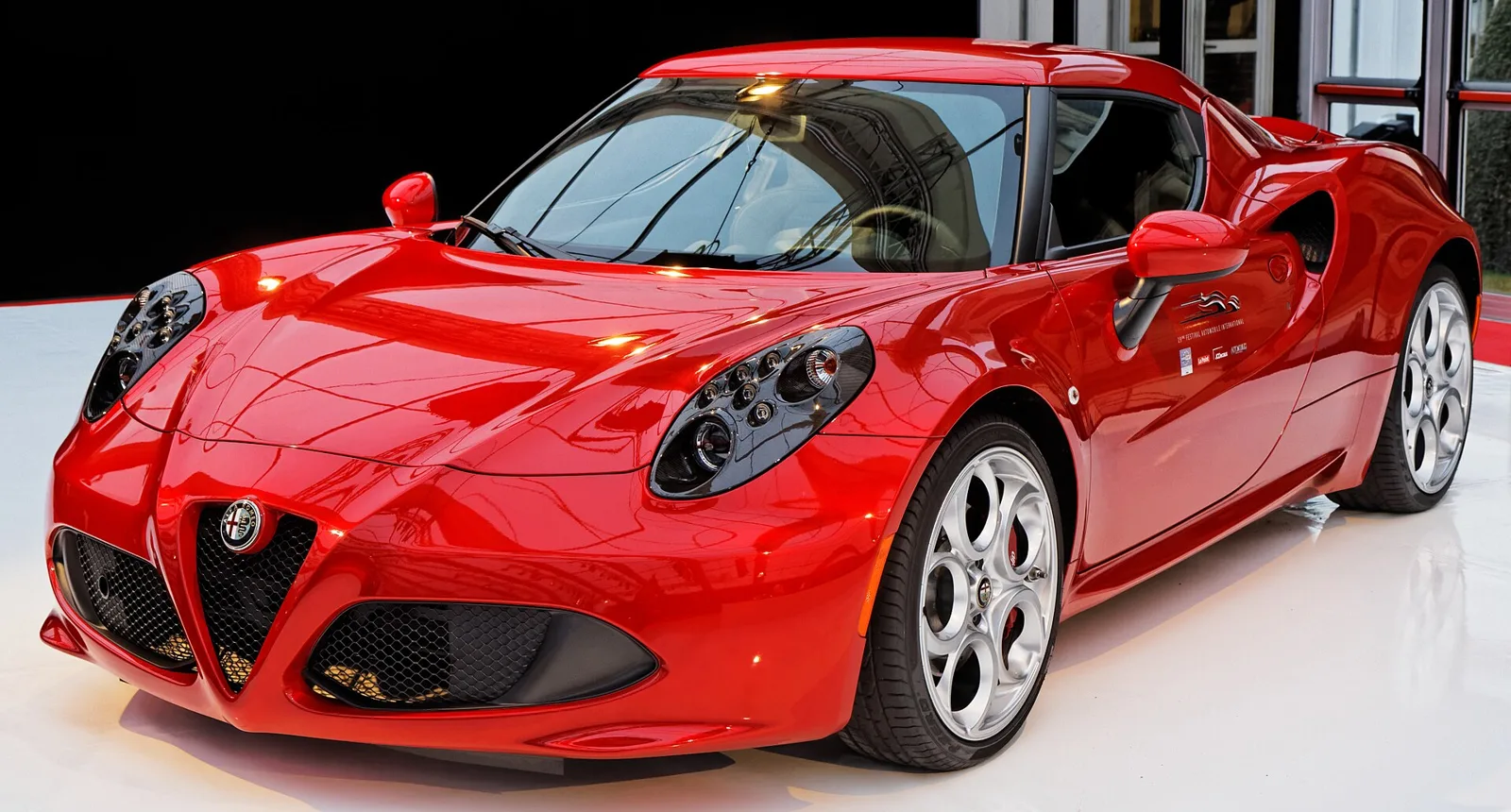
A two-seat, rear mid-engined coupe and roadster with a turbo four, Alfa's lightweight route back to the sports car.
The Alfa Romeo 4C is a lightweight Italian sports car made from 2013 to 2020, with a carbon fibre tub, a 240 PS turbocharged engine and a six-speed dual-clutch gearbox. The coupe arrived first and the roadster followed in 2015.
The Alfa Romeo 4C was a two-seat sports car that Maserati built and Alfa Romeo sold from 2013 until 2020. It began as a coupe, gained a roadster in 2015, and used a rear mid-engined, rear-wheel-drive layout with a turbocharged four-cylinder engine that gave the model its name.
Where did the Alfa Romeo 4C come from?
The 4C started life as a concept car shown in 2011, built with technology borrowed from the 8C Competizione. Alfa Romeo unveiled the production version at the 2013 Geneva Motor Show, and European customers could place orders from October of that year.
The concept carried a turbocharged 1750 cc petrol engine with direct injection, a twin dry clutch gearbox called Alfa TCT and the DNA drive-mode selector. Those systems passed largely unchanged into the road car, so the concept and production models feel close to one another.
Centro Stile Alfa Romeo handled the styling, and designers Marco Tencone and Lorenzo Ramaciotti were credited with the look. The concept appeared at the Geneva show in March 2011 before visiting the Mille Miglia, Goodwood and Frankfurt. Readers of the German magazine Auto Bild voted it the most beautiful concept car of the year.
The production car kept the concept's proportions while changing the details a road car needs, such as lighting, air intakes and mirrors. The result looked almost identical to the show car, which made the road version easy to recognise from the first photographs.
A carbon tub, a turbo four and no power steering made the 4C a stripped-back sports car with a clear purpose.
What was the 4C made from?
The 4C used a central carbon fibre tub with aluminium subframes at each end, and the complete car weighed 940 kg (2,070 lb) at the kerb. The outer body was a composite moulding that Alfa Romeo said was 20% lighter than steel while remaining stable.
The tub was produced by TTA in Airola, a partnership of Adler Plastic and Lavorazione Materiali Compositi, and it weighed 65 kg (143 lb) on its own. Computer-controlled cutting shaped the carbon components before assembly began.
Front and rear aluminium subframes, roof reinforcements and the engine mounts joined the tub to give a chassis weight of 107 kg (236 lb). The composite body was chosen for its stiffness, which Alfa Romeo judged on a par with steel and superior to aluminium.
The subframes carried the suspension and engine mountings, while the roof reinforcements added rigidity at the top of the cabin. Those parts together formed the structure that the tub alone could not provide.
How quick was the 4C in a straight line?
Alfa Romeo quoted 4.5 seconds for the 0-100 km/h sprint, with a top speed of 258 km/h (160 mph). The North American car ran slightly slower because of its extra weight, while a race-mode launch could cut the sprint to 4.2 seconds.
The engine is a 1.75 L (1,742 cc) all-aluminium inline four with a turbocharger, rated at 240 metric horsepower (177 kW) at 6000 rpm. Engineers worked to keep its mass down, which mattered as much as its output in a car of this weight.
Fuel economy on the combined cycle was rated at 6.8 litres per 100 kilometres (42 mpg-imp; 35 mpg-US). The power-to-weight ratio of 0.267 hp/kg (8.22 lb/hp) explains much of the acceleration on paper.
Quattroruote, the Italian magazine, published a Nurburgring lap time of 8:04, and one of its journalists timed the car faster than the official 4.5 seconds from 0 to 100 km/h.
How did the 4C's gearbox and chassis work?
The car paired a six-speed twin dry clutch unit with steering-wheel paddles and an Alfa DNA selector that adjusts the engine, brakes, throttle, suspension and gearbox. Brembo brakes with 305 mm front discs and 292 mm rear discs stopped the car from 100 km/h in 36 metres.
The front axle used double wishbones, and MacPherson struts handled the rear. Wheel and tyre sizes differed between the axles, with 205/45 R17 at the front and 235/40 R18 at the rear on the standard car, while optional fittings were 205/40 R18 and 235/35 R19. Pirelli P Zero tyres came on both options.
There was no power steering, a decision that kept weight low and gave the driver more feedback through the wheel. The weight split was 38% at the front and 62% at the rear. The centre of gravity sat 40 cm (16 in) above the road, which puts it 7 cm (2.8 in) below the Lotus Elise figure.
The 4C added a Race mode to the DNA settings already found on the Giulietta. In that mode, a launch could be set with the left foot on the brake and both paddles pulled, which lifted the revs to 6000 rpm and shortened the sprint.
Was the 4C sold in the United States?
Yes, although the North American car needed changes. It was introduced at the 2014 New York International Auto Show, 850 had been shipped by the end of 2014, and the coupe left the market in 2018 while the Spider carried on through model year 2020.
US crash regulations required extra bracing and aluminium inserts inside the carbon chassis. That reinforcement added 100 kg (220 lb) compared with the European car, and the American version also received headlamps similar to those on the Spider. The first 100 cars reached buyers in early July 2014.
The coupe's withdrawal came from a rule on ejection mitigation under US safety law. Because volumes were low, the car was allowed to keep running until a late compliance date, so every 2018 coupe for North America carried a build date of August 2017 or earlier. The Spider remained on sale for model years 2019 and 2020.
What set the 4C Spider apart?
The open-top 4C Spider was first shown as an early prototype at the 2014 Geneva Motor Show. It shares the coupe's engine, has different headlights, exhaust and bonnet, and uses a removable roof panel rather than a fixed roof.
The Spider's body changed at the front and rear, and the roof was the most notable difference. On North American specification it weighed 10 kg (22 lb) more than the coupe, a small penalty for the open-top layout.
Alfa Romeo quoted a top speed of 257 km/h (160 mph) and a 0-100 km/h time of 4.5 seconds, figures almost identical to the coupe's. In practice the Spider felt like the coupe with a roof panel that could come off, and that identity carried into its later limited editions.
Buyers could compare the two body styles directly, because the figures published for each were so close. The choice came down to whether the roof panel or the fixed coupe roof suited the owner's climate and driving habits.
Which limited editions did the 4C get?
The 4C was sold in several limited runs, starting with the 2013 Launch Edition, which used carbon trim and numbered plaques. Later special versions included the Competizione, the Spider Italia and the Tributo, which Alfa Romeo announced in late 2020 to mark the end of production.
The Launch Edition came in four colours: a Rosso Alfa red, a red tri-coat, a white tri-coat and a matte white. Allocations were 500 cars for Europe and the rest of the world, 500 for North America, 88 for Australia, 200 for Japan and 100 for the Middle East. The carbon details covered the headlight housings, the spoiler and the mirror caps.
Other touches included dark-painted 18-inch front and 19-inch rear alloys, red brake calipers, a racing exhaust and bi-LED headlights, along with sports seats trimmed in Alcantara. In Europe the car sold for 60,000 euros including VAT.
The 2018 Competizione wore matte Vesuvio Grey paint with carbon accents and reportedly ran to 108 units, with 25 for Japan and 10 for Australia. The Spider Italia began as a limited 108-car run with 15 cars for Japan, and 16 more joined it for North America in 2020, bringing the global total to 124.
The Tributo carried a 33-car allocation for North America, along with 15 for Australia and 50 for Japan. It borrowed its name from the 33 Stradale and wore Rosso Villa d'Este tri-coat paint, with grey-gold alloys and brown leather in two tones inside. Its red carbon fibre tub was a first for Alfa Romeo, and each car came with a numbered plaque and a book on the 4C and the 33 Stradale.
How did the 4C perform in motorsport?
The 4C is best known for a Nurburgring lap in 8 minutes 4 seconds, set in 2013, and for acting as the safety car at SBK Superbike World Championship events from the same year. Private tuners also produced a race-prepared version called the Picchio, with 600 horsepower.
On 12 September 2013, Horst von Saurma completed the Nordschleife circuit in that time using Pirelli P Zero Trofeo tyres, which gave the car one of its best-known talking points. The championship's safety car role passed to a Dodge Challenger at the Laguna Seca round, because FCA was giving the Dodge brand American exposure at that time.
Picchio, a private tuning and racing firm, built a limited run of race-prepared 4Cs. They used a 1750 cc turbo engine with 600 horsepower (CV), a Hewland sequential gearbox operated from the steering wheel, FIA certification and a roll cage. Customers could order one for 296,000 euros.
What awards did the 4C win?
The 4C collected awards in several European countries, including Most Beautiful Car of the Year 2013 in France and Performance Car of the Year 2015 in Ireland. Several of these honours came from public votes rather than expert panels, which made them a useful gauge of how the design struck ordinary buyers.
At France's 29th annual automobile festival, the 4C took 41 percent of the vote, with the BMW 4 Series on 25 percent, the Mercedes-Benz CLA on 22 percent and the Mazda3 on 12 percent. More than 100,000 votes were cast in over 50 countries.
The Association of Professional Motoring Press gave the car its Irish award, while the Sunday Times and CompleteCar guide named it joint overall best car. What Car? readers chose it as the most exciting car of 2013, FHM made it its 2013 Car of the Year, and WhichCar Australia called it the most stylish car for 2016.
What are the Alfa Romeo 4C specifications?
| Specification | Detail |
|---|---|
| Type | Two-seat, rear mid-engined sports car |
| Production | 2013 to 2020, built by Maserati at Modena |
| Engine | 1.75 L (1,742 cc) turbocharged inline four, all-aluminium |
| Output | 240 PS (177 kW) at 6000 rpm |
| Transmission | Six-speed Alfa TCT dual dry clutch with paddles |
| 0-100 km/h | 4.5 seconds (official); 4.2 seconds in race mode |
| Top speed | 258 km/h (160 mph) |
| Fuel use | 6.8 L/100 km (42 mpg-imp; 35 mpg-US) |
| Curb weight | 940 kg (2,070 lb) |
| Weight split | 38% front, 62% rear |
| Brakes | Brembo discs, 305 mm front and 292 mm rear |
| Spider | 10 kg (22 lb) heavier than the coupe in North American specification |
| Launch Edition | 60,000 euros including VAT in Europe |