Founded in 1984 as a motorsport team, the Wellingborough company became an engineering group that won touring car titles, built Le Mans contenders and now makes the GT Hypercar.
RML Group is a Wellingborough engineering company that grew out of Ray Mallock's 1984 motorsport team. It has won Le Mans class titles, BTCC and WTCC championships, and it now builds the GT Hypercar alongside work for carmakers and other industries.
RML Group, formerly Ray Mallock Ltd., is a British engineering solutions company based in Wellingborough, Northamptonshire. It was founded in 1984 by Ray Mallock as a motorsport team, and it has since grown into a group that serves carmakers, defence, aerospace and marine clients as well as racing teams.
What is RML Group today?
The group is spread across four divisions: Power, Engineering, Motorsport and Bespoke. As of 2025 it had received significant investment, with a new senior management team and the chief executive Paul Dickinson joining the board.
Carmakers including Nissan, MG Motor, Lotus Cars, NIO, Bentley, McLaren Automotive and Aston Martin have all commissioned special projects from the group. Its VarEVolt platform gives it a route into bespoke, high-performance battery packs for hybrid and electric cars.
The company backs carmakers' factory motorsport work and race teams in touring cars and GT racing. At series level it is the Official Parts Supplier to the British Touring Car Championship, so every competitor runs its chassis, suspension and steering parts.
A Northamptonshire team that began as a driver's garage and grew into a Le Mans, BTCC and WTCC champion and a GT Hypercar maker.
How did Ray Mallock start the business?
Under their father Major Arthur Mallock, who designed the Mallock U2 chassis for Clubmans racing, Ray and Richard started building racing cars. Ray then raced in Formula 3, Formula Atlantic and sportscars before founding his own team.
He founded Ray Mallock Atlantic Racing in 1979 and renamed it RML in 1984. That change turned a driver's team into the core of what would become a wider engineering group.
How did RML build its sportscar record?
Mallock raced for Viscount Downe Racing and worked on the Nimrod NRA/C2, a privateer car with an Aston Martin engine that competed in World Endurance Championship races from 1982 to 1984. RML then built Ecurie Ecosse's C2 prototypes and took the class crown in 1986.
In 1987 RML went back to the top class with the Aston Martin AMR-1. That project closed in 1990, and the company turned to the works Nissan operation instead, preparing the Nissan R90CK programme for Le Mans. One of those cars spent five hours at the front and also set a fresh lap record.
In 1999 RML came back to sportscars with the RML Mallock P20 Supersports car, made in association with the company of Mallock's brother Richard. The P20 took the National Supersports titles of 1999 and 2000, the second with Michael Mallock at the wheel.
What did the Saleen S7 and MG-Lola programmes achieve?
The Saleen S7 supercar came from RML in 2000, first as a road car and then as the S7-R racer. That racer took the GT1 class in the European Le Mans Series in 2001, and it won the Spanish GT Championship overall in 2002. Two cars followed in the FIA GT Championship in 2004.
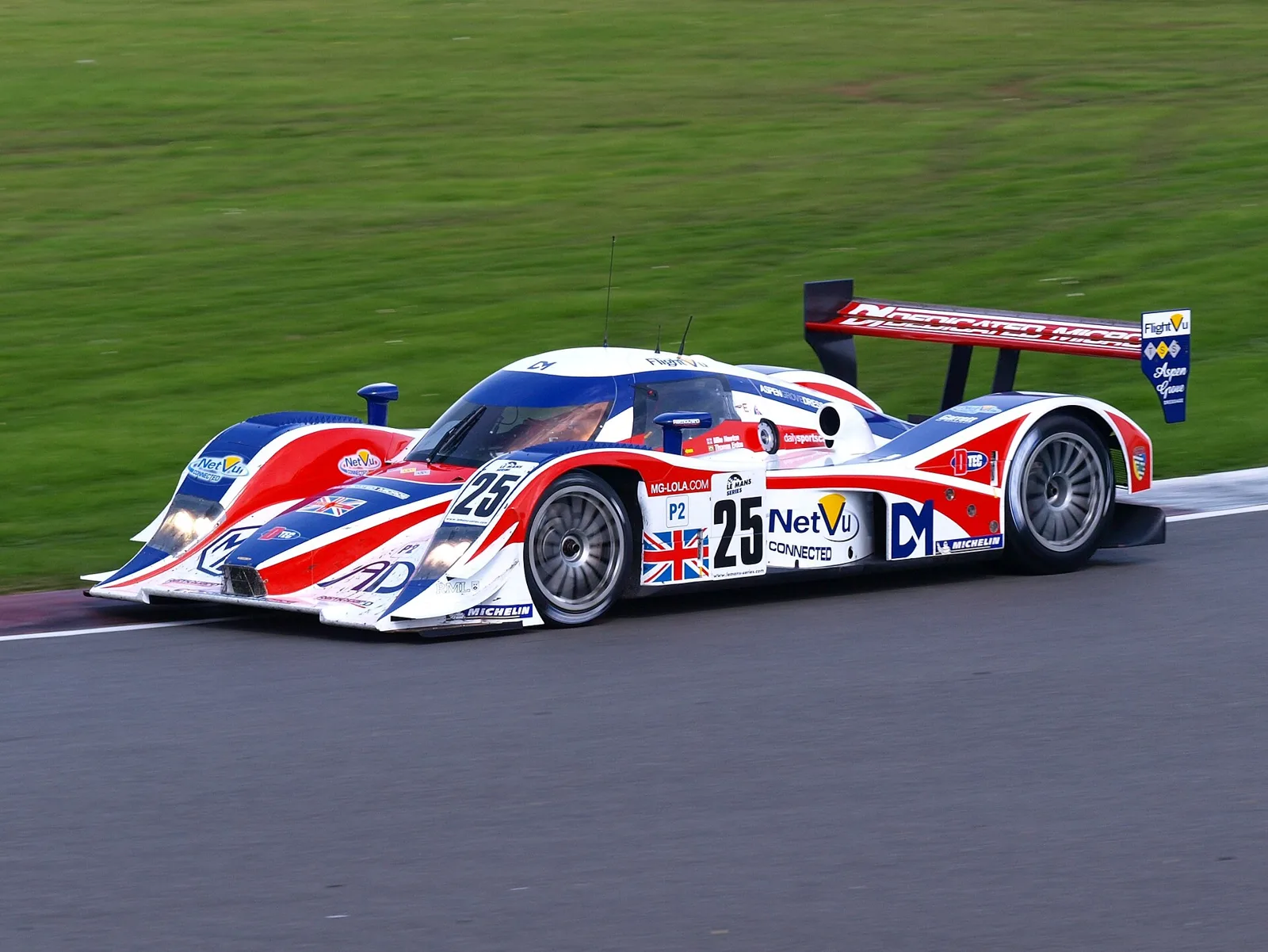
Also in 2004 RML ran an MG-Lola EX257 at the Le Mans 24 Hours and in the Le Mans Endurance Series. When the design became obsolete under new LMP2 regulations, RML merged its components into the Lola B05/40 chassis and bodyshell, creating the MG-Lola EX264. The EX264 won the LMP2 class at Le Mans in 2005 and 2006.
The team upgraded the car again for the 2008 Le Mans Series season with a new MG XP21 engine, and renamed it EX265. A coupe version, the EX265C, debuted at the 2008 1000km at Silverstone.
Why did the Mazda and Honda years struggle?
In 2009 the team turned to a turbocharged Mazda MZR-R engine in the back of the Lola B08/80, dropping the MG name. Issues with the spec fuel caused several engine failures, and the car finished only twice over the whole season.
In 2010 the Lola chassis stayed, but a naturally aspirated V8 from Honda Performance Development went in, the unit that powered the HPD ARX-01. In 2011 it raced an HPD ARX-01d in the LMP2 class, the second squad to run the ARX-01 in Europe, behind Strakka Racing.
How did RML work with Nissan on advanced racers?
In 2012 RML built a new engine for the Nissan DeltaWing RML. Nissan's motorsport partner ran the car and gave engineering support at Le Mans and Petit Le Mans, and the car finished fifth overall.
In 2014 RML took on the Nissan ZEOD RC as a design and build job, an unusual racer entered in Garage 56 at Le Mans. It was the first car to switch between electric and petrol propulsion, and RML was responsible for the whole vehicle, including a lightweight powertrain.
The engine was a fresh RML design: a three-cylinder unit of 1.5 litres, weighing only 40 kg, with more than 400 bhp. An early gearbox failure, caused by a new part with a material defect, ended the race, but in practice the car managed the first fully electric lap of Le Mans, and more than 300 km/h on battery power.
How did RML's touring car career begin?
Taking advantage of its relationship with Ecurie Ecosse, RML made its touring car debut in 1992 in the British Touring Car Championship. Its first two seasons used semi-works Vauxhall Cavaliers entered by Ecurie Ecosse.
In 1993 the first purpose-built Super Touring car came from RML, the Vauxhall Cavalier RML P7, which scored the maiden BTCC win with David Leslie at Thruxton. The works Vauxhall deal came in 1994, replacing Dave Cook Racing, and the team won the championship the following year.
Its 1995 crown came from the Cavalier RML P11, which took both the team and drivers' titles that year. The Vectra RML P12 arrived for 1996, a transitional year in which the team scored just one victory, with James Thompson.
How did the Nissan and SEAT years go?
RML's association with Nissan in touring cars had begun with the design of the Sentra RML P8 for the South African Touring Car Championship in 1993. From 1997 the company switched from Vauxhall to Nissan, running its Super Touring BTCC effort.
The 1998 and 1999 seasons brought the BTCC manufacturers' and teams' crowns, won with the RML project numbers P17 and P18. The drivers' championship came in 1999 with Laurent Aiello.
In 2004 RML ran two SEAT Toledo Cupras in the BTCC for SEAT Sport UK, with Jason Plato and Rob Huff. Late that year RML switched to the World Touring Car Championship with Chevrolet.
How did the Chevrolet WTCC titles come about?
From 2005 RML held the contract to build, develop and run Chevrolet's works Lacetti in the WTCC. Its first win came in 2006, and the car added seven more in 2007 and five in 2008.
In 2009 the Chevrolet Cruze was introduced and took six wins in its first year. In 2010 the Chevrolet team won the manufacturers' championship by 74 points, and with Yvan Muller it won the drivers' title. The team won the WTCC again in 2011 with Muller and in 2012 with Rob Huff.
Chevrolet Europe confirmed on 4 July 2012 that the season would be the final one for its WTCC operation. RML returned on 4 March 2013 as an independent two-car entry with Muller and Tom Chilton, and Muller won the 2013 WTCC championship.
How did the BTCC Chevrolet and Mercedes eras run?
Back in the BTCC in 2009, the team ran ex-WTCC Chevrolet Lacettis for Jason Plato, with Mat Jackson and James Nash in later rounds. The 2009 campaign brought 11 wins and Plato second in the drivers' championship.
In 2010 the team became a full works Chevrolet operation, running a pair of Cruzes. Plato won the drivers' championship with seven race wins, and in 2011 he won eight races but finished third as Matt Neal and Gordon Shedden had better consistency. Chevrolet then pulled out of the BTCC on 1 February 2012.
For 2026 former RML driver Jason Plato founded Plato Racing, using the RML warehouse as its base. The team fielded two Mercedes A35 saloons, and RML served as chassis and parts supplier.
What did rallying and other series add?
At the end of 1997 Opel cut back its touring car involvement and contracted RML to develop an Astra kit car for World Rally Championship and national rallies. The RML-built Astra took national titles in Germany, Norway and Sweden in 1999.
In 2000 Opel gave RML the job of designing and building the Corsa for the new Super 1600 category. Its competition debut came in the JWRC class of the Monte Carlo Rally in 2002 and won its first title the following year.
RML also entered the British ASCAR stock car series in 2002, where Nicolas Minassian and Ben Collins took the crowns in 2002 and 2003. In 2010 it considered a Formula One entry, but it did not enter.
What about road cars and the GT Hypercar?
RML's engineering skills first reached road-going cars in 1990, when it made a small run of Ford GT40 replicas. In 1999 it returned with the Opel Astra Concept DTM and the fresh design of the Saleen S7.
In 2021 RML showed the Short Wheelbase, a modern classic inspired by the Ferrari 250 GT SWB, and it said that only 30 units would be made. The GT Hypercar followed as a modern interpretation of road-going Le Mans racers, designed under the P39 codename.
The GT Hypercar pairs a 912 PS turbo six with active aero and carbon bodywork. Deliveries to customers began in September 2025, and the cars are built at Wellingborough.
What are the key results?
| Series | Result | Year |
|---|---|---|
| Le Mans, EX264 LMP2 class | Class win | 2005 and 2006 |
| European Le Mans Series, Saleen S7-R | GT1 class win | 2001 |
| National Supersports | Championships, RML Mallock P20 | 1999 and 2000 |
| BTCC, Vauxhall | Team and drivers' titles, Cavalier RML P11 | 1995 |
| BTCC, Nissan | Manufacturers' and teams' titles, RML P17 and P18 | 1998 and 1999 |
| WTCC, Chevrolet | Manufacturers' and drivers' titles | 2010 |
| WTCC, Chevrolet | Drivers' title, Yvan Muller | 2011 |
| WTCC, Chevrolet | Drivers' title, Rob Huff | 2012 |
| WTCC, independent entry | Drivers' title, Yvan Muller | 2013 |
What is the legacy of RML Group?
RML's legacy is a record of championships across touring cars, sportscars and rallying, built by a company that began as a driver's team. Its Le Mans class wins and WTCC titles show how far a small Northamptonshire operation could travel.
The group's current push into batteries, defence and the GT Hypercar suggests that its engineering base will keep shaping its future. The Wellingborough campus remains the centre of that work.