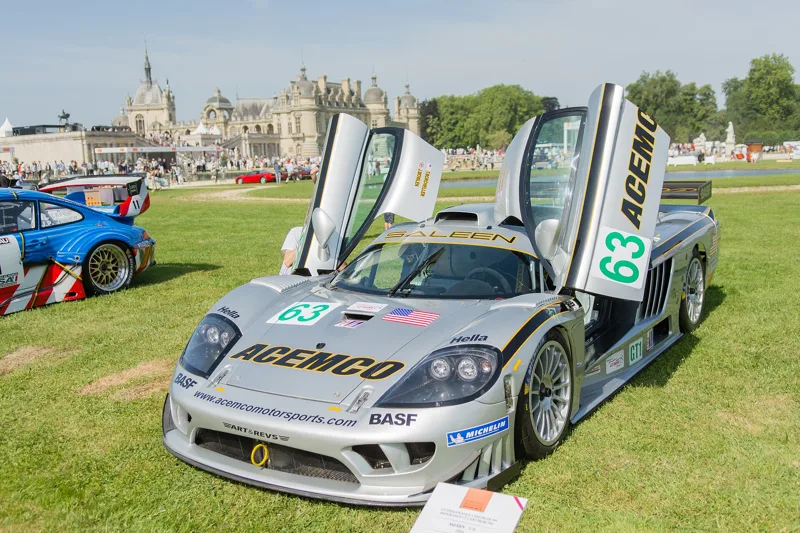
A carbon-bodied, all-aluminium V8 sports car from Irvine, California, which won at Sebring, Le Mans and Imola and returned as the S7 LM in 2017.
The Saleen S7 is a hand-built American mid-engined sports car from Saleen Automotive, shown in August 2000 with a carbon fibre body and a proprietary all-aluminium 7.0 L V8. It produced 410 kW (550 hp) naturally aspirated and later 559 kW (750 hp) with twin turbochargers, and it raced successfully into the 2010s.
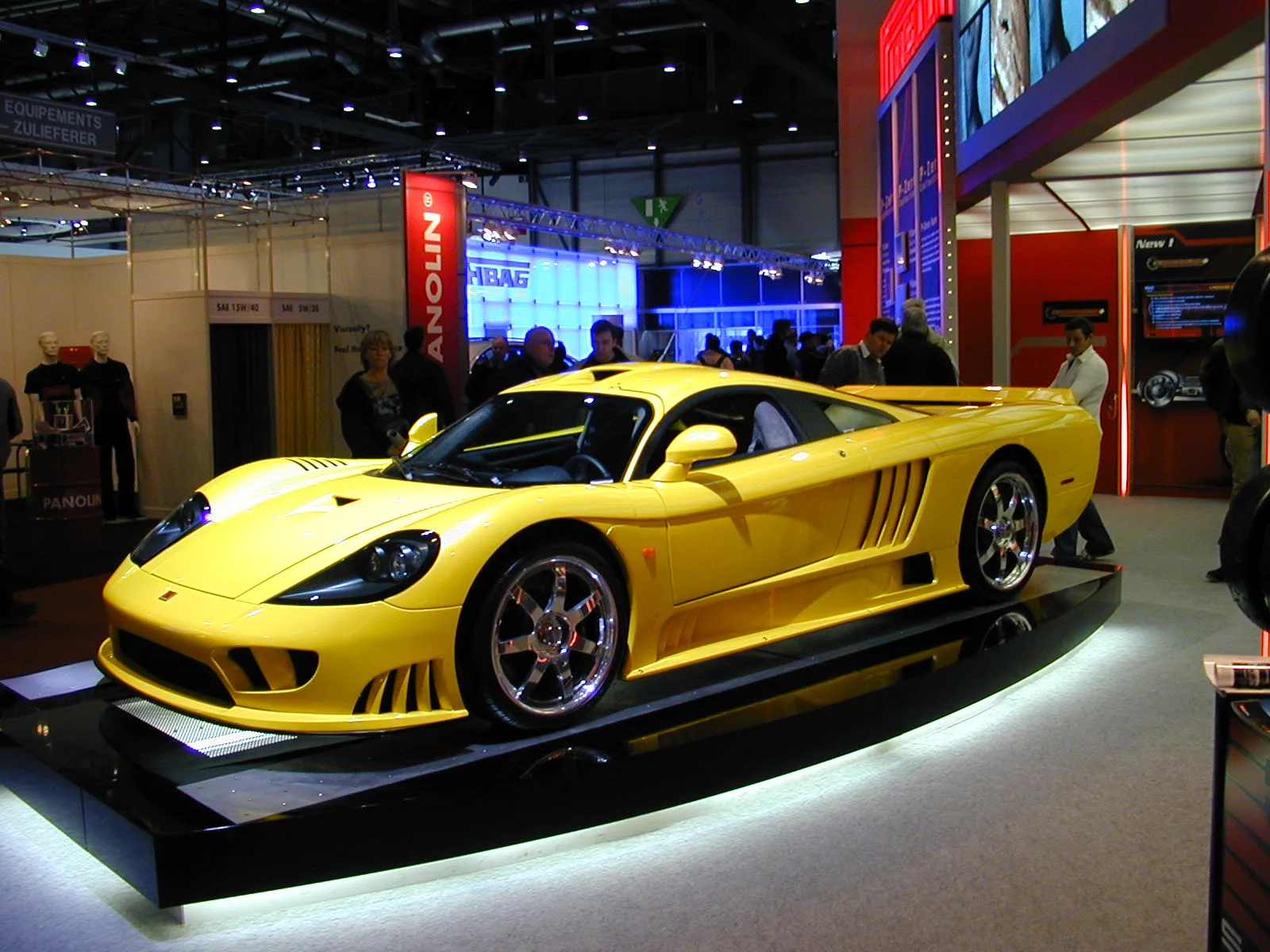
The Saleen S7 is an American hand-built high-performance sports car from Saleen Automotive, Inc., shown at the Monterey Historic Races in August 2000. It was the company's first fully proprietary car and one of the few mid-engined production sports cars built in America. Its carbon fibre body and all-aluminium V8 made it one of the most unusual supercars of its time.
Who designed and built the S7?
Steve Saleen led the concept, the direction and the engine. Hidden Creek Industries supplied resources and initial funding, and the chassis and suspension were built in Irvine, California. Phil Frank handled the aerodynamic, body and interior CAD design and development.
The S7 was America's sixth mid-engine production sports car, following the Pontiac Fiero, Consulier GTP, Mosler Raptor, Vector W8 and M12. Its engine was developed and built in house.
A carbon-bodied American supercar that beat Ferrari on its home track and came back in 2017 with 1,500 hp.
What engine did the S7 use?
The all-aluminium engine was a proprietary unit developed and built in-house. Its roots lie in Ford's 351 Windsor small block, which was bored and stroked, and it wears reworked Cleveland-style heads with canted valves. The displacement was 7.0 L (427 cu in), and the engine was not based on Ford's FE big block.
Naturally aspirated, the engine produced 410 kW (550 hp) at 6,400 rpm. It proved tractable and flexible for such a high-output requirement, and the design was developed around the lighter small-block architecture.
How did the twin-turbo S7 change?
In 2005 the S7 gained a twin-turbocharged engine with Garrett turbochargers producing 5.5 psi (0.38 bar) of boost. Peak output rose to 559 kW (750 hp; 760 PS) at 6,300 rpm, and torque reached 949 N m (700 lb-ft) at 4,800 rpm. The front and rear diffusers and the rear spoiler were reworked to increase downforce by 60 percent.
Saleen's own estimates for the twin-turbo car were 2.7 seconds to 60 mph, 5.9 seconds to 100 mph, 27 seconds to 200 mph, a 10.5 second quarter mile and a top speed of 248 mph (399 km/h). The car's top speed had been estimated at 250 mph (402 km/h) when the twin-turbo was first announced.
- 2006 competition package: about 1,000 hp (1,014 PS; 746 kW), a 33 percent increase
- Competition package extras: revised suspension, new diffusers and optional carbon fibre spoilers
- Aero upgrades: front and rear diffusers, rear spoiler, 60 percent more downforce
How did the naturally aspirated S7 perform?
The naturally aspirated S7 was estimated to reach 97 km/h (60 mph) in 3.3 seconds and 161 km/h (100 mph) in 7.6 seconds. Its quarter mile took an estimated 11.36 seconds at 204 km/h (127 mph). The claimed top speed of 354 km/h (220 mph) was never confirmed in testing.
The car creates downforce close to its own weight at 257 km/h (160 mph), which is why its body includes scoops, spoilers and other aerodynamic features to create split channel airflow.
What was the S7's construction like?
The body is made entirely from carbon fibre, and the chassis uses a steel space frame of 4130 lightweight steel with aluminium honeycomb composite reinforcing panels. It is divided into bolt-fastened sub-assemblies, so critical systems can be reached quickly. The car weighs 1,300 kg (2,865 lb).
Wiring harnesses used Teflon-coated tinned military specification wire, cannon plugs and gold plated pins. The harnesses were wrapped in high-temperature glass mesh and covered with a woven Kevlar outer skin. The car also had a 110 volt inlet for maintaining the battery and a shut-off control for the electric fuel pump on crash impact.
What was inside the S7?
Leather runs through the cabin with aluminium accents, and buyers received custom-fit luggage. The mid-engine layout gives two trunks, at the front and rear. The dash houses an LCD monitor and a rear-view camera, while the speedometer reads to 390 km/h (240 mph).
The cabin is asymmetrical, with the driver's seat set toward the centre to improve visibility and centre the driver's weight. The seats are fixed, so the car relies on the seating position for its ergonomics.
How did the S7-R race?
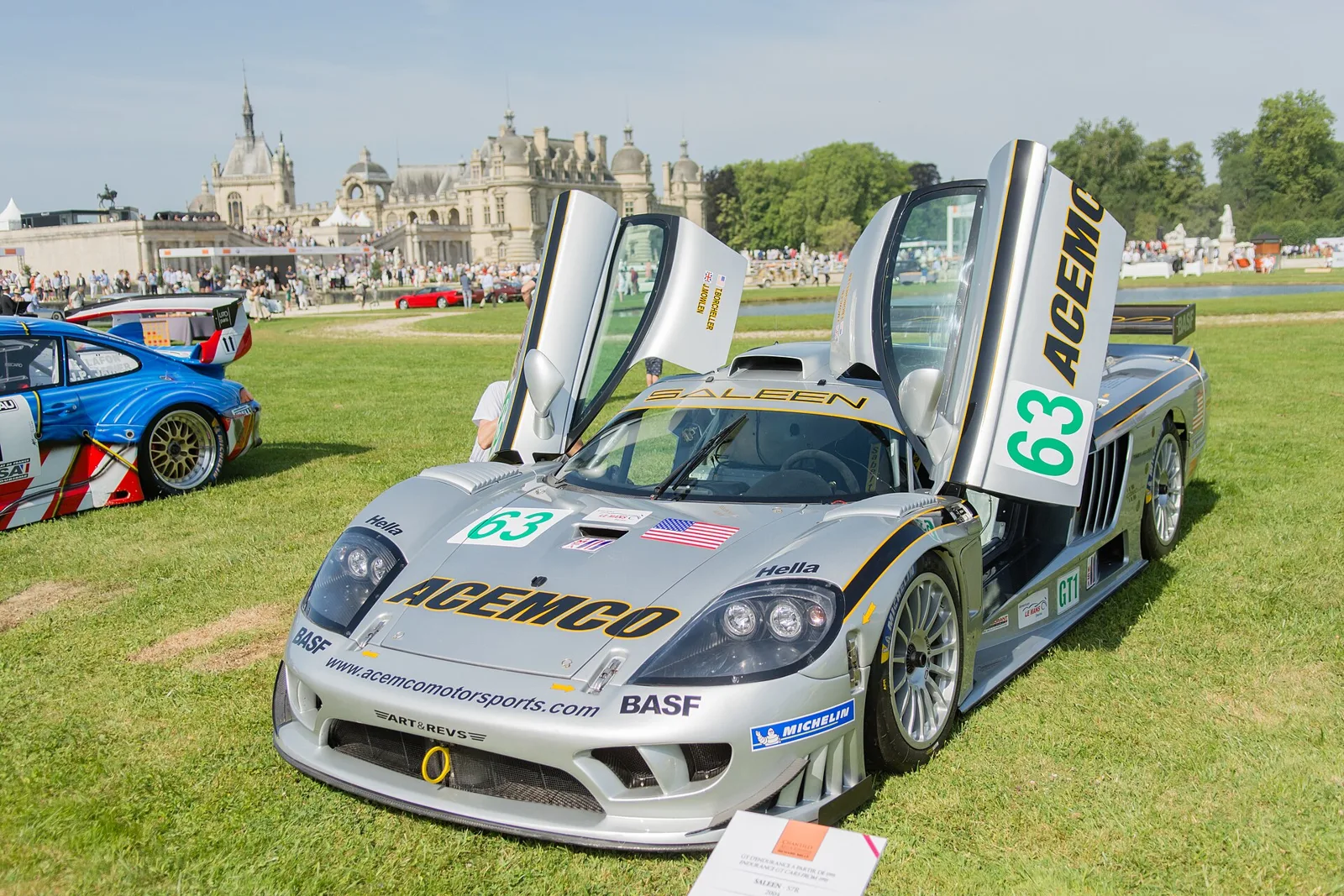
The S7-R was a racing version of the naturally aspirated car, built from 2000 to 2007 for grand touring series and events such as the American Le Mans Series, the FIA GT Championship and the 24 Hours of Le Mans. It produced about 631 hp with two air restrictor plates, and unrestricted output was 760 hp, with 740 lb-ft of torque.
Ray Mallock Ltd. assembled the first few S7-Rs in Britain under Saleen's engineering supervision. Oreca in France carried out the final outfitting from 2006, and a total of fourteen cars were completed to race-ready condition. Seven more were assembled to the point of needing Vehicle Identification Numbers but were never fitted out as complete cars.
How did the S7 beat Ferrari at Imola?
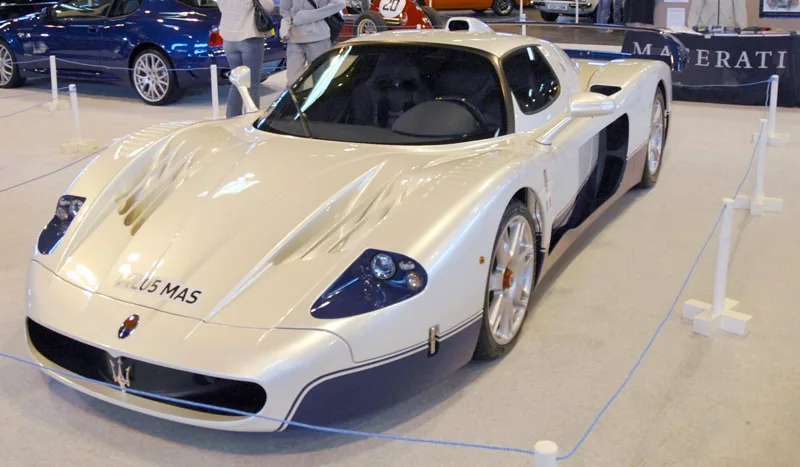
In 2004, Ferrari gathered VIPs and the automotive press at its Imola circuit for round eight of the FIA GT Super Racing Weekend, where it expected to show its Maserati MC12 GT1 cars. A Vitaphone Racing S7-R, driven by Michael Bartels and Uwe Alzen, won overall against two Maserati MC12s, three Ferrari 550s, three Ferrari 575s and two Lamborghini Murcielago entries in GT class.
Ferrari's chief executive, Luca Cordero di Montezemolo, attended the race and admitted that Ferrari had been no match for the Saleen that day. The result is often cited as one of the biggest upsets in racing history, when a car from a low-volume maker beat Ferrari on its own home track.
What were the S7-R's key results?
The first S7-R assembled by RML debuted at Laguna Seca in the American Le Mans Series, finishing 26th. For 2001, customer chassis were entered by Fordahl Motorsports in the Grand American series, by RML in the European Le Mans Series and by Konrad Motorsport in both ALMS and ELMS. Konrad finished sixth at the 12 Hours of Sebring for its first class victory.
- 2001: Fordahl won seven Grand American events and finished second in the class
- 2001: RML won four ELMS events and the championship by a single point
- 2001: Saleen-Allen Speedlab finished 18th at Le Mans, with a podium-level result
- 2002: Park Place won the Grand American title, while Graham Nash won British and Spanish GT titles
- 2004: Vitaphone won three FIA GT races and DDO won two FFSA GT races
- 2005: DDO earned three Saleen wins, while ACEMCO took second in the American Le Mans Series
- 2006: ACEMCO finished 11th at Le Mans, the best result by a Saleen at the time
What happened to the S7-R after 2006?
Zakspeed took over as the factory squad in FIA GT for 2006, with Balfe Racing running as a privateer. Zakspeed finished fourth in the championship, but the team went bankrupt during the 2007 off-season. ACEMCO also withdrew, and Oreca finish-assembled two more chassis for 2007, winning four races that season.
In 2010 an Oreca finish-assembled S7-R, chassis 610 and entered by Larbre Competition, won the LMGT1 class at the 24 Hours of Le Mans. It was the only LMGT1 class win in that category's final year. Saleen's engineers had built the chassis after normal business hours in 2006 and 2007 due to a shortage of funding, and they nicknamed the car Melissa.
What was the S7 LM?
Saleen announced the relaunch of the S7 in 2017 as the S7 LM, commemorating the company's motorsport success. Wind tunnel development led to a full-width rear spoiler, side skirts, underbody channels and forged alloy wheels. The cabin gained bucket seats, a digital tachometer, a shift light and a 240 mph speedometer.
Saleen first quoted 1,300 hp (969 kW) for the engine. By 2019 the figure had risen to 1,119 kW (1,500 hp), with torque of 1,895 N m (1,398 lb-ft). The claimed figures include 0 to 100 km/h (62 mph) in 2.2 seconds and a top speed of 480 km/h (298 mph). It was never clear how many cars would be built.
How did the S7 handle electrical safety?
Standard electronics included electronic power steering with redundant safety circuits and a rear-view camera with a flip-up in-dash monitor. Power windows, power door locks and remote openers for the doors, hood and trunk were fitted as standard.
How did the S7-R fare in the late 2000s?
Results slowed after 2005 as teams ran into money trouble. Oreca prepared upgraded chassis that won two Le Mans Series races and the 2006 FFSA GT title, while Zakspeed carried the factory FIA GT effort until it went bankrupt in the 2007 off-season.
Oreca then won four races in 2007. ACEMCO's best finish came at Le Mans in 2006, when it placed 11th overall. The chassis lineage continued until the 2010 LMGT1 class win at Le Mans.
Specifications at a glance
| Specification | Detail |
|---|---|
| Debut | 19 August 2000, Monterey Historic Races |
| Displacement | 7.0 L (427 cu in) all-aluminium V8 |
| Naturally aspirated output | 410 kW (550 hp) at 6,400 rpm |
| Twin-turbo output | 559 kW (750 hp; 760 PS) at 6,300 rpm |
| Twin-turbo torque | 949 N m (700 lb-ft) at 4,800 rpm |
| Weight | 1,300 kg (2,865 lb) |
| Chassis | Steel space frame with carbon fibre body |
| S7 LM output (2019) | 1,119 kW (1,500 hp), 1,895 N m (1,398 lb-ft) |