From a 2008 Super GT debut that won seven of nine races to Group GT3 titles and record-setting drag runs, the GT-R has one of the deepest competition records of any road-based car.
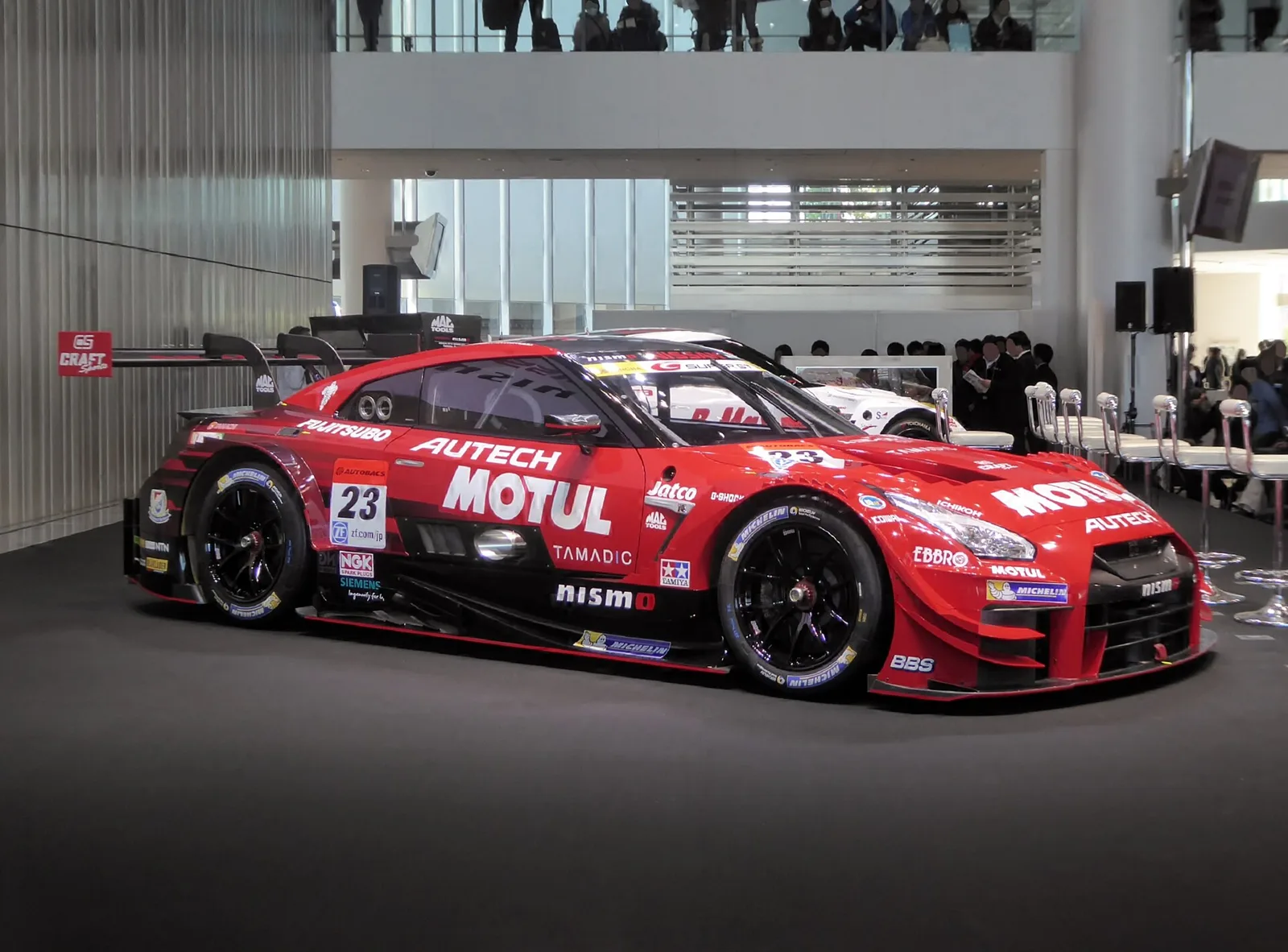
The GT-R GT500 won the Super GT drivers' title in its debut year of 2008 and went on to 41 race wins. Its GT3 derivative later won the GT300 class three times, and the FIA GT1 car took the 2011 drivers' championship.
The Nissan GT-R has one of the deepest competition records of any road-based sports car. Its Super GT years, its FIA GT1 and GT3 campaigns, its endurance wins and its drag and tuning records stretch over more than a decade. This article takes each strand in turn and shows where the car stands in each.
How did the GT-R start in Super GT?
The GT-R GT500 entered Super GT in 2008 with a 4.5-litre V8 in place of the road car's engine. It won seven of nine races in its debut season and took the drivers' championship with Satoshi Motoyama and Benoit Treluyer, running under the Xanavi banner.
The car was not a finished product in its first weeks. A prototype was spotted testing around Suzuka and at Fuji, and the debut season opened with a 1-2 finish for Nissan at Suzuka. The engine was the naturally aspirated VK45DE, and the car used a six-speed sequential manual gearbox with a rear-wheel-drive layout derived from its predecessor.
The drivers' title came through Xanavi, but the car's team placed only third in the teams' championship. Across the year the car scored ten podium finishes with four different teams, a dominant start for a model that had only just appeared in the category.
A road car that became a Super GT title winner, an FIA GT1 champion, a GT3 record holder and a drag-strip legend in one career.
How did the GT500 car's record develop after 2008?
The car's middle years were leaner, but Team Mola's Ronnie Quintarelli and Masataka Yanagida took back-to-back championships in 2011 and 2012. Its career ended in 2021 with 41 race wins and 89 podium finishes from 113 starts, the most race wins of any GT500 car.
The 2009 season was harder. Engine reliability problems held the car to four victories and eight podium finishes, and the reigning champions finished third. In 2010 the VK45DE gave way to the exclusively developed VRH34A 3.4-litre engine, and the car won twice with four podium finishes while Team Impul finished fifth.
The 2011 and 2012 titles belonged to Team Mola. Quintarelli and Yanagida won both the drivers' and the teams' championships in each year, and across those two seasons the car won eight of 16 races and achieved 19 podium finishes with three different teams. Quintarelli also won the first race of the 2012 JAF Grand Prix from 10th on the grid.
In 2014 Super GT rules were aligned with those of the DTM, and the V8 gave way to the NR20A 2.0-litre turbocharged four-cylinder. Quintarelli and Tsugio Matsuda won the 2014 and 2015 titles with Team Nismo, and the car won seven races and took 21 podium finishes over the two seasons.
Later seasons were less kind. The car missed the 2017 title by two points, and it was eighth in 2018 after a single win. It recovered to finish third in 2019, 32.5 points behind the champions, then dropped to fifth in 2020. In 2021 it won two races and took six podium finishes before the car was retired at the end of the season.
What did the GT-R Nismo GT3 win in Super GT?
The GT-R Nismo GT3 has won the GT300 class championship in 2015, 2020 and 2022. Each of those seasons delivered both the drivers' and the teams' titles, which is a record for the class since the car's 2012 debut.
The GT3 car began in 2012 at Okayama with Katsumasa Chiyo and Yuhi Sekiguchi. It won its first race in the fourth round at Sportsland Sugo and finished fourth in the standings. Two difficult seasons followed, with no podium in 2013 and one win in 2014. In the 2013 JAF Grand Prix the car finished runner-up overall after Daiki Sasaki won race one from pole.
The car bounced back in 2015, when Gainer's No. 10 entry, driven by Andre Couto, won the championship with two race wins and four podiums. The team total for the season reached four wins and seven podiums. Kondo Racing then took the 2020 title with Kiyoto Fujinami and Joao Paulo de Oliveira, and Fujinami and de Oliveira won again in 2022.
The 2020s brought mixed fortunes. The car was second in 2021, and in 2024 it managed only two podium finishes while Balance of Performance restrictions hurt its pace. For the first time in Super GT history the car finished four races outside the points, and Oliveira openly criticised the BoP regime.
In 2025 the GT3 car finished second in the drivers' standings by a single point, and its team was second on the count-back, level on points with the champions K2 R&D LEON Racing. In 2026 Kondo Racing won at Fuji, the car's first Super GT victory in three years, and the team inherited the championship lead after Suzuka before a collision at Sugo cost the lead.
How did the GT-R perform in FIA GT1?
The GT-R GT1 was built in 2009 for the FIA GT1 World Championship, with a 5,552 cc naturally aspirated V8 and a Ricardo sequential transmission driving the rear wheels. It won the 2010 RAC Tourist Trophy and secured the 2011 drivers' title with JR Motorsports before the series folded in 2012.
Nismo announced a partnership with Gigawave Motorsports on 27 February 2009. Michael Krumm and Darren Turner were recruited to drive, and former Formula One driver Anthony Davidson joined them for the 24 Hours of Spa, where the car finished third in class from eighth on the grid. The car was not eligible for points because it was run as a factory entry.
In 2010 Sumo Power GT and Swiss Racing Team both ran GT-R GT1s. The car made its championship debut in Abu Dhabi, and the first win came when the Sumo No. 22 car, driven by Jamie Campbell-Walter and Warren Hughes, won the race by just over two seconds. That season the car finished with two race wins and eight podium finishes.
The 2011 season was the high point. Four GT-R GT1s ran across Sumo Power GT and JR Motorsports, and Krumm and Luhr won the drivers' title by over 17 points. JR Motorsports finished second in the teams' championship, while Sumo Power GT finished fifth. The car recorded five race wins, three pole positions and 18 podium finishes, and it missed the team title by three points after a drive-through penalty on the No. 22 car.
What were the GT-R Nismo GT3's technical details?
The GT3 car kept the VR38DETT twin-turbo engine, which produced 390 kW (530 PS; 523 hp) at 6,400 rpm. It drove the rear wheels through a Ricardo six-speed sequential gearbox. Nismo updated the car in 2013, 2016 and 2018, and it is homologated for use until the end of 2030.
Nissan was the first Japanese manufacturer to sell a Group GT3 race car. Sales and service were handled by Nissan in Japan, Asia and North America, while JR Motorsports covered Europe, Russia and the Middle East. Customer teams took the car around the world for more than a decade.
The 2013 update raised output to 405 kW (551 PS; 543 hp) at 6,500 rpm, added front canards and repositioned the rear wing. The 2016 update brought larger AP Racing brakes and a lowered dashboard, and the 2018 facelift lowered the engine by 150 mm (5.9 in) and changed the rear to double wishbones. Nismo said the 2018 changes saved around 15 kg (33 lb), and the 2020 GT3 Evo followed with a Power Distribution Module.
Nissan and Nismo withdrew from international GT3 racing at the end of 2017, to focus on Formula E, though they continued to support customer teams technically. KCMG's relationship with Nissan ended at the end of 2019, and the car's presence in international events outside Japan ended with it.
How did the GT3 car compete in Europe and Asia?
The GT-R Nismo GT3 won the GT World Challenge Europe Endurance Cup titles in 2013 and 2015. In 2013 it also stood on the podium in every Sprint Cup race it entered, and in Asia it has raced through GT World Challenge Asia and the SRO Japan Cup since 2018.
In 2013 the Nissan GT Academy team RJN won two races, took two poles and finished on ten podiums in the Sprint Cup. The first race win came at Silverstone in the endurance series, and the Pro-Am team title went to GT Academy at the end of the season, beating the Ferrari works team.
In Asia the car made its GT World Challenge debut in 2018 with KCMG, scoring two race wins, three poles and 11 podium finishes that year. Later the GT-R Nismo GT3 Evo raced with RunUp Sports and 5ZIGEN in the 2023 SRO Japan Cup. In 2024 5ZIGEN finished second in class with three race wins, and in 2025 it was runner-up in the championship with five race wins.
Australia was another stop. Hobson Motorsport raced the car in the GT World Challenge Australia in 2021, winning four races and taking three poles and six podium finishes. It finished second overall, eight points behind the Audi R8 LMS Ultra.
Which endurance races has the GT-R won?
The GT-R won the Bathurst 12 Hour in 2015, and it took the SP8T class at the Nurburgring 24 Hours in 2011 and 2012. It is also the most successful Group GT3 car in Japan's Super Taikyu Series, with six championships from 12 full seasons.
At Bathurst in 2015 the car qualified third and then charged from third to first on the penultimate lap. A year later it finished second behind the McLaren 650S GT3, closing a 14-second gap to 1.2 seconds in the final stages. It led 107 of the 297 laps and set a record fastest lap during that race.
The Super Taikyu record is strong too. In 2016 the GT-R won every race in the season, and its entries finished 1-2-3 in the final standings. The car's first win in the series came at Okayama in 2012, when it crossed the line over 21 seconds clear of the second-placed BMW Z4 GT3.
The Suzuka 10 Hours has been good to the GT500 car. It won the race in 2008 with Impul, and Quintarelli and Yanagida took pole and the win in 2012. Across its career the GT500 car had a 100 percent podium rate in that event, making it a near-perfect endurance car at Suzuka.
How did the GT-R set drag and tuning records?
The GT-R became a favourite of tuners and drag racers, and AMS Performance in Illinois took it deep into the records. In June 2013 the Alpha Omega GT-R ran a 7.98-second quarter mile at 299.56 km/h (186.14 mph), and its best quarter-mile time was 7.49 seconds at 310 km/h (193 mph) when it set the fastest road-legal record of its era.
The records kept falling. In 2015 an AMS car set a trap speed of 361.8 km/h (224.91 mph) from a standing half-mile at the WannaGoFast shootout. In 2017 the Alpha-G GT-R ran 6.937 seconds, and ETS later ran 6.88 seconds at 358.80 km/h (223 mph) and set the standing half-mile trap speed of 410.29 km/h (255 mph).
In December 2018 Alpha Logic Performance from Dubai ran 6.582 seconds at 373.82 km/h (232.28 mph) in its Panda GT-R. In 2019 the ETS-G car ran 6.56 seconds at 362.02 km/h (225 mph), and T1 Race's Nightfury GT-R posted 6.51 seconds, with a trap speed of 370 km/h (230 mph), and set the fastest stock-location turbo GT-R run.
Tuning houses have also cracked the car's electronics. COBB Tuning was the first to access its encrypted ECU, and Ecutek altered the automatic shift points in the transmission module and later offered flex-fuel hardware. Nismo's own Club Sports and N-Attack packages were offered to owners as well.
What drift and speed records has the GT-R set?
Masato Kawabata won the 2015 D1 Grand Prix in a modified Toyo Tires Drift Trust Racing GT-R, and a heavily modified GT-R set the Guinness World Record for the fastest drift in 2016. Mike Newman also set a Guinness record in 2014 for the fastest speed by a blindfolded driver.
The 2016 drift record was set at 304.96 km/h at a 30-degree angle, at the Fujairah International Airport, with Kawabata at the wheel. Nissan Middle East needed three attempts to set it. Darren Kelly, with The Heart of Racing, won the Pro-series championship in D1NZ Drifting in 2019 and 2021.
Hill climbing has produced its own GT-R results. A factory-standard GT-R was named the most successful supercar in the 2019 Top 10 Shootout, and Kyle Mitchell set 40.862 seconds in that final Top 10 Shootout event.
Newman's record was set on 13 August 2014 in a GT-R modified by Litchfield Motors in the UK. It shows how far the car's reputation has spread beyond circuits, from endurance racing to drifting, drag strips and speed trials.