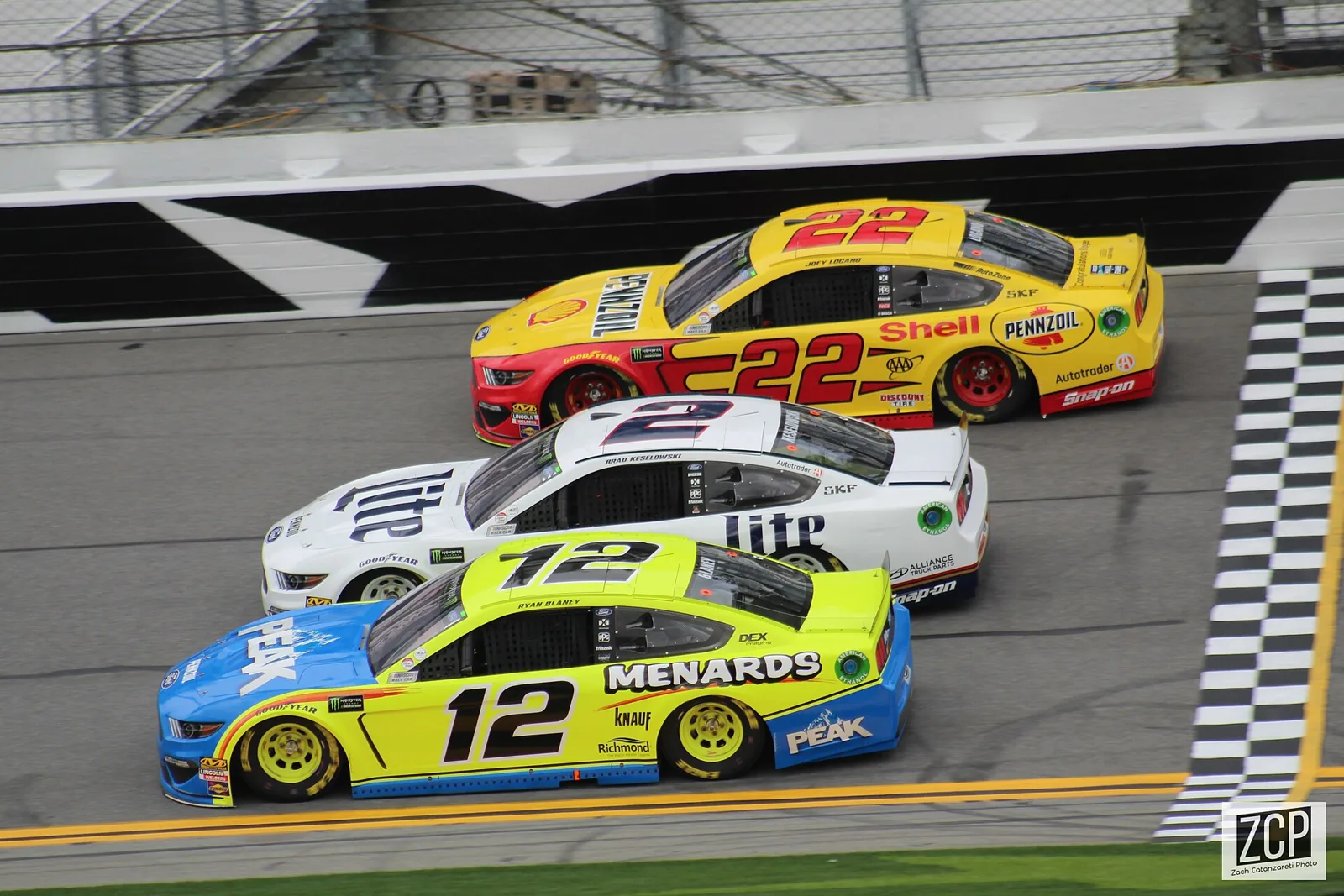
From a 1972 Matador at Riverside to five drivers' championships, the Mooresville operation has run Pontiac, Ford and Dodge cars across two NASCAR series.
Team Penske is a NASCAR operation based in Mooresville, North Carolina, that has won five drivers' championships and over 170 races across the Cup and Xfinity series. It debuted at Riverside in 1972 and has raced Pontiac, Ford and Dodge machinery.
Team Penske fields Ford Mustangs in the NASCAR Cup Series from a base in Mooresville, North Carolina. The operation traces its history to a 1972 debut at Riverside, and it has moved between Pontiac, Ford and Dodge machinery over the decades. Across the Cup and Xfinity series it has won five drivers' championships and more than 170 races.
The story is one of changing numbers, sponsors and manufacturers. The team's most important cars carried the No. 2, No. 12 and No. 22, and each number has its own line of drivers. Shorter entries filled the gaps, including a 2004 car that carried Kodak sponsorship.
Where did Team Penske's NASCAR story begin?
The team debuted in 1972 at Riverside International Raceway, where Mark Donohue drove a factory-sponsored American Motors Matador. Nicknamed the flying brick for its squarish aerodynamics, the car finished 39th after rear-end problems. Donohue later won the 1973 Western 500 in the No. 16 Matador.
The team went full-time with Bobby Allison in 1976, and the new fastback coupe finished 4th in the points that year. The early seasons showed that the operation could move from one-off entries to a steady presence on the grid.
The sequence of cars from the Matador in 1972 to the fastback coupe in 1976 shows a team that changed its machinery quickly, and it had a driver with a Cup record of his own on hand when the team came back in 1991.
Five drivers' championships, three manufacturers and a line of car numbers that runs from a 1972 Matador to the modern Mustang.
Why did the team leave NASCAR and come back?
Penske sold its machinery to the Elliott family in 1977, and the team did not run for eleven years. It returned in 1991 with Rusty Wallace at the wheel, bringing the Miller sponsorship with him from Blue Max Racing's suspended operation.
In 1980 the team had fielded two races for Wallace, so he was already a familiar name when the return came. The comeback set up a new phase in which the team ran Pontiacs before moving to Ford.
Which manufacturers did the team race for?
Pontiac came first, with the team fielding Pontiacs from 1991 to 1993. Full-works Ford followed in 1994, and the team switched to full-works Dodge in 2003 with factory support. Roger Penske announced the return to Ford on March 1, 2012, and Ford returned in 2013 with the Roush Yates engine package.
By 2011 the team was the only Cup team running Dodges full-time. Its final Dodge season in the Cup Series was 2012, the year Keselowski won Penske's first Cup title.
The manufacturer sequence gives the history a clear shape: Pontiac in the early 1990s, Ford from 1994, Dodge from 2003 and Ford again from 2013. The return to Ford therefore gave the team a second long Ford period, after the one that began in 1994.
Which championships has the team won?
The team has won five drivers' championships in the Cup Series. Brad Keselowski delivered its first title in 2012, Ryan Blaney won in 2023, and Joey Logano took the crown in 2018, 2022 and 2024. The Phoenix finale produced two of those titles.
Ryan Newman had already given the team a milestone in 2008, when he won the Daytona 500, the first win in that race for Penske. Keselowski's title season was a strong one too, since he won five races in 2012 including two Chase wins.
The five titles went to three drivers, and Logano won three of them. Blaney's title came in 2023, the year after Logano's 2022 win, so the championship run moved between drivers rather than stopping with one name.
Car No. 2: from Rusty Wallace to Austin Cindric
The No. 2 car's history is traced to the late 1970s, with Benny Parsons among the early names. Rusty Wallace drove the car from 1991 to 2005, and his debut at the team came in the 1991 Daytona 500, where he finished 27th.
Wallace was winless in 2002, the first winless season for him since 1985. He finished eighth in series points in 2005, and he retired after that season.
Kurt Busch drove the No. 2 from 2006 to 2010, won six more races in the car and finished fourth in the standings in 2009. Brad Keselowski took over in 2011 after a number swap, and he finished fifth in points that year before going on to win the 2012 title.
Keselowski left at the end of the 2021 season. Austin Cindric won the 2022 Daytona 500 and Rookie of the Year honours in 2022, and he finished 12th in the points standings that season.
The number itself outlived any single driver. Wallace drove the car in the early 1990s, Keselowski took it over in 2011, and Cindric carried the same number from 2022 onward.
Car No. 12: a long line of drivers
The current No. 12 began in 1994 as the No. 07 Ford, owned by Michael Kranefuss and Carl Haas under the Kranefuss-Haas Racing name. John Andretti drove the Kmart-sponsored No. 37 in 1995, and the car's identity kept shifting from one driver to the next.
Jeremy Mayfield joined in 1998 in a Mobil 1 Ford Taurus and won at California and Pocono in 2000. He was fired following the race at Kansas in 2001.
Ryan Newman took the No. 12 in 2002 with Alltel. He won the Winston and New Hampshire that year and finished sixth in points as a rookie. After the switch to Dodge, Newman won eight races and eleven poles, and he left for Stewart-Haas Racing in 2008.
The sponsor changed in 2009. The Verizon purchase of Alltel ended the arrangement, and Keselowski ran the No. 12 unsponsored in 2010 before moving to the No. 2.
Ryan Blaney took the car in 2018 and won the inaugural Charlotte Roval race that year. He also won the 2020 Talladega race and the 2021 Atlanta race. Those wins came on a road-style course, a superspeedway and an intermediate oval, which shows how varied the car's record has been. In 2023 he won the Coca-Cola 600 after a 59-race drought, and he finished second at Phoenix to win the title.
Logano's run with the No. 22 covers most of the team's modern success. Three of the five drivers' titles came while he was in that car, and his 2024 title came at Phoenix, just as his 2022 title had.
Car No. 22 and the Logano years
Kurt Busch drove the No. 22 in 2011 with Shell and Pennzoil sponsorship, and he won at Sonoma and Dover. A. J. Allmendinger drove the car in 2012 before Sam Hornish Jr. replaced him mid-season.
Joey Logano was announced as the driver on September 4, 2012, and he took the No. 22 full-time from 2013. He won five races in 2014 and the 2015 Daytona 500 to open that season, then finished second in the 2016 standings behind Jimmie Johnson.
Logano won the 2018 Ford EcoBoost 400 to take his first Cup title, then added titles in 2022 and 2024. He was fined US$50,000 after a Richmond incident in 2024, and in 2026 he broke a 45-race winless streak at North Wilkesboro.
What happened in the Xfinity Series?
Penske's first Xfinity entry came in 1997 with Rusty Wallace, who finished 21st in a Miller Lite Ford at Auto Club Speedway. The team won the Nationwide driver title in 2010 with Brad Keselowski, and its owners' championships came in 2013, 2014, 2015 and 2017.
The Xfinity record shows depth in a second series. The team's cars carried several drivers who also raced in the Cup Series, including Rusty Wallace, Sam Hornish Jr. and Brad Keselowski.
Sam Hornish Jr. won his first Xfinity race at Phoenix in 2011 and finished fourth in points in 2012. The series programme was later diverted to IMSA and WEC sportscar racing in 2022.
What penalties have the team's cars and people received?
Penalties have reached both the team's cars and its people. Crew chief Jeremy Bullins was suspended for four races in 2022, and Logano was fined US$50,000 in 2024 after a Richmond incident. Cases like these show how penalties can hit pit crews and drivers alike.
Which other car numbers did the team use?
Beyond the No. 2, 12 and 22, the team's other numbers included the No. 77. Brendan Gaughan drove it in 2004 with Kodak sponsorship, and Sam Hornish Jr. drove it from 2008 to 2010. Paul Menard drove the No. 21 Wood Brothers car in 2018, after Ryan Blaney moved to the No. 12. Those entries were brief, but they show the team ran more than the three numbers that define its history.
What is the team's legacy?
The team's legacy rests on five drivers' championships, more than 170 races across two series and a record with Ford, Dodge and Pontiac. It has also fielded cars for Wood Brothers Racing since 2016.
The span from a Matador that finished 39th in 1972 to a Mustang that carried Logano and Blaney to titles gives the team's history its shape.
One of its drivers, Brad Keselowski, accepted a driver and co-owner role at RFK Racing in 2021, and Austin Cindric took over the No. 2 seat.
The team's modern identity is also closely tied to Ford. The Mustang is the car it fields in the Cup Series today, and the Ford return of 2013 brought it back to a manufacturer it had raced for in the 1990s.
Team Penske driver tenures at a glance
The table lists the main drivers by car number, with their years in the seat and one notable result for each. Five of the eight entries won a title or a Daytona 500, which shows how closely the team's results follow its most successful seats.
| Car | Driver | Years | Notable result |
|---|---|---|---|
| No. 2 | Rusty Wallace | 1991-2005 | Eighth in series points in 2005 |
| No. 2 | Kurt Busch | 2006-2010 | Fourth in the standings in 2009 |
| No. 2 | Brad Keselowski | 2011-2021 | 2012 Cup title |
| No. 2 | Austin Cindric | 2022-present | 2022 Daytona 500 win |
| No. 12 | Ryan Newman | 2002-2008 | 2008 Daytona 500 win |
| No. 12 | Ryan Blaney | 2018-present | 2023 Cup title |
| No. 22 | Joey Logano | 2013-present | Cup titles in 2018, 2022 and 2024 |
| No. 77 | Brendan Gaughan | 2004 | Kodak sponsorship |